

By David Kiknadze, Transport & Openings Reporter · 28/10/2026
Georgia has four distinct kinds of hot water to try, and none of them require a doctor’s note to enjoy responsibly: the sulphur bathhouses of Tbilisi‘s Abanotubani district, the radon-carbonate baths of Tskaltubo, the alkaline drinking cure of Borjomi, and the mountain spas of Sairme and Abastumani. A fifth category exists too, informal and free: wild springs at Vani, Nokalakevi and Tsaishi in western Georgia, used by local families for generations but with no lifeguard, no posted water-quality data and no medical supervision.
Prices range from a few lari for a communal sulphur pool to several hundred euros for a supervised balneology course with a physician’s review. This guide sets out what each place actually offers, what a reasonable 2026 price looks like, and where to verify details yourself before booking, because bathhouse tariffs and sanatorium opening hours change without a central public listing. For anything beyond relaxation, especially radon treatment, pregnancy, heart conditions or uncontrolled blood pressure, see a doctor first and ask the clinic directly about its current protocol.
Tbilisi’s sulphur bathhouses: prices and etiquette
Abanotubani, the domed bathhouse quarter below Narikala, sits over natural sulphur springs that surface at roughly 40°C. The baths are not a drinking cure and are not marketed as medical treatment; they are a long-standing social ritual, somewhere between a hammam and a public pool. Most houses offer a public hall (segregated by sex) and private rooms booked by the hour, usually for two to six people.
| Option | Typical price (2026) | Notes |
|---|---|---|
| Public hall, per person | roughly 10–15 GEL | Communal pool, bring your own towel and flip-flops |
| Private room, per hour | roughly 60–150 GEL per room | Price depends on room size and finish, not per person |
| Kisa scrub and soap massage | roughly 30–50 GEL extra | Paid to the attendant directly, tip is customary |
These are approximate and operator-set, so confirm the current tariff on arrival or by phone before you book. Etiquette is simple: shower before entering the pool, keep voices down in the older houses, and do not bring your own soap into the historic marble halls as some operators restrict products that foam excessively. For a guided first visit with the history explained and a private room arranged, see our Sulphur Baths Experience.
Tskaltubo: the radon-carbonate baths and Stalin’s spa town
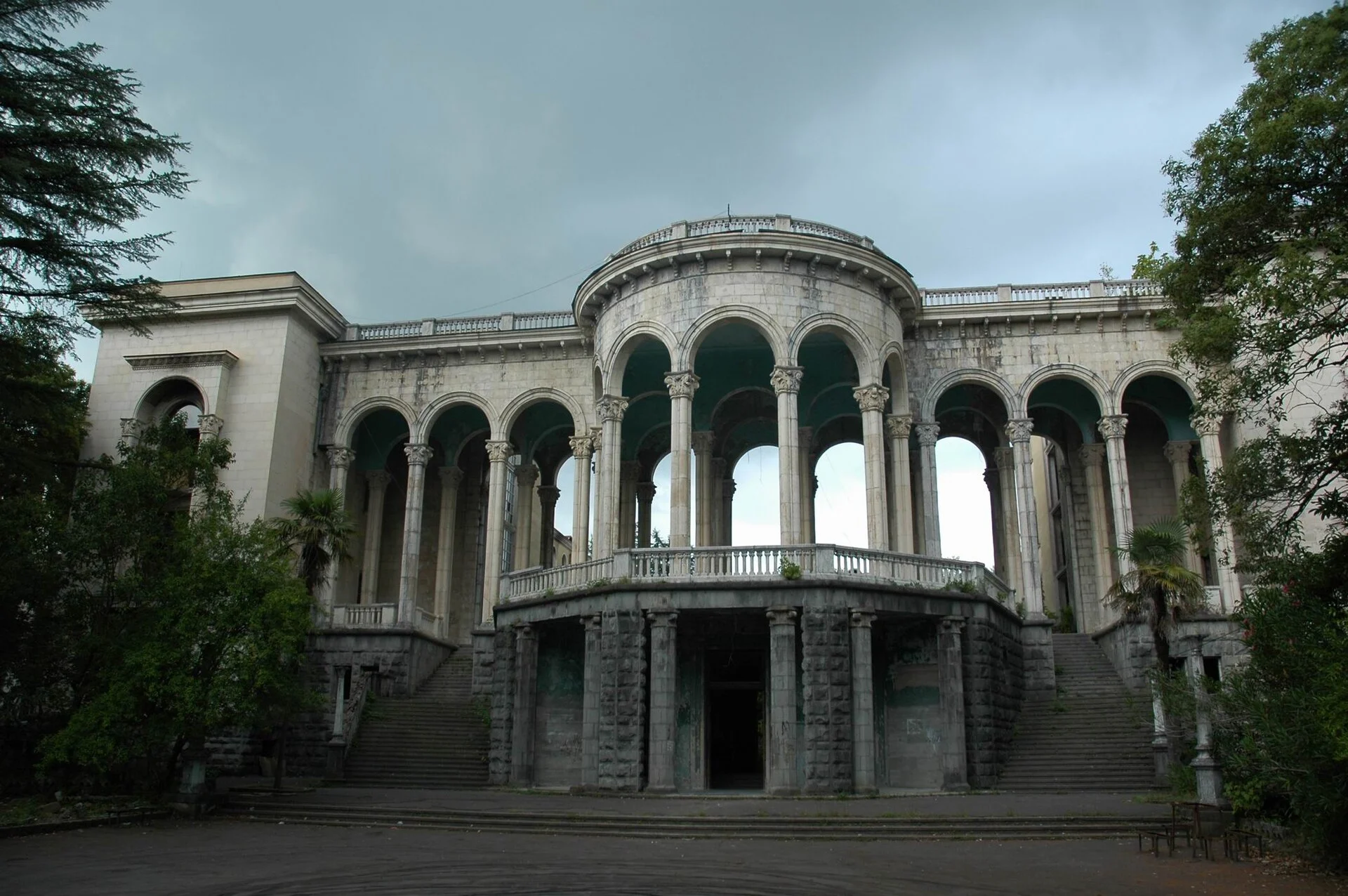
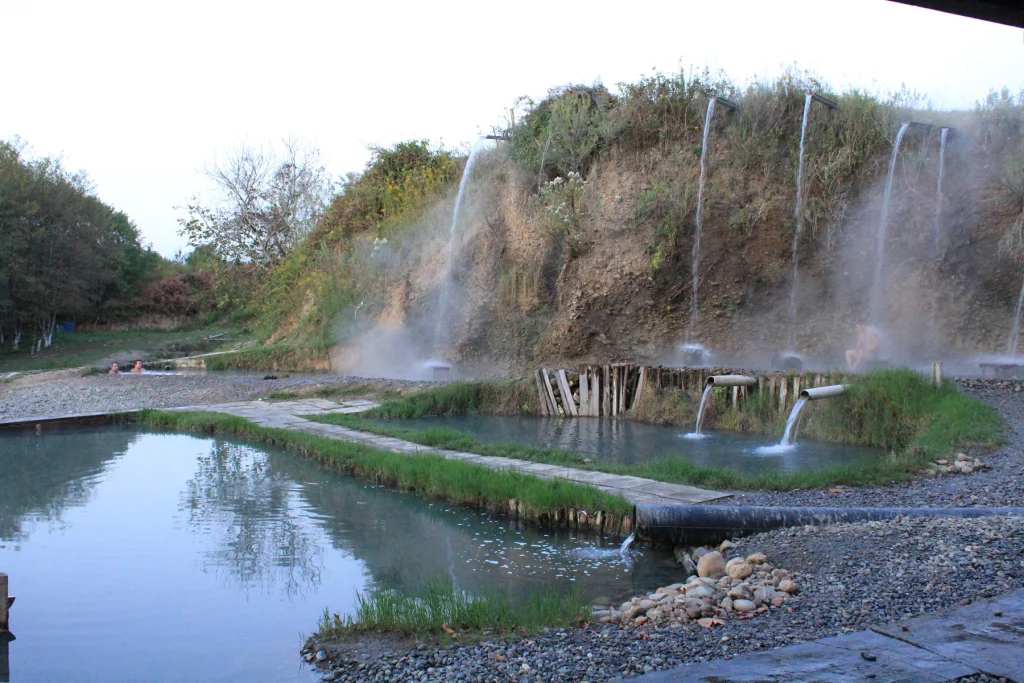
Tskaltubo, in Imereti near Kutaisi, drew Soviet officials and war veterans to its low-radioactivity, carbonate-rich springs from the 1920s through the 1980s, when nineteen grand sanatoriums operated on a single wooded park. Many of those buildings fell derelict after independence and some were used as housing for people displaced from Abkhazia for over two decades; relocation and restoration work has continued in recent years, and the town’s condition varies block by block. Travellers should expect a mix of renovated bath buildings and hotels offering supervised radon-carbonate baths, and other sanatoriums still closed or under restoration.
Historically the waters were used for rheumatic, skin, gynaecological and nervous-system conditions, always under a staff physician’s guidance with limited sessions per course. We could not verify a single published, up-to-date public safety bulletin covering radon exposure limits at every currently operating Tskaltubo facility, so ask the clinic directly for its session protocol before committing to a multi-day course. For background on the town’s redevelopment, see reporting by Agenda.ge. Our Tskaltubo Short Cure runs three nights for a first taste, and the Tskaltubo Cure extends to seven nights with a fuller mud and bath programme; for a single day combining the baths with Gelati and Motsameta, see Gelati, Motsameta and Tskaltubo.
Borjomi: the drinking cure and its spa hotels
Borjomi’s naturally carbonated, alkaline bicarbonate water has been bottled commercially since the nineteenth century and is sold internationally today. In Borjomi Central Park, drinking galleries let you fill a cup straight from the source for a small park entrance fee; locals traditionally take small glasses before meals rather than large quantities, and there is no single official Georgian clinical dosage guideline that we could confirm, so treat it as a mild traditional practice rather than a prescribed cure. People with kidney disease or hypertension should ask a doctor first given the water’s sodium and mineral content.
The town’s spa hotels, including those around the former Likani estate, pipe the same mineral water into pools and offer massage, mud and physiotherapy packages alongside it. The park itself borders Borjomi-Kharagauli National Park, one of the largest protected forest areas in the Caucasus, run by the Agency of Protected Areas, so a spa stay pairs naturally with a forest walk. Our Borjomi Family Spa Break covers four nights for families, the Borjomi Spa Week extends to five nights of fuller treatment, and the Borjomi and Bakuriani day trip suits anyone short on time.
Sairme and Abastumani: the mountain spas
Sairme, in a forested valley of Imereti at around 950 metres, has carbonic mineral water historically used for digestive and kidney complaints, with a modest drinking gallery and quiet walking paths. Abastumani, higher again at roughly 1,300 metres in Samtskhe-Javakheti, built its reputation in the imperial era on mountain-climate therapy for respiratory conditions, alongside mineral baths; it is also home to a historic astrophysical observatory, a reminder that the clean high air drew scientists as well as patients.
Both towns are quieter and less extensively renovated than Borjomi or Tbilisi, which suits travellers who want a slow, low-key stay rather than a resort atmosphere. They combine well with the cave city of Vardzia and the fortress town of Akhaltsikhe. Our Sairme and Abastumani Mountain Spas tour covers four nights across both towns, and The South in 3 Days links Abastumani with Borjomi, Vardzia and Rabati for a shorter trip. A single-day option from Kutaisi, Vani, Baghdati and Sairme, adds the ancient gold-working site of Vani on the way.
Wild hot springs: Vani, Nokalakevi and Tsaishi
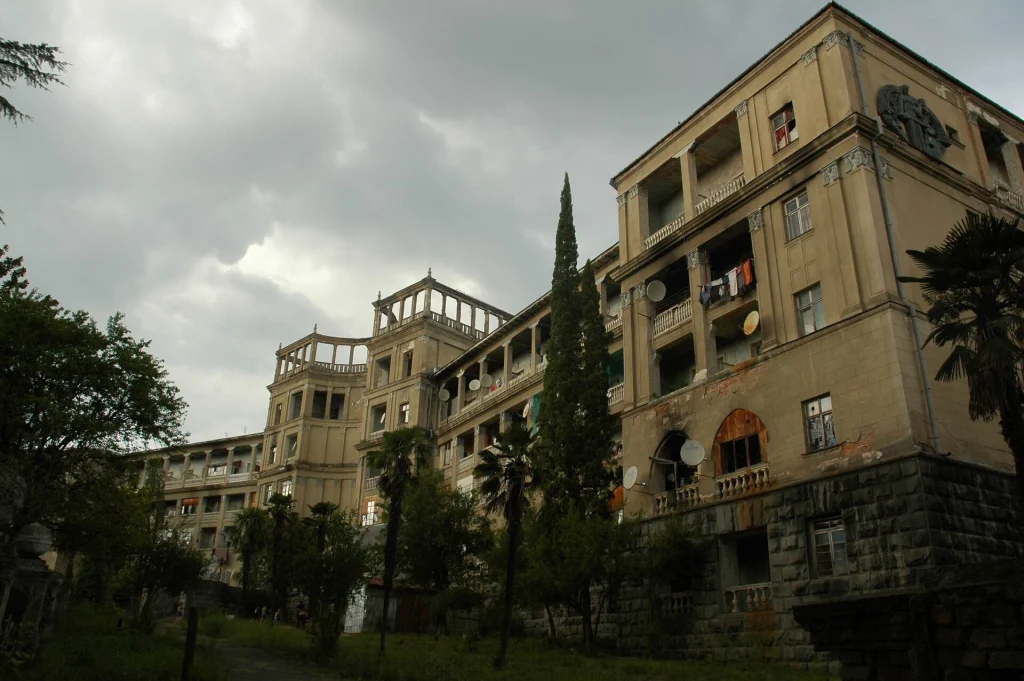
Western Georgia has several natural springs that locals use informally, with no admission fee, no staff and, usually, no changing facilities beyond a basic shed. They are worth knowing about but should be treated with more caution than a managed bathhouse or sanatorium.
- Vani: warm springs on the Sulori river near the Vani archaeological museum, the site of the ancient Colchian gold-working settlement recorded in the national heritage database at heritagesites.ge and described by the Georgian National Museum. The springs themselves are separate from the archaeological site and have no formal infrastructure.
- Nokalakevi: a sulphur spring near the Nokalakevi-Archaeopolis fortress, the ancient capital of Egrisi, in a river gorge in Samegrelo. Access can be affected by seasonal water levels and the approach road is unpaved in places.
- Tsaishi: a warm pool near Zugdidi used by local families, with minimal development and variable water levels by season.
None of these sites publish water-quality testing results that we could verify, and there is no lifeguard or medical staff at any of them. Treat a visit as a local curiosity rather than a therapeutic cure, avoid them after heavy rain because of flash-flood and landslide risk on the access tracks, and go with a driver who knows current road conditions, which our Car with Driver by the Day service can arrange alongside a local guide.
Choosing a cure: how the five options compare
| Place | Water type | Typical stay | Best suited to | GTOUR package |
|---|---|---|---|---|
| Tbilisi bathhouses | Sulphur, geothermal | 1–2 hours | Relaxation, a social evening, no medical claim | Sulphur Baths Experience |
| Tskaltubo | Radon-carbonate | 3–7 nights | Joint, skin and nervous-system conditions, under medical supervision | Tskaltubo Short Cure, Tskaltubo Cure |
| Borjomi | Alkaline bicarbonate | 4–5 nights | Digestive support, general wellness, forest air | Borjomi Family Spa Break, Borjomi Spa Week |
| Sairme / Abastumani | Carbonic, mountain climate | 4 nights | Digestive and respiratory complaints, quiet recovery | Sairme and Abastumani Mountain Spas |
| Wild springs | Sulphur or warm mineral, untested | An afternoon stop | Curiosity, local colour, not a cure | Vani, Baghdati and Sairme |
Health, safety and what to verify before you go
Balneology in Georgia is a long tradition, not a regulated medical pathway with uniform national standards that we could confirm across every operator. Before any multi-day course, particularly radon-carbonate treatment at Tskaltubo, ask the clinic in writing about its session length, frequency limits and who should avoid it; this matters especially if you are pregnant, have cardiovascular disease, uncontrolled hypertension, an active infection, or are undergoing other radiation-based medical treatment. A plain conversation with your own doctor before you travel is the simplest safeguard, and our Health Check-up and Wellness Break in Tbilisi can be arranged alongside a doctor’s consultation if you want a medical opinion before committing to a spa programme.
Prices, opening hours and which sanatoriums are currently operating change without a single central listing, so always confirm directly with the bathhouse or hotel, or check our continuously updated price and planning data page and today page for current notes on road access to Tskaltubo, Borjomi and the western valleys.
If this guide is part of a trip you are planning, our Borjomi-Kharagauli National Park Trek — 3 Days and Ubisa Frescoes, Surami Fortress and the Borjomi-Kharagauli Forest cover the places it describes with a private guide and driver; a GTour travel expert adapts the route to your dates.
Practical summary
- Tbilisi sulphur baths: public hall roughly 10–15 GEL, private room 60–150 GEL per hour, confirm on arrival
- Tskaltubo radon-carbonate baths: ask the clinic for its current session protocol before a multi-night course
- Borjomi drinking cure: small glasses before meals is traditional, not a prescribed dose; check with a doctor if you have kidney or blood-pressure issues
- Sairme and Abastumani: quieter mountain spas, best combined with Vardzia, Rabati or Akhaltsikhe
- Wild springs at Vani, Nokalakevi and Tsaishi: free, undeveloped, no water testing published, avoid after heavy rain
- See your own doctor before any spa cure, especially if pregnant, cardiac, or hypertensive
- Always verify current prices and opening status directly with the operator before booking
Sources
- Agency of Protected Areas, Borjomi-Kharagauli National Park
- Georgian National Museum, Vani Archaeological Museum
- National heritage database, Vani and western Georgia sites
- Agenda.ge, Tskaltubo redevelopment reporting
- Tbilisi Sulphur Baths (Abanotubani) – Lonely Planet Guide
- The Eerie Allure of Tskaltubo's Abandoned Soviet Spas – Smithsonian Magazine
Questions this guide does not answer? Write to info@castle.ge or WhatsApp +995 577 41 63 14 — a person in Tbilisi replies. See also our travel services and all guides.
The grand colonnaded Medea bathhouse in Tskaltubo, famed for its radon-carbonate mineral baths. · Photo: Yarkolp / Wikimedia Commons, CC BY-SA 3.0
Been to Georgia? Tell us how it went — the best stories are published here.
Share your tripOne email a week: what changed for travellers in Georgia — rules, roads, flights, seasons — plus one place worth the trip. Written by the GTour desk, no advertising, unsubscribe in one click.
This story across our partner network — ქართულად: შენი დასვენება
