

By Mariam Lomidze, Culture & Events Reporter · 09/11/2026
Short answer: carry some Georgian lari (GEL) in cash, but you do not need very much of it. Visa and Mastercard are accepted in almost every hotel, supermarket, fuel station and restaurant in Tbilisi, Batumi and Kutaisi, and contactless and Apple Pay work in most city shops. Cash still matters for marshrutka minibuses, village guesthouses, small wine cellars, market stalls, tips and the mountain regions of Tusheti, Khevsureti, Svaneti and Racha, where card terminals are scarce and internet can drop out. ATMs from Bank of Georgia (BOG), TBC Bank, Liberty Bank and Credo are widespread in cities and in most district towns, and generally do not add their own surcharge to a foreign card withdrawal, though your home bank almost certainly will charge a foreign-transaction or cash-advance fee, and the exchange rate your bank applies is outside Georgia’s control.
Lari is Georgia’s only legal tender; the authoritative daily buying and selling rates are published each morning by the National Bank of Georgia. On 9 November 2026 the reference rate was about GEL 2.90 per euro, GEL 2.59 per US dollar and GEL 3.47 per pound sterling. These move daily, sometimes by a percent or more, so treat any figure in this guide as indicative and check the current rate before changing a large sum or planning a tour deposit. The rest of this guide sets out, bank by bank and situation by situation, where you will need lari, where a card will do, and how to avoid the two real traps: a bad exchange rate and a counterfeit note.
ATMs: which bank, what it costs, and withdrawal limits
Bank of Georgia and TBC Bank between them run most of the country’s ATM network, with Liberty Bank and Credo filling gaps in smaller towns. For a foreign-issued Visa or Mastercard, the Georgian bank that owns the machine typically does not levy its own withdrawal fee, but this is a bank policy that can change, so check the current terms on your card issuer’s app rather than assume. Three costs usually apply regardless of which Georgian ATM you use: your home bank’s foreign-transaction fee (often 1 to 3 percent), a cash-advance fee if your card treats ATM withdrawals that way, and the exchange-rate margin built into the conversion, which is set by your card network and bank, not by Georgia.
- Single-withdrawal limits at most ATMs run from roughly GEL 500 up to GEL 2,000–4,000, depending on the machine and your daily limit set by your own bank; you can usually withdraw again until you hit your bank’s daily cap.
- ATMs in central Tbilisi, Batumi and Kutaisi are plentiful and mostly stocked around the clock; in district towns such as Telavi, Mestia, Sighnaghi, Kutaisi and Stepantsminda (Kazbegi) there are working ATMs but fewer of them, so do not leave your last withdrawal until the evening before a mountain trip.
- There is effectively no functioning ATM network inside Tusheti, deep Khevsureti beyond Shatili, or Ushguli in winter; withdraw what you need in Telavi, Mestia or Zugdidi before you head up.
Where cards work, and where you still need cash
In Tbilisi, Batumi and Kutaisi, card payment (chip, PIN, and increasingly contactless) is standard in hotels, supermarket chains, fuel stations, pharmacies, and sit-down restaurants. Outside the main cities the picture is patchier.
| Situation | Card acceptance |
|---|---|
| City hotels, chain supermarkets, fuel stations | Reliable |
| Marshrutka minibuses and shared taxis | Cash only, exact or small change helpful |
| Dezerter Bazaar, Dry Bridge market, village markets | Mostly cash; a few larger stalls have card readers |
| Small family guesthouses, home-stays in Svaneti, Tusheti, Racha | Usually cash only |
| Wine cellars and family-run tasting rooms off the main road | Mixed; ask before ordering |
| Sulphur baths, small museums, church donation boxes | Cash expected |
If you are travelling with us on a tour that includes village lunches, wine-cellar visits, or the markets walk, our driver-guides routinely carry change and can advise how much cash to bring for the day; see, for example, the Dry Bridge and Dezerter Bazaar walk or the Kakheti farm-to-table day.

Apple Pay, Google Pay and tap-to-pay
Apple Pay and Google Pay are widely supported at POS terminals in Tbilisi and Batumi, particularly where the terminal belongs to Bank of Georgia or TBC, and contactless “tap” payment under the standard limit (commonly GEL 100 without a PIN, though this threshold is set by the acquiring bank and can change) is routine in supermarkets, cafes and taxis booked through an app. Coverage thins quickly once you leave the cities: village shops, mountain guesthouses and informal roadside stalls often have no terminal at all, let alone NFC. Keep mobile payment as your city convenience, not your only plan for a multi-day mountain trip.
Cash: exchange offices versus bank branches
Licensed currency exchange booths (sakanksho punktebi), found on almost every central street in Tbilisi and Batumi, generally post live buy and sell rates for euro, US dollar, and a handful of other currencies, and rates can differ noticeably between neighbouring booths, so it is worth comparing two or three before changing a significant sum. Bank branches also exchange cash and will give a receipt, useful if you need proof of a legal exchange for any reason, but their displayed rate is sometimes slightly less favourable than a competitive street booth. Airport exchange counters at Tbilisi, Kutaisi and Batumi are convenient for a small amount to cover a taxi or first coffee, but rarely offer the best rate, so change only what you need there and do the rest in town.
| Currency | Approx. GEL per unit (9 Nov 2026, indicative) |
|---|---|
| Euro (EUR) | 2.90 |
| US dollar (USD) | 2.59 |
| Pound sterling (GBP) | 3.47 |
| UAE dirham (AED) | 0.71 |
| Israeli shekel (ILS) | 0.81 |
These are the National Bank of Georgia’s reference rates for that single day, published on its own site each morning; commercial rates at banks and exchange booths sit a little above or below this figure. Always check the current official rate before moving a large sum, since it moves daily and sometimes sharply around political or market news.

Tipping, counterfeit notes and small cash habits
Tipping in Georgia is appreciated rather than obligatory, and is almost always done in cash, in lari, left on the table or handed directly to a waiter, driver or guide; 10 percent in restaurants is a common guide where service is not already included, and a smaller note is customary for a day driver or walking-tour guide. It helps to keep a stock of GEL 5, 10 and 20 notes rather than only large denominations, since small vendors and market stalls often cannot break a GEL 100 or 200 note early in the day.
Counterfeit lari notes are uncommon but not unknown, and the National Bank periodically reissues security guidance; shops and banks routinely check larger notes (GEL 50 and GEL 100) under UV light or against a watermark. As a visitor, the simplest precautions are to get your cash from a bank or ATM rather than an informal street changer, to check that a note feels right (crisp paper, a visible watermark and colour-shifting ink on higher denominations), and to be cautious of unsolicited offers to exchange cash on the street at a rate that looks unusually good.
Paying deposits and booking tours from abroad
Our own tour and transfer prices are quoted in euros, as shown on each tour page and on our price data page, and deposits or full payment can be made by card online or by international bank transfer before you fly; balances, where applicable, are usually settled in Georgia in either euros, US dollars or lari, as agreed at booking. If you are paying a deposit from abroad by card, expect your own bank to apply a foreign-currency conversion, separate from anything we charge, and if you transfer by SWIFT, allow for your sending bank’s fee and a working day or two for the funds to arrive; our booking and payment policies page sets out the current accepted methods, confirmation timelines and cancellation terms, and is the page to check first if something looks different from what is written here.
If this guide is part of a trip you are planning, our Tbilisi to Gudauri Transfer — Ski Season 4×4 and Mtskheta on Foot — the Ancient Capital in 2 Hours cover the places it describes with a private guide and driver; a GTour travel expert adapts the route to your dates.
Practical summary
- Carry GEL 200 to 400 in small notes for a city day, more before heading into Tusheti, Khevsureti, Svaneti or Racha where ATMs disappear.
- Georgian ATMs (Bank of Georgia, TBC, Liberty, Credo) rarely add their own fee for foreign cards, but your home bank’s foreign-transaction and cash-advance fees will apply regardless.
- Cards and Apple Pay or Google Pay work reliably in Tbilisi, Batumi and Kutaisi; assume cash-only once you leave the main towns.
- Compare two or three exchange booths before changing a large sum; use the airport counter only for a small top-up.
- Keep tips in cash, in lari, and favour smaller notes for markets, guesthouses and drivers.
- Check a larger note’s watermark and texture if it is handed to you in change on the street rather than from a bank.
- Verify today’s exchange rate, ATM fee policy, or any other figure in this guide against the relevant official source before committing to a large transaction, since all of them can change.
- Pay tour deposits by card or SWIFT transfer well ahead of travel, and read the current terms on our policies page before you book.
Sources
- National Bank of Georgia reference rates (verify current rate)
- National Statistics Office, tourism and finance data
- World Bank, Georgia country overview
- Agenda.ge, business and economy news
- Geostat – Official Exchange Rate Statistics
- Matsne – Law of Georgia on the National Bank of Georgia
- Agenda.ge – Bank of Georgia and TBC Announce New ATM Fees
- BM.ge – TBC Bank and Bank of Georgia Compare Card Fees
Questions this guide does not answer? Write to info@castle.ge or WhatsApp +995 577 41 63 14 — a person in Tbilisi replies. See also our travel services and all guides.
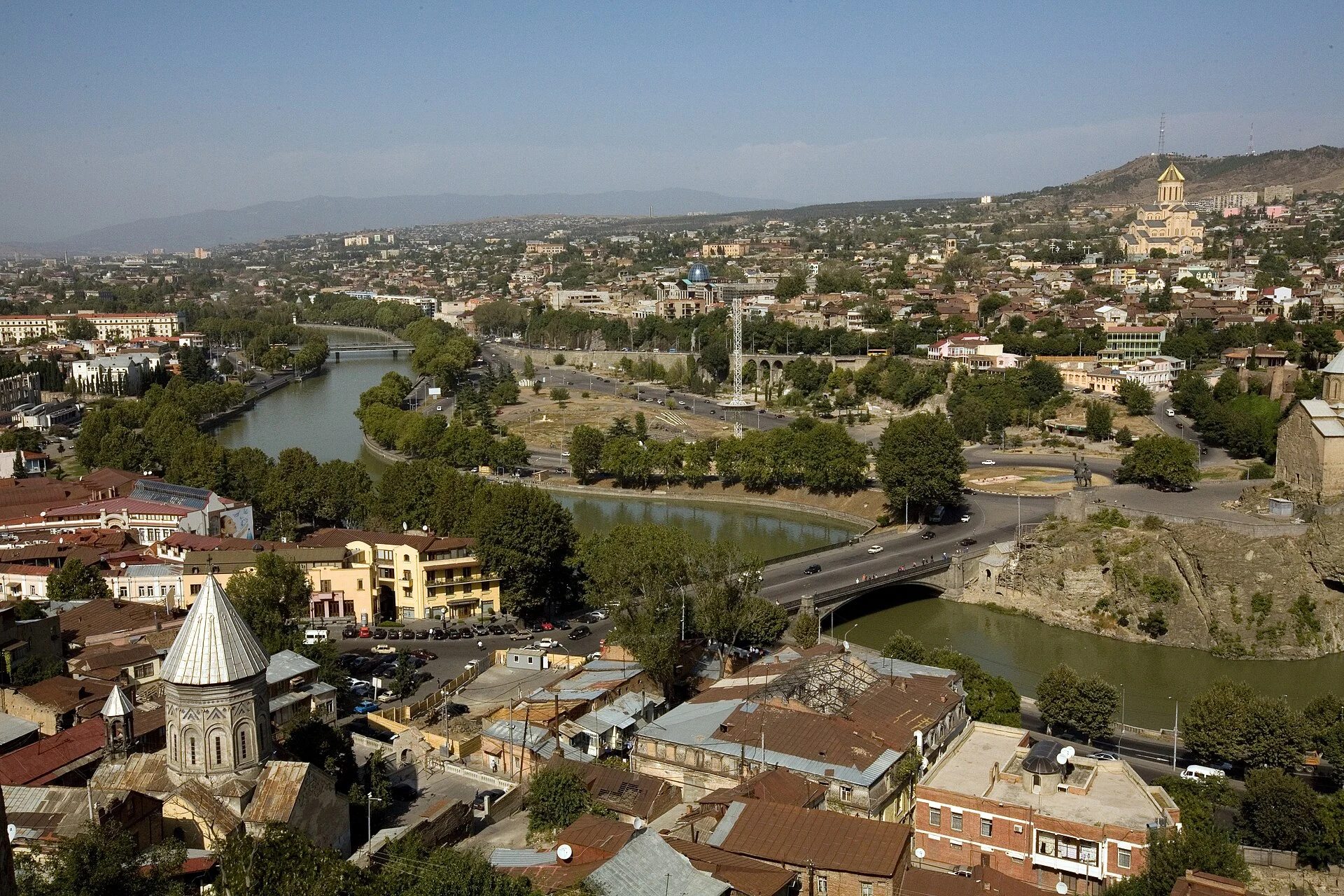
The Kura River winds through central Tbilisi, where banks and ATMs are concentrated for travelers. · Photo: EvgenyGenkin / Wikimedia Commons, CC BY 2.5
Been to Georgia? Tell us how it went — the best stories are published here.
Share your tripOne email a week: what changed for travellers in Georgia — rules, roads, flights, seasons — plus one place worth the trip. Written by the GTour desk, no advertising, unsubscribe in one click.
This story across our partner network — ქართულად: შენი დასვენება
