


By Nino Gelashvili, Travel News Editor · 14/11/2026
The single best museum experience in Georgia is the Georgian National Museum’s Simon Janashia building on Rustaveli Avenue in Tbilisi, where the Archaeological Treasury’s pre-Christian gold sits one floor above the Museum of Soviet Occupation, and both can be seen in a single ticket. But the full picture needs three more stops: the Svaneti Museum in Mestia for the icons and crosses that mountain communities hid from invaders, the Vani Archaeological Museum in Imereti for the Colchian gold that predates the Treasury’s best pieces, and Niko Pirosmani’s birthplace at Mirzaani in Kakheti for the naive-art painter who became Georgia’s best-known artist after his death in poverty.
Beyond these four anchors, Georgia’s museum landscape rewards slower travel: the Dadiani Palace in Zugdidi, the much-debated Stalin Museum in Gori, Tbilisi’s small Silk Museum, and a handful of regional collections that rarely make a first-time itinerary but repay an extra hour. This guide sets out what each holds, how they relate to one another, and the practical details of hours and tickets, which in Georgia change often enough that we point you to the official page rather than print a number that may be wrong by the time you read this.
The Georgian National Museum, Tbilisi: Treasury gold and the Soviet Occupation hall
The Georgian National Museum is a network of branches rather than a single building, and the flagship is the Simon Janashia Museum of Georgia on Rustaveli Avenue. Its Archaeological Treasury holds gold, silver and gemstone work spanning roughly three thousand years, from Bronze Age burial goods to Hellenistic and early Christian jewellery, shown in a secured, low-lit vault designed for small groups. It is the best single collection of ancient Georgian goldsmithing anywhere, and the pieces explain why Colchis and Iberia appear in Greek and Roman sources as sources of wealth.
On another floor of the same building, the Museum of Soviet Occupation documents the 1921 Red Army invasion, collectivisation, the purges, deportations and the 1989 and 1991 events that bookend the Soviet period in Georgia. It is a deliberately unsentimental exhibition, built around original documents, photographs and a reconstructed Gulag freight wagon, and it is worth pairing in your head with the Stalin Museum in Gori, which tells a very different story about the same century from a different town. The National Museum network also includes the Georgian National Gallery on Rustaveli, which holds the largest public collection of Pirosmani’s original paintings, and administers branches as far afield as Mestia and Vani, discussed below. For current branch list, combined tickets and any temporary closures, check the museum’s official pages directly, since the network periodically rotates exhibitions between buildings.
Svaneti Museum of History and Ethnography, Mestia
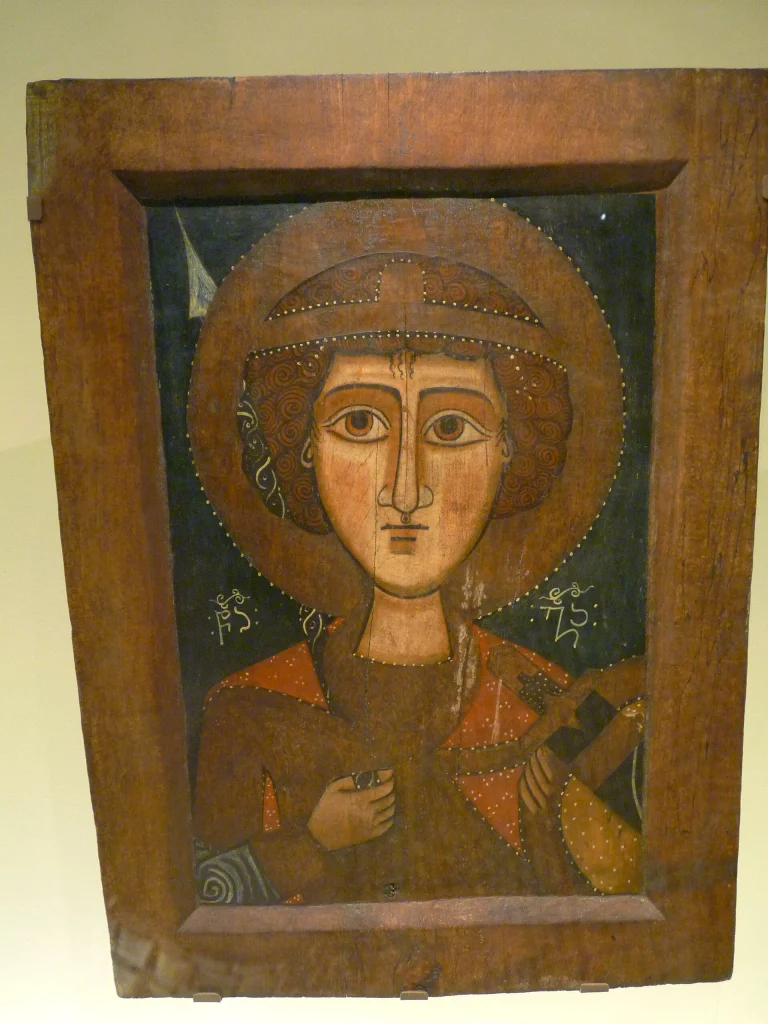
Mestia’s museum is unlike anything else in Georgia because of what it protects: icons, processional crosses, illuminated manuscripts and liturgical silver that Svan villages removed from their churches and towers during centuries of raiding, then quietly kept safe through Soviet anti-religious campaigns. The collection includes early medieval cloisonné enamel work and chased metal icons of a quality that would not look out of place in the Treasury, but here the context is different: these are objects a mountain community hid in its own walls rather than state regalia, and the museum’s labelling explains that lineage well.
The building itself, a Soviet-era structure renovated with modern display cases, sits a short walk from Mestia’s main square, and most visitors combine it with the town’s Svaneti towers and a day trip or trek toward Ushguli. Georgian National Museum branches, including this one, generally follow similar closing days and ticket tiers for residents, foreign visitors, students and children, but Mestia’s opening hours have shifted with the tourist season in past years, so confirm before building a tight itinerary. Our Mestia and Ushguli 3-day tour and the Svaneti Day Hikes itinerary both build in museum time around the Koruldi Lakes and Chalaadi Glacier walks.
Vani Archaeological Museum: Colchian gold before the Treasury
Vani, in Imereti near Kutaisi, was a major city of ancient Colchis, and decades of excavation on its hilltop sanctuary site have produced gold jewellery, bronze figurines and imported Greek ceramics that are now displayed in a purpose-built museum beside the dig. Some of the most refined Colchian gold in the country, including intricate filigree and granulation work, comes from Vani rather than from Tbilisi, and seeing it on site, a short walk from the excavated terraces, gives a sense of context that a vitrine in the capital cannot.
The museum is modest in size compared with the National Museum in Tbilisi, which makes it an easy half-day addition rather than a full day out. It pairs naturally with Kutaisi’s own sights and with Imereti wine country. Our Vani, Baghdati and Sairme day trip from Kutaisi links the museum with the mineral springs at Sairme and the birthplace of the poet Galaktion Tabidze in Baghdati, making a single themed day of gold, poets and springs.
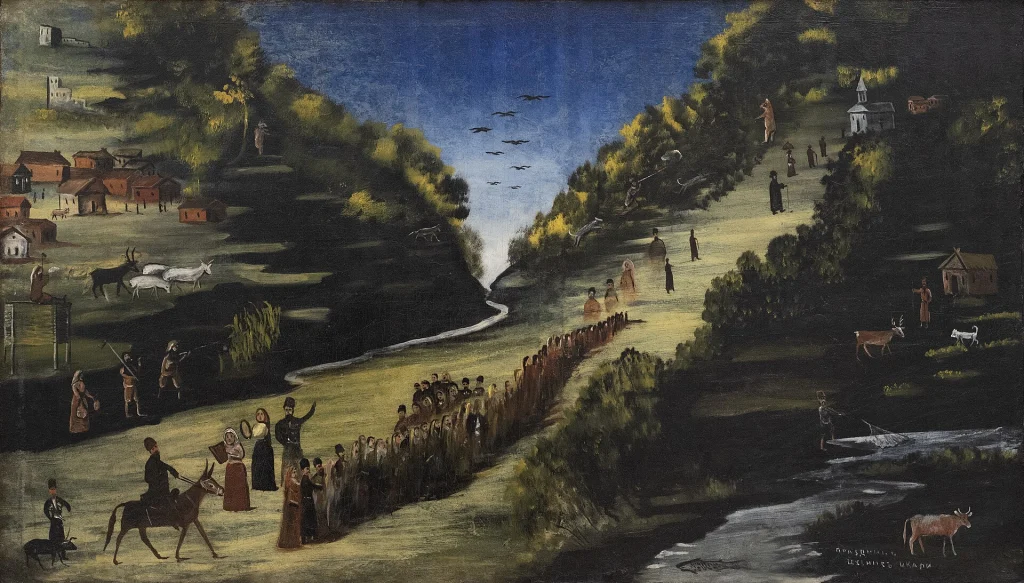
Pirosmani: the house in Mirzaani and the paintings in Tbilisi
Niko Pirosmani (1862–1918) painted on oilcloth and tin for Tbilisi’s taverns and shops, was largely unrecognised in his lifetime, and died in poverty before being rediscovered by Georgian and Russian avant-garde artists in the 1910s. His birthplace at Mirzaani, a village in Kakheti, has been preserved as a house museum showing the rural setting he came from, along with a small gallery of works and reproductions. It is a quiet, unhurried stop rather than a blockbuster collection, and best understood as a pilgrimage to origins rather than a place to see his major canvases.
The bulk of Pirosmani’s surviving originals, including well-known works such as his animal and feast scenes, hang in the Georgian National Gallery on Rustaveli Avenue in Tbilisi, part of the National Museum network. If your time is limited, prioritise the Tbilisi gallery for the paintings themselves and treat Mirzaani as an optional detour for travellers already touring Kakheti’s wine country, easily combined with a cellar visit on a day like our Kakheti Classic or Sighnaghi and Bodbe itineraries.
Dadiani Palace Museum, Zugdidi
The Dadiani family ruled Samegrelo as a semi-independent principality into the nineteenth century, and their palace complex in Zugdidi, now a state history and architecture museum, reflects that status. The collection mixes Georgian royal and princely material with European pieces that arrived through the family’s marriage ties to Napoleon’s Murat relatives, including items long presented locally as connected to Napoleon’s household. As with any such claim, treat the attribution with the same caution the museum itself generally applies, and ask the on-site guide for the current, most careful version of the story rather than relying on older guidebook language.
Zugdidi is a practical base for visits to the Enguri Dam and the approach roads into Svaneti, and the palace museum works well as a half-day stop on that route. Our Zugdidi, Dadiani Palace and Enguri Dam day trip from Kutaisi covers the palace, the dam viewpoint and the town in a single outing.
The Stalin Museum, Gori: an exhibit that needs context
Stalin was born in Gori, and the state museum dedicated to him, built around his preserved birth house and a replica of one of his Kremlin railway carriages, remains one of the most visited sites in the region. It has long been criticised, including by Georgian and international historians, for presenting his career with minimal reference to the purges, deportations and famine his government caused across the Soviet Union, Georgia included. The museum has made incremental changes over the years in response to this criticism, and Georgian cultural authorities periodically revisit how the site should be framed; the debate is well documented in Georgian and international press.
We recommend visiting Gori with a guide who can supply the historical context the exhibit itself does not always provide, and, if your schedule allows, pairing it with the Museum of Soviet Occupation in Tbilisi, which tells the other half of the same story. Our Gori and Uplistsikhe day trip includes guided commentary alongside the cave city, and a licensed guide booked by the day can tailor the historical framing to your own interest.
The Silk Museum and other small gems
Tbilisi’s Silk Museum, founded in the late nineteenth century under the reforming mayor Niko Nikoladze to support the Caucasus silk industry, holds an unexpectedly engaging collection of cocoons, looms, historic textile samples and the biology of silk production, housed in an Art Nouveau building that is itself worth the visit. It rarely appears on first-time itineraries but is a reliable choice on a rainy afternoon or for travellers with a textile or craft interest.
- The Tbilisi Open-Air Museum of Ethnography, on the hillside above Vake Park, reconstructs village houses and farmsteads from across Georgia’s regions and is particularly good for families and for understanding regional architecture before heading out to Svaneti or Khevsureti.
- Regional house-museums dedicated to writers, from Ilia Chavchavadze’s estate in Kakheti to smaller literary homes, offer a quieter counterpoint to the capital’s major collections.
- Kutaisi’s historical museum and Batumi‘s archaeological museum are worth an hour each if you are already in those cities for other reasons.
Opening hours, tickets and planning your museum days
Georgian state museums generally close on Mondays and open through the rest of the week, commonly from around 10:00 to 18:00, but exact hours, ticket categories for residents, foreigners, students and children, and seasonal closures change from year to year and sometimes from branch to branch within the same network. Rather than quote prices that may already be out of date, verify the current figures on each museum’s official page before you travel, and recheck if your visit falls on a public holiday, when many state museums close regardless of the posted weekly schedule.
| Museum | Location | Known for | Typical closing day |
|---|---|---|---|
| Simon Janashia Museum (Treasury and Soviet Occupation hall) | Tbilisi, Rustaveli Avenue | Pre-Christian gold, Soviet-era history | Monday |
| Georgian National Gallery | Tbilisi, Rustaveli Avenue | Pirosmani originals, Georgian painting | Monday |
| Svaneti Museum of History and Ethnography | Mestia | Church icons and crosses | Monday |
| Vani Archaeological Museum | Vani, Imereti | Colchian gold, excavation site | Monday |
| Pirosmani House Museum | Mirzaani, Kakheti | Pirosmani’s birthplace | Varies by season |
| Dadiani Palace Museum | Zugdidi | Princely residence, European collection | Varies by season |
| Stalin Museum | Gori | Birth house, Soviet-era artefacts | Rarely closed |
| Silk Museum | Tbilisi | Caucasus silk industry history | Varies by season |
A licensed guide booked by the day is the simplest way to avoid a wasted trip to a closed museum, since guides generally check opening status the day before and can substitute an alternative stop if a branch is closed for a temporary exhibition change.
If this guide is part of a trip you are planning, our Western Georgia in 6 Days — Kutaisi, Svaneti and the Sea and Mestia to Kutaisi or Zugdidi Transfer cover the places it describes with a private guide and driver; a GTour travel expert adapts the route to your dates.
Practical summary
- Start in Tbilisi: Simon Janashia Museum for the Treasury gold and the Soviet Occupation hall, plus the National Gallery for Pirosmani’s originals.
- In Svaneti, see the Mestia museum’s icons before or after a day hike; combine with Mestia and Ushguli touring.
- Visit Vani on a half-day from Kutaisi, paired with Baghdati and Sairme.
- Treat Pirosmani’s Mirzaani house as a Kakheti detour, not a substitute for the Tbilisi gallery.
- See the Dadiani Palace in Zugdidi en route to or from Svaneti, with caution around the Napoleon attributions.
- Visit the Stalin Museum with a guide who supplies the historical context, ideally alongside the Soviet Occupation hall in Tbilisi.
- Check each museum’s official page for current hours, closing days and ticket prices before you go, since these change by season and sometimes by year.
Sources
- Upper Svaneti World Heritage listing
- Historical Monuments of Mtskheta, for comparison on Georgian heritage listing practice
- Georgia heritage sites database
- Stalin Museum context and debate
- Georgia travel official tourism portal
Questions this guide does not answer? Write to info@castle.ge or WhatsApp +995 555 42 38 45 — a person in Tbilisi replies. See also our travel services and all guides.
The Georgian National Museum in Tbilisi, home to the Treasury and Soviet Occupation hall. · Photo: Mostafameraji / Wikimedia Commons, CC BY-SA 4.0
Been to Georgia? Tell us how it went — the best stories are published here.
Share your tripOne email a week: what changed for travellers in Georgia — rules, roads, flights, seasons — plus one place worth the trip. Written by the GTour desk, no advertising, unsubscribe in one click.
This story across our partner network — ქართულად: შენი დასვენება
