

By Nino Gelashvili, Travel News Editor · 02/11/2026
Georgia packs five biogeographic zones into a country the size of Ireland, and that is why its wildlife list reads like a continental atlas: over a million migrating raptors over Batumi in a single autumn, Caucasian tur balanced on Lagodekhi‘s ridgelines, lynx and brown bear in the beech forests between, bearded vulture riding thermals above Kazbegi, and cranes and ducks stacking up on the volcanic lakes of the Javakheti plateau. No other country this small lets you move from subtropical coast to semi-desert to 3,000-metre alpine pasture in a day’s drive, and each habitat has its own season and its own specialities.
The short answer for a first visit: come to Batumi in September for the raptor migration, add a few days in Lagodekhi or Vashlovani for mammals and dry-country birds, and if time allows, detour to the Javakheti lakes or Kazbegi for wetland and high-mountain species. None of this needs rare luck or expensive gear, but it does need the right week, a licensed guide who knows the sites, and restraint around nests, dens and feeding animals. The sections below set out what to expect, when, and how to watch responsibly.
Batumi raptor migration: when and where to stand
Every autumn, raptors that breed across Russia, Scandinavia and Central Asia funnel down the eastern Black Sea coast because they avoid long open-water crossings. Batumi sits at the narrowest pinch point of that flyway, squeezed between the sea and the Lesser Caucasus, so birds that spread out over hundreds of kilometres further north converge into a visible river of wings. The counting project known as the Batumi Raptor Count has logged well over a million raptors in a single autumn season, dominated by honey buzzards, steppe buzzards, black kites and lesser spotted eagles, with sparrowhawks, harriers and the occasional imperial or steppe eagle moving through.
The core season runs from mid-August to late October, with the honey buzzard peak in early-to-mid September and the heaviest buzzard and kite movement through late September and October. Counters work two main watch points on the hills above the city, at Sakhalvasho and Shuamta, where volunteers and researchers tally birds from dawn and will usually let visitors watch alongside them. Mornings after a clear night with a north or northwest wind tend to produce the biggest numbers, since raptors avoid flying in rain or thick cloud. For current count dates, access notes and the season’s running totals, check the project directly rather than relying on a fixed calendar, since timing shifts a little each year with the weather.
From Batumi the watch points are a short taxi or guided drive away, and they combine well with a wider look at the Adjara highlands. Our Batumi & the Ajara Mountains — 2 Days and Batumi Half-Day — Old Town, Boulevard and the Botanical Garden tours can be adapted around a dawn raptor watch, and a Licensed Private Guide by the Day is the simplest way to get a local who knows which hillside is active on a given morning.
Javakheti lakes and Lake Paravani
South of Borjomi, the Javakheti volcanic plateau sits at 1,800 to 2,100 metres and holds a chain of shallow lakes, Georgia’s largest, Paravani, among them, alongside Khanchali, Madatapa and Bugdasheni. These lakes and their surrounding wetlands have long been recognised internationally for waterbirds, and parts of the plateau fall under protection as the Javakheti Protected Areas, with wetlands here also listed under the Ramsar Convention. Spring and autumn passage brings large numbers of ducks, grebes, cranes and waders, while the breeding season holds species such as the Armenian gull and various terns, and raptors including the Montagu’s harrier hunt the open steppe around the shores.
The plateau is remote, windswept and without much tourist infrastructure, which is part of its appeal for serious birders but also means you should plan around a local driver who knows the unsurfaced lake roads and the weather, which can close in fast even in summer. There is no ready-made GTOUR itinerary to Javakheti at the time of writing; the practical way to see it properly is a custom day from Borjomi or Akhaltsikhe using our Car with Driver by the Day service paired with a Licensed Private Guide by the Day, ideally one with birding experience, since species identification at a distance over open water rewards a trained eye.
Lagodekhi: Caucasian tur, bear, lynx
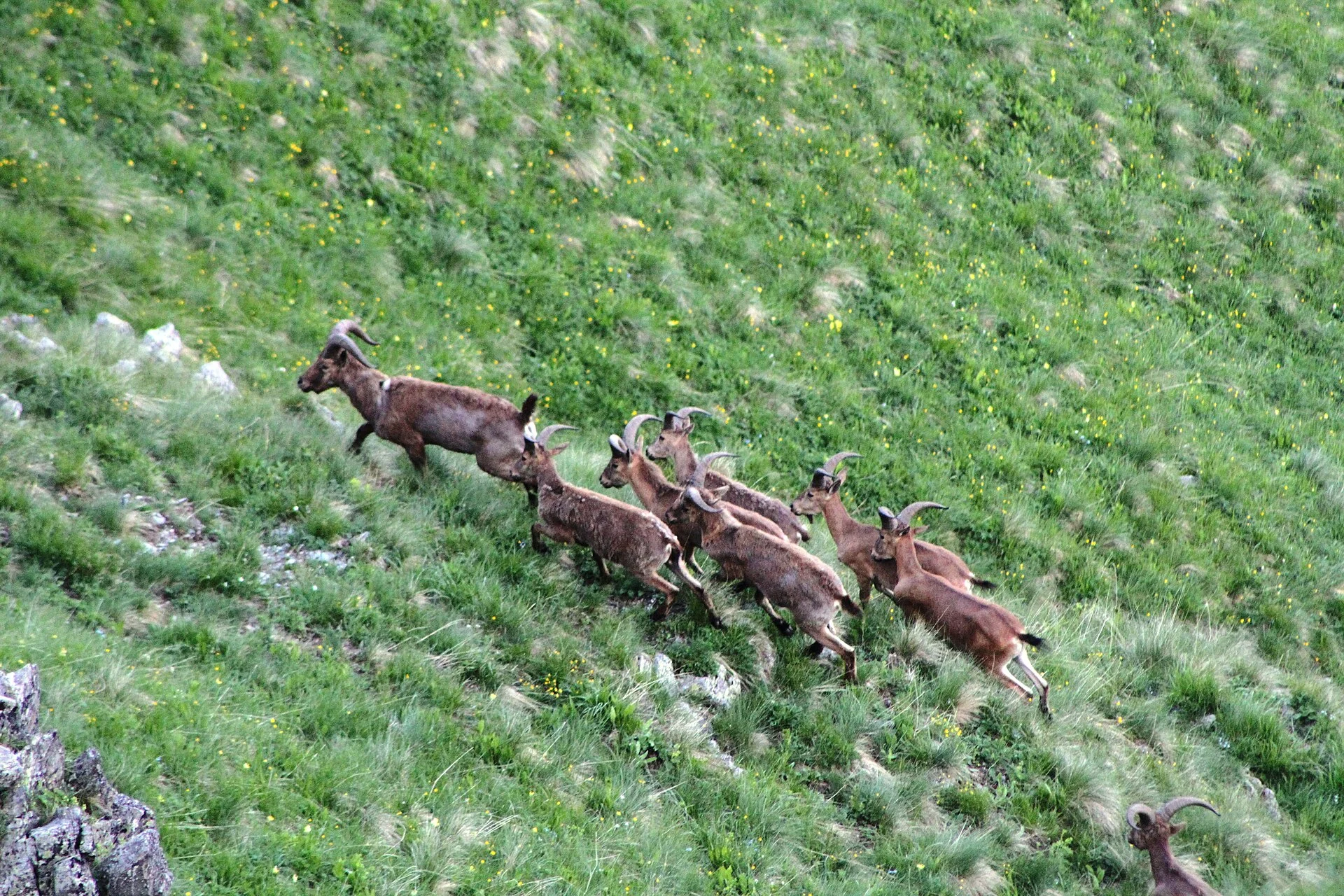
Lagodekhi Protected Areas, hard against the Dagestan border in the far east, is Georgia’s oldest reserve and still one of its best for large mammals, because the terrain rises from lowland forest to alpine ridgelines above 3,000 metres inside a single, strictly managed park. Caucasian tur, the stocky wild goat endemic to the Caucasus, graze the high pastures and rocky slopes in the upper park, typically visible from July to September when snow has cleared the ridges; brown bear and lynx live in the forest belt below but are shy and far more often tracked by sign, a scratched beech trunk or a print in mud, than seen directly. Patience, early starts and a guide who reads the ground are the only reliable method here.
The classic route to tur country is the trek to Black Rock Lake, a two or three day round trip through beech and spruce forest into alpine meadow, which also turns up chamois, a range of forest birds and, with luck, golden eagle overhead. Our Black Rock Lake Trek — 2 Days in Lagodekhi and the longer Lagodekhi — Black Rock Lake Trek, 3 Days on the Dagestan Border both follow this route with a guide and camping or refuge stays, and the gentler Eastern Kakheti — Nekresi, Gremi, Kvareli and the Lagodekhi Forest day trip gives a lower-elevation taste of the park’s forest and birdlife without the overnight trek.
Vashlovani: semi-desert and dry-country species
At the opposite climatic extreme, Vashlovani Protected Areas in the far southeast is a badlands of eroded canyons, juniper woodland and semi-desert steppe along the Azerbaijan border, hot and nearly rainless in summer. It holds a different wildlife list entirely: Bezoar goat on the canyon walls, golden jackal and wild boar lower down, and a strong cast of dry-country birds including Egyptian vulture, long-legged buzzard and, in good years, the rare courser species that pass through on migration. Leopard sign has occasionally been recorded in this border region, part of a wider South Caucasus recovery effort, though sightings remain exceptional and should be treated as a very long shot rather than an expectation.
Vashlovani sits further out than most visitors manage on a standard itinerary and has no paved roads once you leave the main highway, so a 4×4 and a driver who has worked the park before are not optional extras. It is often confused with the better-known David Gareji monastery complex further north, which sits in similar semi-desert country and is covered by our Davit Gareji and the Semi-Desert — Monastery, Steppe and Rainbow Hills day trip, but Gareji and Vashlovani are separate protected areas with different access points. For Vashlovani itself, arrange a dedicated trip through a Car with Driver by the Day in 4×4 configuration combined with a specialist guide, and confirm ranger station opening and any permit requirements before setting out, since rules at remote border-zone parks change without much notice.
Bearded vulture and the Kazbegi highlands
Kazbegi National Park, around the extinct volcano Mkinvartsveri and the Georgian Military Highway corridor, is the most accessible place in the country to watch the bearded vulture, or lammergeier, a huge bone-eating raptor with a wingspan close to that of a small eagle and a diet almost entirely of carrion bones, which it drops onto rocks to crack open. Pairs nest on inaccessible cliff ledges and range widely over alpine pasture above the treeline, so sightings come from patient scanning of ridgelines around Gergeti, Juta and the Truso valley rather than any fixed viewpoint. Late spring through early autumn gives the best combination of accessible trails and active birds, since the species is a year-round resident but harder to find once heavy snow closes the high ground.
The bearded vulture is listed as Near Threatened by the IUCN, and in the Caucasus its main pressures are poisoned carcasses set for other predators and disturbance at nest sites, so keeping well back from any cliff where one is seen circling repeatedly matters more here than almost anywhere else on this list. Our Georgian Military Highway — Ananuri, Gudauri and Gergeti in a Day and Kazbegi — 2-Day Mountain Journey tours put you in the right habitat, and Juta, Sno and Gergeti — Kazbegi Off the Main Road reaches quieter valleys where raptor activity is often higher than along the main road.
Ethical wildlife watching
Georgia’s protected area network is managed by the national Agency of Protected Areas, and its rules exist mainly to keep both wildlife and visitors safe; they are not bureaucratic decoration. A short set of principles covers most situations:
- Keep a minimum distance from nests, dens and roosting raptors; a bird that flushes repeatedly is being harmed by your presence even if it does not fly far.
- Never bait or feed wild bears, jackals or raptors to bring them closer for photographs; this habituates animals and has led to dangerous encounters elsewhere in the Caucasus.
- Stay on marked trails in Lagodekhi, Vashlovani and Kazbegi National Park, both to protect fragile alpine turf and because off-trail movement in bear and tur country increases the risk of a startled encounter.
- Use a guide registered with the park or a licensed national guide for anything beyond a short marked walk; rangers and experienced guides know current closures, recent bear activity and lambing or nesting periods when access is restricted.
- Report any sign of poaching, poisoned bait or snares to park rangers rather than intervening directly.
Rules on group size, drone use and camping inside protected areas are set and occasionally revised by the Agency of Protected Areas and the Ministry of Environmental Protection and Agriculture, so confirm current conditions for your chosen park before travel rather than relying on a previous visit or a guidebook.
Guides, seasons and getting there
| Site | Best season | Target species | How to go |
|---|---|---|---|
| Batumi raptor watch points | Mid-August to late October, peak mid-September | Honey buzzard, steppe buzzard, black kite, eagles | Day trip from Batumi with guide |
| Javakheti lakes, Paravani | April–May and August–October passage | Cranes, ducks, grebes, Montagu’s harrier | Custom day from Borjomi, 4×4 and local guide |
| Lagodekhi | July–September for tur, year-round for forest species | Caucasian tur, lynx (sign), bear (sign), chamois | 2–3 day guided trek to Black Rock Lake |
| Vashlovani | Spring and autumn, avoid summer heat | Bezoar goat, jackal, Egyptian vulture, dry-country birds | 4×4 with specialist operator, book ahead |
| Kazbegi | Late spring to early autumn | Bearded vulture, golden eagle, chamois | Day trip or two-day stay with guided walks |
None of these sites require technical mountaineering, but Lagodekhi’s tur trek and Vashlovani’s canyons both call for a reasonable level of fitness and, for Vashlovani, a driver experienced with unsurfaced border-zone tracks. A Licensed Private Guide by the Day can be booked in English, German, French, Russian, Italian or Hebrew and is worth the cost on any wildlife-focused day, since identification and ethical spacing both improve sharply with local experience. For a longer itinerary stitching several of these sites together, build a custom route using our Car with Driver by the Day service alongside the park-specific tours above.
If this guide is part of a trip you are planning, our Batumi to Kutaisi Transfer — Private Car and Borjomi-Kharagauli National Park Trek — 3 Days cover the places it describes with a private guide and driver; a GTour travel expert adapts the route to your dates.
Practical summary
- Batumi raptor migration: mid-August to late October, peak around mid-September, watch from Sakhalvasho or Shuamta at dawn.
- Javakheti lakes and Paravani: best on spring and autumn passage, no fixed GTOUR itinerary, arrange a custom day with driver and birding guide.
- Lagodekhi: Caucasian tur most visible July–September on the Black Rock Lake trek; bear and lynx are usually tracked by sign, not sighted directly.
- Vashlovani: remote semi-desert park, 4×4 and specialist guide essential, confirm ranger station access before travel.
- Kazbegi: year-round bearded vulture territory, best watched late spring to early autumn, keep well back from cliff nesting sites.
- Always verify current park rules, permits and seasonal closures with the Agency of Protected Areas before setting out.
- Book a licensed guide for anything beyond a marked day walk; ethics and identification both improve with local expertise.
Sources
- Ministry of Environmental Protection and Agriculture
- Georgian National Tourism Administration
- Colchic Rainforests and Wetlands of Georgia (UNESCO World Heritage)
- IUCN Caucasus Programme
- Agenda.ge – Batumi Raptor Count Reports Record Migration Numbers
Questions this guide does not answer? Write to info@castle.ge or WhatsApp +995 577 41 63 14 — a person in Tbilisi replies. See also our travel services and all guides.
Wild tur bound across a grassy mountainside in Lagodekhi, the species sought by Georgia's wildlife trackers. · Photo: Giorgimailo / Wikimedia Commons, CC BY-SA 4.0
Been to Georgia? Tell us how it went — the best stories are published here.
Share your tripOne email a week: what changed for travellers in Georgia — rules, roads, flights, seasons — plus one place worth the trip. Written by the GTour desk, no advertising, unsubscribe in one click.
This story across our partner network — ქართულად: შენი დასვენება
