

By Nino Gelashvili, Travel News Editor · 01/11/2026
Samtskhe-Javakheti is the quietest of Georgia’s touring regions, and the one most people see in one long day or a two- to three-day loop from Tbilisi: Borjomi‘s spa park and mineral water, the pine-forest ski village of Bakuriani above it, the rebuilt Rabati fortress in Akhaltsikhe, the cliffside monasteries of Sapara and Vardzia, the fortress of Khertvisi at the meeting of two rivers, and the high volcanic plateau of Javakheti around Paravani lake, Poka and Ninotsminda. Driving time from Tbilisi to Borjomi is about two and a half to three hours; add another hour to Akhaltsikhe and a further forty minutes to Vardzia, so a single long day covers the lowland highlights while the Javakheti highlands reward an overnight stay.
The region has two distinct characters. Meskheti, the lower, forested half around Borjomi and Akhaltsikhe, is a landscape of gorges and spa towns with a layered history of Georgian, Ottoman and Armenian rule visible in a single fortress courtyard. Javakheti, the volcanic plateau above 2,000 metres around Ninotsminda and Akhalkalaki, is colder, windier and largely ethnic Armenian in population, with lakes, extinct craters and monastic communities that feel closer to the Armenian highlands than to the Georgian coast. Spring to October is the practical season for the plateau; Borjomi and Bakuriani work in every month, the latter especially from December to March.
Borjomi: the park, the mineral water and the Romanov palace at Likani
Borjomi’s reputation rests on its naturally carbonated mineral water, bottled from springs inside Borjomi Central Park since the nineteenth century and still exported as Georgia’s best-known brand. The park itself is the point of a visit: a gorge-side promenade along the Borjomula river, a cable car up to a Ferris-wheel viewpoint, outdoor mineral pools, and free taps where you can drink the warm, salty water straight from the source (most visitors manage a cup, not a bottle). The town sits inside the buffer zone of Borjomi-Kharagauli National Park, one of the largest protected forest areas in the Caucasus, with marked trails running from day walks to the three-day traverse to Abastumani; current trail status and ranger-station contacts are listed by the Agency of Protected Areas at apa.gov.ge.
A short drive from the park centre, the Likani Palace was built in the 1890s as a summer residence for the Russian imperial Romanov family and is now a state guesthouse used for official visits, so access is restricted and not guaranteed on any given day; ask locally or through a guide before planning around it, since opening policy changes without much notice. For a full spa stay rather than a day visit, see our Borjomi Family Spa Break and Borjomi Spa Week itineraries, or the single-day Borjomi and Bakuriani — Spa Town and Mountain Air in a Day.
Bakuriani: the mountain resort above Borjomi
Bakuriani sits at roughly 1,700 metres, a thirty-minute drive up a forested road from Borjomi, and works as a ski base in winter and a cool, pine-scented retreat in summer. The resort has three main ski sectors — Kokhta-Mitarbi, Didveli and the smaller beginner slopes near the centre — with lift passes, equipment rental and ski schools aimed squarely at families and beginners rather than advanced off-piste skiing, which is better found in Gudauri or Svaneti. A narrow-gauge line historically connected Borjomi and Bakuriani; services and schedules have been intermittent in recent years, so check current status with Georgian Railway at railway.ge rather than assume it is running. In summer the same slopes become walking and horse-riding routes, and the town is noticeably cooler than Tbilisi, which is the main reason Georgian families have summered here since Soviet times. Our Bakuriani Family Winter package and the combined Borjomi, Bakuriani & Rabati — 2 Days cover the practical logistics.
Akhaltsikhe’s Rabati and Sapara monastery
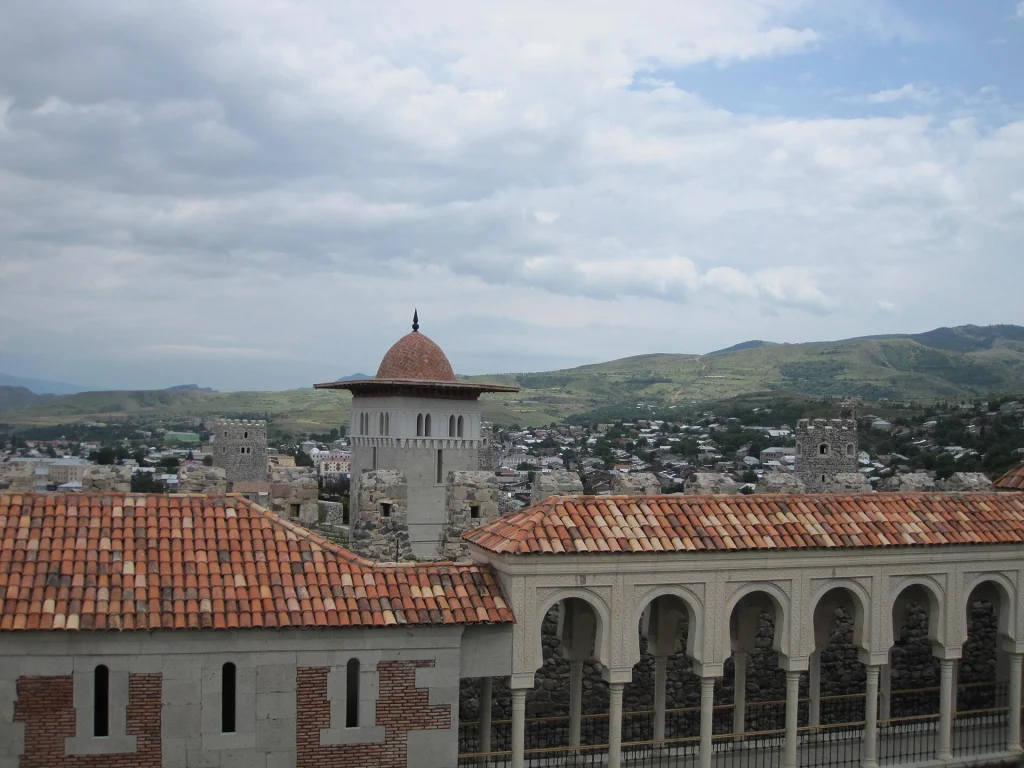
Akhaltsikhe, the regional capital, is built around Rabati, a fortress complex rebuilt and opened to visitors in 2012 after a large-scale restoration. Inside the walls stand a mosque, a church and other buildings reflecting the town’s long Ottoman and Georgian past, along with a museum covering Meskheti’s archaeology and history; it is the most photogenic single stop in the region and works well lit at dusk. Current opening hours and ticket prices for the fortress and museum are best confirmed before you go through the Ministry of Culture’s heritage listings at culture.gov.ge, since these details are revised periodically.
Ten kilometres south-east of Akhaltsikhe, a winding road climbs to Sapara monastery, a ninth- to thirteenth-century complex associated with the Jakeli family who ruled Meskheti for centuries. The main church keeps some of the best-preserved medieval frescoes in southern Georgia, and the cliffside setting, reached by a short final walk from the car park, is reason enough to come even without deep interest in the paintings. Modest dress is expected at all working monasteries in the region, as it is everywhere in Georgia; shoulders and knees covered, headscarves available for women at the gate.
Vardzia and Khertvisi
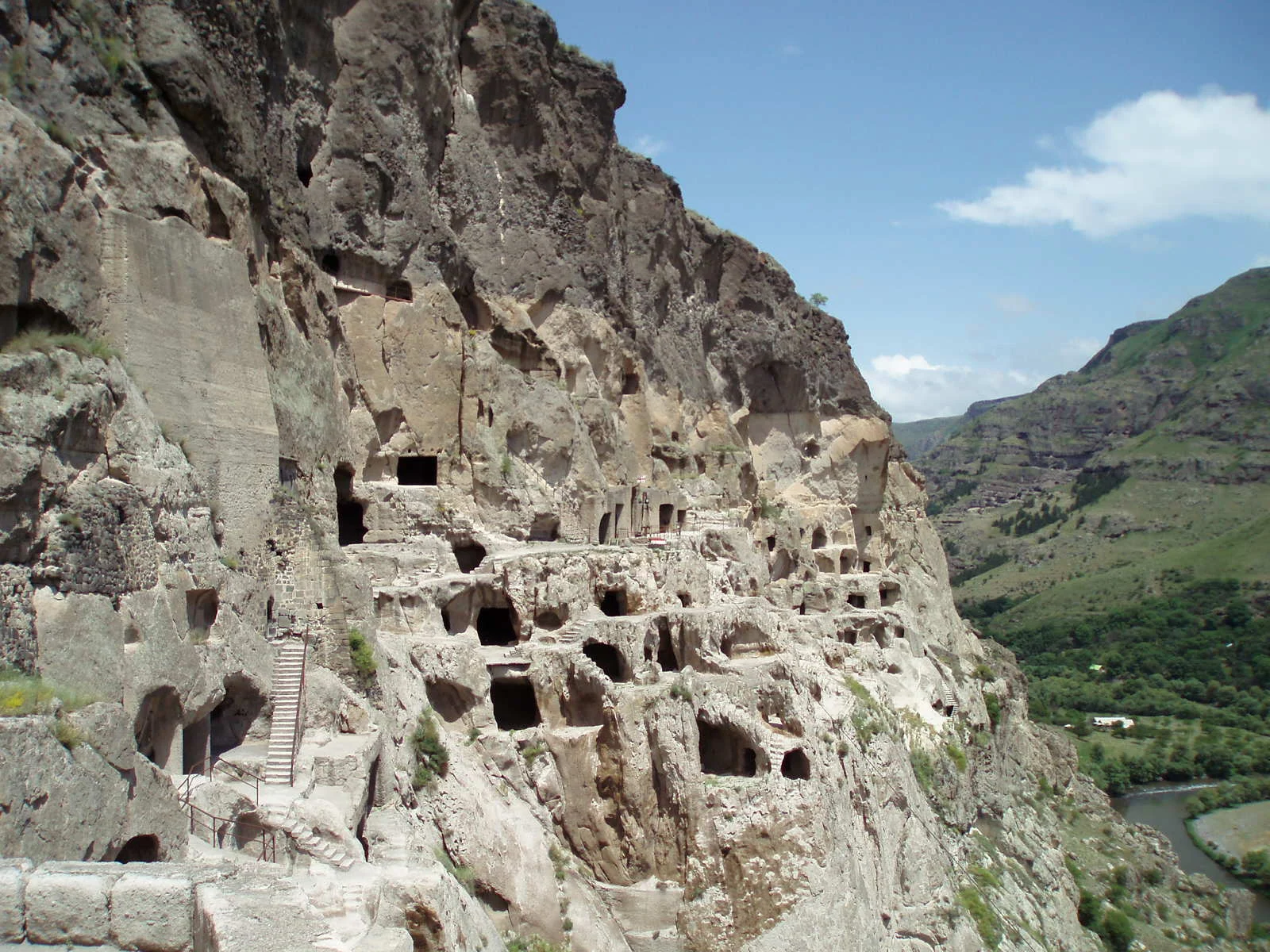
Vardzia is the reason most visitors come this far south: a cave city of several thousand rooms cut into the cliff face above the Mtkvari river in the twelfth century under Queen Tamar, originally reaching thirteen levels before a 1283 earthquake sheared off the outer wall and exposed the interior rooms you see today. A working monastery still occupies part of the complex, so some areas are closed to visitors and modest dress applies throughout. The site is roughly ninety minutes from Akhaltsikhe on a scenic road that follows the Mtkvari gorge, and it rewards a slow two to three hours rather than a quick stop.
Halfway along that road, Khertvisi fortress stands on a rock at the point where the Paravani river meets the Mtkvari, one of the oldest fortress sites in Georgia and arguably the most dramatic silhouette in the region when the light is low. Most visitors see it from the road or a short walk up; it pairs naturally with Vardzia on the same outing, which is how our Vardzia Cave City Day Trip and the longer Vardzia and Rabati — the Long Day South are built, along with the two-day Vardzia, Rabati & Borjomi and the three-day South in 3 Days — Borjomi, Vardzia, Rabati and Abastumani for a slower pace that also reaches the mountain spa of Abastumani.
The Javakheti highlands: Paravani, Poka and Ninotsminda
South and east of Akhalkalaki the land rises onto the Javakheti volcanic plateau, a different Georgia again: treeless, windswept, dotted with extinct cones and shallow lakes, and sitting above 2,000 metres for most of its area. Lake Paravani, Georgia’s largest lake by surface area, lies on this plateau near the road to Ninotsminda, with cold water, few visitor facilities, and good conditions for birdwatching in the warmer months. Winters here are long and roads can be affected by snow well into spring, so this is a summer and early-autumn destination rather than a year-round one; check conditions before travelling at our road status page or the Road Department’s updates at georoad.gov.ge.
Near the lake, the village of Poka is home to a convent of nuns known locally for an icon-painting workshop, a quieter and less-visited stop than the main monastic sites further north. Ninotsminda itself is the plateau’s main town and predominantly ethnic Armenian, a reminder that Samtskhe-Javakheti’s southern half has deep ties to Armenian communities that settled here in the nineteenth century; Armenian is widely spoken alongside Georgian, church architecture includes Armenian Apostolic buildings, and the border with Armenia is close enough that this corner of Georgia feels genuinely transitional between the two countries’ highlands.
Planning a route: timing, distances and getting there
The region splits naturally into a lowland loop (Borjomi, Bakuriani, Akhaltsikhe, Sapara, Vardzia, Khertvisi) that can be driven in one long day or spread over two, and a highland extension (Paravani, Poka, Ninotsminda) that needs an overnight if you want more than a drive-through. Table below gives rough driving times from Tbilisi.
| From Tbilisi to | Approx. driving time | Notes |
|---|---|---|
| Borjomi | 2.5–3 hours | Via Khashuri and the Rikoti road |
| Bakuriani | 3–3.5 hours | Add 30–40 minutes from Borjomi |
| Akhaltsikhe (Rabati) | 3.5–4 hours | Continue past Borjomi toward the Turkish border road |
| Vardzia | 4.5–5 hours | Via Akhaltsikhe and the Mtkvari gorge road past Khertvisi |
| Ninotsminda / Paravani | 5–5.5 hours | Climbs onto the Javakheti plateau; winter closures possible |
A private car or driver removes the guesswork over bus timetables, which are infrequent on the Javakheti plateau; see our Tbilisi to Borjomi or Bakuriani Transfer, Car with Driver by the Day, or a Licensed Private Guide by the Day if you want commentary at Rabati, Sapara and Vardzia rather than a self-guided visit. For the full south in one organised trip, the two-day Borjomi, Bakuriani & Rabati and three-day South in 3 Days cover the lowland sites comfortably; neither currently extends to Paravani or Ninotsminda, so build the plateau in as a custom add-on if that is a priority.
If this guide is part of a trip you are planning, our Borjomi-Kharagauli National Park Trek — 3 Days and Ubisa Frescoes, Surami Fortress and the Borjomi-Kharagauli Forest cover the places it describes with a private guide and driver; a GTour travel expert adapts the route to your dates.
Practical summary
- Base yourself in Borjomi for mineral water, park walks and Bakuriani; base in Akhaltsikhe if Vardzia and the Javakheti plateau are the priority.
- Likani Palace access is restricted and not guaranteed; confirm before planning around it.
- Rabati fortress and the Vardzia cave monastery both expect modest dress; carry a scarf and cover shoulders and knees.
- Bakuriani’s narrow-gauge train service is intermittent; check current status with Georgian Railway before relying on it.
- Javakheti (Paravani, Poka, Ninotsminda) sits above 2,000 metres and is best visited May to October; check road conditions beforehand in winter and early spring.
- A one-day loop covers Borjomi, Bakuriani and Rabati; a two- to three-day trip is needed to add Sapara, Vardzia, Khertvisi and the highlands without rushing.
Sources
- Georgian Railway
- Ministry of Culture heritage information
- Georgian Road Department live conditions
- Vardzia Cave Monastery (UNESCO Tentative List)
- Samtskhe-Javakheti Travel Guide
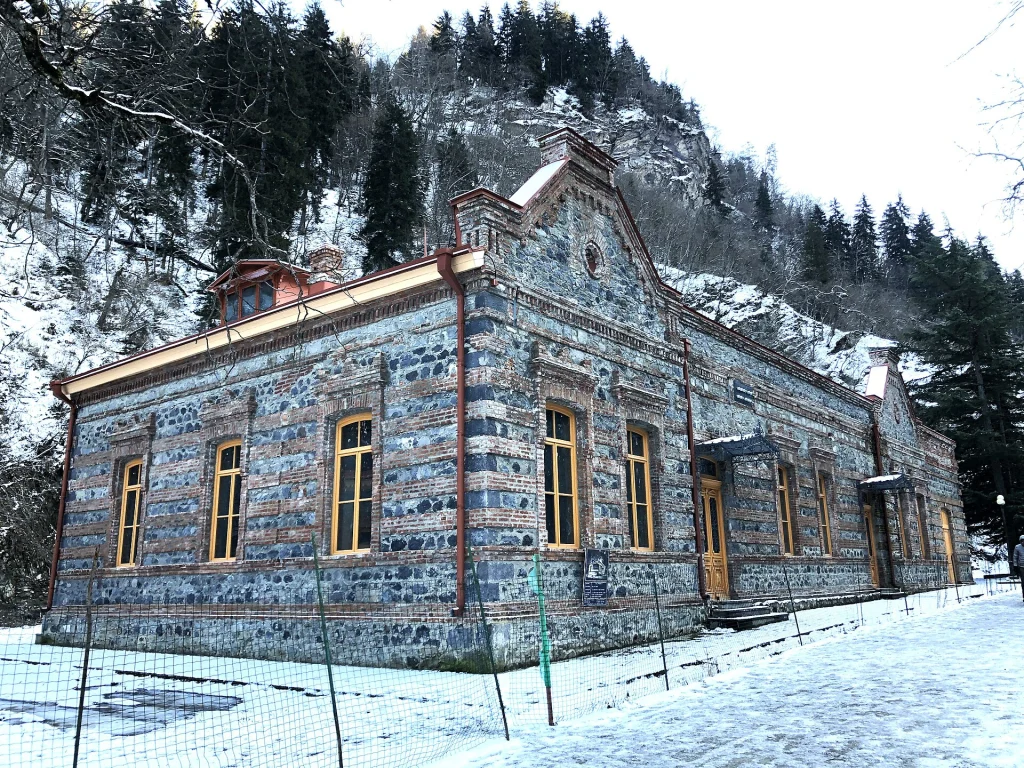
- Borjomi-Likani Railway Station
Questions this guide does not answer? Write to info@castle.ge or WhatsApp +995 577 41 63 14 — a person in Tbilisi replies. See also our travel services and all guides.
Panoramic view of the Vardzia cave monastery complex carved into the cliff face. · Photo: DAVID HOLT from London, England / Wikimedia Commons, CC BY-SA 2.0
Been to Georgia? Tell us how it went — the best stories are published here.
Share your tripOne email a week: what changed for travellers in Georgia — rules, roads, flights, seasons — plus one place worth the trip. Written by the GTour desk, no advertising, unsubscribe in one click.
This story across our partner network — ქართულად: შენი დასვენება
