

By David Kiknadze, Transport & Openings Reporter · 29/10/2026
Tbilisi‘s air is worst from November to February, when cold, still weather traps vehicle exhaust and heating smoke in the Mtkvari valley, and best disregarded as a planning factor the rest of the year, when pollen and summer heat matter far more to a sensitive traveller than any smog day. Most visitors with no history of asthma, COPD or heart disease need no special precaution beyond glancing at a forecast on a grey winter morning and packing their usual allergy medicine for spring. Those who do have a respiratory or cardiac condition, who are pregnant, or who are travelling with small children should read the sections below, check the official data links each morning of a sensitive week, and ask their own doctor before departure, because thresholds and advisories change from year to year and this guide is written to be conservative rather than precise.
This article was prepared with the same evidence-based approach GTour applies across its health content, cross-checked against official Georgian monitoring bodies rather than estimated. Where a figure can change season to season, we say so and link to where you can verify it yourself on the day you travel.
How Tbilisi’s air behaves through the year
Tbilisi sits in a river valley flanked by hills, a shape that favours temperature inversions: on cold, windless nights, a layer of warmer air can sit over the city and stop exhaust and domestic heating smoke from dispersing. The practical effect is a grey, often visibly hazy sky through parts of December, January and February, with the heaviest traffic corridors around Didube, Saburtalo and the Tbilisi Sea Road generally reading worse than the Old Town and the hillside districts of Mtatsminda or Vake. Spring and autumn are transitional, with occasional dusty or smoky days when agricultural burning in surrounding valleys drifts into the basin. Summer usually disperses pollution more readily, though ozone can build on hot, still afternoons. None of this is unique to Georgia, and Tbilisi’s pattern resembles other basin-shaped cities worldwide; it is simply worth knowing before you plan outdoor walking tours in deep winter.
Where to check the official, current numbers
Do not rely on a single impression of the sky. Georgia’s ambient air monitoring network is run by the National Environmental Agency (NEA), under the Ministry of Environmental Protection and Agriculture, with fixed stations in Tbilisi and the other main cities. The network is smaller than those of most European capitals, so a reading tells you the general trend for that part of the city rather than a street-by-street picture, which matters if your hotel sits on a busy ring road rather than in the Old Town. Check the agency’s page on the morning of any day you are planning a long outdoor walk in November to February, and treat a single bad reading as a reason to shift a walking tour to the afternoon rather than cancel it. Tbilisi City Hall also publishes transport and environmental initiatives relevant to air quality on its own site, at tbilisi.gov.ge.
Pollen seasons: what actually triggers symptoms
Georgia does not run a public, real-time pollen count in the way several Western European countries do, so the table below reflects the general flowering calendar of the Tbilisi basin and eastern Georgia rather than a daily measured figure. If you have diagnosed hay fever, plan around the season, not a forecast.
| Period | Main pollen source | Who is usually affected |
|---|---|---|
| January–March | Alder, hazel | Early tree-pollen allergy sufferers |
| March–May | Birch, plane (widely planted in Tbilisi streets), cypress | The single highest-symptom window for most hay-fever sufferers |
| May–July | Grasses | Grass-allergic travellers, worse in vineyard and countryside days |
| August–September | Ragweed, mugwort | Weedy roadsides and field edges, often worse outside the city than in it |
If you know you react to tree or grass pollen, carry your usual antihistamine or nasal spray from home, start it a few days before arrival if your doctor advises this for you, and expect April to June to be the highest-risk window for long outdoor days such as the Old Tbilisi Walking Tour or a Kakheti wine day among vines and roadside grass. For a formal medical opinion on managing allergies while travelling, consult your own doctor or allergist before the trip; the National Center for Disease Control and Public Health of Georgia publishes general seasonal health advisories that are worth a look if you are visiting during a known high-pollen month.
Summer heat: the more common everyday risk
For most travellers, heat rather than air pollution or pollen is the health issue that actually bites in Tbilisi. July and August regularly bring daytime highs in the low-to-mid 30s Celsius, and the valley’s humidity can make the Old Town’s stone streets feel hotter than the number on a forecast suggests; short, sharp heatwaves have pushed readings higher in recent summers, so check a live forecast rather than assume a fixed ceiling. Sensible precautions are unglamorous but effective: walk the Old Town, the sulphur baths district and the markets in the morning or early evening, carry water, wear a hat, and treat midday as a rest or indoor window rather than a sightseeing slot, particularly for children, older travellers and anyone on blood-pressure medication. If the heat is the main concern, the Black Sea coast around Batumi is milder with a sea breeze, and the mountain towns of Borjomi and Bakuriani offer a genuinely cooler escape within a few hours of Tbilisi; our Borjomi and Bakuriani — Spa Town and Mountain Air in a Day and Borjomi Spa Week — 5 Nights of Mineral Water, Forest and Likani both build a reprieve from city heat into the itinerary.
Altitude on mountain extensions
Tbilisi itself sits at roughly 380 to 490 metres, low enough that altitude is never a factor in the city. It becomes relevant only once you head into the Greater Caucasus. Gudauri sits near 2,200 metres, Stepantsminda (Kazbegi town) around 1,740 metres, and the walk up to Gergeti Trinity Church reaches about 2,170 metres; treks that continue toward Kazbek base camp go well above 3,000 metres, and Tusheti’s Abano Pass sits near 2,900 metres. Mild symptoms such as headache, shortness of breath on exertion or disturbed sleep can appear above roughly 2,500 metres and become more likely above 3,000 metres, especially if you drive up quickly rather than spend a night acclimatising on the way. Drink more water than usual, avoid alcohol on the first evening at altitude, ascend gradually where the itinerary allows it, and if you have a heart or lung condition, are pregnant or have previously had altitude sickness, discuss a high-elevation itinerary with your doctor before booking something like our Gergeti Glacier and Kazbek Base Camp — 2 Days or Tusheti — Georgia’s Last Wild Frontier (4 Days).
Clinics, pharmacies and getting help
Pharmacies, locally called aptekas, are common in Tbilisi and many operate late or around the clock; over-the-counter antihistamines are generally easy to buy, but travellers who rely on a specific inhaler or prescription medicine should bring enough for the whole trip plus a few extra days, along with a copy of the prescription. Georgia’s single emergency number is 112, covering ambulance, police and fire; the Ministry of Foreign Affairs publishes general travel and consular guidance worth checking before a trip, particularly if you hold a nationality that needs a visa or has specific entry requirements. Private clinics in Tbilisi are used to treating international visitors and several staff English-speaking doctors; if you would rather not navigate an unfamiliar system alone, GTour’s Medical Travel to Tbilisi — Accompanied Clinic Visits, Interpreter and Recovery Stay arranges interpretation and appointments, and the gentler Health Check-up and Wellness Break in Tbilisi — 4 Days pairs a check-up with a slower-paced stay for anyone who simply wants peace of mind before or after a mountain extension.
If this guide is part of a trip you are planning, our Georgia Off the Beaten Track — 9 Days in Racha, Samegrelo and Guria and Racha and Lechkhumi by 4×4 — 3 Days cover the places it describes with a private guide and driver; a GTour travel expert adapts the route to your dates.
Practical summary
- Worst air-quality window: December to February, worse on cold, still days; check nea.gov.ge each morning rather than judging by eye.
- Highest pollen risk: April to June for tree and grass pollen, with a smaller ragweed peak in August–September; Georgia has no public real-time pollen count, so plan by season and pack your own antihistamines.
- Bigger everyday risk for most people: summer heat, not smog or pollen; walk mornings and evenings in July–August and hydrate well.
- Altitude only matters above roughly 2,500 metres (Gudauri, Gergeti, Tusheti passes); ascend gradually and skip alcohol the first night up high.
- Carry your own prescription medicines and inhalers; Georgian pharmacies are widely available but do not assume a specific brand will be stocked.
- Emergency number: 112. See mfa.gov.ge for general travel guidance before you fly.
- Anyone with asthma, COPD, heart disease, or who is pregnant should get personal advice from their own doctor before a high-altitude trek or a winter visit coinciding with poor air days.
Sources
- National Environmental Agency air monitoring
- Ministry of Environmental Protection and Agriculture
- Ministry of Foreign Affairs of Georgia, travel guidance
- Georgia National Tourism Administration
- Law of Georgia on Ambient Air Protection
- Geostat – Health Care Statistics Section
- Tbilisi City Hall – Environmental Protection Programs
- Agenda.ge – Report on Tbilisi Air Quality
Questions this guide does not answer? Write to info@castle.ge or WhatsApp +995 577 41 63 14 — a person in Tbilisi replies. See also our travel services and all guides.
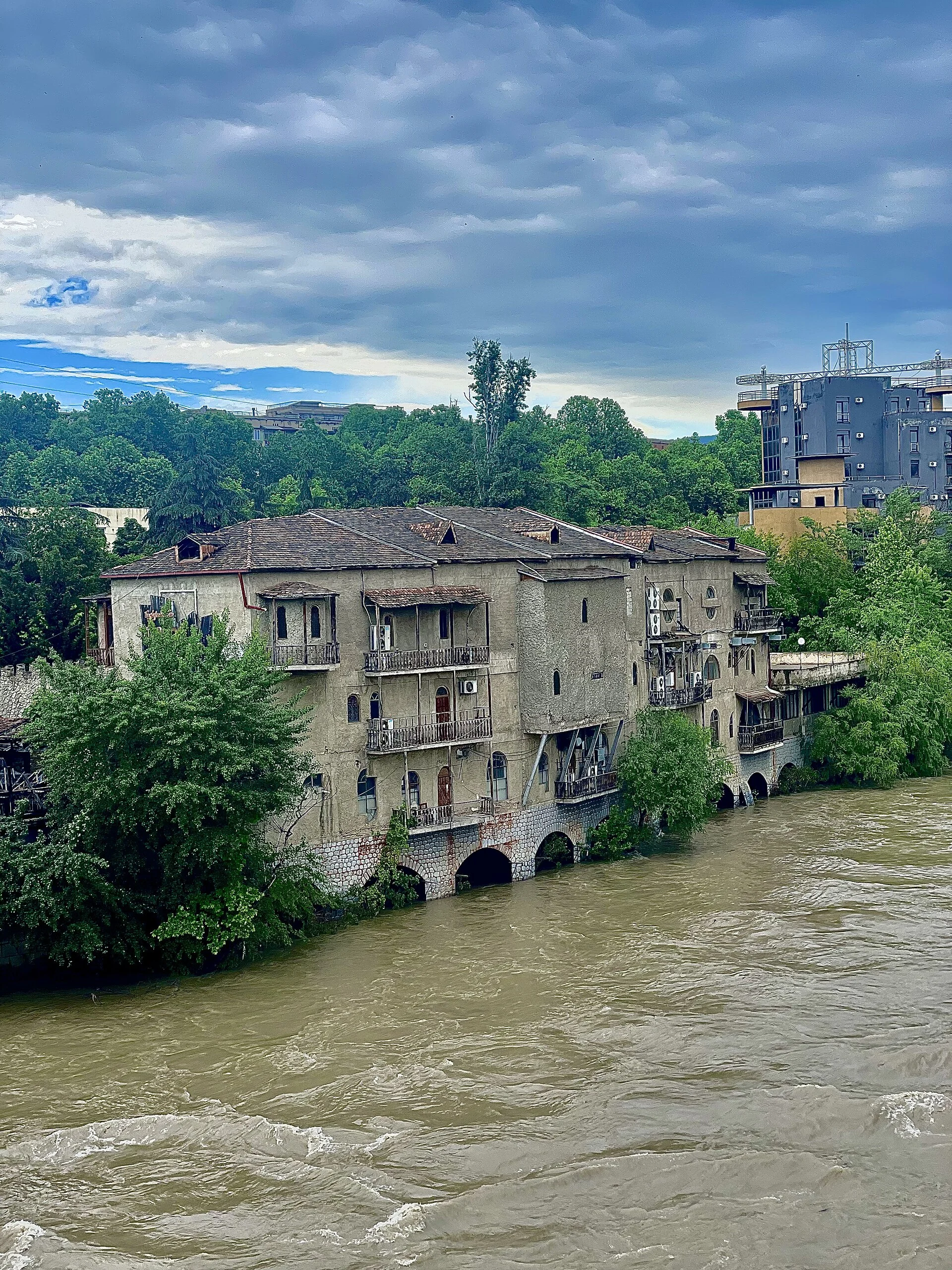
Old riverside buildings along the Mtkvari River in Tbilisi, Georgia. · Photo: AlexandreAssatiani / Wikimedia Commons, CC BY 4.0
Been to Georgia? Tell us how it went — the best stories are published here.
Share your tripOne email a week: what changed for travellers in Georgia — rules, roads, flights, seasons — plus one place worth the trip. Written by the GTour desk, no advertising, unsubscribe in one click.
This story across our partner network — ქართულად: შენი დასვენება
