

By Mariam Lomidze, Culture & Events Reporter · 29/10/2026
Georgian bread and the classic autumn and New Year sweets come from two different kitchens that happen to share one produce stall. Bread is the daily, communal food: shoti puri and tonis puri are baked in a clay tone oven, in bakeries you can watch from the pavement in almost any Tbilisi neighbourhood or Kakhetian village. Churchkhela, gozinaki and pelamushi are the grape-harvest sweets: strings of walnuts dipped in thickened grape juice, honey-glazed nuts, and a soft grape-juice pudding, all linked to the rtveli (grape harvest) in September and October and then to the New Year table.
If you want to see and taste both, Tbilisi gives you the bakeries and the city markets in a single morning, while Kakheti gives you the churchkhela stalls, the honey sellers and the village tone ovens in their original setting. Below is what each item actually is, when it is in season, where the rules or prices might move, and how to arrange a proper tasting rather than a rushed photograph.
The tone bakery: how shoti and tonis puri are baked
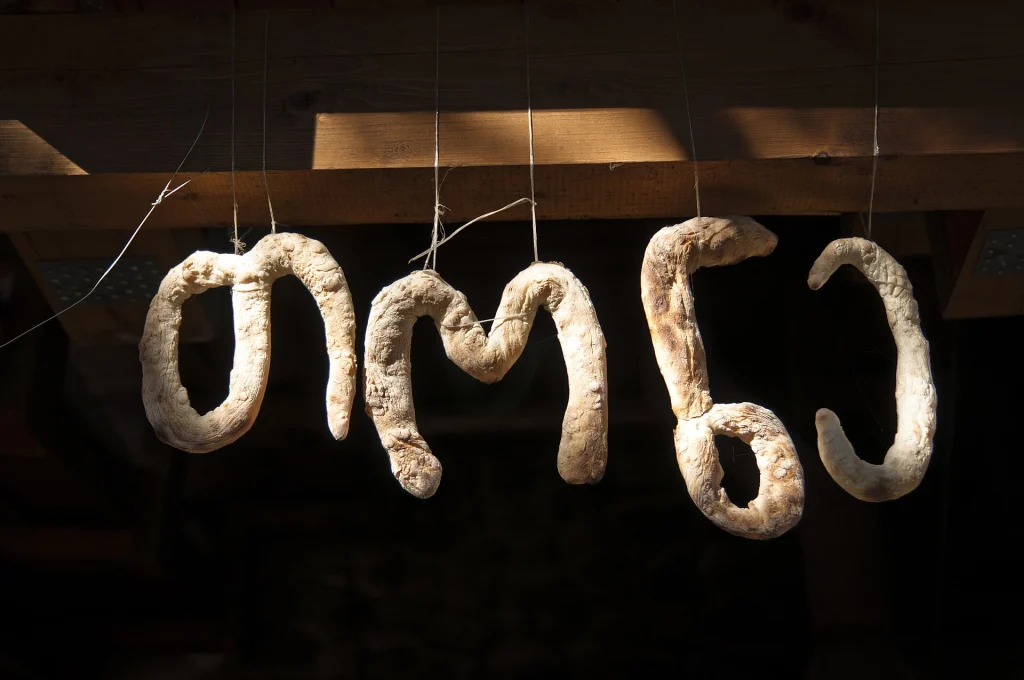
A tone (also spelled toné) is a cylindrical clay oven sunk into the floor or a counter, heated from below with wood, gas or, in some city bakeries, electricity. The baker slaps a flattened piece of dough against the hot inner wall, where it sticks and bakes in minutes, pulled out with a long hooked tool before it falls into the embers. Shoti puri, the long, pointed, boat-shaped loaf most associated with Tbilisi and eastern Georgia, is the classic example: it is baked standing almost upright against the tone wall, which is what gives it its characteristic curved shape and the crisp, slightly charred crust at the tips. Tonis puri is the broader term for any bread baked this way; a single bakery may produce several shapes through the day depending on the order.
Most Tbilisi tone bakeries work from early morning into the afternoon, selling loaves hot, wrapped in a sheet of paper rather than a bag so the crust stays crisp. There is no fixed national price list for bread; it is sold loaf by loaf at small bakeries and supermarkets alike, so treat any figure you read as approximate and check the loaf in front of you rather than a remembered price. For a guided visit with explanation of the oven and the dough, our Bread, Cheese and Churchkhela — Tbilisi Food Workshops pairs a working tone bakery with a cheese tasting and a churchkhela demonstration in one morning.
Bread types by region
Georgia does not have a single national loaf; shape and crumb change from region to region, partly for practical reasons (mountain villages needed bread that kept longer) and partly by local habit.
| Bread | Typical region | Shape and crumb | Where to try it |
|---|---|---|---|
| Shoti puri | Tbilisi, eastern Georgia | Long, pointed, boat-shaped, crisp crust | City bakeries, Dezerter Bazaar |
| Tonis puri (generic) | Nationwide | Round or oval, varies by baker | Any working tone, village or city |
| Kakhuri puri | Kakheti | Large, round, dense crumb | Village ovens in Telavi area, Kakheti farm visits |
| Guruli and Imeruli round loaves | Guria, Imereti, western Georgia | Smaller, softer, slightly sweeter dough | Kutaisi‘s Green Bazaar, Batumi markets |
| Mountain breads (Khevsuruli, Mtiuluri) | Khevsureti, Tusheti, Kazbegi highlands | Thick, dense, bakes less often, keeps longer | Rarely sold commercially; seen on village stays |
A Tbilisi Market and Street-Food Walk — Dezerter Bazaar to the Old Town is the simplest way to compare several of these in one visit, with a guide who can explain what each stall is actually selling rather than guessing from a photograph.
Churchkhela season: from grape must to candle-shaped sweet
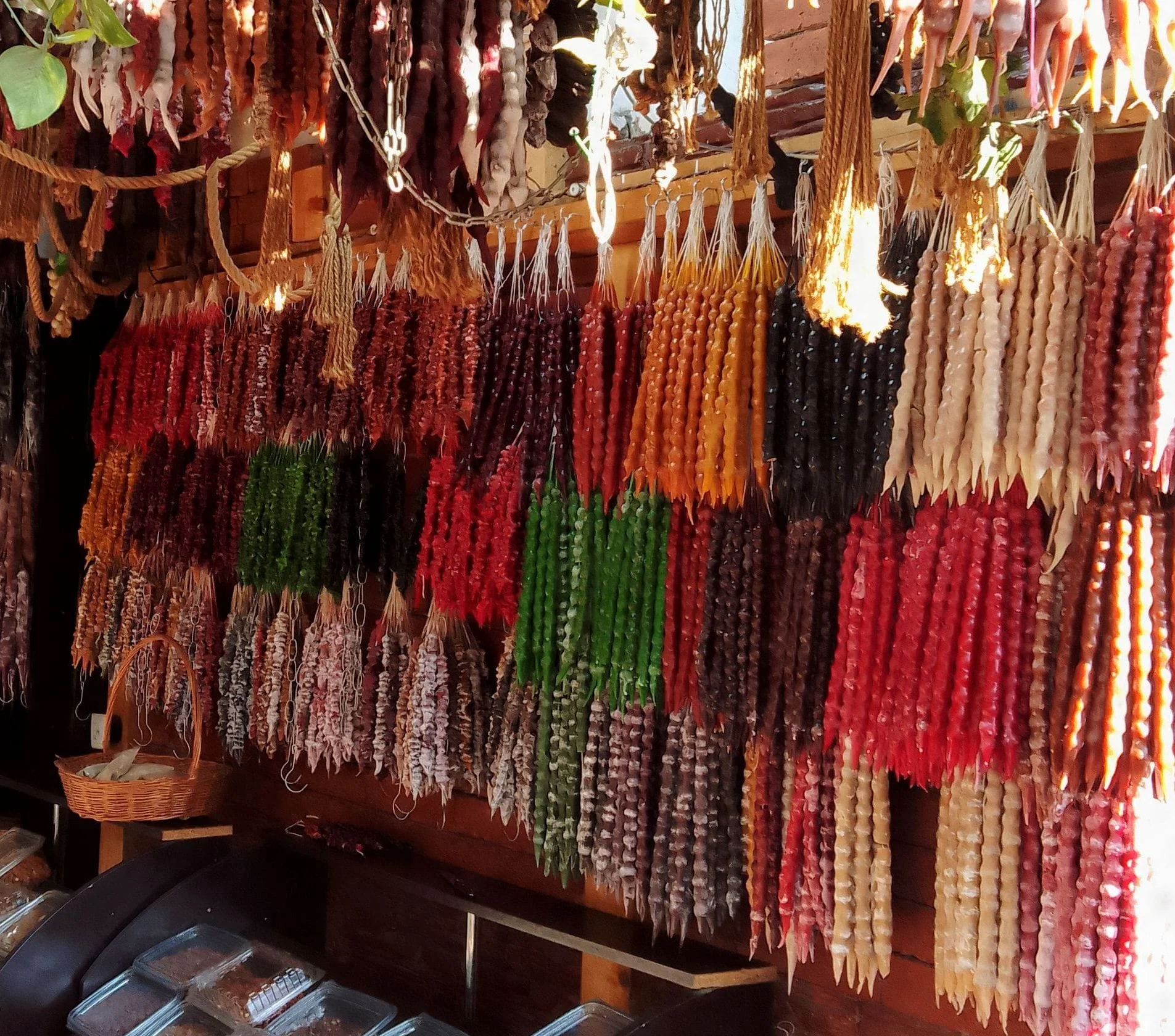
Churchkhela is made by threading walnut halves (hazelnuts are used in some regions) onto a string, then dipping the string repeatedly into tatara or badagi, a thickened grape juice sweetened only by the grape itself and bound with a little flour, until a thick candle-like coating builds up. The strings are then hung to dry, usually outdoors under cover, for one to three weeks depending on humidity and the weather that year. This ties churchkhela directly to the grape harvest: production starts as soon as the first must is pressed in September and continues through October, which is why late September to November is the best window to see it actually being made rather than bought ready-dried from a shelf. The method and its link to Georgia’s qvevri winemaking tradition sit inside the same harvest calendar that UNESCO recognises for Georgia’s ancient winemaking culture.
Colour and flavour vary with the grape used: a deep purple-brown churchkhela usually means a red grape must, while a lighter amber one points to a white grape. None of this is regulated by a formal grade or official standard that we are aware of, so quality is a matter of the maker’s reputation rather than a certification you can check online; buying from a stall you can see working, or from a market vendor recommended locally, is the more reliable approach. Visitors travelling in Kakheti during harvest week can watch the whole process, from pressing to the first dip, on our Kakheti in Autumn — Harvest Photography, 2 Days or the Kakheti Table — 3 Days of Supras, Cellars and Village Kitchens itinerary.
Honey and gozinaki at New Year
Gozinaki is walnut or hazelnut pieces cooked in caramelised honey, poured out flat and cut into diamond shapes once set. It is specifically a New Year dish, prepared in the days before 31 December and eaten through the Orthodox Christmas period in early January; Georgian New Year and Christmas customs, including the Alilo procession, are covered in detail by the Georgian Patriarchate and in general terms on patriarchate.ge. Georgian beekeeping produces regional honeys, including well-known chestnut and linden honeys from the western forests, though we are not aware of a single published national figure for annual honey output that we could cite with confidence; for the latest agricultural statistics, check Geostat’s agriculture section directly at geostat.ge rather than relying on an older figure.
Because gozinaki is essentially caramelised sugar and honey with nuts, it is a concentrated source of sugar and calories by volume; people managing diabetes or watching sugar intake should treat it, like any confectionery, in moderation and ask their own doctor if unsure, and general dietary guidance for Georgia is published by the National Center for Disease Control and Public Health at ncgh.ge. Travellers in Georgia for the New Year period can see gozinaki being made and taste it alongside a full Kakheti supra on our New Year in Georgia — Tbilisi Fireworks, Kakheti Supra and Gudauri Snow, 6 Days tour, or during the Orthodox Christmas in Tbilisi — Alilo Procession and Winter Kakheti, 4 Days itinerary.
Pelamushi: the soft cousin of churchkhela
Pelamushi is made from the same badagi (thickened, sweetened grape must) used to coat churchkhela, but thickened further with flour or cornflour into a soft, jelly-like pudding and set in bowls rather than strung on nuts. It is usually eaten with a spoon, sometimes with crushed walnuts mixed through, and like churchkhela it appears in autumn straight after the harvest, often on the same table as the first fresh churchkhela of the season. Because both desserts come from the same base, a good way to understand the difference is to taste them side by side in Kakheti during harvest week rather than trying to compare a bought churchkhela with a remembered pelamushi from a different trip.
Where to watch and taste in Tbilisi
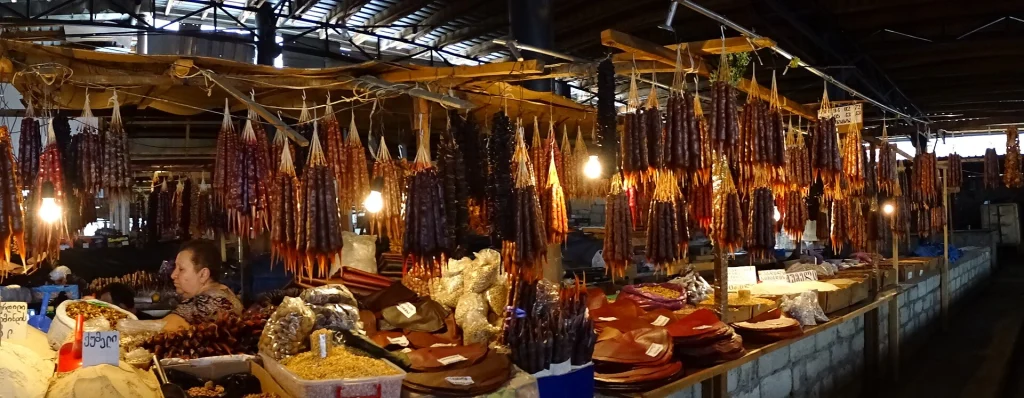
- Dezerter Bazaar and the surrounding bakeries: working tone ovens, shoti puri sold hot, and stalls with churchkhela and gozinaki stacked by colour and size.
- Dry Bridge and Dezerter Bazaar — the Markets Walk pairs the bread stalls with the flea market next door.
- Old Town bakeries near Sioni and the sulphur bath district, visible from the street through open shopfronts.
- A guided hands-on session: Bread, Cheese and Churchkhela — Tbilisi Food Workshops or the broader Cooking Class in Tbilisi — Khinkali, Khachapuri and a Family Lunch, which usually includes a bread-baking stop.
Where to watch and taste in Kakheti
- Village tone ovens in the Telavi and Sighnaghi areas, usually shared by a few households and used on a rotating schedule rather than daily.
- Roadside stalls on the Telavi–Sighnaghi road selling fresh churchkhela directly after the autumn dip, often still slightly tacky to the touch.
- Farm visits that combine bread, cheese and a cellar: the Kakheti Farm-to-Table Day — Bread, Cheese, Mtsvadi and a Cellar.
- Full harvest-season immersion: Rtveli — the Harvest Week in Kakheti, 5 Days or the shorter Rtveli — Wine Harvest in Kakheti (3 Days, September–October).
- A seated feast that brings bread, cheese, churchkhela and gozinaki to one table with a tamada: Supra Evening — a Georgian Feast with a Tamada and Polyphonic Song.
If this guide is part of a trip you are planning, our Tbilisi to Kakheti Transfer — Telavi or Sighnaghi and Georgia in 4 Days — Tbilisi, Kazbegi and Kakheti cover the places it describes with a private guide and driver; a GTour travel expert adapts the route to your dates.
Practical summary
- Shoti puri and tonis puri are baked daily in a tone oven; sold hot, by the loaf, no fixed national price, so check the bakery directly.
- Bread shape changes by region: shoti in the east, rounder softer loaves in Imereti and Guria, thicker dense loaves in the highlands.
- Churchkhela season runs from the September-October grape harvest through drying into November; this is the best window to watch it being made.
- Gozinaki is a New Year and Orthodox Christmas dish, honey and nuts only, best eaten in moderation if managing sugar intake; ask your doctor for personal dietary advice.
- Pelamushi shares its base with churchkhela but is eaten as a soft pudding straight after harvest.
- Tbilisi gives you the bakery and market experience in a morning; Kakheti gives you the harvest-season and village-oven setting in its original context.
- Rules, opening times and prices at individual bakeries or markets are set locally and can change; verify on the day rather than from an old guide.
Sources
- Ancient Georgian traditional Qvevri wine-making method
- Georgia's agriculture statistics
- Patriarchate of Georgia, Christmas and New Year customs
- Georgian National Tourism Administration
- Georgia Travel, national tourism portal
- Tbilisi City Hall, Old Town and markets
Questions this guide does not answer? Write to info@castle.ge or WhatsApp +995 577 41 63 14 — a person in Tbilisi replies. See also our travel services and all guides.
Colorful strings of churchkhela hang for sale at a street market in old Tbilisi. · Photo: Ekkatterrinna / Wikimedia Commons, CC BY-SA 4.0
Been to Georgia? Tell us how it went — the best stories are published here.
Share your tripOne email a week: what changed for travellers in Georgia — rules, roads, flights, seasons — plus one place worth the trip. Written by the GTour desk, no advertising, unsubscribe in one click.
This story across our partner network — ქართულად: შენი დასვენება
