

By Nino Gelashvili, Travel News Editor · 29/10/2026
Georgia rewards a cyclist with more variety per kilometre than almost anywhere in the wider Black Sea and Caucasus region: flat vineyard roads in Kakheti, a windswept volcanic plateau in Javakheti, and gravel passes over 2,000 metres connecting Imereti to Adjara or dropping into Tusheti’s canyons. The best riding window is roughly May to early October, with the high passes (Abano, Zekari, Goderdzi) realistically open from June to September depending on snowmelt and autumn weather — always confirm current conditions before you commit a week’s itinerary, since Georgia’s mountain roads close fast when it rains or snows.
This guide is deliberately conservative: it tells you what is true as a baseline in 2026, flags where rules and surfaces change year to year, and gives you the official pages to check before you ride. For tarmac loops, stick to Kakheti and the Javakheti plateau. For gravel and bikepacking, Tusheti, Zekari and Goderdzi are the classics, and sections of the Transcaucasian Trail now carry mountain bikes as well as hikers. Where the terrain, altitude or weather risk is high, we note where a supported 4×4 alternative makes more sense than a loaded touring bike.
Road cycling: the Kakheti loop
The easiest multi-day road circuit in the country runs Tbilisi–Mtskheta–Telavi–Kvareli–Sighnaghi–Tbilisi, roughly 280–320 km depending on detours into wine villages, almost entirely paved and rolling rather than mountainous. Traffic is light once you clear the S5 highway near Tbilisi, and villages have guesthouses every 20–30 km during the harvest season (September–October), though rtveli (harvest) weekends bring extra truck traffic as grapes move to the cellars. Riders who want the scenery without the saddle time sometimes split the loop with a support vehicle; our Kakheti Wine Country Day Trip and Telavi & Kakheti Wine Region tours cover the same ground by car for a rest day or for non-cycling partners.
Road cycling: the Javakheti plateau
South of Borjomi, the Samtskhe-Javakheti plateau around Akhalkalaki, Ninotsminda and Paravani lake sits above 2,000 metres, with long straight asphalt roads, almost no traffic, and a genuinely different Georgia: volcanic cones, Armenian-speaking villages, and wind that can stop a loaded bike dead even in July. Nights are cold year-round and services are sparse, so carry food, water and a windproof layer regardless of season. This is a plateau for experienced tourers rather than a first Georgian cycling trip; our South in 3 Days — Borjomi, Vardzia, Rabati and Abastumani tour covers the approach roads if you want to recce the region by car first.
Gravel and high passes: Tusheti, Zekari, Goderdzi
These three passes are where Georgia stops being a road-touring country and becomes a genuine gravel and bikepacking destination.
- Abano Pass (Tusheti), 2,850 m — a rough, exposed jeep track with long drops and no barriers, officially open to vehicles roughly June to September depending on snow and rockfall; it is within the Tusheti Protected Landscape, so check current access and camping rules with the Agency of Protected Areas before planning a self-supported crossing. Many strong riders choose to ride the plateau inside Tusheti and take a 4×4 over the pass itself; our Khevsureti and Tusheti by 4×4 — 5 Days and Tusheti — Georgia’s Last Wild Frontier (4 Days) tours show the terrain if you want to judge it before committing a bike.
- Zekari Pass, 2,182 m — connects Nedzvi in Imereti to Adjara near Khulo on a rutted dirt and stone track, seasonal and occasionally impassable after heavy rain; a gravel or mountain bike with wide tyres is the minimum, not a touring bike with slicks.
- Goderdzi Pass, around 2,025 m — links Khulo to the Adjara highlands and down toward Batumi; sections are tarmac, sections are gravel, and the road has been under periodic upgrade, so surface quality varies by year. Our Adjara Highlands — Khulo, the Goderdzi Pass and the Green Lake day tour and the two-day Adjara Highlands by 4×4 — Beshumi, Goderdzi and the Alpine Villages trip cover the same route for anyone combining cycling days with vehicle-supported sightseeing.
| Route | Surface | Typical season | Who it suits |
|---|---|---|---|
| Kakheti loop | Paved | April–October | Road cyclists, first-time Georgia riders |
| Javakheti plateau | Paved, exposed | May–September | Experienced tourers, wind-tolerant |
| Abano Pass / Tusheti | Rough gravel, jeep track | June–September | Mountain bikers, guided or very experienced |
| Zekari Pass | Dirt, stone, rutted | June–September | Gravel/MTB, self-sufficient |
| Goderdzi Pass | Mixed tarmac/gravel | May–October | Gravel bikes, intermediate |
The Transcaucasian Trail for bikes
The Transcaucasian Trail is a volunteer-built long-distance route network stretching across the Greater and Lesser Caucasus in Georgia and Armenia, designed primarily for hikers but increasingly used for mountain bike and bikepacking segments, particularly the lower-altitude connector sections through Kakheti’s forests and Racha’s valleys. Waymarking and surface quality are inconsistent between finished and unfinished sections, GPS tracks are essential, and some high alpine stretches are not rideable at all and should not be attempted on a bike. Treat any published GPX file as a starting point rather than a guarantee, cross-check recent trip reports, and carry a satellite messenger on remote stretches; mobile coverage disappears for long periods above 2,000 metres.
Bike rental in Tbilisi and Batumi
Tbilisi has a growing number of independent rental shops offering hybrid, road, gravel and e-bikes, typically priced from roughly 30–60 GEL a day for a city or hybrid bike and considerably more for a proper gravel or mountain bike with suspension; multi-day and deposit terms vary by shop, so confirm insurance and theft liability in writing before you sign. Batumi’s seaside boulevard has long had casual bike rental kiosks aimed at the promenade rather than mountain riding, useful for a flat afternoon loop past the Botanical Garden but not for Goderdzi. If you are flying in with your own bike, our Tbilisi Airport Transfer and Batumi Airport Transfer services run minivans that take bike boxes, and a Car with Driver by the Day can double as a sag wagon on a point-to-point ride.
Traffic reality and road safety
Georgian driving culture tolerates overtaking on blind corners, narrow shoulders on secondary roads, and trucks on the Kakheti highway (S5) and the Georgian Military Highway toward Russia at Larsi, which can be heavily congested with freight traffic at the border. Ride early morning where possible, assume drivers will not expect a cyclist on a mountain pass, and treat stray dogs and loose livestock as a constant rather than an occasional hazard. Fog, rockfall and sudden closures are routine on high passes; check current status before a pass-crossing day rather than assuming last year’s conditions still apply.
Trains, transfers and getting bikes around
Georgian Railway runs daytime and overnight services linking Tbilisi with Batumi, Kutaisi and Zugdidi, and bicycles can generally travel as oversized luggage, though whether a bike must be boxed or bagged and how much space is guaranteed varies by train and season, so confirm directly with the current timetable and baggage rules before buying a ticket. Minibuses (marshrutka) will often take a bike on the roof or in the boot for a negotiated small fee, but this is informal and not guaranteed, especially in peak summer. For point-to-point transfers with a boxed bike and no room to negotiate, a private transfer such as Tbilisi to Batumi — Private Transfer or Tbilisi to Kutaisi Transfer removes the uncertainty.
Where to sleep
Kakheti and the main tourist towns (Telavi, Sighnaghi, Borjomi, Khulo) have abundant family guesthouses from roughly 20–40 EUR a night with breakfast; book ahead in September and October when wine-harvest and hiking traffic overlaps. In Tusheti, guesthouses cluster in Omalo, Dartlo and Shenako and fill quickly in July and August; outside the village network, wild camping is more regulated inside the protected landscape than people assume, so check current rules with the Agency of Protected Areas rather than assuming open access. On the Javakheti plateau and along less-travelled Transcaucasian Trail sections, carry a tent and enough food for 24–48 hours, since villages can be far apart and shops limited.
If this guide is part of a trip you are planning, our Chkhaveri and Tsolikouri — the Wines of Adjara and Guria and Tbilisi to Borjomi or Bakuriani Transfer cover the places it describes with a private guide and driver; a GTour travel expert adapts the route to your dates.
Practical summary
- Best season: May–early October for road routes; June–September for Abano, Zekari and Goderdzi, weather permitting.
- Kakheti and Javakheti are the reliable paved options; Javakheti demands wind and cold tolerance even in summer.
- Tusheti, Zekari and Goderdzi need gravel or mountain bikes, not loaded touring rigs with slicks.
- Check current pass and road status before committing multi-day plans; conditions change fast on Georgian mountain roads.
- Confirm bike policy on Georgian Railway trains and airport baggage handling before you travel with a boxed bike.
- Consider a 4×4-supported day or sag wagon for the riskiest high-pass sections rather than a fully self-supported crossing.
- Book Tusheti and Kakheti guesthouses ahead for July–October.
Sources
- Georgian Railway, timetable
- Georgian Road Department – Zekari Pass road rehabilitation news
- Agenda.ge – Transcaucasian Trail launch in Georgia
Questions this guide does not answer? Write to info@castle.ge or WhatsApp +995 577 41 63 14 — a person in Tbilisi replies. See also our travel services and all guides.
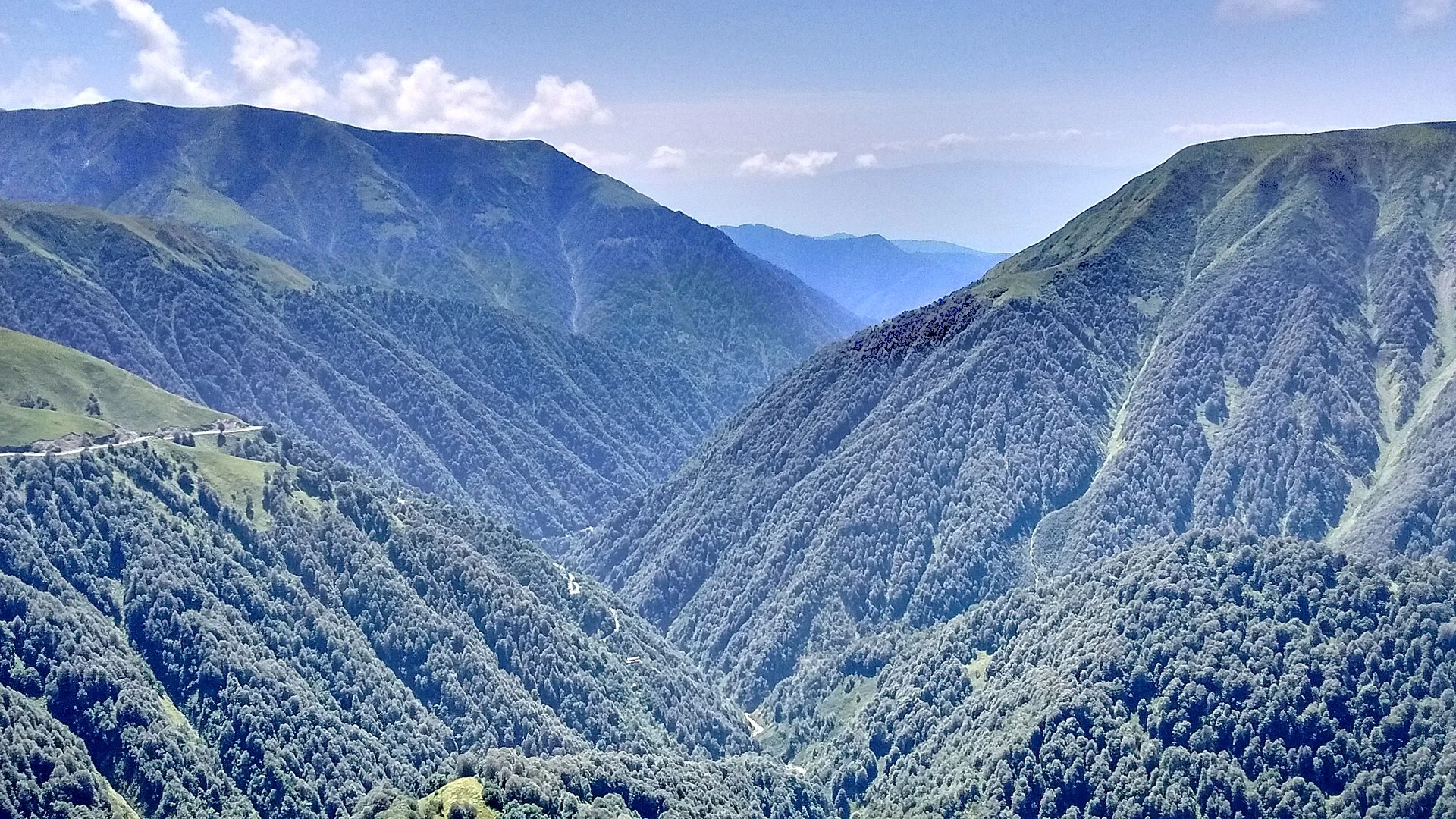
The Abano Pass road through the Tusheti mountains, a classic high-altitude cycling and bikepacking route in Georgia. · Photo: Daviti Zhorzholiani / Wikimedia Commons, CC BY-SA 4.0
Been to Georgia? Tell us how it went — the best stories are published here.
Share your tripOne email a week: what changed for travellers in Georgia — rules, roads, flights, seasons — plus one place worth the trip. Written by the GTour desk, no advertising, unsubscribe in one click.
This story across our partner network — ქართულად: შენი დასვენება
