

By Mariam Lomidze, Culture & Events Reporter · 28/10/2026
Namibian citizens can visit Georgia, but almost nobody arrives on a direct flight, and most Namibian passport holders will need to apply for a visa in advance rather than simply land and enter. The practical route is a connection through Doha, Dubai or Istanbul, a visa or e-visa arranged ahead of time through Georgia’s official portal, and a plan for cash, SIM cards and driving that assumes very little English or Afrikaans will be understood outside Tbilisi and Batumi.
This guide sets out what is actually true for 2026, what changes often enough that you should check it again close to your travel date, and where the two countries genuinely connect — which, being honest, is not very much beyond diplomatic courtesy and a shared interest in wine, tourism and mountain landscapes. We link the exact official pages to verify before you book, and note where our own guides and drivers at G Tour can remove the guesswork.
Visa and entry rules for Namibian citizens
Georgia operates a generous but selective entry policy: citizens of around 90 to 100 countries can enter visa-free for stays of up to a year, and a further group can apply online. Namibia has historically not appeared on the short visa-free list, which means Namibian travellers should plan to apply for a visa before departure rather than assume visa-free entry. The authoritative, current list by nationality sits with Georgia’s Ministry of Foreign Affairs, and rules are reviewed periodically, so confirm your category before booking flights.
- Check your exact requirement on the Ministry of Foreign Affairs consular pages at mfa.gov.ge, which lists visa categories by nationality.
- If a visa is required, Georgia’s e-Visa system at evisa.gov.ge handles most short-stay tourist applications online: you upload a passport scan, a photo, your itinerary, proof of funds and a hotel booking, and processing is usually quoted in a few business days, though busy periods can run longer.
- Apply at least two to three weeks before travel to allow for any request for extra documents, and keep a printed copy of your approval, since border officers at Tbilisi, Kutaisi and Batumi airports may ask to see it.
Because this is the single rule most likely to change, treat anything written elsewhere, including this article, as a starting point rather than the final word, and recheck evisa.gov.ge and mfa.gov.ge within the week before you fly.
Getting there: flights and the usual hubs
There is no direct flight between Namibia and Georgia, and none is likely soon given the thin passenger volume between the two countries. Namibian travellers typically fly out of Windhoek (or connect first through Johannesburg or Cape Town) and then join one of the long-haul hubs that do serve Tbilisi directly.
| Hub | Typical first leg from Namibia | Onward to Georgia |
|---|---|---|
| Doha | Qatar Airways serves Doha from Windhoek and from Johannesburg | Qatar Airways flies Doha–Tbilisi |
| Dubai | Emirates and flydubai connect via Johannesburg or Cape Town | Several carriers link Dubai–Tbilisi |
| Istanbul | Turkish Airlines usually routes via Johannesburg | Turkish Airlines flies Istanbul–Tbilisi frequently, plus Kutaisi and Batumi seasonally |
Total journey time door to door typically runs 18 to 26 hours depending on connection waits. Arrivals information, including which terminal and transfer desks are open, is published by the airports themselves: see tbilisiairport.com, kutaisiairport.com and batumiairport.com. Kutaisi in particular has become a low-cost hub for European connections, so travellers coming via Istanbul sometimes find a cheaper onward leg there than into Tbilisi. If you land tired after a long routing, a pre-booked private transfer removes one variable: our Tbilisi Airport Transfer and Kutaisi Airport to Tbilisi transfer are fixed-price and meet you at arrivals with a name board.
Driving in Georgia on a Namibian licence
Namibia issues driving licences in English with photo and category information, which helps, but Georgian traffic police and car rental firms generally expect either an International Driving Permit (IDP) accompanying your national licence, or a notarised Georgian translation. The underlying rule sits in Georgia’s road traffic legislation, consolidated on the official legislative database; check the current wording before you plan a self-drive trip, since enforcement practice has shifted in the past.
- Bring an IDP if you can obtain one in Namibia before departure; it is the simplest way to avoid argument at a rental counter or a police stop.
- Mountain roads (Kazbegi, Tusheti, Svaneti) often require 4×4 vehicles and local experience with unsealed switchbacks; renting a car with a driver is markedly safer for a first visit.
- See the current legal text at matsne.gov.ge if you want the primary source rather than a rental company’s summary.
If the idea of driving Georgian mountain roads on the correct (right-hand) side for the first time feels like one risk too many after a 20-hour flight, our Car with Driver by the Day service, or a full Georgia Self-Drive package with booked hotels and 24/7 support, both remove that decision without removing your independence.
Money, cards and SIM cards
Georgia’s currency is the lari (GEL). On 28 October 2026 the National Bank of Georgia’s reference rate was approximately 2.596 GEL per US dollar and 2.894 GEL per euro; Namibian dollars are not quoted directly, so expect to convert via USD, EUR or South African rand once you land, and check the rate again close to your trip since it moves daily.
- Cards are widely accepted in Tbilisi and Batumi hotels, restaurants and supermarkets; smaller guesthouses, mountain villages and market stalls often want cash.
- ATMs are common in cities and in most regional towns; carry some GEL cash for Svaneti, Tusheti and Racha, where card machines and network coverage are patchy.
- Local SIM cards (Magti, Geocell, Beeline) are sold at airport kiosks with a passport, and prepaid data packages are inexpensive; eSIM options from international providers also work in most of the country, though mountain valleys have weaker signal.
Language, food and what to expect
Georgian is the official language and uses its own script, which means street signs and menus are not always readable at a glance even where transliteration exists. English is used comfortably in Tbilisi and Batumi’s tourism sector, hotels and by younger Georgians; outside these centres, expect limited English and no Afrikaans or Oshiwambo at all. Russian is still widely understood by older Georgians, which will not help most Namibian visitors directly, but explains why many signs carry a Russian line alongside Georgian.
Food is unlikely to be unfamiliar in substance, if not in name: Georgian mtsvadi (skewered grilled meat) sits close to a Namibian braai, and the maize-based ghomi of western Georgia echoes pap. Vegetarians eat well here thanks to lobio (bean stew), pkhali (vegetable pâtés) and badrijani (walnut-stuffed aubergine), all naturally meat-free. Halal food is not part of mainstream Georgian cuisine, which uses pork widely and treats wine as a cultural staple rather than an occasional drink; halal-certified restaurants exist mainly in Tbilisi and Batumi near mosque areas, and travellers keeping halal should ask explicitly rather than assume. Our Cooking Class in Tbilisi and Supra Evening with a Tamada both let you taste the range and ask questions about ingredients before you commit to a full meal.
Diplomatic ties, trade and cultural links — an honest picture
Ties between Georgia and Namibia are thin, and it would be misleading to dress them up. Namibia does not maintain an embassy in Tbilisi, and Georgia does not maintain one in Windhoek; consular matters for Namibian citizens travelling to Georgia are typically handled through Namibia’s nearest accredited mission or an honorary consul, and the arrangement can change, so confirm current coverage directly with Namibia’s Ministry of International Relations and Trade and with Georgia’s own Ministry of Foreign Affairs at mfa.gov.ge before you travel, in case you need consular assistance.
Trade between the two countries is small enough that it does not appear as a separate line in most published bilateral statistics; Georgia’s National Statistics Office publishes detailed external trade tables by partner country at geostat.ge if you want to see this for yourself. There is no established Namibian diaspora community in Georgia and no equivalent Georgian community in Namibia. What the two countries do share is a growing tourism relationship on paper — Georgia actively promotes itself to African markets through its national tourism administration — and a coincidental overlap of interests: both are known internationally for distinctive wine traditions (Georgia’s qvevri winemaking is recognised by UNESCO) and both attract visitors for dramatic, sparsely populated landscapes. Beyond that, expect to be explaining where Namibia is more often than meeting anyone who already knows.
Seasons, health insurance and safety
Namibia’s dry winter (June to August) is Georgia’s warm high season, good for Tbilisi, Kakheti wine country and hiking in Svaneti or Tusheti before autumn closes the high passes. Namibia’s hot summer (November to March) overlaps with Georgian winter, when Gudauri‘s ski season runs and the lowlands stay mild enough for city breaks; this timing suits Namibian visitors seeking snow they will not see at home. Georgia’s public health authorities periodically review entry requirements including proof of travel medical insurance for visitors; this has applied at points in recent years for certain nationalities and stay lengths, so check current wording on evisa.gov.ge and mfa.gov.ge when you apply, and buy a policy that covers mountain rescue if you plan to hike above 2,000 metres, since altitude and weather in Kazbegi, Svaneti and Tusheti change quickly. For any pre-existing condition or medication question, see a doctor at home before you travel rather than relying on general travel guidance.
Georgia is, by regional standards, a safe destination for independent travellers, including women travelling alone, but normal precautions apply in Tbilisi’s nightlife areas and at unlit mountain trailheads after dark. Toasting is a serious social ritual at a Georgian supra: a tamada (toastmaster) leads rounds of wine toasts, and declining outright can read as rude, though pointing to a health reason or simply sipping rather than draining the glass is accepted practice. Dress modestly (covered shoulders and knees, a headscarf for women) when entering Orthodox churches and monasteries, which make up a large share of the country’s sightseeing.
What a G Tour private guide adds
Given the long flight, the unfamiliar script, patchy English outside the main cities, and a visa process that rewards careful preparation, a private guide mainly saves time and reduces friction rather than unlocking anything invisible. A Licensed Private Guide by the Day reads Georgian menus and signs, handles the toasting etiquette at a village supra, and knows which mountain roads are open before you drive two hours to find out otherwise. For a first visit, pairing a guide with a Car with Driver by the Day, or booking a structured itinerary such as Georgia in 7 Days — The Classic Grand Tour or Georgia Essentials in 3 Days, removes the logistics entirely so the unfamiliarity works in your favour rather than against your schedule.
If this guide is part of a trip you are planning, our Tbilisi to Borjomi or Bakuriani Transfer and Mtskheta on Foot — the Ancient Capital in 2 Hours cover the places it describes with a private guide and driver; a GTour travel expert adapts the route to your dates.
Practical summary
- Visa: assume you need one; check your exact category on mfa.gov.ge and apply via evisa.gov.ge well ahead of travel.
- Flights: no direct route; connect via Doha, Dubai or Istanbul, usually routed through Johannesburg or Cape Town first.
- Driving: bring an International Driving Permit; mountain routes favour a hired driver over self-drive on a first visit.
- Money: lari (GEL); cards work in cities, carry cash for mountain villages and markets; check the daily NBG rate before you convert.
- SIM/eSIM: buy a local SIM at the airport or use an international eSIM; expect weak signal in remote valleys.
- Language: English works in Tbilisi and Batumi tourism; elsewhere, plan for a guide or translation app.
- Food: ask explicitly about halal; vegetarians eat well; wine culture is central to Georgian hospitality.
- Insurance and health: confirm current entry insurance rules on evisa.gov.ge; buy cover that includes mountain rescue if hiking high.
Sources
- Georgia e-Visa portal
- Ministry of Foreign Affairs of Georgia, consular information
- Legislative Herald of Georgia (traffic and entry legislation)
- Georgia's National Statistics Office, external trade data
- Georgian National Tourism Administration
Questions this guide does not answer? Write to info@castle.ge or WhatsApp +995 577 41 63 14 — a person in Tbilisi replies. See also our travel services and all guides.
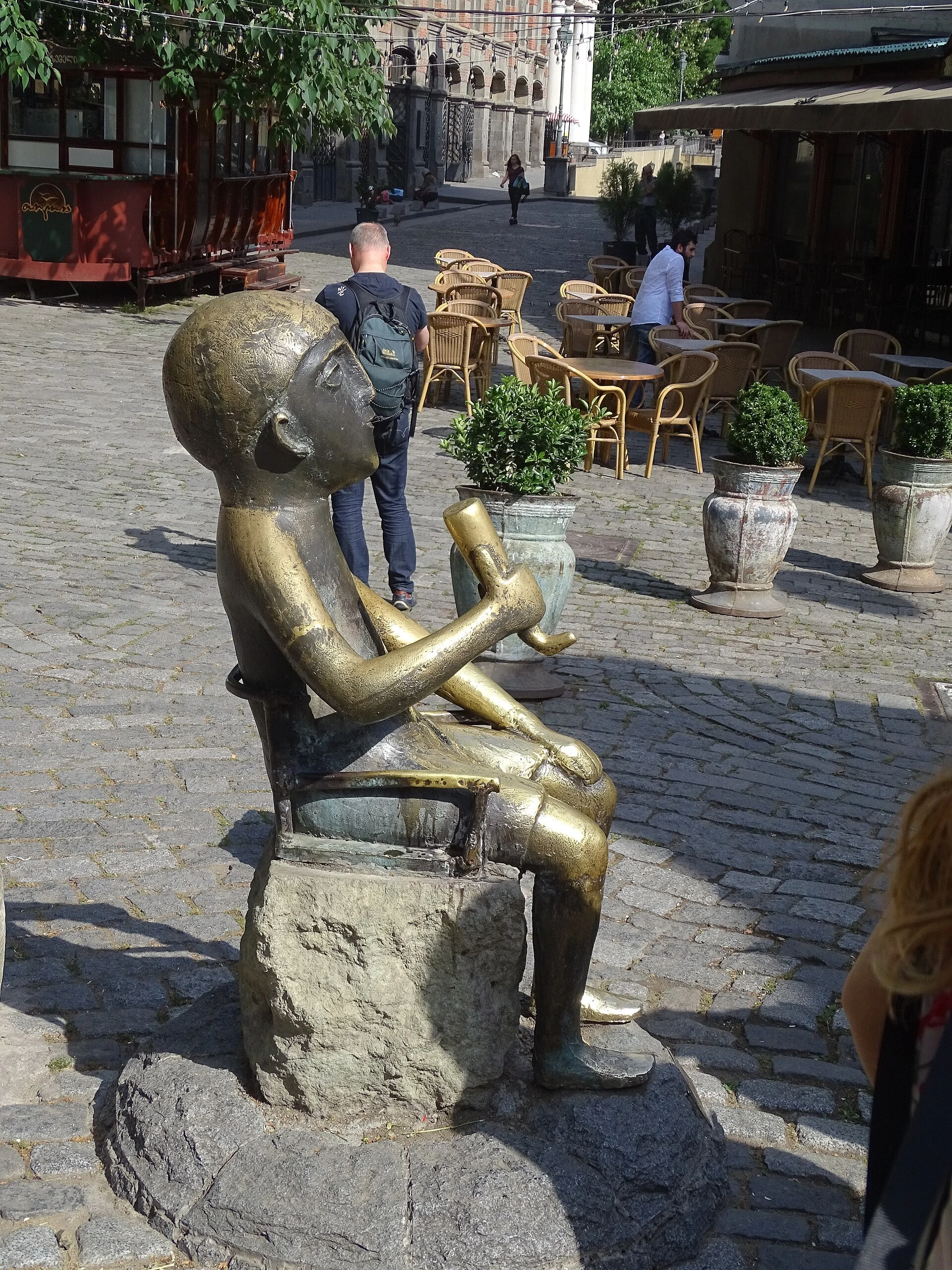
A bronze Tamada (toastmaster) statue in Tbilisi's Old Town reflects Georgia's feast and toasting culture. · Photo: Giftzwerg 88 / Wikimedia Commons, CC BY-SA 3.0
Been to Georgia? Tell us how it went — the best stories are published here.
Share your tripOne email a week: what changed for travellers in Georgia — rules, roads, flights, seasons — plus one place worth the trip. Written by the GTour desk, no advertising, unsubscribe in one click.
This story across our partner network — ქართულად: შენი დასვენება
