

Zhinvali Reservoir — opening hours, tickets, how to get there and what to see
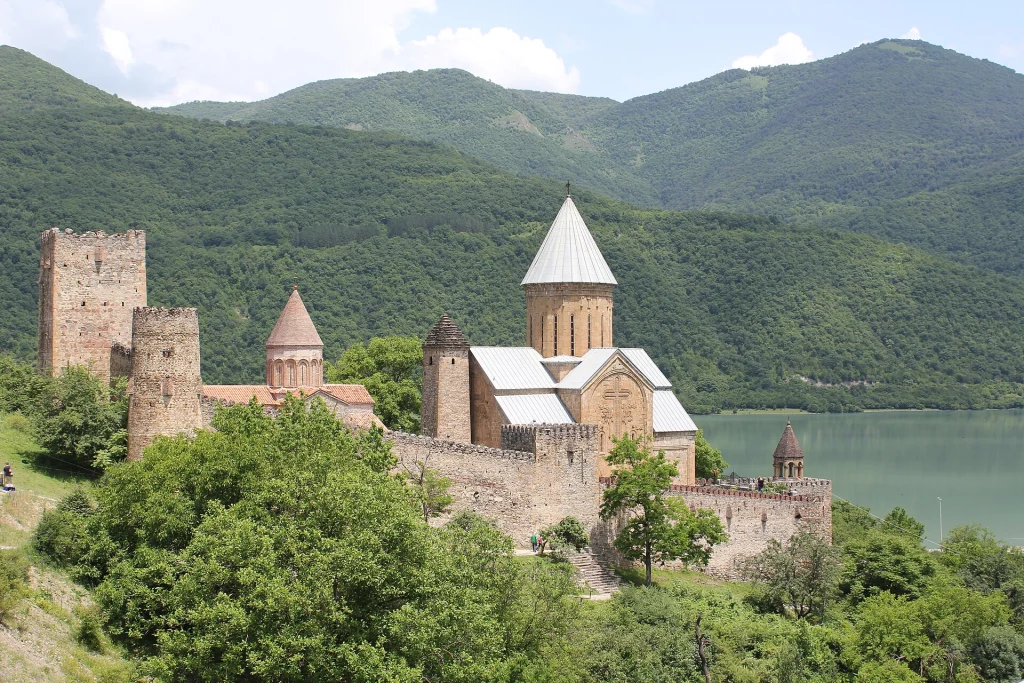
Zhinvali Reservoir is an artificial lake on the Aragvi River in the Mtskheta-Mtianeti region, formed in 1985 when the Zhinvali hydroelectric dam was completed about 40 km north of Tbilisi. Its turquoise water, backed by the stone towers of Ananuri fortress on its southern shore, makes it one of the most photographed stops on the Georgian Military Road toward Kazbegi and the Russian border at Dariali. The reservoir supplies drinking water to Tbilisi and feeds a 130 MW hydropower plant, and its water level visibly rises and falls with the season.
What you see
From the main road (the E117, commonly called the Georgian Military Road) the reservoir appears as a long, curving arm of turquoise-green water hemmed in by bare hills, with the walled fortress of Ananuri standing on a promontory on its right bank. The colour comes from glacial silt suspended in the Aragvi River water; it is more vivid in spring and early summer when snowmelt feeds the river, and duller, with a wider band of exposed shoreline, in late autumn and winter when the reservoir is drawn down for hydropower generation. The dam itself, an arch structure roughly 100 m high, sits a few kilometres downstream and is not generally open to visitors, since it remains active state infrastructure. Several pull-offs along the highway give wide views over the water, and small jetties near Ananuri rent rowing boats and jet-skis in the warmer months. Looking across the lake on a clear day, the snow line of the Greater Caucasus is visible to the north.
History
The reservoir did not exist before the mid-1980s. It was created by damming the Aragvi River as part of a Soviet-era scheme to secure drinking water for Tbilisi and to generate hydroelectricity for the surrounding region; the dam and reservoir were completed in 1985, submerging the old village of Zhinvali and several smaller settlements along the valley floor. Ananuri fortress, which stands on higher ground above the flood line, predates the reservoir by several centuries. It was built up between the 13th and 18th centuries as the seat of the Aragvi dukes (eristavis), who controlled traffic along the only practicable pass across the central Caucasus. The complex and its two churches, one with elaborately carved stone facades, survive largely intact and are listed among Georgia’s immovable cultural heritage monuments by the national heritage agency (heritagesites.ge). Today the dam, reservoir and fortress sit together as a single, heavily visited landscape on the road north, a juxtaposition of medieval defence architecture and 20th-century engineering (georoad.gov.ge).
Opening hours and tickets
| Site | Access | Notes |
|---|---|---|
| Reservoir shoreline and viewpoints | Open access, no fixed hours | Free; roadside pull-offs and informal paths down to the water |
| Ananuri fortress grounds | Typically 09:00–19:00 daily | Small entrance fee in GEL; hours shorter in winter, checked at booking |
| Dam structure | Not open to the public | Active hydropower and water-supply infrastructure |
| Boat and jet-ski rental near Ananuri | Seasonal, roughly May–September | Informal operators, prices negotiated on site |
How to get there
From Tbilisi, Zhinvali Reservoir and Ananuri are about 65–70 km north along the Georgian Military Road (E117), a drive of roughly 1 hour 15 minutes to 1 hour 30 minutes depending on traffic through Mtskheta. Any marshrutka or shared taxi heading from Didube station toward Pasanauri, Gudauri or Kazbegi (Stepantsminda) passes directly alongside the reservoir and can drop passengers near Ananuri, though schedules are infrequent and informal. With GTour, the reservoir and fortress are included as a standard stop on the Kazbegi — Gergeti Trinity Church in a Day tour and the Kazbegi — 2-Day Mountain Journey, and can be added to any private car-with-driver day trip (from €150 per car per day for a sedan, see gtour.ge/services). From Kutaisi or Batumi there is no direct route; travellers normally transit through Tbilisi first.
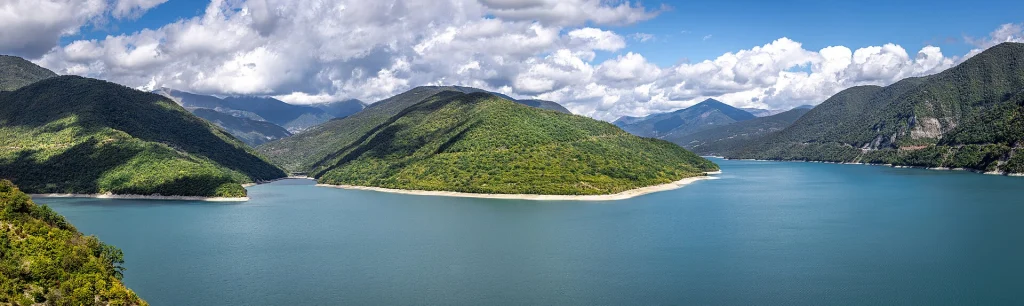
Feel free to / Wikimedia Commons, CC BY 4.0
How long and the best time
A roadside photo stop takes 10–15 minutes; combined with a visit to Ananuri fortress, allow 1 to 1.5 hours. Late spring through early autumn (May to September) gives the clearest turquoise water and the best light for photographs in the morning or late afternoon; midsummer weekends bring heavy coach traffic because the site sits on the only road to Kazbegi. Winter and early spring bring a lower, often grey-green water level and occasional snow on the surrounding hills, which some visitors find more dramatic but less colourful.
Tips
- Dress for a working religious site if entering the churches inside Ananuri fortress: shoulders and knees covered, headscarves available at the gate for women.
- The classic photograph of fortress-above-turquoise-water is taken from the small viewpoint just north of the fortress car park, or from the road bridge further along.
- Weather changes quickly at this elevation; a clear valley morning in Tbilisi does not guarantee clear skies here, especially from late autumn to spring.
- Expect queues and parked coaches at midday in July and August; an early start or a late-afternoon stop avoids most of the crowds.
- Combine with Pasanauri, Gudauri and the Jvari Pass, all on the same road further north, for a full day along the Georgian Military Road.
Nearby
- Ananuri fortress and churches
- Pasanauri (trout restaurants on the Aragvi)
- Gudauri ski and mountain resort
- Jvari Pass (Cross Pass)
- Mtskheta, on the return road to Tbilisi
Zhinvali Reservoir is on these private tours: Georgia Classic in 7 Days — Tbilisi, Kazbegi, Kakheti and Mtskheta · Medical Travel to Tbilisi — Accompanied Clinic Visits, Interpreter and Recovery Stay · Culinary Georgia in 6 Days — Tbilisi, Kakheti, Imereti and the Sea. A travel expert adapts any of them to your dates.
Questions
Can visitors swim in Zhinvali Reservoir?
Informal swimming happens in summer near Ananuri, but there are no lifeguards or official beaches, and the water level and currents near the dam change without warning.
Is there an entrance fee for the reservoir itself?
No, the shoreline and viewpoints are open access; only the fortress of Ananuri on its bank charges an entrance fee, checked at booking.
How far is Zhinvali Reservoir from Tbilisi?
About 65–70 km, roughly 1 hour 15 minutes to 1 hour 30 minutes by car along the Georgian Military Road.
Does the water level change during the year?
Yes, it is drawn down for hydropower and water-supply use, so the reservoir is typically fuller and more turquoise from late spring to early autumn and lower in winter.
Sources
Ananuri fortress and monastery overlook the turquoise waters of Zhinvali Reservoir. · Photo: Stomac / Wikimedia Commons, CC BY 3.0