

Ananuri Fortress — opening hours, tickets, how to get there and what to see
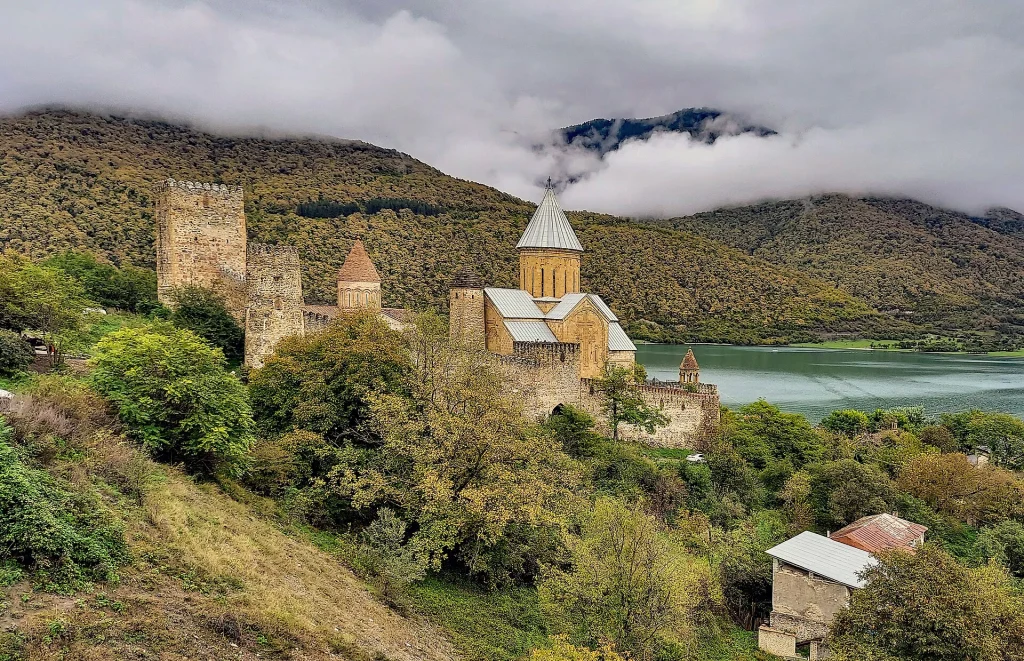
Ananuri is a fortified complex of towers, walls and two carved stone churches on the right bank of the Aragvi River, about 70 km north of Tbilisi on the Georgian Military Road. It was the seat of the Aragvi dukes (eristavis) from roughly the 13th century until a feud destroyed much of the garrison by fire in 1739, and it now overlooks the turquoise Zhinvali Reservoir, completed in 1985. Georgia has proposed Ananuri for UNESCO World Heritage status on its tentative list.
What you see
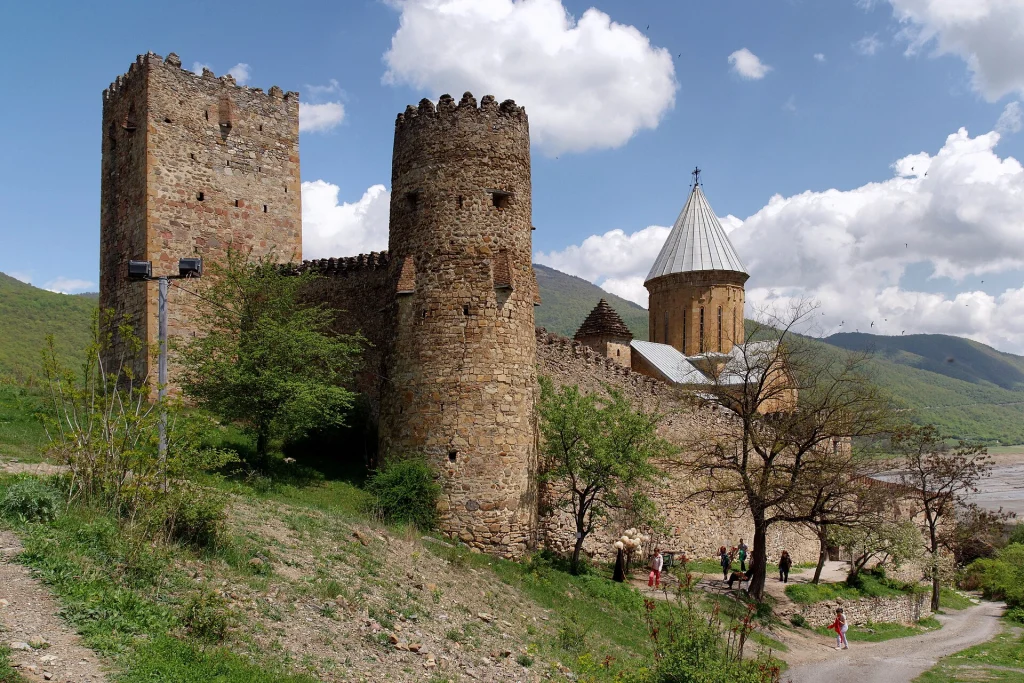
Ananuri stands on a rocky spur above the Aragvi River, enclosed by a crenellated curtain wall with several defensive towers. The tallest, the Sheupovari tower, rises in the upper courtyard and can be climbed by a narrow internal stair for a view over the Zhinvali Reservoir and the road north toward Gudauri. Inside the walls are two churches built of pale sandstone: the larger Church of the Mother of God (Ghvtismshobeli), completed in 1689, has an elaborately carved western facade with a large stone cross, vine and animal motifs typical of late medieval Georgian stonework, and a vaulted interior that served as the ducal burial place. A smaller, older church stands beside it. A separate bell tower and the ruined keep of an earlier fortress complete the complex. Little of the original roofing survives on the secular buildings, so most of what is visible is stonework, towers and the two churches rather than furnished interiors.
History
Ananuri was the stronghold of the Aragvi eristavis, a feudal duchy controlling the only reliable crossing of the central Greater Caucasus, from the 13th century onward. The complex was expanded through the 17th century, with the main Church of the Mother of God dated by inscription to 1689. In 1739 a rival duke, Shanshe of Ksani, besieged and burned Ananuri, killing members of the ruling family who had taken refuge in one of the towers, an episode recorded in Georgian chronicles of the period. The duchy itself was abolished later in the 18th century as the Georgian kingdoms drew closer to the Russian Empire. The fortress lost its military role once the Georgian Military Road was formalised in the 19th century, and in the 20th century the surrounding valley was reshaped by the Zhinvali hydroelectric dam, completed in 1985, which created the reservoir now visible from the towers. Ananuri appears on Georgia’s UNESCO World Heritage tentative list, submitted as part of the country’s ongoing nominations process.
Opening hours and tickets
| Item | Usual pattern |
|---|---|
| Grounds | Open daily, roughly sunrise to sunset, no fixed gate hours |
| Entry fee | Free at the time of writing; small parking or photography fees are sometimes charged informally by site staff (checked at booking) |
| Church access | May close briefly during services; modest dress expected (shoulders and knees covered, headscarf for women) |
There is no official ticket office or printed timetable, so the pattern above should be checked at booking, particularly in winter when access to the upper tower can be restricted after snow.
How to get there
From Tbilisi, Ananuri is about 70 km and 1 h 25 min by car along the Georgian Military Road (E117), the same route used for Gudauri, Kazbegi and the Russian border crossing at Dariali. Marshrutka minibuses running from Tbilisi’s Didube station toward Kazbegi or Pasanauri pass directly by the fortress and can drop passengers at the entrance, though schedules are irregular and there is no dedicated stop. From Kutaisi, allow around 4 hours by car via Tbilisi; there is no direct public transport. With GTour, a car and driver from Tbilisi for the day, or a guided stop on the way to Kazbegi, can be arranged through our car-with-driver and private-guide services, or as part of our Kazbegi day tours.
How long and the best time
Most visitors need 45 minutes to 1 hour to walk the courtyards, climb the tower and see both churches. Early morning or late afternoon gives softer light over the reservoir and fewer tour buses, which tend to arrive in clusters mid-morning on the Kazbegi route. Spring and autumn are the most comfortable seasons; summer brings heat with little shade inside the walls, and winter can be cold and occasionally icy on the tower stairs.
Tips
- Cover shoulders and knees before entering either church; scarves are sometimes available at the door but it is safer to bring your own.
- The tower stair is steep and uneven; wear flat, closed shoes, especially after rain or snow.
- The reservoir view from the upper tower is the best photograph on the site; midday light is flat, so early or late visits work better.
- Parking areas fill with tour coaches between roughly 10:00 and 14:00 on the main Kazbegi route; arriving before or after this window avoids crowds.
- Small stalls near the car park sell local honey, churchkhela and soft drinks, useful for a short break before continuing north.
Nearby
- Zhinvali Reservoir and dam viewpoint
- Pasanauri
- Gudauri ski resort
- Jvari Pass
- Mtskheta
Ananuri Fortress is on these private tours: Georgia Classic in 7 Days — Tbilisi, Kazbegi, Kakheti and Mtskheta · Georgia in 10 Days — Tbilisi to Svaneti to the Sea · Culinary Georgia in 6 Days — Tbilisi, Kakheti, Imereti and the Sea. A travel expert adapts any of them to your dates.
Questions
Is there an entrance fee at Ananuri Fortress?
Entry is generally free, though this should be checked at booking since informal parking charges are sometimes applied.
How long does a visit to Ananuri take?
Most travellers spend 45 minutes to 1 hour walking the towers and the two churches.
Can I visit Ananuri on the way to Kazbegi?
Yes, it sits directly on the Georgian Military Road between Tbilisi and Kazbegi and is a standard stop on that route.
Is Ananuri a UNESCO World Heritage Site?
It is on Georgia's UNESCO tentative list, not yet inscribed as a full World Heritage Site.
Sources
Ananuri's towers and churches rise above the turquoise Aragvi reservoir. · Photo: Arian Zwegers from Brussels, Belgium / Wikimedia Commons, CC BY 2.0