

Sapara Monastery — opening hours, tickets, how to get there and what to see
Sapara Monastery is a 9th- to 13th-century Georgian Orthodox complex set on a forested ridge about 12 kilometres southeast of Akhaltsikhe, in Samtskhe-Javakheti. Its main church, dedicated to St Saba, was rebuilt around 1293 under the Jaqeli dynasty, who ruled the Samtskhe-Saatabago principality, and its interior still holds one of the most complete sets of medieval Georgian wall paintings outside Svaneti. The site remains an active monastery today, reached by a winding mountain road rather than a marked tourist route.
What you see
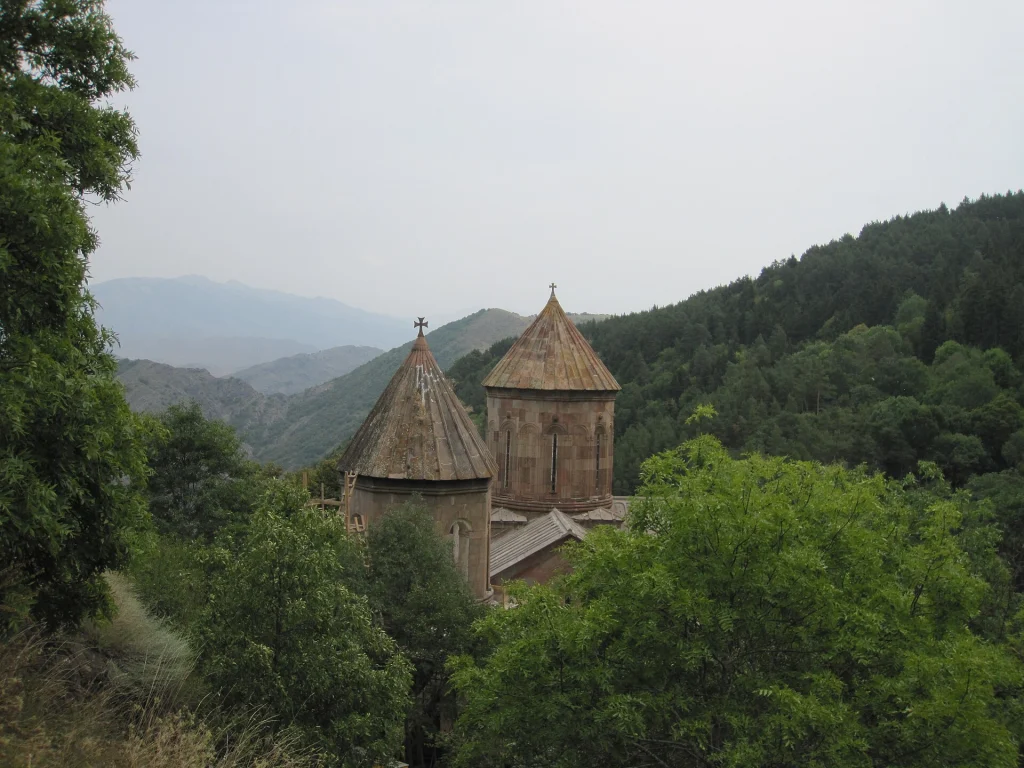
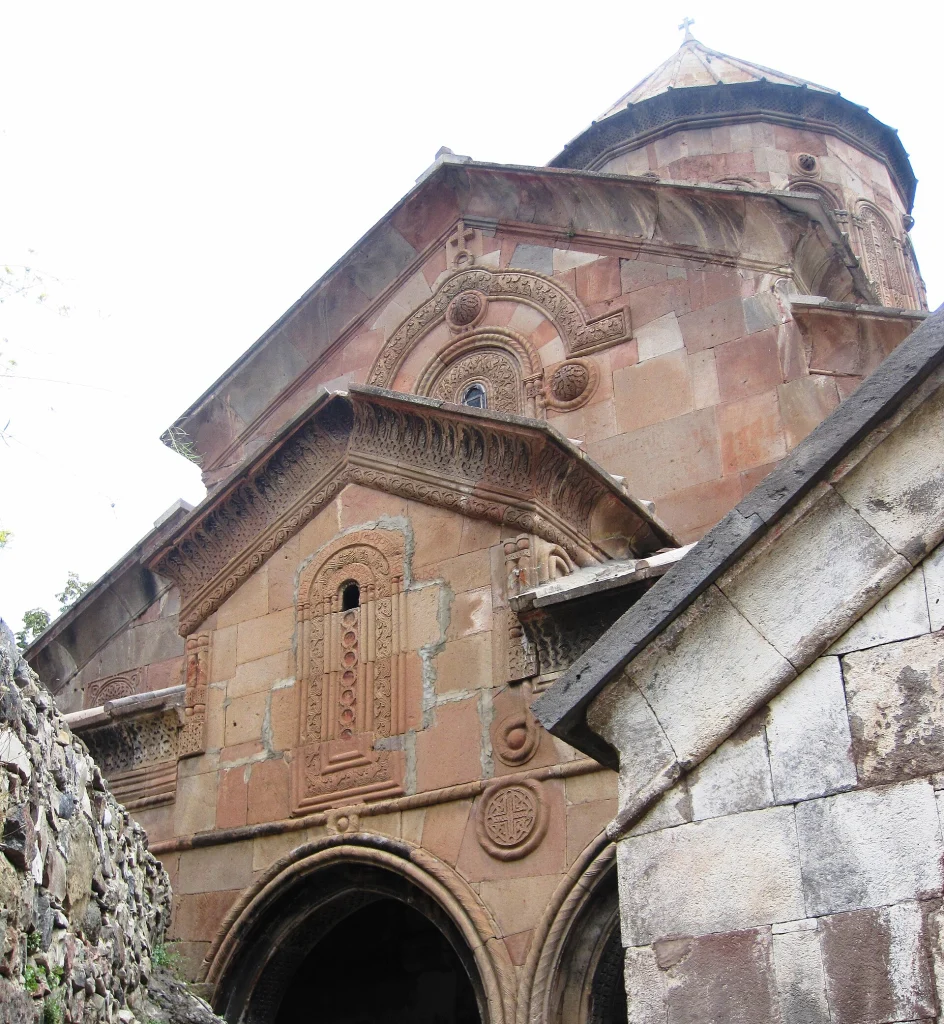
Sapara sits on a wooded spur above a gorge, visible from some distance as a cluster of stone domes and a free-standing bell tower. The core of the complex is the Church of St Saba (Sabatsminda), a domed cross-in-square building faced in finely cut stone, adjoined by the smaller Church of the Theotokos and a defensive tower that predates the main church. Inside St Saba’s, the apse and walls carry 13th-century frescoes, including donor portraits of members of the Jaqeli family, painted in the Byzantine-influenced style typical of the period. A separate bell tower stands slightly apart from the churches, and the whole complex is enclosed by a low defensive wall, since Sapara also functioned as a fortified retreat for the Samtskhe nobility. The setting, on a ridge with views over the Potskhovi valley, is as much a reason to visit as the architecture itself.
History
The name Sapara derives from the Georgian word for “hidden” or “secluded,” a reference to the monastery’s position away from the main valley routes. A religious community is believed to have existed on the site from the 9th century, but the buildings seen today date mainly from the late 13th century, when Sargis Jaqeli and his son Beka Jaqeli, rulers of the Samtskhe principality, rebuilt the main church and commissioned its frescoes. The Jaqeli family used Sapara as a dynastic burial place and spiritual centre through the following centuries, as Samtskhe became a semi-independent principality balancing Georgian, and later Ottoman, influence. The monastery declined under Ottoman control of the region from the 16th to the 19th century, when much of Samtskhe-Javakheti‘s Christian population and infrastructure was affected, and it was restored and reconsecrated as a working monastery in the 20th century under the Georgian Orthodox Church. The complex is listed as an immovable cultural heritage monument of national significance (see sources).
Opening hours and tickets
| Item | Typical pattern |
|---|---|
| Grounds and churches | Open daily, roughly dawn to dusk; no fixed closing hour posted |
| Entrance fee | Free; donations welcomed inside the church |
| Dress code | Enforced: headscarves and wrap skirts for women, long trousers for men; scarves/wraps sometimes available at the entrance, best to bring your own |
| Photography inside the church | Usually restricted or discouraged; ask before photographing frescoes |
As with most working monasteries in Georgia, there is no formal ticket office or published timetable. Hours can shift around major church holidays. Checked at booking is the safest approach if your visit is time-sensitive.
How to get there
From Tbilisi, Akhaltsikhe is about 2 hours 45 minutes by car on the main road through Khashuri and Borjomi; Sapara is a further 20 to 30 minutes up a partly unpaved mountain road from Akhaltsikhe, so allow roughly 3 hours 15 minutes door to door. Marshrutka minibuses run from Tbilisi’s Ortachala station to Akhaltsikhe (around 4 hours), but there is no public transport up to the monastery itself; a taxi from Akhaltsikhe (round trip with waiting time) is the usual solution. From Kutaisi or Batumi, the drive to Akhaltsikhe takes about 3 hours 20 minutes, with the same final stretch to Sapara. There is no passenger rail service to Akhaltsikhe. With us, Sapara can be added as a stop to a private car-with-driver day from Akhaltsikhe, or combined with Rabati Castle and Vardzia on our Vardzia, Rabati & Borjomi — 2 Days tour or the Borjomi, Bakuriani & Rabati — 2 Days tour, both of which can route through Sapara on request.
How long and the best time
Most visitors spend 45 minutes to an hour at Sapara, including time at the viewpoint below the churches. Combined with the drive, this makes it a half-day addition to a stay in Akhaltsikhe or a stop en route to Vardzia. Spring and autumn offer the clearest light for the valley views and cooler conditions for the uphill approach; summer is fine but can be hot by midday. Winter visits are possible but the access road can be icy after snowfall, and a 4×4 or careful driving is advisable.
Tips
- Bring a headscarf and a long skirt or trousers; monastery staff can be strict about dress for both men and women.
- The access road has sections of gravel and potholes; a standard sedan manages it in dry weather, but check conditions after rain or snow.
- Avoid photographing monks or the interior frescoes without asking first.
- There are no shops or food stalls at the monastery itself, so bring water, especially in summer.
- Visitor numbers are low compared with Vardzia or Rabati, so queues are rarely an issue even in peak season.
- Combine the visit with Akhaltsikhe’s Rabati Castle, a 20 to 30 minute drive away, to make a fuller day.
Nearby
- Rabati Castle, Akhaltsikhe
- Vardzia cave monastery
- Khertvisi Fortress
- Vanis Kvabebi cave monastery
- Borjomi-Kharagauli National Park
Sapara Monastery is on these private tours: The South in 3 Days — Borjomi, Vardzia, Rabati and Abastumani · Vardzia and Rabati — the Long Day South · Borjomi and Bakuriani — Spa Town and Mountain Air in a Day. A travel expert adapts any of them to your dates.
Questions
Is Sapara Monastery free to visit?
Yes, there is no entrance fee, though donations inside the church are welcomed.
Can I reach Sapara without a car?
Not easily; there is no public transport up the mountain road, so a taxi from Akhaltsikhe or a private driver is needed.
Do I need to cover my head and arms?
Yes, women are expected to wear a headscarf and long skirt, and men should wear long trousers.
How does Sapara compare to Vardzia?
Sapara is smaller and much quieter, valued for its 13th-century frescoes and hillside setting rather than scale, while Vardzia is a far larger rock-cut cave city.
Sources
Panoramic view of Sapara Monastery nestled among forested hills near Akhaltsikhe, Georgia. · Photo: Kober / Wikimedia Commons, CC BY-SA 4.0