

Jvari Monastery — opening hours, tickets, how to get there and what to see
Jvari Monastery is a sixth-century cross-cupola church on a ridge above Mtskheta, built where Saint Nino is said to have raised a wooden cross around 337 AD. It forms part of the UNESCO World Heritage property “Historical Monuments of Mtskheta,” inscribed in 1994, and offers the classic view over the confluence of the Mtkvari and Aragvi rivers.
What you see
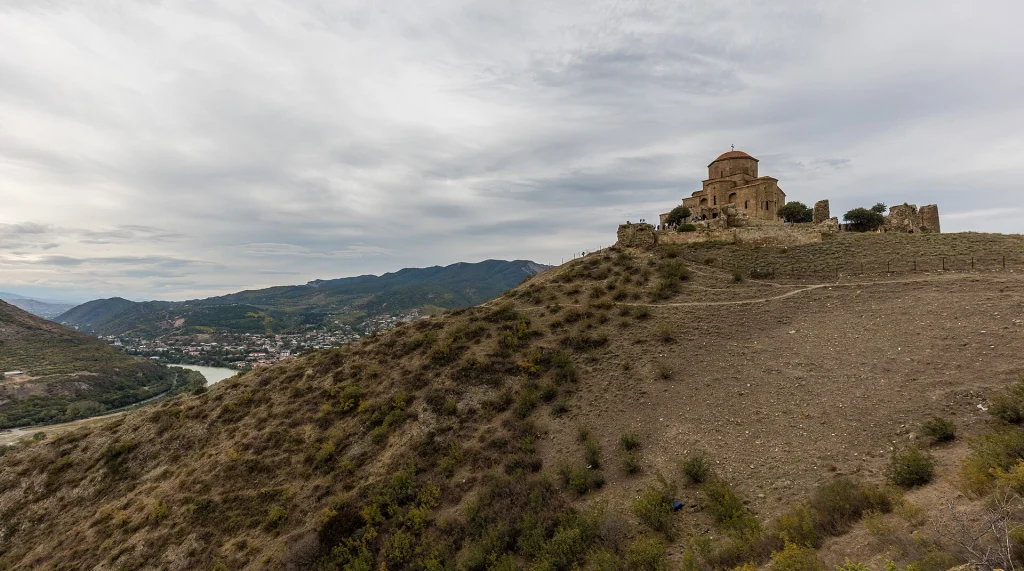
Jvari stands alone on a rocky spur about 300 metres above the point where the Aragvi river meets the Mtkvari, with the domes and bell tower of Svetitskhoveli Cathedral and the rooftops of Mtskheta laid out below. The main building is a tetraconch, a compact cruciform church with four equal apses under a single drum and dome, a design that became a reference point for church architecture across the Caucasus. Carved stone reliefs survive on the exterior facades, including figures associated with the ruling Stepanoz dynasty and winged angels, worn by thirteen centuries of weather. Beside the main church are the foundations of the earlier, smaller Jvari church and fragments of a defensive wall. Most visitors spend their time on the small terrace in front of the entrance, which gives the widest view of the river confluence and the Georgian Military Highway valley running north toward the mountains.
History
Tradition holds that Saint Nino erected a wooden cross on this hilltop around 337 AD, on the site of a pagan shrine, shortly after Georgia’s conversion to Christianity. A small church, known as the Small Jvari, was built over the site around 545 by the ruler Guaram, and the larger church seen today was completed between 586 and 605 under the erismtavari Stepanoz I. The site entered Russian-language literature through Mikhail Lermontov’s 1839 poem “Mtsyri,” which opens with a description of the monastery and helped fix its image in the wider imagination. Jvari, together with Svetitskhoveli Cathedral and Samtavro Convent, was inscribed by UNESCO in 1994 as “Historical Monuments of Mtskheta,” cited for its exceptional testimony to medieval religious and artistic development in the region (UNESCO World Heritage Centre). The property has since been the subject of periodic monitoring over visitor pressure, slope erosion and the condition of the stone carving, issues the state heritage authorities continue to track (Britannica).
Opening hours and tickets
| Item | Usual pattern |
|---|---|
| Opening hours | Daily, roughly 09:00–19:00 in summer and 09:00–18:00 in winter; no fixed closing day |
| Entry | Free, donations welcome inside the church |
| Guided access | No ticket booth; licensed guides can be arranged in advance |
Hours are informal and can shift around services or weather on the exposed ridge; details checked at booking.
How to get there
From central Tbilisi it is about 21 km and 25–30 minutes by car to the monastery car park, via Mtskheta and a short uphill road with hairpin bends. From Kutaisi the drive is roughly 3.5 hours; from Batumi about 5.5 hours. Marshrutkas run frequently from Tbilisi’s Didube station to Mtskheta town (about 25 minutes), but there is no public transport up to Jvari itself; a taxi from Mtskheta takes about 10 minutes, or a marked footpath climbs the hillside in 1.5–2 hours for those who prefer to walk. With us, the half-day Tbilisi & Mtskheta — The Essential First Day tour and the St Nino’s Way — Mtskheta, Sioni and Bodbe in a Day tour both include Jvari with a private car and driver; a car with driver for a custom day around Tbilisi is also available separately.
How long and the best time
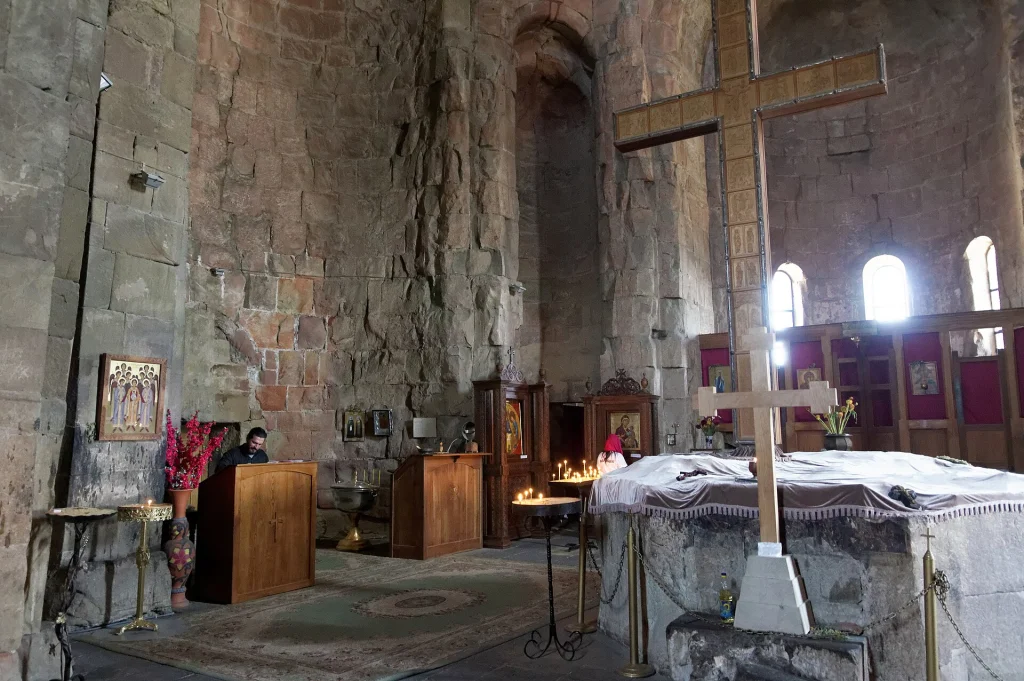
Most visits last 30–45 minutes, enough time to see the church interior and take in the view from the terrace. Early morning, shortly after opening, or the last hour before sunset give the best light and the thinnest crowds, since tour buses from Tbilisi concentrate in the late morning and early afternoon. The ridge is exposed and noticeably windier and colder than Mtskheta below, in any season.
Tips
- Dress follows standard Georgian Orthodox rules: covered shoulders and knees for everyone, and a headscarf for women; scarves and wraps are usually available at the entrance if needed.
- Photography is fine on the terrace and exterior; avoid photographing inside during a service.
- Bring a layer even in summer, as wind off the river valley makes the hilltop cooler than it looks from below.
- The car park is small and fills by mid-morning in high season; arriving before 09:30 or after 17:00 avoids the worst of it.
- Combine the visit with Svetitskhoveli Cathedral and Samtavro Convent in Mtskheta, both a short drive back down the hill.
Nearby
- Svetitskhoveli Cathedral, Mtskheta
- Samtavro Convent, Mtskheta
- Mtskheta Archaeological Museum-Reserve
- Shio-Mgvime Monastery
- Armaztsikhe ancient site
Jvari Monastery is on these private tours: Georgia in 10 Days — Tbilisi to Svaneti to the Sea · Tbilisi in a Day — Old Town, Sulphur Baths, Mtatsminda and the Markets · Mtskheta, Gori and Uplistsikhe — Kartli in a Day. A travel expert adapts any of them to your dates.
Questions
Is Jvari Monastery free to enter?
Yes, there is no admission fee; donations inside the church are welcome, checked at booking.
How long does a visit take?
Most people spend 30 to 45 minutes, including time at the viewpoint terrace.
Can Jvari be combined with Svetitskhoveli Cathedral in one trip?
Yes, both sit within a short drive of each other and are usually visited together.
Is there a dress code at Jvari?
Yes, shoulders and knees should be covered and women are expected to wear a headscarf inside the church.
Sources
Jvari Monastery perched above Mtskheta, its sixth-century stone church and ruined tower against the sky. · Photo: This Photo was taken by Supanut Arunoprayote.
Feel free to / Wikimedia Commons, CC BY 4.0