

By David Kiknadze, Transport & Openings Reporter · 27/10/2026
Yes, in almost all cases Algerian citizens need a visa to enter Georgia in 2026, and the practical route is Georgia’s e-visa system rather than a sticker visa issued by a consulate. Georgia’s wide unilateral visa-free regime does not currently extend to Algeria, so travellers should plan on applying online through evisa.gov.ge before booking non-refundable flights, and should recheck the rule close to departure because Tbilisi revises its visa lists periodically.
Beyond the paperwork, Georgia works well for a first visit from Algeria: no direct flights, so expect one stop, usually in Istanbul, Doha or Dubai; a currency (the lari) that is easy to exchange but rarely needed in Algerian dinars; Georgian and Russian as the everyday languages with English concentrated in Tbilisi and Batumi‘s tourist zones; and a food culture built on grilled meat, bread, walnuts and fresh vegetables that will feel partly familiar, alongside wine and some pork dishes that will not suit every Algerian traveller. Historical and trade ties between the two countries are thin, and this guide says so plainly rather than inventing links that do not exist, while giving the practical detail that actually matters for planning a trip.
Visa and entry rules for Algerian citizens
Algeria is not on Georgia’s current unilateral visa-free list, which is dominated by EU, Gulf, North American and several Asian states. Algerian passport holders should apply for an electronic visa before travel through the official portal, evisa.gov.ge, which issues both single and multi-entry short-stay e-visas for most tourism and business purposes. The checklist typically asks for a scanned passport, a passport photo, proof of accommodation, a return ticket and proof of travel medical insurance covering the stay; processing is usually quoted at a few working days, though it can run longer around holidays, so apply at least two to three weeks ahead. Because visa categories, fees and processing times are updated by the Georgian government without much notice, confirm the exact requirements and current fee for your passport on the e-visa portal and on the Ministry of Foreign Affairs’ consular pages at mfa.gov.ge before you book flights. If in doubt, Algeria’s own Ministry of Foreign Affairs can also confirm the latest reciprocal arrangement.
Getting there: flights and routes
There are no direct flights between Algeria and Georgia in 2026. Algerian travellers connect through a regional hub, most commonly Istanbul, which has the densest network of onward flights to Tbilisi, Kutaisi and Batumi and is well served from Algiers, Oran and Constantine. Doha and Dubai are credible alternatives with good onward frequency to Tbilisi, useful if your Gulf carrier has a better fare or schedule than the Istanbul routing. Warsaw and Munich, which matter for some European nationalities’ routings into Georgia, are not typical connection points for passengers departing Algeria and can usually be ignored unless you are already routing through Europe for other reasons.
| Connection hub | Typical carriers on the Algeria leg | Onward airport in Georgia |
|---|---|---|
| Istanbul | Turkish Airlines and codeshares from Algiers, Oran, Constantine | Tbilisi, Kutaisi, Batumi — check tbilisiairport.com |
| Doha | Qatar Airways from Algiers | Tbilisi — check tbilisiairport.com |
| Dubai | Emirates, flydubai from Algiers | Tbilisi, with seasonal links to Batumi |
Always confirm current schedules directly with the airline or the airport’s own flight pages, since Gulf and Turkish carriers adjust Caucasus frequencies by season; see tbilisiairport.com, kutaisiairport.com and batumiairport.com for live flight boards.
Driving licence, money, cards and SIM
Georgia generally recognises foreign driving licences printed in Latin script, or accompanied by an International Driving Permit, for the length of a short tourist stay. Algerian national licences are issued in Arabic and French, so carry an International Driving Permit alongside your Algerian licence if you plan to rent a car or sign a car-with-driver contract that requires you to hold a licence yourself; car hire desks in Tbilisi and Batumi routinely ask for one. The underlying traffic and licensing rules sit in Georgian legislation published through matsne.gov.ge, and the state Roads Department publishes winter pass closures and road conditions at georoad.gov.ge, worth checking before any mountain drive to Kazbegi, Svaneti or Tusheti.
The currency is the Georgian lari (GEL). On 27 October 2026 the National Bank of Georgia’s reference rate is roughly 2.91 GEL to the euro and 2.60 GEL to the US dollar; the Algerian dinar is not quoted or exchanged inside Georgia, so bring euros or US dollars in cash to change at a licensed exchange office, and rely on your Visa or Mastercard for the rest. Cards are accepted in almost all Tbilisi, Batumi and Kutaisi hotels, restaurants and larger shops; carry some cash for guesthouses, market stalls, marshrutka minibuses and mountain villages where card terminals are patchy. A local SIM or eSIM from Magti, Geocell or Beeline, bought at the airport arrivals hall or a city shop with your passport, is the simplest way to get data and a local number for the duration of your trip.
Language and what to expect
Georgian is the state language and the one you will see on road signs and menus outside the main tourist strips. Russian remains widely understood, particularly among people over about forty and in the regions. English is concentrated in Tbilisi’s Old Town, in Batumi’s seafront hotels and restaurants, and among licensed guides and younger hospitality staff, but it thins out quickly once you leave the main circuits. Arabic and French, Algeria’s working languages, are not generally understood by the Georgian public; you may occasionally find French among older academics or staff at European-trained hotels, and Arabic recognition is limited mostly to religious sites and a handful of businesses used to Gulf tourists in Batumi. A phrasebook, a translation app, or booking a guide who speaks Arabic, available at G Tour for a modest surcharge over the standard day rate, removes most of this friction.
Food and dietary notes
Georgian cuisine leans on bread, walnuts, fresh herbs, grilled and stewed meat, and wine, which gives Algerian visitors both common ground and some things to navigate. Dishes such as mtsvadi (grilled skewered meat), lobio (bean stew), pkhali (vegetable and walnut pâté) and badrijani (eggplant rolls) are naturally close to North African tastes and widely available. Pork appears often, in khinkali fillings, sausages and some stews, so ask specifically when ordering if you avoid it; lamb, beef and chicken versions of most dishes exist and staff in tourist restaurants are used to the question. Formal halal certification is uncommon outside Adjara, where Batumi’s long history of Muslim communities and Gulf and Turkish tourism supports halal-labelled restaurants and butchers; in Tbilisi, look for Turkish, Azerbaijani or Middle Eastern restaurants, which tend to be halal or close to it, and confirm directly rather than assuming. Vegetarian and vegan eating is straightforward almost everywhere thanks to the strong tradition of bean, vegetable and walnut dishes tied to Georgian Orthodox fasting periods.
Ties between Georgia and Algeria, and who to contact
The honest answer is that historical, trade and diaspora ties between Georgia and Algeria are thin. There is no significant historical record of direct contact comparable to Georgia’s long exchanges with Persia, the Ottoman world or Russia, and no meaningful resident Algerian community in Georgia or Georgian one in Algeria. Trade volumes are small and not separately prominent in Georgia’s national statistics, published by geostat.ge, where Algeria does not feature among Georgia’s leading partners. What does exist is a small and growing flow of Algerian students and professionals exploring Georgian universities and medical training programmes, and occasional business delegations, but this is modest rather than a defined bilateral relationship. Algeria does not maintain an embassy in Tbilisi; consular matters for Algerian citizens travelling to Georgia are typically handled by Algeria’s nearest regional mission, and the designation can change, so confirm the current arrangement with Algeria’s own Ministry of Foreign Affairs before you travel. On the Georgian side, the list of Georgia’s embassies and the countries each one covers is maintained at mfa.gov.ge.
Health, insurance and safety
Georgia does not currently apply a blanket mandatory-insurance rule at the border for all nationalities, but travel medical insurance covering the full length of stay is part of the standard e-visa document checklist for applicants who need a visa, Algerians included; check the exact wording and minimum coverage on evisa.gov.ge before you apply. Independently of any visa requirement, carrying insurance that covers medical treatment, evacuation and trip cancellation is sensible for any trip to Georgia’s mountain regions, where altitude, weather and road closures can complicate access to care; see a doctor before travel if you have a condition that mountain altitude or long transit times could affect. Georgia is generally safe for visitors, including solo women and families, with low rates of violent crime in the areas tourists use; ordinary precautions around valuables in crowded markets and on night buses are enough. Dress modestly when visiting working churches and monasteries regardless of your own faith, and expect to be asked to cover shoulders and, for women, to wear a provided headscarf at some Orthodox sites, a norm Algerian visitors familiar with mosque etiquette will find easy to follow.
What a G Tour private guide adds
For a first trip from Algeria, the value of a private guide is less about translation than about removing the guesswork around halal food, prayer times, mountain road conditions and which sites are worth the drive. G Tour’s licensed guides can work in Arabic for a surcharge of €25 a day over the standard rate shown on gtour.ge/services, and a fixed-price airport transfer (from €25 for a sedan at Tbilisi airport) removes the first-night stress of arriving on a connecting flight that may land late. Good starting itineraries for a first visit include Tbilisi & Mtskheta — The Essential First Day for orientation, and the Georgia in 7 Days — The Classic Grand Tour for travellers who want Tbilisi, Kakheti wine country, Kazbegi and Svaneti combined into one planned route, with halal-aware restaurant choices and prayer-time-friendly scheduling arranged in advance rather than improvised on the road.
If this guide is part of a trip you are planning, our Georgia in 10 Days — Tbilisi to Svaneti to the Sea and Monasteries of Georgia — Mtskheta, the Thirteen Fathers and Kakheti in 3 Days cover the places it describes with a private guide and driver; a GTour travel expert adapts the route to your dates.
Practical summary
- Check Georgia’s current visa list for Algerian passport holders before booking flights; apply for an e-visa at evisa.gov.ge if required, allowing two to three weeks.
- Expect one stop via Istanbul, Doha or Dubai; there are no direct flights from Algeria to Georgia.
- Carry an International Driving Permit alongside your Algerian licence if you intend to drive.
- Bring euros or US dollars in cash to exchange; Algerian dinars are not exchangeable in Georgia; cards work in most cities.
- Buy a local SIM or eSIM on arrival; English is concentrated in Tbilisi and Batumi, Russian is widely understood, Arabic and French are not.
- Ask specifically about pork and halal status when ordering; Batumi has more halal options than Tbilisi.
- Confirm which mission covers Algerian consular affairs for Georgia before you travel, since there is no Algerian embassy in Tbilisi.
- Carry travel medical insurance covering the full stay, and see a doctor before travel if mountain altitude is a concern.
Sources
- Georgia e-visa portal
- Georgia Ministry of Foreign Affairs
- Georgia road conditions and passes
- Legislative Herald of Georgia
- National Statistics Office of Georgia
Questions this guide does not answer? Write to info@castle.ge or WhatsApp +995 577 41 63 14 — a person in Tbilisi replies. See also our travel services and all guides.
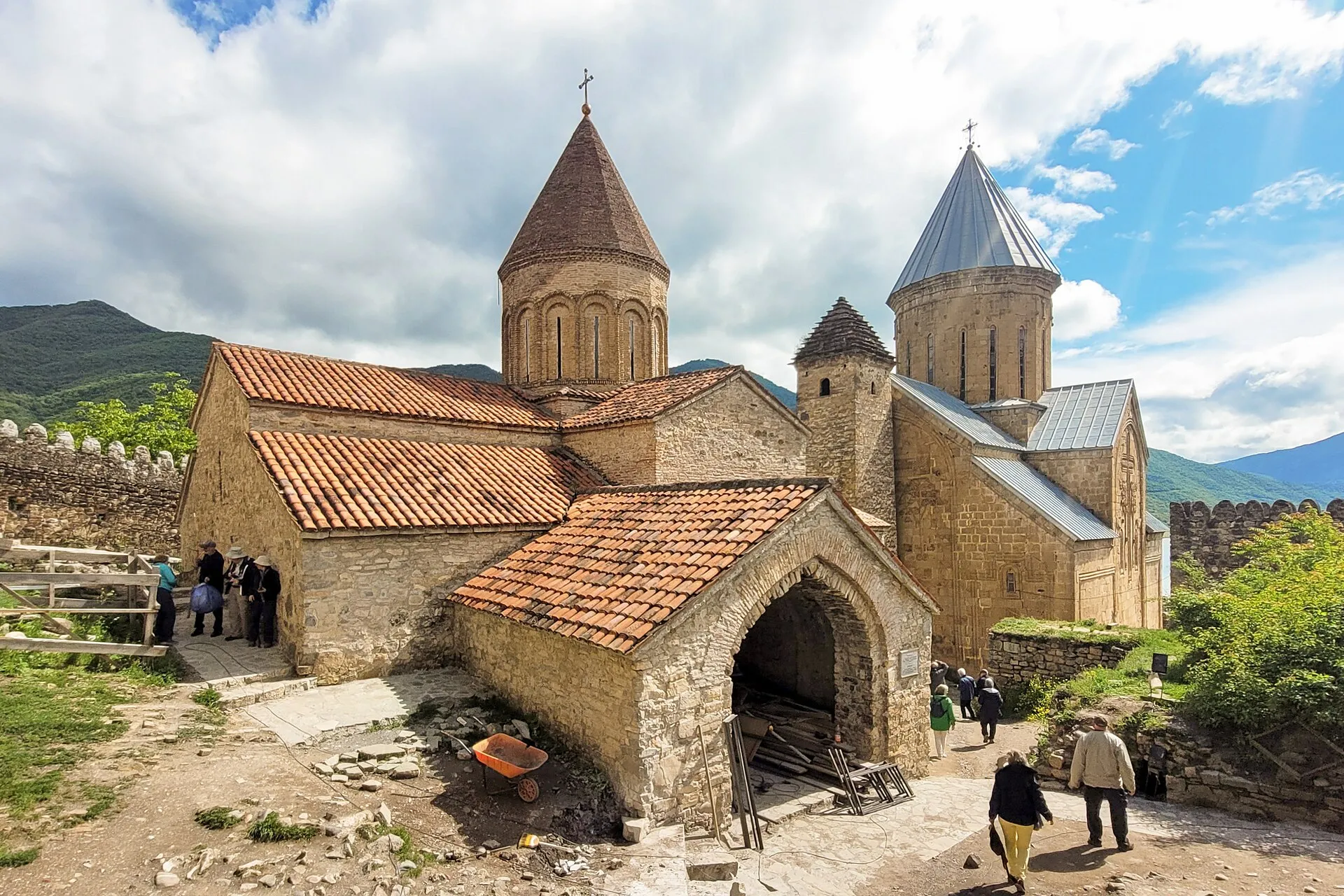
Ananuri fortress, a classic day-trip from Tbilisi along the Georgian Military Highway. · Photo: Bernard Gagnon / Wikimedia Commons, CC BY 4.0
Been to Georgia? Tell us how it went — the best stories are published here.
Share your tripOne email a week: what changed for travellers in Georgia — rules, roads, flights, seasons — plus one place worth the trip. Written by the GTour desk, no advertising, unsubscribe in one click.
This story across our partner network — ქართულად: შენი დასვენება