

By David Kiknadze, Transport & Openings Reporter · 27/10/2026
Yes. As of 27 October 2026, a valid driving licence from your home country lets you drive in Georgia for up to one year from your date of entry, provided the licence is in Latin script or you carry an International Driving Permit (IDP) alongside it. There is no need to apply for a Georgian licence as a visitor, and this applies to EU, UK, US, Canadian, Australian, UAE, Israeli and most other foreign licences.
The nuance is that the law is more relaxed than most car rental companies. Rental firms in Tbilisi, Batumi and Kutaisi routinely ask for an IDP regardless of the legal minimum, set their own minimum age (usually 21, sometimes 25 for 4x4s), and sell insurance with deductibles that surprise people after a scrape on a gravel road. None of that is about whether you are “allowed” to drive; it is about what the rental desk will hand you the keys for.
Which licences are accepted, and do you need an IDP
Georgian traffic law recognises licences issued by countries party to the Geneva (1949) or Vienna (1968) road traffic conventions, which covers most of Europe, North America and much of Asia. If your licence uses a non-Latin alphabet, or a Georgian traffic police officer cannot read it, you are expected to produce an IDP or a notarised Georgian translation. In practice, carrying an IDP alongside your national licence is the simplest way to avoid any argument at a checkpoint or a rental counter, and it is cheap to obtain before you travel. For anything beyond the one-year tourist window, or questions specific to your passport, the Ministry of Foreign Affairs publishes entry and residence rules that are worth a direct check before departure.
Renting a car: age, deposit and insurance
Expect a minimum age of 21 (often 23 for larger SUVs), a licence held for at least one or two years, and a credit card hold as deposit rather than cash. Basic insurance in most contracts carries a deductible of several hundred euros to over a thousand for 4x4s used off paved roads, so read the excess before you sign, and ask specifically whether unsealed roads, river fords or the high mountain passes (Tusheti, Ushguli, Mestia‘s side valleys) are covered at all — many policies exclude them outright. If self-drive logistics or insurance small print feel like more hassle than holiday, a car with an English-speaking driver removes the question entirely; current day rates are listed at the gtour.ge data page.
Road rules and speed limits
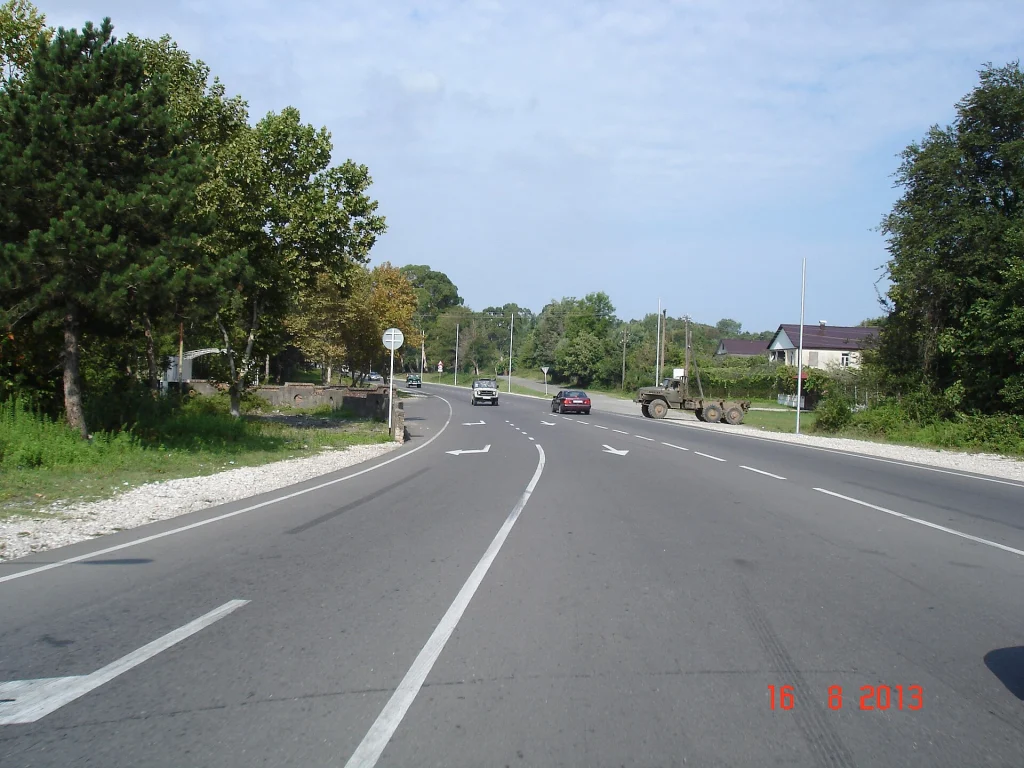
Georgia drives on the right. Seatbelts are compulsory in front and rear, hand-held phone use is banned, and headlights are required at all times outside towns. The widely applied limits are summarised below, though local signage always overrides the general rule, and expressway limits can vary by stretch.
| Road type | Typical limit |
|---|---|
| Built-up areas (towns, villages) | 50-60 km/h |
| Outside built-up areas | 80-90 km/h |
| Expressways (e.g. Tbilisi-Rikoti sections) | 100-110 km/h |
The drink-drive limit is very low by international standards, commonly cited at 0.03% blood alcohol for private drivers and effectively zero for professional and commercial drivers. Treat this as “do not drink and drive at all” rather than relying on a margin, and confirm the current figure before you travel since enforcement thresholds are occasionally revised.
Speed cameras and fines
Fixed and mobile speed cameras operate on main highways and at town approaches, and fines are issued in Georgian lari, payable at a discount if settled within a short window (commonly stated as a few days). Amounts scale sharply with the degree of overspeeding and are far higher for drink-driving, which can mean licence suspension as well as a fine. Because fine schedules and discount periods are set administratively and do change, we are not printing specific lari figures here; check the current schedule through Georgia’s Legislative Herald before you drive, and use the daily rate at gtour.ge data if you need to convert any posted figure into your own currency.
Mountain roads and winter equipment
The Georgian Military Highway toward Kazbegi, the Rikoti and Goderdzi passes, and routes into Svaneti and Tusheti close periodically for snow, avalanche risk or rockfall, sometimes for hours and sometimes for days. Winter tyres or chains are expected, and at times mandatory, on designated mountain sections during the cold months, with police controlling access and running escorted convoys when conditions are bad.
- Check road status before any winter mountain drive, including the Tbilisi-Kazbegi and Kutaisi-Mestia routes
- Carry chains even with winter tyres fitted; some passes require both
- Fill the fuel tank before climbing, since stations thin out above 1,500 metres
- A 4×4 is strongly advised, and sometimes required by rental terms, for Tusheti and Ushguli
For an up-to-date view of which passes are open, gtour.ge publishes a road status page during the winter season, and for travellers who would rather not navigate convoy schedules themselves, a day trip or multi-day tour to Kazbegi or Svaneti with a local driver handles the judgement calls for you.
Where this comes from
This answer draws on Georgia’s traffic and administrative legislation as published through the Legislative Herald (matsne.gov.ge), entry and documentation guidance from the Ministry of Foreign Affairs (mfa.gov.ge), and road and pass condition practices reported through Georgia’s road authority. Rental age limits, deposits and insurance terms vary by company and are not set by law, so always confirm them directly with your chosen rental firm before booking. Checked 27 October 2026; fine amounts, the drink-drive threshold and winter equipment rules are revised periodically, so verify current figures through the official sources above or through gtour.ge/road-status/ before a mountain drive.
If this guide is part of a trip you are planning, our Georgia in 10 Days — Tbilisi to Svaneti to the Sea and Monasteries of Georgia — Mtskheta, the Thirteen Fathers and Kakheti in 3 Days cover the places it describes with a private guide and driver; a GTour travel expert adapts the route to your dates.
Sources
- Ministry of Foreign Affairs of Georgia
- Legislative Herald of Georgia
- Law of Georgia on Road Traffic (Matsne consolidated legislation)
- Georgian Road Department (georoad.gov.ge) – Road Conditions and Winter Travel Advisories
- Agenda.ge – Traffic Fines and Speed Camera Regulation Updates
Questions this guide does not answer? Write to info@castle.ge or WhatsApp +995 577 41 63 14 — a person in Tbilisi replies. See also our travel services and all guides.
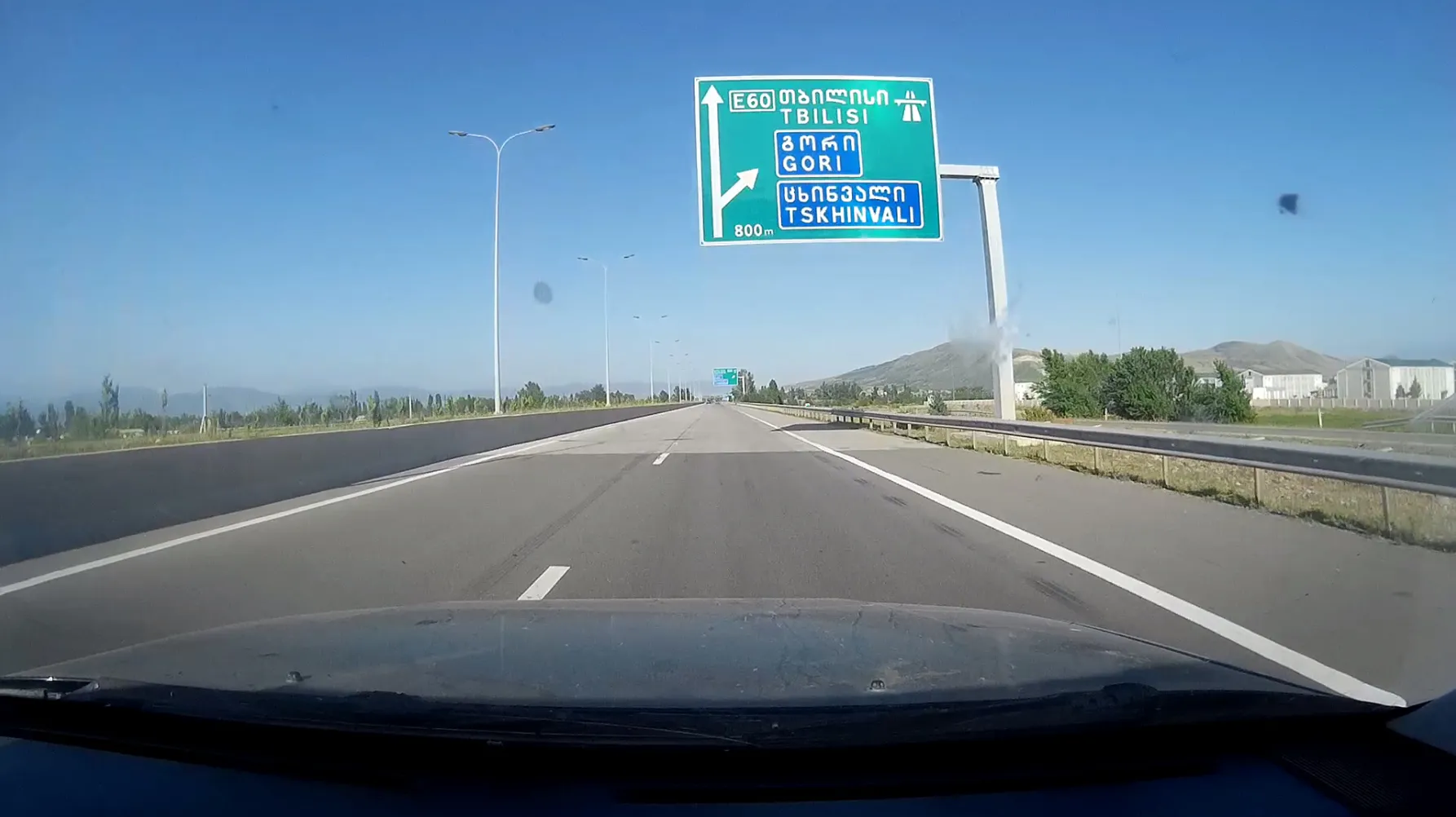
Highway sign near Tbilisi shows the E60 route and exits, typical of Georgia's road signage drivers must navigate. · Photo: Jelger Groeneveld / Wikimedia Commons, CC BY 2.0
Been to Georgia? Tell us how it went — the best stories are published here.
Share your tripOne email a week: what changed for travellers in Georgia — rules, roads, flights, seasons — plus one place worth the trip. Written by the GTour desk, no advertising, unsubscribe in one click.
This story across our partner network — ქართულად: შენი დასვენება