

By Nino Gelashvili, Travel News Editor · 27/10/2026
Andorran citizens do not currently need a visa to visit Georgia. Under Georgia’s general visa-free regime, nationals of Andorra may enter and stay for tourism, business or family visits for up to 365 days within a calendar year, the same allowance given to citizens of the European Union, Switzerland, Norway, Iceland and a handful of other European states. There is no Georgian e-visa requirement for this nationality, no pre-travel form to fill in, and no airport visa fee — you simply present a valid passport at the border. The one Andorran-specific wrinkle is that your national ID card is not sufficient; Georgia is outside the Schengen area, so airlines and border police require a passport.
Beyond entry rules, the honest picture for a traveller from Andorra is this: there are no direct flights, the ties between the two countries are thin, and almost everything else — money, SIM cards, driving, food — works the same way it does for any Western European visitor. This guide sets out what actually matters for trip planning, says plainly where official rules can change, and links the primary sources so you can check before you fly.
Visa and entry rules for Andorran citizens
Georgia’s visa policy is set by government decree and is reviewed periodically, so treat any guide, including this one, as a starting point rather than a guarantee. The Ministry of Foreign Affairs publishes the current visa-free list and consular contact details, and the e-visa portal explains who needs to apply and how; both are worth checking in the weeks before departure, especially if you are travelling on a document other than a standard Andorran passport, or staying beyond the tourist allowance for study, work or long-term residence, which does require a separate permit.
- Standard tourist stay: visa-free, up to 365 days, passport required
- Document needed: valid Andorran passport (not the national ID card)
- E-visa: not required for this nationality under current rules
- Verify before you fly: Ministry of Foreign Affairs of Georgia and evisa.gov.ge
Andorra has no embassy or consulate in Tbilisi, and Georgia has no resident diplomatic mission in Andorra la Vella. If you need consular help while in Georgia, Andorra’s own foreign ministry maintains a list of the posts that can assist its citizens abroad; register your trip with them before departure rather than assuming a nearby European embassy will automatically cover you, since Andorra is not an EU member and the EU’s “unrepresented citizen” consular-protection rule does not apply to it in the same way.
Flights from Andorra: routes and hubs
Andorra has no commercial airport. The practical starting points are Barcelona–El Prat (around two to two and a half hours by road or bus) or Toulouse–Blagnac (around two hours), both served by regular coach links from Andorra la Vella. From either city there is no nonstop service to Georgia; you will connect once, typically through Istanbul with Turkish Airlines, through Munich with Lufthansa, or through Doha with Qatar Airways, landing at Tbilisi International. Warsaw, via LOT, is another hub used on some Central European itineraries, and low-cost carriers periodically add seasonal links to Kutaisi International in western Georgia, which is useful if your trip starts in Batumi or Svaneti rather than the capital. Schedules and hub choices shift between seasons, so compare live options rather than assuming a fixed route.
| From | Typical connection | Arrives at |
|---|---|---|
| Barcelona or Toulouse | One stop via Istanbul, Munich or Doha | Tbilisi International |
| Barcelona or Toulouse | One stop via Warsaw or a European low-cost hub (seasonal) | Kutaisi International |
| Barcelona | One stop, various carriers | Batumi International (limited, mostly regional) |
Check live routes at Tbilisi International Airport, Kutaisi International Airport and Batumi International Airport. For the transfer at the Georgian end, G Tour’s fixed-price airport transfers start at €25 for a sedan between Tbilisi airport and any address in the city (full list at gtour.ge/services), which removes the guesswork of arriving after a long connection.
Driving licence and getting around
An Andorran driving licence issued in the standard EU/EEA format (most Andorran licences follow the French or Spanish model) is generally accepted for short-term driving in Georgia alongside your passport. Car rental desks and some police checks are more comfortable with an International Driving Permit attached to a foreign licence, so it is worth obtaining one before you leave, even though it is not always formally required. Georgia drives on the right, mountain passes close seasonally for snow, and road surfaces vary sharply between the main highways and remote valleys such as Tusheti or Svaneti, where a 4×4 and local experience matter. Current road and pass status is published at georoad.gov.ge; G Tour also maintains a plain-language road status page. If you would rather not drive, a car with an English-speaking driver starts at €90 a day around Tbilisi, rising to €165 for a multi-day 4×4 route (see services and prices).
Money, cards and cash
Georgia’s currency is the lari (GEL). As of 26 October 2026 the National Bank of Georgia’s reference rate is roughly 2.91 GEL to the euro, the currency Andorra itself uses, which makes rough mental conversion straightforward; always check the live rate before a large exchange, since it moves daily. Contactless and chip cards are accepted in almost all Tbilisi, Batumi and Kutaisi hotels, restaurants and shops, and widely across Kakheti‘s wine country. Carry cash for rural guesthouses, market stalls, small mountain villages in Svaneti, Tusheti and Racha, and for tipping. ATMs are common in cities and in most regional towns, less so in high mountain areas, so withdraw before heading into Svaneti or Tusheti.
SIM cards, eSIM and language
Georgian mobile operators Magti, Geocell and Beeline sell tourist SIM cards at both airports and in city branches, usually with generous data allowances; eSIM options from international providers also work well in cities and along the main road network, though coverage thins out in deep mountain valleys. Georgian is the official language, written in its own script, and the one you’ll see on road signs and menus; Russian is understood by much of the older generation and in tourism-facing businesses; English is the practical working language in Tbilisi’s hotels, restaurants and tour operations, and increasingly so in Batumi and Kutaisi. Catalan, Spanish and French — Andorra’s own languages — are not generally understood, so plan on English as your bridge, and a translation app for rural areas.
Food, dietary needs and what’s on the table
Georgian cuisine centres on bread, cheese, walnuts, fresh herbs and wine rather than heavy spice, which travellers from the Catalan and Occitan food traditions of Andorra tend to find approachable. Khinkali (dumplings), khachapuri (cheese-filled bread) and mtsvadi (grilled meat) are the staples most visitors try first. Vegetarian eating is easy: lobio (bean stew), pkhali (walnut-and-vegetable pâtés) and ajapsandali (stewed vegetables) are traditional, not token additions, and Tbilisi now has a growing number of dedicated vegan restaurants. Halal options are more limited outside Adjara, where Batumi’s Muslim community supports several halal-certified kitchens; elsewhere, ask directly, as pork and pork fat are common in traditional cooking. Georgia’s qvevri clay-vessel winemaking tradition, recognised by UNESCO as intangible cultural heritage, is worth building a day around, particularly in Kakheti (see Kakheti Wine Country — Day Trip or the longer Kakheti Grand Wine & Heritage tour).
Health, insurance, safety and etiquette
Georgia does not currently impose a blanket mandatory-insurance requirement at the border for visa-free visitors, but this has changed before during public-health emergencies, so verify current entry conditions at mfa.gov.ge or evisa.gov.ge close to your travel date rather than relying on last year’s rule. Whatever the border requirement, travel medical insurance that explicitly covers hiking, skiing and mountain evacuation is strongly advisable: state emergency care is billed to foreign nationals, and rescue from remote areas such as Tusheti or the Svaneti high passes can be costly and logistically slow. Altitude is a genuine factor around Kazbegi and Gudauri; ascend gradually and see a doctor before any high-altitude trekking if you have a cardiac or respiratory condition. Georgia is, by regional standards, a safe destination with low rates of violent crime against tourists; usual precautions apply around transport hubs and markets. At the table, the supra (feast) comes with a structured toasting culture led by a tamada (toastmaster) — participation is welcomed, heavy drinking is not obligatory, and saying so plainly is accepted. In churches and monasteries, women are expected to cover their heads and shoulders, and shorts are discouraged for all visitors; headscarves are usually available at the door.
Georgia and Andorra: honest about the ties
There is no significant trade relationship, diaspora community or historical link between Georgia and Andorra, and it would be misleading to suggest otherwise. Georgia’s statistics office publishes visitor numbers by nationality, and Andorra registers as a negligible, often unlisted, share of arrivals (see geostat.ge for the tourism series). What the two countries do share is a cultural resonance that makes Georgia an interesting choice for an Andorran traveller specifically: both are small, mountainous, historically Christian societies with strong pastoral and wine traditions, where valley life and high-altitude village life sit close together. That similarity is a reason to visit, not a historical tie, and it is worth framing it that way rather than inventing a connection that is not there.
If this guide is part of a trip you are planning, our Georgia in 10 Days — Tbilisi to Svaneti to the Sea and Monasteries of Georgia — Mtskheta, the Thirteen Fathers and Kakheti in 3 Days cover the places it describes with a private guide and driver; a GTour travel expert adapts the route to your dates.
Practical summary
- Visa: not required for stays up to 365 days — verify current rules at mfa.gov.ge and evisa.gov.ge before you fly
- Travel on your Andorran passport, not the national ID card
- No direct flights; connect via Barcelona or Toulouse, then typically Istanbul, Munich, Doha or Warsaw
- Driving: Andorran licence usually accepted short-term; carry an International Driving Permit for rental desks
- Money: lari (GEL), roughly 2.91 to the euro on 26 October 2026 — check the live rate; cards work in cities, cash needed in the mountains
- SIM/eSIM widely available; English is the practical bridge language in tourism settings
- Travel medical insurance covering mountain activities is strongly recommended even if not mandatory at the border
- No formal diplomatic ties between the two countries; register travel with Andorra’s own foreign ministry before departure
- For a structured first visit, see Georgia in 7 Days — The Classic Grand Tour or, for mountains specifically, Kazbegi — 2-Day Mountain Journey and Mestia & Ushguli — 3 Days in Svaneti
Sources
- Ministry of Foreign Affairs of Georgia
- Georgia e-visa portal
- Road conditions and pass status
- Georgia's National Statistics Office, tourism data
- Qvevri wine-making, intangible cultural heritage
Questions this guide does not answer? Write to info@castle.ge or WhatsApp +995 577 41 63 14 — a person in Tbilisi replies. See also our travel services and all guides.
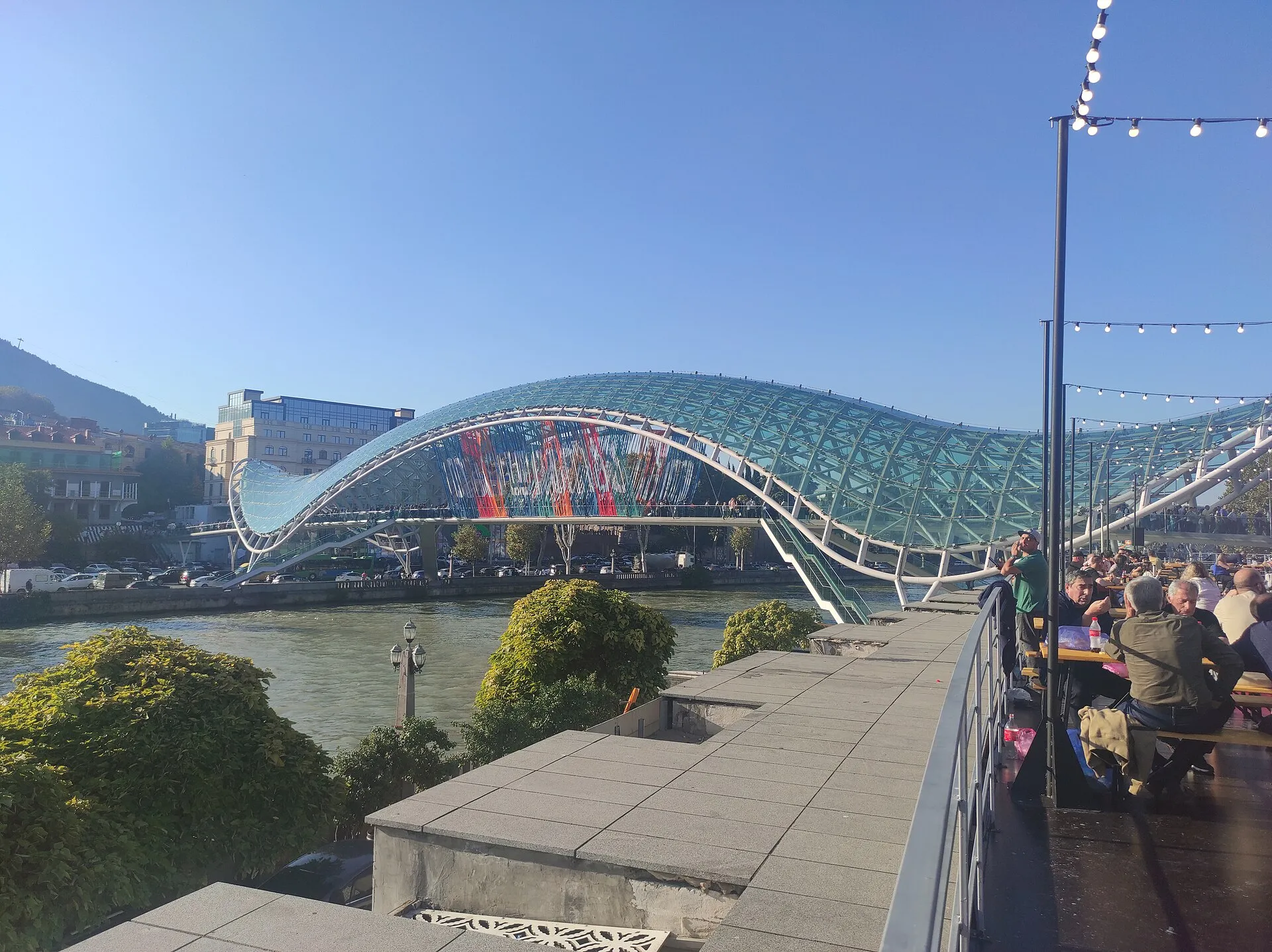
Crowds gather at Tbilisi's Bridge of Peace during a city festival, a key sight for visitors. · Photo: David Osipov / Wikimedia Commons, CC BY 4.0
Been to Georgia? Tell us how it went — the best stories are published here.
Share your tripOne email a week: what changed for travellers in Georgia — rules, roads, flights, seasons — plus one place worth the trip. Written by the GTour desk, no advertising, unsubscribe in one click.
This story across our partner network — ქართულად: შენი დასვენება
