

By David Kiknadze, Transport & Openings Reporter · 27/10/2026
Thai citizens travelling to Georgia in 2026 should expect a straightforward entry process, no direct flights, and a country that is easy but not yet set up specifically for Thai visitors: expect good infrastructure, polite confusion if you speak Thai, and food that is unfamiliar but increasingly easy to navigate with a little guidance. As of this writing Georgia’s unilateral visa-free policy generally allows Thai ordinary-passport holders to enter for tourism without a visa, with a permitted stay historically reported at up to one year, but this rule has shifted before and could shift again, so confirm it on the Ministry of Foreign Affairs consular pages and the official e-visa portal before you book anything.
This guide covers what actually matters for a Thai traveller: the current visa and insurance rules, how to physically get here (there are no non-stop flights from Thailand), what to do about money and SIM cards, where Georgian and Thai will or will not overlap, what you will eat, whether there is any real historical connection between the two countries, and where a private guide from G Tour removes the friction that independent travellers from Thailand tend to hit hardest, namely language and logistics in rural Georgia.
Visa and entry rules for Thai citizens
Georgia has long run one of the more liberal visa regimes in the region, and Thai nationals have generally benefited from this as part of the country’s unilaterally declared visa-free list for tourism. Reported allowances have included stays of up to 365 days without a visa for short tourist and business visits, but Georgia reviews this list periodically and stay lengths or eligibility can change without much public notice. Do not rely on secondhand blog posts, including this one, for your actual travel date: check the consular section of Georgia’s Ministry of Foreign Affairs and the official entry-requirements summary on Georgia’s national tourism site in the weeks before you fly.
If your situation falls outside the visa-free category, or if the rules change before your trip, Georgia’s e-visa system is run through evisa.gov.ge. The portal lets you apply online, upload a passport scan and photo, pay the fee by card, and receive a decision electronically rather than visiting an embassy in person. Processing is usually quoted in a small number of working days, but the portal itself states the current turnaround, and it is sensible to apply at least a week before departure rather than relying on expedited processing.
Georgia does not maintain an embassy in Bangkok, and Thailand does not maintain one in Tbilisi. Consular coverage for each country is typically handled from a neighbouring capital, which has changed over the years, so if you need consular assistance while travelling, check the current arrangement through the Thai Ministry of Foreign Affairs before you leave home rather than assuming a specific office will be open in the region.
Getting there: flights and driving in Georgia
There are no non-stop flights between Thailand and Georgia, and this is unlikely to change soon given the thin passenger volume between the two countries. Practically every Thai traveller connects through a major hub. From Bangkok, the three routings that actually apply are:
- Via Istanbul on Turkish Airlines, landing at Tbilisi International Airport.
- Via Doha on Qatar Airways, with an onward connection to Tbilisi or Kutaisi.
- Via Dubai on Emirates or flydubai, connecting to Tbilisi, Kutaisi or Batumi depending on season.
Warsaw and Munich routings exist for European travellers but are rarely the sensible choice flying out of Thailand, so they are not covered here. Total journey time from Bangkok is usually 12 to 16 hours of flying plus a connection, so plan for a long travel day either way. Check live schedules and arrivals directly at Tbilisi International Airport, and at Kutaisi and Batumi’s own sites if your routing lands there, since Georgian budget and seasonal capacity changes year to year.
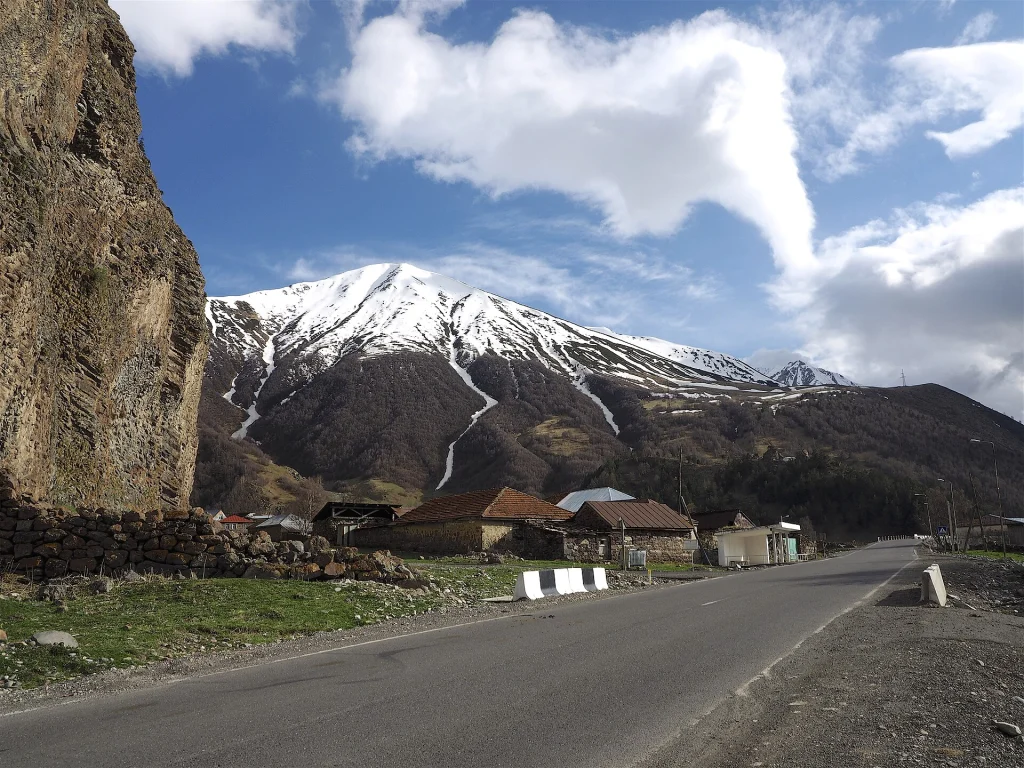
For driving, Georgia generally allows visitors to drive on a foreign national licence for a limited period, and Thai licences carry Thai and English text on the card itself, which helps with rental desks and police checks. An International Driving Permit is still worth carrying as a backup, since enforcement and rental-company policy can vary, and the exact rule sits in Georgia’s traffic legislation, which you can check through Matsne, Georgia’s legislative herald, or ask your rental company directly. Mountain routes such as the road to Kazbegi or over winter passes are steep and can close with snow; check conditions before driving yourself on the Georgian Road Department’s site, or let a driver handle it, which is the approach most of our clients prefer once they have seen a Georgian mountain road in winter.
Money, cards and SIM cards
Georgia’s currency is the lari (GEL). As of 26 October 2026 the National Bank of Georgia’s reference rate was roughly 2.60 GEL per US dollar and 2.91 GEL per euro; there is no direct lari rate quoted for Thai baht, so most travellers convert baht to US dollars or euros before arrival, or simply withdraw lari from an ATM on arrival using a Thai bank card through the Visa or Mastercard networks. Cards are widely accepted in Tbilisi, Batumi and Kutaisi hotels, restaurants and supermarkets; cash is still the norm in rural guesthouses, small mountain villages, and local markets, so carry some lari once you leave the main cities.
SIM and eSIM options are easy: Georgia’s three main mobile operators sell tourist SIM packages at the airport and in city centres, and eSIM profiles from international providers generally work without issue. Coverage is good in cities and along main roads, and patchy in remote mountain regions such as Tusheti or parts of Svaneti, which matters if you are relying on translation apps there.
Language: where you will and will not be understood
Georgian is written in its own alphabet and is not related to Thai in any way, so there is no shortcut here. English is reasonably common in Tbilisi’s tourist-facing businesses, hotels and among younger guides, less so in small towns and villages. Russian is still widely understood by the older generation due to the Soviet period, which is irrelevant for most Thai travellers but worth knowing if you see signage in two scripts. Thai is not spoken anywhere in Georgia in any practical sense, including at the airport, so a translation app with an offline Georgian pack is genuinely useful outside the capital, and a guide who speaks both English and Georgian removes the problem entirely for day trips and multi-day touring.
Food: halal, vegetarian and what will feel familiar
Georgian food is built around bread, cheese, walnuts, herbs and grilled or stewed meat, and it is not spicy by Thai standards, though the table condiment adjika brings real heat if you ask for it. Vegetarian travellers are well served: dishes such as lobio (bean stew), pkhali (walnut and vegetable pâtés), mushroom khinkali, and grilled vegetables are standard on most menus, not an afterthought. Halal food is not the norm in a country that is overwhelmingly Orthodox Christian, but it is not absent either: halal butchers and restaurants exist in Adjara and parts of Kvemo Kartli with larger Muslim populations, and in Tbilisi near areas with Turkish and Azerbaijani communities. If halal certification matters to you, ask your guide or hotel in advance rather than assuming a restaurant qualifies, since labelling is inconsistent. Thai, Chinese and other Asian restaurants have grown in number in Tbilisi in recent years, useful on a night when you want something familiar rather than another plate of khachapuri.
Georgia and Thailand: honest about thin ties
There is no deep historical, religious or trade relationship between Georgia and Thailand to draw on here, and it would be misleading to invent one. The two countries sit on opposite sides of Asia with different religious traditions, different alphabets, and limited direct trade; Georgian wine exports to Thailand and Southeast Asia have grown modestly in recent years as Georgian wine gains international attention, and Thai tourist numbers to Georgia have risen gradually post-pandemic alongside wider growth in Asian arrivals, a trend you can track through Georgia’s official visitor statistics at Geostat. Beyond that, the practical reality is that most Thai visitors are discovering Georgia independently, drawn by mountains, wine country and a style of travel very different from Southeast Asia, rather than following any established community or historical link.
Health, insurance, safety and etiquette
Georgia has at various points required visitors to carry proof of travel medical insurance for entry, a rule introduced during the pandemic period and subject to revision; confirm the current requirement through Georgia’s official government portal at gov.ge before you fly, and buy a policy that covers medical evacuation, since mountain regions such as Svaneti, Tusheti and Kazbegi have limited medical facilities. For any vaccination or health advisory specific to your trip, consult Thailand’s own travel health guidance and, for Georgia-specific public health information, Georgia’s National Center for Disease Control and Public Health; a doctor is the right source for personal medical decisions, not a travel article.
Georgia is a generally safe country with low rates of violent crime against tourists; normal precautions around valuables and late-night streets apply as anywhere. Etiquette notes specific to Thai travellers: Georgian greetings do not involve the wai, a handshake or nod is standard; a Georgian supra (feast) involves extended toasting with wine, and declining alcohol is accepted if you explain you do not drink, though you will likely be offered it repeatedly and warmly; churches require covered shoulders and knees, and women are often asked to cover their heads with a scarf, which are provided at the door of most working churches and monasteries. Shoes stay on indoors in most Georgian homes and restaurants, unlike in Thailand, so do not feel obliged to remove them unless asked.
What a G Tour private guide adds
For a Thai traveller, the main friction points in Georgia are language outside Tbilisi, navigating mountain roads safely, and knowing which restaurants can actually accommodate dietary needs. A licensed G Tour guide handles all three: our day guides run from €70 for a half-day city walk to €140 for a specialist full day, and a car with an English-speaking driver starts at €90 a day around Tbilisi or €100 a day on multi-day touring, with a 4×4 required and available for routes like Tusheti or Ushguli. Airport pickup is a fixed €25 by sedan from Tbilisi airport, arranged in advance with flight tracking so nobody is left waiting at arrivals after a long multi-stop flight from Bangkok. For a first visit, the Tbilisi & Mtskheta — The Essential First Day tour or the longer Georgia in 7 Days — The Classic Grand Tour cover the country’s core sites with a guide who can also act as your translator and cultural buffer, which matters more here than in destinations where English is universal. Full pricing for every tour and service sits on our data page.
If this guide is part of a trip you are planning, our Georgia in 10 Days — Tbilisi to Svaneti to the Sea and Monasteries of Georgia — Mtskheta, the Thirteen Fathers and Kakheti in 3 Days cover the places it describes with a private guide and driver; a GTour travel expert adapts the route to your dates.
Practical summary
- Visa: Thai citizens are generally expected to enter visa-free for tourism, but confirm current stay length and eligibility on mfa.gov.ge and evisa.gov.ge before booking.
- Flights: no direct route from Thailand; connect via Istanbul, Doha or Dubai to Tbilisi, Kutaisi or Batumi.
- Driving: Thai licence usually accepted short-term; carry an International Driving Permit as backup and check road conditions before mountain driving.
- Money: lari (GEL) is the only currency used day to day; cards work in cities, carry cash for villages and mountains.
- SIM/eSIM: easy to buy on arrival; coverage thins out in remote mountain areas.
- Language: English works in Tbilisi’s tourist zones; Thai is not understood anywhere; a guide solves the gap elsewhere.
- Food: not spicy by default, strong vegetarian options, halal food exists but is not standard — ask ahead.
- Insurance: travel medical insurance requirements have changed before; verify on gov.ge and buy cover that includes evacuation from mountain regions.
- Ties: historically thin between the two countries; this is a practical destination choice, not a heritage trip.
Sources
- Georgia e-visa portal
- Ministry of Foreign Affairs of Georgia
- Georgia national tourism administration
- Georgian legislative herald (Matsne)
- Georgian Road Department, road conditions
- Georgian government official portal
- Geostat, tourism statistics
Questions this guide does not answer? Write to info@castle.ge or WhatsApp +995 577 41 63 14 — a person in Tbilisi replies. See also our travel services and all guides.
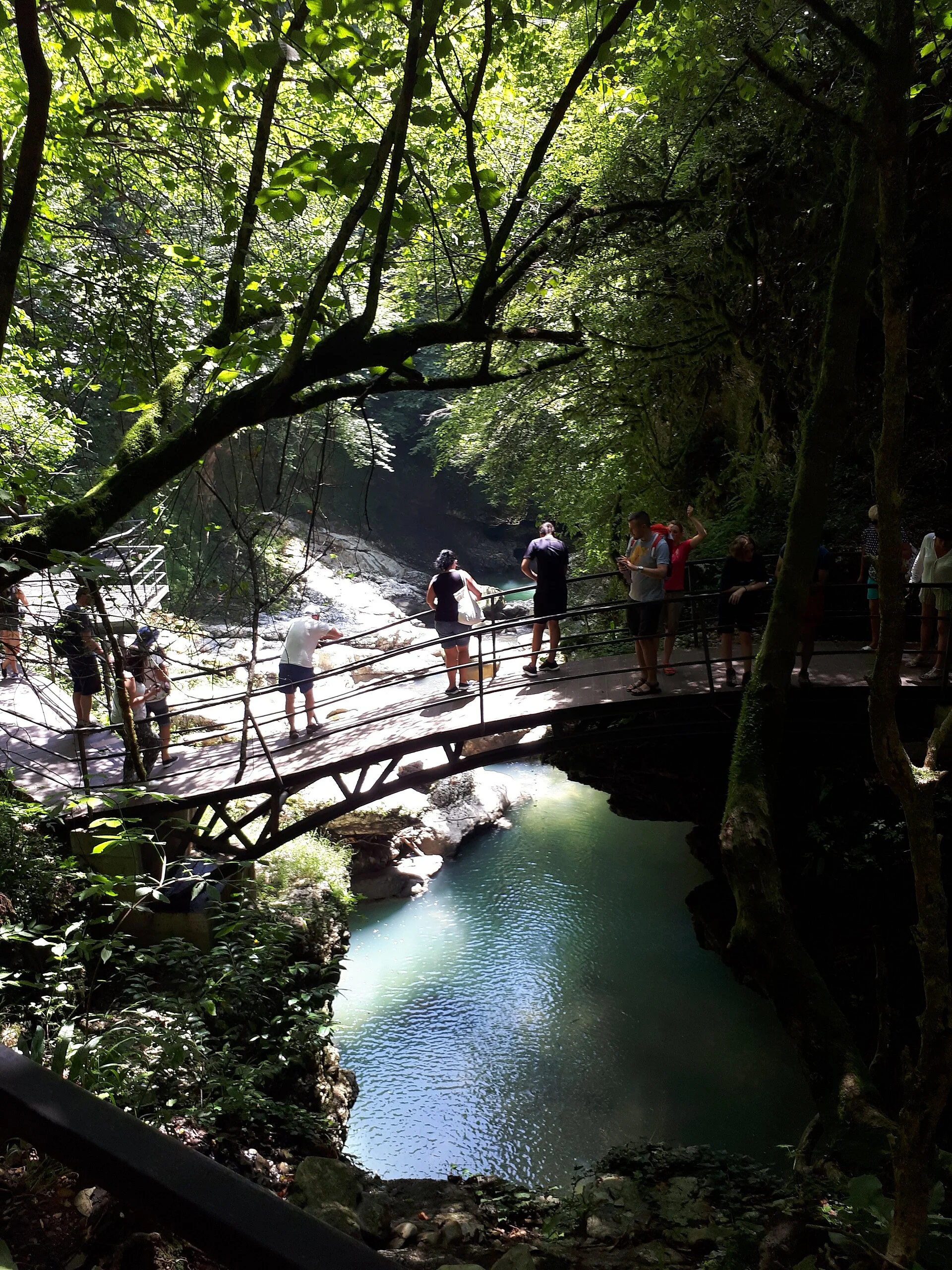
Tourists cross a bridge over the turquoise water of Martvili Canyon, a popular Georgian day trip. · Photo: Kober / Wikimedia Commons, CC BY-SA 4.0
Been to Georgia? Tell us how it went — the best stories are published here.
Share your tripOne email a week: what changed for travellers in Georgia — rules, roads, flights, seasons — plus one place worth the trip. Written by the GTour desk, no advertising, unsubscribe in one click.
This story across our partner network — ქართულად: შენი დასვენება