

By David Kiknadze, Transport & Openings Reporter · 14/11/2026
Georgia’s Soviet-era architecture is worth a detour because nowhere else compressed late-Soviet engineering bravado, national revival and provincial industrial planning into such a small territory in so few decades. The candidates span the capital’s cantilevered Ministry of Highways and the domed Palace of Rituals, the cable cars still hauling miners and shoppers above Chiatura‘s gorge, the crumbling spa halls of Tskaltubo, the grid-planned steel city of Rustavi, and the roadside bus pavilions of Adjara and the western lowlands, many decorated with the mosaics that gave Soviet Georgian modernism its distinctive, half-folkloric, half-futurist look.
None of this is officially branded heritage in the way Georgia’s medieval churches are. Protection status varies by building, some structures are unsafe or in active dispute over demolition, and several sanatoriums still house families displaced by the 1992-93 war in Abkhazia. This guide sets out which sites reward a special trip, what condition to expect in November 2026, and how to visit without turning someone’s damaged home into a backdrop.
What “Soviet modernism” means in a Georgian context
From the 1960s, Georgian architects were given unusual latitude within the Soviet system to blend brutalist concrete with motifs drawn from medieval Georgian church architecture, metalwork and folk pattern. The result, sometimes called the Tbilisi or Georgian school, produced buildings that look structurally daring even by today’s standards: cantilevers with no visible support, interlocking concrete tubes, and facades carrying ceramic or smalti mosaics rather than plain render. The best-known names are Giorgi Chakhava and Zurab Jalaghania, who designed the Ministry of Highways building, and Victor Djorbenadze, associated with the Palace of Rituals. Because these buildings postdate Georgia’s main UNESCO inscriptions, you will not find them on the World Heritage list; status and ownership instead sit with national and municipal bodies, and it is worth checking current protection listings before planning entry, since some buildings have changed hands or faced demolition threats in the past decade.
Tbilisi’s brutalist landmarks: from the Ministry of Highways to the Wedding Palace
The former Ministry of Highways building, now the Bank of Georgia headquarters in the Dzveli Tbilisi district, is the single most photographed piece of Georgian Soviet architecture: a stack of cross-shaped concrete modules raised on pilotis above the Mtkvari gorge, completed in 1975. It remains a working office, so exterior viewing from the riverside path and the Saburtalo side is the practical approach. The Palace of Rituals, popularly the Wedding Palace, on Paliashvili descent, is a 1985 Djorbenadze design of pierced towers and a domed hall built for secular Soviet wedding ceremonies; it passed into private ownership and today functions as an exhibition and event venue, with opening hours that vary by booking. The former Tbilisi bus station, several Saburtalo and Vake apartment blocks with ceramic relief panels, and the mosaic-clad former cinema interiors are all reachable on foot from the old town. For context and interior access arranged in advance, Soviet Tbilisi — Modernist Architecture and Mosaics, 3.5 Hours is built around exactly this route.
Tskaltubo: the sanatorium district
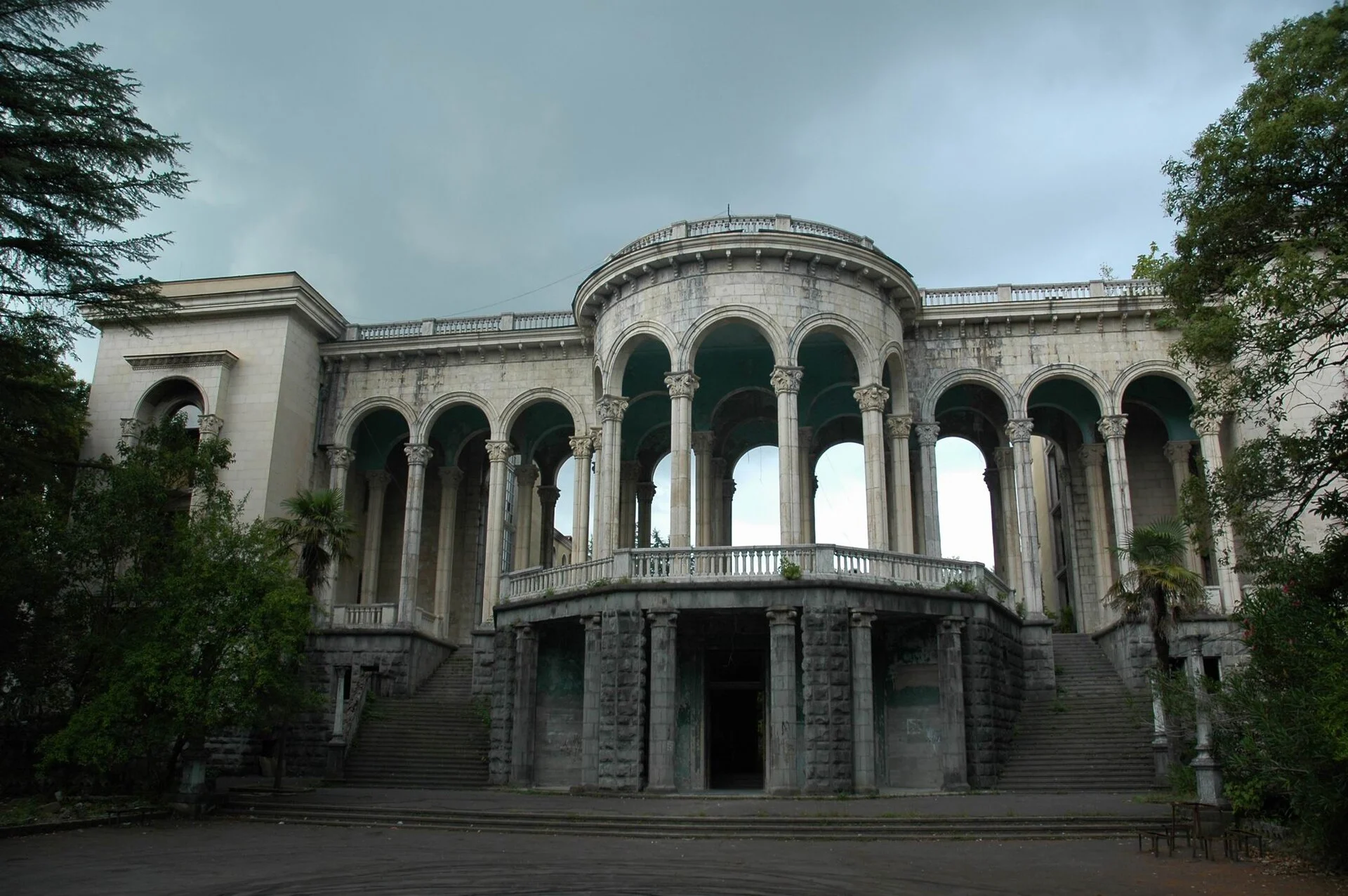
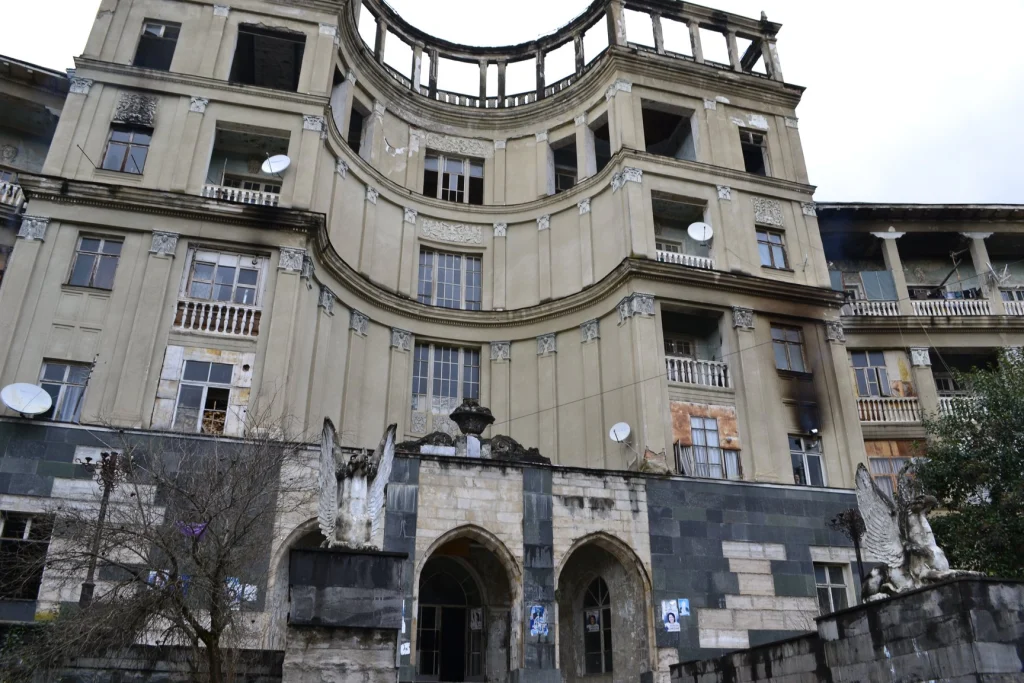
Tskaltubo, forty minutes from Kutaisi, was the Soviet Union’s showcase radon-spa town, with around twenty grand sanatoriums built from the 1950s, each attached to a distinct ministry or republic. Several stand roofless and stripped, others are mid-restoration as boutique hotels, and a number still have residential wings occupied by people displaced from Abkhazia in the 1990s who were only fully rehoused into durable housing in the past few years under a government and donor-backed program. This means parts of Tskaltubo are private homes, not ruins, whatever the exterior suggests; always ask before entering a wing or photographing residents, and expect some buildings to be fenced for structural safety. The spa function itself continues: radon-carbonate bathing in the renovated bathhouses is bookable, and several of the historic sanatoriums now operate as hotels. Gelati, Motsameta and Tskaltubo — Kings, Saints and Soviet Spas from Kutaisi pairs the medieval sites with a guided, permission-based look at the sanatorium district; travellers wanting the cure itself rather than the architecture can book Tskaltubo Cure — 7 Nights of Radon-Carbonate Baths and Mud or the shorter Tskaltubo Short Cure — 3 Nights of Radon Baths.
Chiatura: the cable-car town
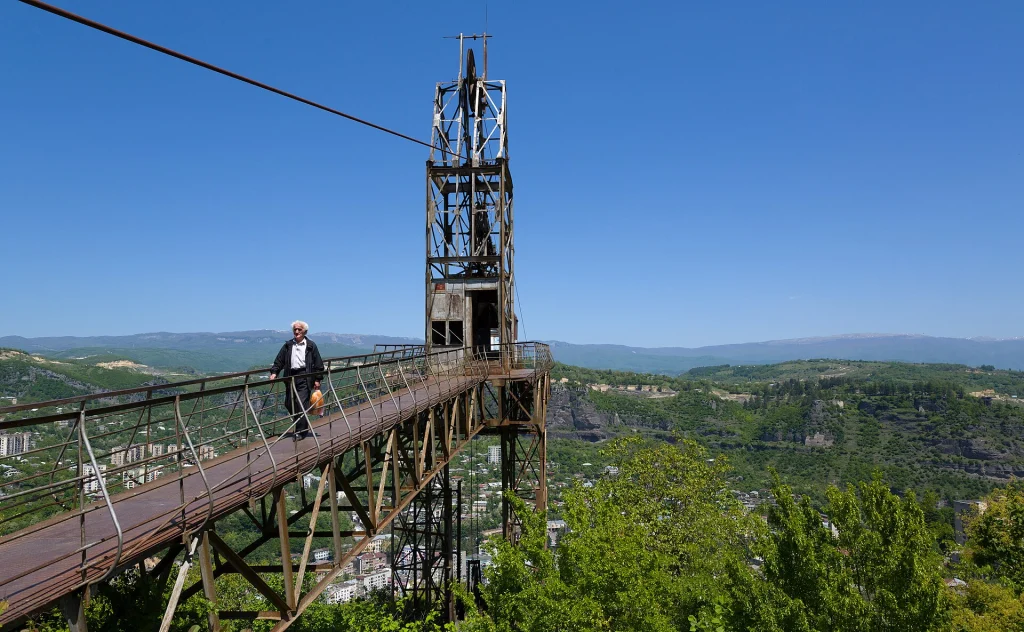
Chiatura, built around manganese mining in a steep gorge north of Zestaponi, is strung with Soviet-era cable cars that still carry residents up the cliff faces to hillside neighbourhoods, since the alternative is a long stair climb. Several lines were renovated with Austrian engineering support over the past decade and remain in daily public use at low fares, which makes this one of the few sites on this list where you are riding working infrastructure rather than viewing a ruin. The town itself, with its manganese-dust patina and Soviet administrative buildings, is worth an hour beyond the cable cars. It combines naturally with the nearby cliff monastery of Katskhi Pillar on Katskhi Pillar and Chiatura — the Monk’s Rock and the Cable-Car Town from Kutaisi.
Rustavi and the roadside mosaic trail
Rustavi, twenty-five kilometres south-east of Tbilisi, was built from the 1940s as a model steel and chemical city, with a wide, axial, strictly gridded centre that is the clearest surviving example of Soviet urban planning in Georgia, in contrast to the organic old towns elsewhere in the country. The metallurgical plant’s smokestacks remain visible from the central boulevard. Away from Rustavi, the real distributed museum of this era is the roadside bus pavilion: hundreds of small shelters across Imereti, Guria, Adjara and Samegrelo were built as one-off concrete and mosaic sculptures rather than standard models, a regional variant of the style documented across the wider former Soviet space. Few are signposted or named, so spotting the best examples along the Batumi-Kobuleti coast road or the Khulo-Goderdzi mountain road benefits from a driver who already knows where to slow down, which is one reason to combine the search with a scheduled stop on Adjara Highlands — Khulo, the Goderdzi Pass and the Green Lake or a bespoke Car with Driver by the Day.
| Site | Region | Built | Current state (Nov 2026) | Visit notes |
|---|---|---|---|---|
| Ministry of Highways (Bank of Georgia HQ) | Tbilisi | 1975 | Working office building | Exterior view only, riverside path |
| Palace of Rituals (Wedding Palace) | Tbilisi | 1985 | Privately owned, event venue | Interior by booking or guided tour |
| Tskaltubo sanatoriums | Imereti | 1950s-1970s | Mixed: ruins, hotels, some former residential wings | Ask before entering occupied or fenced sections |
| Chiatura cable cars | Imereti | 1950s, several lines renovated | Working public transport | Ride as a passenger, respect queueing locals |
| Rustavi city centre | Kvemo Kartli | 1940s-1950s | Functioning planned city | Self-guided walk along the central boulevard |
| Roadside bus pavilions | Adjara, Guria, Imereti | 1960s-1980s | Mostly in use or disused roadside, variable condition | Photograph from the roadside, do not block traffic |
Visiting respectfully
Three issues recur across this list: physical safety, residential privacy and the uncertain legal status of several buildings. Concrete at fifty to seventy years old can spall without warning, several sanatorium roofs have collapsed in winter snow loads, and the Chiatura cable cars run to a working schedule for people who need them, not for photographers. Practical rules:
- Treat fenced-off buildings as fenced for a structural reason, not as an invitation.
- In Tskaltubo, assume any wing with laundry, window glass or a door lock is someone’s home, and ask a local guide or the building’s caretaker before stepping past the entrance hall.
- On the Chiatura cableways, let residents board first and keep cameras away from faces without asking.
- Interior access to the Wedding Palace, the former Ministry of Highways and several sanatoriums depends on prior arrangement, which a licensed guide can usually obtain faster than an unannounced visit.
- Check current protected-monument status before assuming a building is safe from demolition or alteration; listings and designations do change.
A specialist guide also closes the gap between seeing a mosaic and understanding which ministry it served, which is most of the appeal of this architecture. Soviet Tbilisi — Modernist Architecture and Mosaics, 3.5 Hours and the Gelati, Motsameta and Tskaltubo day from Kutaisi are built for this; a Licensed Private Guide by the Day can extend either into Chiatura, Rustavi or the Adjara bus-stop road.
If this guide is part of a trip you are planning, our Georgia Off the Beaten Track — 9 Days in Racha, Samegrelo and Guria and Batumi to Kutaisi Transfer — Private Car cover the places it describes with a private guide and driver; a GTour travel expert adapts the route to your dates.
Practical summary
- Tbilisi brutalism: view the former Ministry of Highways from outside, book ahead for the Palace of Rituals interior.
- Tskaltubo: mix ruin, hotel and home, ask before entering any residential-looking wing.
- Chiatura: ride the working cable cars respectfully, combine with Katskhi Pillar.
- Rustavi: a planned industrial city, best as a half-day add-on from Tbilisi.
- Bus pavilions and mosaics: spread along Adjara, Guria and Imereti roads, best found with a local driver.
- Check current heritage-protection status and access rules before relying on any single building remaining open or unaltered.
- Guided options: Soviet Tbilisi — Modernist Architecture and Mosaics, Katskhi Pillar and Chiatura, and Gelati, Motsameta and Tskaltubo cover the core route without a rental car.
Sources
- National Agency for Cultural Heritage Preservation of Georgia
- Cultural heritage monuments database
- The Eerie Abandoned Spa Town of Tskaltubo (Smithsonian Magazine)
- Tskaltubo Sanatorium Restoration Project (Agenda.ge)
- Cultural Heritage Monuments List – Chiatura Ropeway (APA.gov.ge)
Questions this guide does not answer? Write to info@castle.ge or WhatsApp +995 555 42 38 45 — a person in Tbilisi replies. See also our travel services and all guides.
The grand neoclassical rotunda of the Medea sanatorium in Tskaltubo, a showcase of Soviet-era spa architecture. · Photo: Yarkolp / Wikimedia Commons, CC BY-SA 3.0
Been to Georgia? Tell us how it went — the best stories are published here.
Share your tripOne email a week: what changed for travellers in Georgia — rules, roads, flights, seasons — plus one place worth the trip. Written by the GTour desk, no advertising, unsubscribe in one click.
This story across our partner network — ქართულად: შენი დასვენება
