


By Nino Gelashvili, Travel News Editor · 29/10/2026
The honest Georgian souvenirs are five: minankari cloisonné enamel jewellery, felt goods from Tusheti and the high Caucasus, hand-knotted Kakhetian and Caucasian carpets, Shrosha and Imereti pottery, and Khevsur daggers or other mountain ironwork, with the chokha (the belted wool coat with cartridge loops across the chest) as the one wearable piece everyone recognises. All five are still made by hand in Georgia today, all five are sold next to mass-produced imitations from the same stalls, and the difference in price between a genuine piece and a printed-enamel or machine-woven copy is often tenfold, not twofold.
Buy from a named workshop or a stallholder who can tell you who made the piece and where, ask for a receipt that states materials (silver content, wool type, hand-knotted or machine-made), and treat anything claimed as “antique” with real caution, because genuinely old icons, weapons, manuscripts and carpets fall under Georgia’s cultural-heritage export controls and need a permit to leave the country. Dry Bridge market in Tbilisi remains the best single place to see the whole range in one afternoon, but the best pieces at fair prices usually sit in the workshops, not on the pavement.
Minankari: Georgian cloisonné enamel
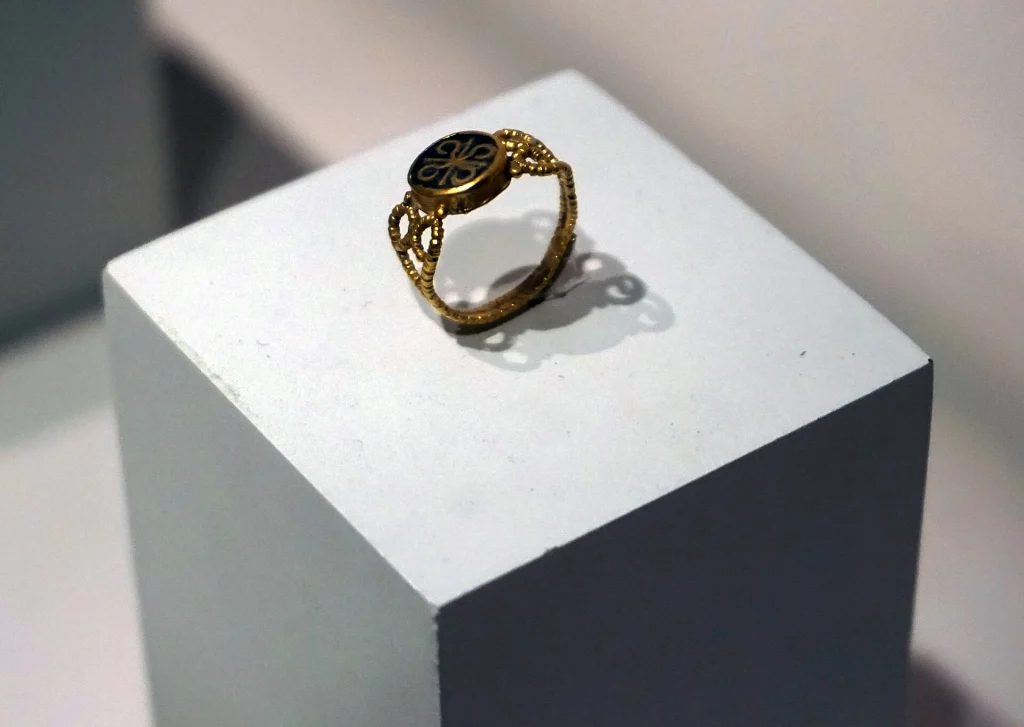
Minankari is vitreous enamel fused onto gold or silver wire cells, a technique documented in Georgian metalwork since at least the early medieval period and visible on the enamelled icons and crosses in the Georgian National Museum’s treasury collection in Tbilisi. Contemporary minankari jewellers in Tbilisi still work the same way: bending fine silver or gold wire into a design, filling the cells with powdered glass enamel, and firing the piece several times in a kiln. A genuine hand-fired piece has slightly uneven colour fields and a visible wire outline you can feel with a fingernail; printed or stamped “enamel-look” jewellery is perfectly flat and far cheaper.
Expect roughly GEL 80 to GEL 300 (about EUR 28 to EUR 104 at the National Bank of Georgia’s reference rate) for small silver pendants and earrings from a workshop, rising well above GEL 1,000 for larger gold pieces or named-artist work. Prices move with the gold and silver market, so treat these as a starting point and ask the workshop for today’s figure.
Felt from Tusheti and the high Caucasus
Tush and other mountain communities have long turned sheep’s wool into felt burka cloaks, nabadi (shepherd’s felt coats), slippers, hats and the thick woollen socks worn under mountain boots. Good felt is dense, slightly springy, and smells faintly of lanolin rather than synthetic dye; it is also heavy, so a full burka is a serious purchase in both price and suitcase weight. Felt hats and socks are the practical buy for most travellers, typically GEL 40 to GEL 120, while a hand-felted burka or nabadi from a mountain cooperative can run from GEL 400 upward. Travellers who want to see the wool worked in its own setting, rather than buy it retrofitted for a souvenir shelf, are better served by a trip into the mountains themselves; our Tusheti Expedition and Khevsureti and Tusheti by 4×4 tours both pass through villages where felt and wool work is still a household craft, not a shop display.
Kakhetian and Caucasian carpets
Hand-knotted and flatwoven (kilim-style) carpets from Kakheti and the wider South Caucasus turn up heavily in Tbilisi’s antique and carpet shops, and distinguishing a genuine old or well-made new piece from a machine-loomed import (often actually made outside Georgia) takes patience. Turn the carpet over: hand-knotted work shows an uneven, slightly irregular pattern on the back that mirrors the front, while machine work is perfectly uniform. Ask whether the piece is wool-on-wool or wool-on-cotton, and whether dyes are natural or synthetic, since both affect price and longevity. A small new hand-knotted rug typically starts around GEL 300 to GEL 600; older carpets claimed as antique should come with documentation, because genuinely antique carpets can fall under the cultural-heritage export rules described below.
Shrosha and Imereti pottery
The villages around Shrosha in Imereti have produced unglazed and glazed earthenware for generations, most recognisably the qvevri-shaped jugs, the squat doqi water jugs, and simple glazed bowls sold along the main road and in Kutaisi‘s markets. This is everyday, affordable craft: a hand-thrown jug or bowl usually costs GEL 15 to GEL 60, and the pottery is sturdy enough to travel reasonably well if wrapped carefully in checked luggage. Kutaisi’s Green Bazaar, covered on our Kutaisi Walking Tour, is a convenient stop to see both the pottery and the wider produce market in the same visit, and several roadside workshops between Kutaisi and Imereti’s wine villages let you watch pieces being thrown and fired.
Khevsur knives and mountain ironwork
Khevsureti produced a distinctive tradition of mountain weaponry and ironwork, including the Khevsur dagger (khanjali) with its decorative hilt and the chain-mail and shields once worn alongside the chokha. Genuine antique Khevsur pieces are rare, collectible, and almost certainly subject to cultural-heritage export controls; what is widely sold today, in Tbilisi’s workshops and at Dry Bridge, is contemporary reproduction knifework made by trained smiths using traditional patterns, which is a legitimate and attractive souvenir provided it is sold and declared honestly as new work. Prices for a well-made contemporary dagger with a decorated sheath typically run GEL 150 to GEL 500 depending on size, metal and silverwork. Because these are sharp blades, pack them in checked luggage, not hand baggage, and confirm current carry-on rules with your airline or with the relevant airport, such as Tbilisi International Airport, before you fly.
The chokha: Georgia’s national coat
The chokha, the long wool coat with rows of cartridge loops (gazyr) across the chest, belted at the waist, is worn today mainly for weddings, state ceremonies, folk-dance performances and festival days, though a few tailors still make it to order. A genuine wool chokha from a tailor is a significant purchase, generally starting around GEL 800 to GEL 1,500 depending on fabric and silver fittings, and usually made to measure, which means ordering ahead rather than buying off a market stall. What is sold cheaply to tourists at souvenir stalls is typically a costume-grade version for photographs rather than a wearable garment, which is a reasonable buy if that is what you want, just not the same product as a tailored chokha. Travellers curious about the broader highland dress culture that produced the chokha, the felt nabadi and the Khevsur ironwork together are better served seeing it in context on our Shatili and Mutso day trip or Mestia & Ushguli 3 Days, where Svan and Khevsur material culture is still visible in the towers and villages themselves.
Where to buy genuine work
| Where | Best for | Notes |
|---|---|---|
| Dry Bridge market, Tbilisi | Everything in one place: enamel, carpets, ironwork, pottery, Soviet-era items | Mixed quality, bargaining expected, ask who made the piece |
| Named minankari workshops, Tbilisi Old Town | Enamel jewellery with a maker’s name | Higher price, more reliable authenticity and receipts |
| Shrosha roadside stalls and workshops | Pottery straight from the kiln | Watch pieces being made, pack carefully |
| Kutaisi Green Bazaar | Pottery and everyday crafts alongside food shopping | Covered on our Kutaisi Walking Tour |
| Mountain cooperatives, Tusheti and Khevsureti | Felt goods and local wool work | Seasonal; roads to Tusheti are open roughly June to October, check road status before travelling |
| Licensed antique dealers, Tbilisi | Older carpets, icons, weapons with documentation | Confirm export status before purchase, not after |
Our Dry Bridge and Dezerter Bazaar — the Markets Walk and Tbilisi Market and Street-Food Walk both take you through the market stalls with a guide who can help judge quality on the spot, which is particularly useful for first-time buyers of carpets or enamel.
Prices, authenticity checks and export rules
Treat all the figures above as a starting point rather than a fixed tariff: craft prices in Georgia move with the gold, silver and wool markets and with each seller’s own costs, so always ask for a current price and, for anything of real value, a written receipt describing materials and origin. As a rough currency reference, the National Bank of Georgia’s rate on 28 October 2026 was EUR 1 to roughly GEL 2.89; check the current rate before converting any quoted lari price.
Georgian law protects cultural heritage, and objects classified as such, which can include old icons, manuscripts, archaeological finds, and some antique weapons or carpets, require an export permit before they may leave the country; exporting them without one is a legal offence. The body responsible for cultural-heritage protection and export procedures is the National Agency for Cultural Heritage Preservation of Georgia, and the underlying law is published through Georgia’s Legislative Herald. If a dealer tells you a piece is old, ask in writing, and if in doubt, check with the agency before you buy rather than at the airport. New, clearly contemporary craft bought from a shop or workshop with a normal sales receipt is not affected by these rules and travels home without any extra paperwork.
If this guide is part of a trip you are planning, our Tbilisi to Kakheti Transfer — Telavi or Sighnaghi and Georgia in 4 Days — Tbilisi, Kazbegi and Kakheti cover the places it describes with a private guide and driver; a GTour travel expert adapts the route to your dates.
Practical summary
- Minankari enamel: look for hand-fired, slightly uneven colour and a felt-able wire edge; small silver pieces from GEL 80 to GEL 300.
- Felt goods: dense, lanolin-scented wool from Tusheti or Khevsureti; hats and socks GEL 40 to GEL 120, a full burka from GEL 400.
- Carpets: check the back for irregular hand-knotting; small new pieces from GEL 300 to GEL 600; ask about antique status before buying.
- Shrosha pottery: affordable, GEL 15 to GEL 60, best bought at the source or at Kutaisi’s Green Bazaar.
- Khevsur knives: buy as contemporary reproductions, GEL 150 to GEL 500; pack in checked luggage only.
- Chokha: order ahead from a tailor for a real garment, from GEL 800; costume versions are a different, cheaper product.
- Always get a receipt describing materials and, for anything claimed as old, check export status with the National Agency for Cultural Heritage Preservation before you buy.
- Verify prices, opening hours and seasonal access (Tusheti roads, market days) through official pages before travelling, since conditions change year to year.
Sources
- Georgian National Museum collections
- National Agency for Cultural Heritage Preservation of Georgia
- Legislative Herald of Georgia
- Georgia Travel official tourism portal
- National Bank of Georgia exchange rates
- Georgia Today culture coverage
- Agenda.ge culture and heritage news
Questions this guide does not answer? Write to info@castle.ge or WhatsApp +995 577 41 63 14 — a person in Tbilisi replies. See also our travel services and all guides.
Rows of traditional clay pottery for sale at the Shrosha pottery market near Tbilisi. · Photo: Aleksey Muhranoff / Wikimedia Commons, CC BY-SA 3.0
Been to Georgia? Tell us how it went — the best stories are published here.
Share your tripOne email a week: what changed for travellers in Georgia — rules, roads, flights, seasons — plus one place worth the trip. Written by the GTour desk, no advertising, unsubscribe in one click.
This story across our partner network — ქართულად: შენი დასვენება
