

By David Kiknadze, Transport & Openings Reporter · 29/10/2026
Georgia charges 18 percent VAT on most goods, and a refund of part of that tax is available to non-resident travellers who buy from registered “Tax Free” shops and carry the goods out of the country unused. In practice this means jewellery, carpets, leather goods, electronics and similar retail purchases above a minimum receipt value can qualify, while meals, hotel bills, wine tastings, car rental and most everyday shopping cannot. The refund is claimed at a dedicated desk at Tbilisi International Airport or Kutaisi International Airport before or after check-in, and it is processed by a licensed tax-free operator rather than by the shop itself.
Because the minimum purchase threshold, the service fee the operator deducts, and the exact list of participating retailers are set administratively and have changed before, we give the figures that applied at the time of writing and show you exactly where to check the current rules before you shop. The safest approach on any given trip is to ask the shop assistant whether the store issues tax-free receipts at the till, and to confirm the current minimum spend on the receipt itself, since Georgian retailers are required to print it.
The 18 percent VAT and who can reclaim it
Value-added tax in Georgia is set at a standard rate of 18 percent under the Tax Code of Georgia, with a small number of goods and services zero-rated or exempt. The refund mechanism for departing travellers is a statutory scheme rather than a shop discount: you still pay the full price, including VAT, at the till, and part of that tax is returned to you once you prove the goods have left the country unused. Eligibility is restricted to people who are not residents of Georgia and who are exporting the goods personally, in their luggage, within the time limit printed on the tax-free receipt. Georgian citizens and holders of Georgian residence permits do not qualify, and goods bought for a business or resold commercially are excluded. The underlying VAT rules sit in the Tax Code, which is published in English by the legislative herald and is the primary source if you need the precise legal wording rather than a summary like this one, see Tax Code of Georgia, Matsne legislative herald.
Which shops take part
Not every shop in Georgia issues tax-free receipts. Participation is voluntary and run through licensed tax-free operators, so look for a visible “Tax Free Shopping” sticker at the till or ask directly before you pay, since the sticker is the only reliable sign. In practice the scheme is strongest in:
- Jewellery and watch shops, particularly in central Tbilisi and in the larger shopping malls
- Carpet and antique dealers
- Leather goods and fashion boutiques in malls such as those around Rustaveli Avenue and the newer retail centres
- Electronics retailers selling higher-value items
- Some department stores and larger souvenir shops aimed at travellers
Small family-run wine cellars, market stalls, the Dezerter Bazaar, craft workshops and most of the shops you will find on a Dry Bridge and Dezerter Bazaar walk generally do not issue tax-free receipts, because the minimum purchase threshold and the paperwork rarely suit single, low-value items. If you plan a significant purchase, for example a carpet, a qvevri-aged wine collection bought in bulk, or jewellery, ask in advance whether the seller is registered, and keep the original receipt, your passport, and the card you paid with together until you have claimed the refund.

Minimum purchase and how much comes back
Georgian retailers are required to show the minimum qualifying purchase on the tax-free receipt itself, and at the time of writing the commonly applied threshold is around GEL 200 (roughly €69 at the National Bank of Georgia’s rate) for a single receipt from a single shop on a single day. The refund is not the full 18 percent: the tax-free operator deducts a service fee, so travellers typically receive a net refund in the range of 11 to 13 percent of the purchase price, paid either in cash at the airport desk, by bank transfer, or back to the card used to pay. These figures are set administratively, not by law, and can be revised, so confirm the current minimum spend and net refund percentage printed on your own receipt, or ask the shop assistant to confirm it in writing before you buy. A compact summary of what to expect:
| Item | Typical rule at time of writing |
|---|---|
| Standard VAT rate | 18 percent |
| Minimum purchase per receipt | Around GEL 200 (about €69) |
| Net refund after service fee | Roughly 11 to 13 percent of purchase price |
| Export window | Goods must leave Georgia within 3 months of purchase |
| Refund payout | Cash, card refund or bank transfer at the airport desk |
How to claim at Tbilisi and Kutaisi airports
The process is the same in principle at both airports, though desk hours and exact locations can differ by season and flight schedule, so build in time and verify current opening hours through the airport’s own passenger information before you fly, see Tbilisi International Airport and Kutaisi International Airport.
- Arrive early. Allow at least an hour beyond normal check-in time if you are claiming a refund, since the desk can have a queue and customs may want to inspect the goods.
- Keep the goods accessible. If the purchase is small enough for hand luggage, keep it there until after the refund is processed, since a customs officer may ask to see the item alongside the receipt and your passport.
- Get the customs stamp first. Before check-in, or at the dedicated tax-free counter if one is sign-posted airside, present your passport, the original tax-free receipt and the unused goods for a customs stamp confirming export.
- Claim the refund. Take the stamped receipt to the tax-free refund desk, where staff will pay out in cash, process a card refund, or arrange a bank transfer, depending on the amount and the operator’s own rules.
- If you miss the desk, some operators allow a postal claim within a limited window after departure, but this is slower and not guaranteed, so claiming in person at the airport remains the reliable route.
Travellers connecting through Kutaisi after a mountain trip, for example after a transfer on the Kutaisi Airport to Tbilisi route or a Kutaisi Airport to Batumi transfer, should note that Kutaisi’s tax-free desk serves fewer flights than Tbilisi’s, so check with the airport directly if your flight is at an unusual hour.

Timelines you need to respect
Three separate clocks matter. First, the purchase itself must meet the minimum receipt value on the day of sale; you generally cannot combine several small receipts from the same shop across different visits to reach the threshold. Second, the goods must be exported within the window printed on the receipt, commonly three months from the date of purchase, so a tax-free receipt from an early trip cannot be used to claim a refund on a much later departure. Third, the refund claim itself should be made at the point of departure; if cash is not available at the desk when you arrive, ask the operator’s staff what their standard processing time is for card or bank transfers, since this varies by operator and is worth confirming on the spot rather than assuming.
What cannot be refunded
- Hotel stays, restaurant meals, wine tastings and supra dinners, since VAT refunds apply only to exported goods, not services consumed in Georgia
- Food, drink and tobacco intended for consumption rather than export, including bottled wine bought by the case for home use in most cases, unless the specific retailer runs an export-documented scheme
- Car rental, taxis, private transfers such as a Tbilisi Airport Transfer, and tour or guide services
- Goods bought from shops not registered for the tax-free scheme, even if the purchase is large
- Items used, worn or consumed before departure, since the customs stamp requires the goods to be presented unused
- Purchases below the minimum receipt threshold printed on the ticket
- Goods left in checked luggage when a physical customs inspection is required before check-in, since you will not be able to present them at the desk afterwards
If your shopping in Georgia is mainly craft items, wine, ceramics or textiles bought from small producers rather than registered retailers, you are unlikely to qualify for a refund, and the more useful practical safeguard is simply asking at the point of sale.
If this guide is part of a trip you are planning, our Tbilisi to Borjomi or Bakuriani Transfer and Mtskheta on Foot — the Ancient Capital in 2 Hours cover the places it describes with a private guide and driver; a GTour travel expert adapts the route to your dates.
Practical summary
- Standard VAT is 18 percent; refunds apply only to goods bought at shops displaying a tax-free sticker, exported unused
- Confirm the current minimum purchase, around GEL 200 at time of writing, printed on your own receipt, since it is set administratively and can change
- Net refund after the operator’s service fee is typically 11 to 13 percent, paid as cash, card refund or bank transfer
- Claim at the Tax Free desk at Tbilisi or Kutaisi airport, with passport, original receipts and the unused goods, before check-in or at the sign-posted counter
- Arrive at least an hour early if you plan to claim; goods must leave Georgia within about three months of purchase
- Services, meals, wine for personal consumption, transfers and small craft-market purchases are not refundable
- Verify current rules directly with the shop, and check airport passenger information before you fly, since desk hours and thresholds can change
Sources
- Tax Code of Georgia (VAT rate and provisions)
- National Bank of Georgia, official exchange rates
- Georgia National Tourism Administration
- Georgia Travel, official destination guide
- Agenda.ge – Georgia Introduces Tax-Free Shopping for Tourists
Questions this guide does not answer? Write to info@castle.ge or WhatsApp +995 577 41 63 14 — a person in Tbilisi replies. See also our travel services and all guides.
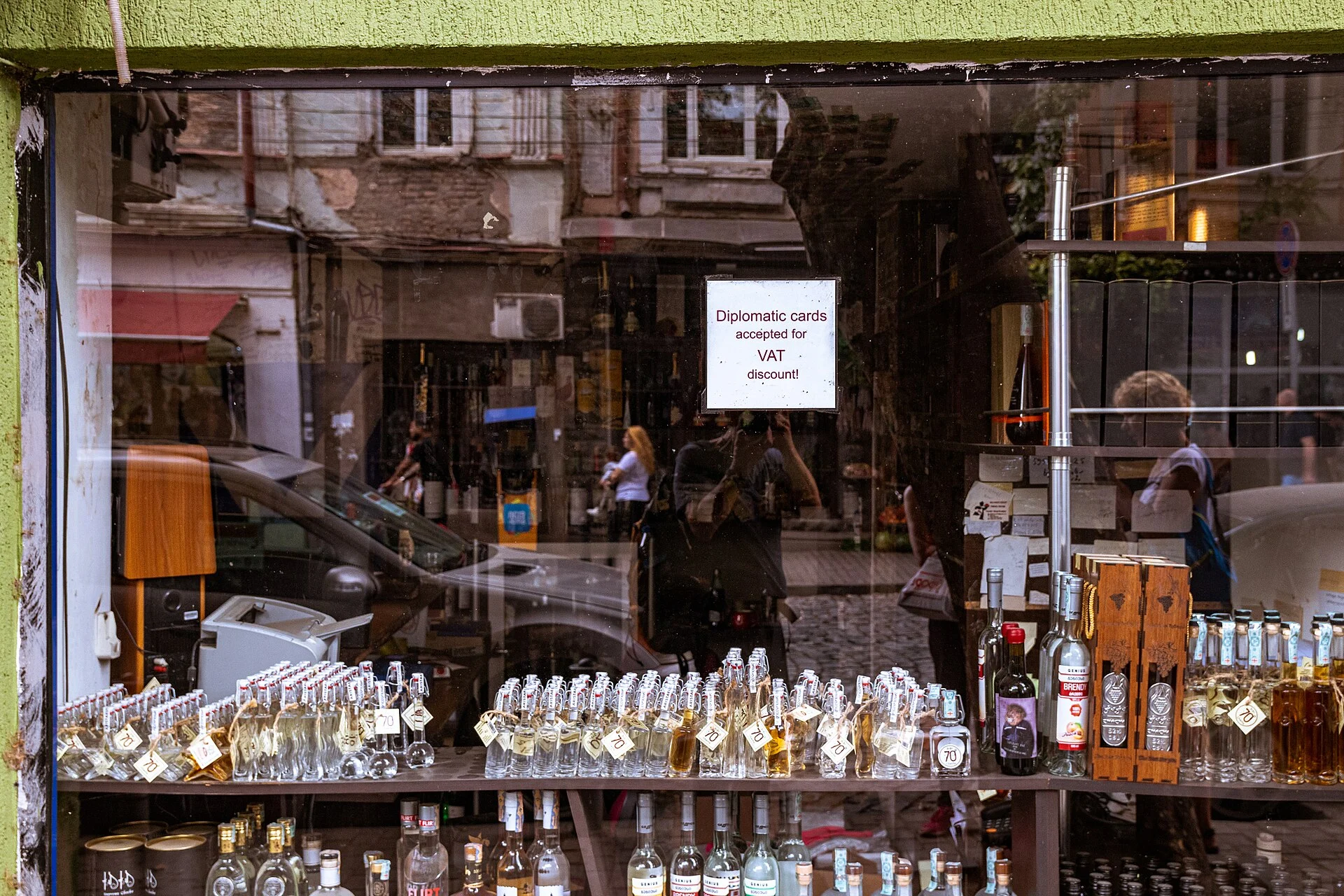
A Tbilisi shop window advertises VAT discounts for diplomatic cards, part of the refund scheme. · Photo: ::ErWin / Wikimedia Commons, CC BY-SA 2.0
Been to Georgia? Tell us how it went — the best stories are published here.
Share your tripOne email a week: what changed for travellers in Georgia — rules, roads, flights, seasons — plus one place worth the trip. Written by the GTour desk, no advertising, unsubscribe in one click.
This story across our partner network — ქართულად: შენი დასვენება
