

By Nino Gelashvili, Travel News Editor · 28/10/2026
Can an Eritrean citizen travel to Georgia easily in 2026? Mostly yes, but not visa-free in most cases, and not with a direct flight. Georgia’s visa policy groups countries into categories, and Eritrea is not currently on the short list of nationalities who enter without a visa or who qualify for Georgia’s standard e-visa without restriction, so the realistic starting point is to check your exact category on evisa.gov.ge and the Ministry of Foreign Affairs consular pages at geoconsul.gov.ge before booking anything. Visa policy is one of the most frequently revised areas of Georgian law, and this guide is written to be conservative: treat every rule below as “true as of 28 October 2026, verify before you fly.”
There is no established travel corridor between Asmara and Tbilisi, no direct flight, and only a small number of Eritreans currently live in or visit Georgia, mostly students and a handful of business travellers. This guide is honest about that: cultural and trade ties are thin, so the focus here is practical, on how to get a visa, how to fly in, what money and SIM options exist, where you will be understood, and what to eat. Where we are not certain, we say so and point to the official source.
Visa and entry rules for Eritrean citizens
As a baseline, Eritrean passport holders should expect to need a visa to enter Georgia for tourism, business or family visits. Georgia operates an e-visa system for many nationalities that are not on the visa-free list, processed through the official portal at evisa.gov.ge. If Eritrea is listed as e-visa eligible at the time you apply, processing is typically quoted as a few working days, though the portal itself states the authoritative timeframe and required documents, including a passport scan, a photo, proof of accommodation and return travel, and sometimes proof of funds or insurance. If Eritrea is not on the e-visa list, you will need to apply at the nearest Georgian diplomatic mission or an accredited consulate, and the Ministry of Foreign Affairs consular site geoconsul.gov.ge lists current visa categories, fees and which missions handle Eritrean applications. Because Georgia revises its visa lists periodically, do not rely on advice from forums or travel agents for your nationality, confirm directly on these two official pages within a few weeks of travel, and keep a screenshot of the rule that applied when you checked.
Flights from Eritrea: routes and connecting hubs
There is no direct flight between Eritrea and Georgia. Asmara International Airport has limited international connections, so in practice Eritrean travellers reach Tbilisi, Kutaisi or Batumi via a connecting hub. The most commonly used routings for travellers from the Horn of Africa region are through Istanbul, Dubai or Doha, each of which has onward service to Tbilisi International Airport, and Istanbul in particular has frequent onward flights to both Tbilisi and Kutaisi. Warsaw and Munich are relevant mainly for travellers already routing through Europe rather than a first connection from Asmara. Because schedules and codeshare arrangements change, check live arrivals and the current list of operating airlines on the airport’s own pages at tbilisiairport.com, kutaisiairport.com and batumiairport.com rather than relying on a fixed list here. Budget a realistic connection window of at least two to three hours at your transfer hub, and confirm visa transit rules for whichever hub country you route through, since transit requirements there are separate from Georgia’s own entry rules.
| Likely hub | Typical use |
|---|---|
| Istanbul | Most frequent onward connections to Tbilisi and Kutaisi |
| Dubai | Alternative routing with onward service to Tbilisi |
| Doha | Alternative routing with onward service to Tbilisi |
Driving licence, money and cards
Georgian authorities generally accept foreign driving licences for short visits when accompanied by an International Driving Permit, particularly for licences not issued in Latin script. Since Eritrean driving licences are typically issued in Tigrinya or Arabic script, carrying a valid IDP alongside your national licence is the safer approach, and car rental counters will usually ask for one. Confirm the current rule before you rent, since recognition of foreign licences is set in Georgian traffic legislation and can be checked through official road authority channels; renting through a tour operator with a driver, such as our own Car with Driver by the Day service, avoids the question entirely.
Georgia’s currency is the lari (GEL). Eritrean nakfa is not convertible in Georgia, so bring US dollars or euros in cash to exchange, or withdraw lari from an ATM with an international card. Visa and Mastercard are widely accepted in Tbilisi, Batumi and Kutaisi hotels, restaurants and supermarkets, but small guesthouses, village shops and some mountain regions such as Tusheti or Svaneti are cash-only, so carry lari in smaller denominations when travelling outside the main cities. On 28 October 2026 the National Bank of Georgia’s reference rate was approximately 2.60 GEL per US dollar and 2.89 GEL per euro; rates move daily, so check the current figure before changing money.
SIM cards, eSIM and language
Georgia has three main mobile operators, Magti, Geocell and Beeline, all offering tourist SIM packages at the airport or in city branches with a passport, and eSIM options are increasingly available for travellers who prefer not to swap a physical card. Coverage is reliable in cities and along main highways, and patchier in remote mountain valleys such as Tusheti.
Georgian is the official language and the Georgian alphabet is unrelated to Latin, Arabic or Ge’ez scripts, so street signs can be disorienting at first; most are transliterated into Latin letters in tourist areas. English is spoken in Tbilisi and Batumi hotels, airports and tourism businesses, less so in villages and among older Georgians, who are more likely to speak Russian as a second language. There is no established Tigrinya, Arabic or Amharic-speaking community in Georgia, so Eritrean travellers should not expect to be understood in those languages outside, occasionally, a university setting with African students.
Consular coverage and embassy information
Eritrea does not maintain an embassy or consulate in Georgia, and Georgia does not maintain a resident mission in Asmara. Eritrean citizens needing consular assistance in Georgia should check with Eritrea’s Ministry of Foreign Affairs for which regional mission is accredited to Georgia, since this can change; Georgian entry and visa matters, by contrast, are handled through Georgia’s own Ministry of Foreign Affairs consular department at geoconsul.gov.ge and general ministry information at mfa.gov.ge. If you need a letter of invitation or confirmation of your booking for a visa application, our office can provide one for guests who book a tour or transfer with us.
Food, halal options and dietary notes
Georgian cuisine centres on bread, cheese, walnuts, fresh herbs and grilled meat, with pork appearing on many menus, so Eritrean travellers who keep halal or avoid pork should ask specifically, since not all restaurants label dishes clearly. Beef and lamb khinkali (dumplings) and mtsvadi (skewered meat) can usually be ordered without pork, and most restaurants in Tbilisi and Batumi can accommodate a no-pork request; dedicated halal-certified restaurants exist but are not widespread, concentrated mainly in Tbilisi near the Jumah Mosque area and in Batumi, which has a larger Muslim population. Vegetarian and vegan travellers are well served: lobio (bean stew), badrijani (walnut-stuffed aubergine), mchadi (cornbread) and the many bean, cheese and vegetable dishes of a Georgian table have no animal products beyond dairy, and Georgian bread culture, built around the clay-oven tonis puri, will feel familiar to travellers used to injera-style communal eating, even though the bread itself is quite different. Alcohol, particularly wine, is central to Georgian hospitality and the supra (feast) tradition; non-drinkers, including many Eritrean Muslims and others who abstain, can decline a toast politely and are not expected to drink, though hosts may press gently.
Cultural, historical and trade ties
Direct historical, trade and diaspora ties between Eritrea and Georgia are modest and should not be overstated. Trade volumes are too small to register separately in most published Georgian foreign trade statistics, which travellers can check for themselves through geostat.ge. The clearest point of cultural resonance is Christian heritage: Georgia’s Orthodox Church, whose cathedrals at Mtskheta form a UNESCO World Heritage site at whc.unesco.org, and Eritrea’s own ancient Orthodox Tewahedo tradition both trace to the early centuries of Christianity, though the two churches belong to different communions (Eastern Orthodox and Oriental Orthodox) and are not in full liturgical communion. Both countries also mark Christmas on 7 January under the older calendar, a coincidence some Eritrean visitors notice when travelling during the Orthodox Christmas and Alilo season in Tbilisi and Kakheti. The small number of Eritreans who do visit Georgia are mostly students enrolled in Georgian medical and other universities, a pattern shared with several African nations, plus occasional business travellers; there is no established Eritrean neighbourhood, shop or community association in Tbilisi at the time of writing.
Health, insurance, safety and what a guide adds
Some Georgian visa categories require proof of travel medical insurance valid for Georgia as a condition of entry; check whether this applies to your application on evisa.gov.ge or geoconsul.gov.ge, since the requirement and accepted minimum coverage have varied by year and visa type. Regardless of whether it is mandatory for your category, carrying adequate travel medical insurance is strongly advisable, particularly for mountain regions such as Svaneti or Kazbegi where emergency evacuation can be costly; for anything beyond routine travel health questions, see a doctor before you go.
Georgia is a generally safe destination for visitors, with petty crime low by regional standards; normal precautions around valuables in markets and night buses apply. Hospitality customs are warm and direct: a host may insist on refilling your glass or plate repeatedly, declining firmly but politely is accepted. Toasting at a supra follows a set order led by a tamada (toastmaster); guests, including non-drinkers, are usually welcome to toast with juice or water instead of wine.
Given the absence of an Eritrean community, limited English outside tourist areas, and the extra planning a visa application requires, a private guide removes most of the friction for first-time visitors. GTour’s Licensed Private Guide by the Day and Car with Driver by the Day services pair an English-speaking guide or driver with your own route, arrange halal-friendly or vegetarian meal stops in advance, handle hotel bookings and airport meet-and-greet through our Tbilisi Airport Transfer and Batumi Airport Transfer services, and can provide a confirmed itinerary letter useful for visa applications.
If this guide is part of a trip you are planning, our Tbilisi to Borjomi or Bakuriani Transfer and Mtskheta on Foot — the Ancient Capital in 2 Hours cover the places it describes with a private guide and driver; a GTour travel expert adapts the route to your dates.
Practical summary
- Visa: check your exact requirement and apply, if eligible, at evisa.gov.ge; confirm categories and missions at geoconsul.gov.ge, since rules change.
- Flights: no direct service; connect via Istanbul, Dubai or Doha; check live routes at tbilisiairport.com, kutaisiairport.com or batumiairport.com.
- Driving: carry an International Driving Permit alongside your national licence.
- Money: bring USD or EUR cash to exchange; cards work in cities, cash needed in villages and mountain regions.
- SIM: buy a tourist SIM or eSIM from Magti, Geocell or Beeline on arrival.
- Language: English in tourist hubs, Georgian and Russian elsewhere; no Tigrinya or Arabic community.
- Food: ask specifically about pork and halal options; vegetarian and bean-based dishes are plentiful.
- Health: confirm whether insurance is mandatory for your visa category; see a doctor for personal medical advice.
- Consider a private guide or driver to handle logistics, dietary requests and documentation.
Sources
- Georgia e-visa portal
- MFA consular information
- Ministry of Foreign Affairs of Georgia
- Historical Monuments of Mtskheta, UNESCO
- Georgia foreign trade statistics
Questions this guide does not answer? Write to info@castle.ge or WhatsApp +995 577 41 63 14 — a person in Tbilisi replies. See also our travel services and all guides.
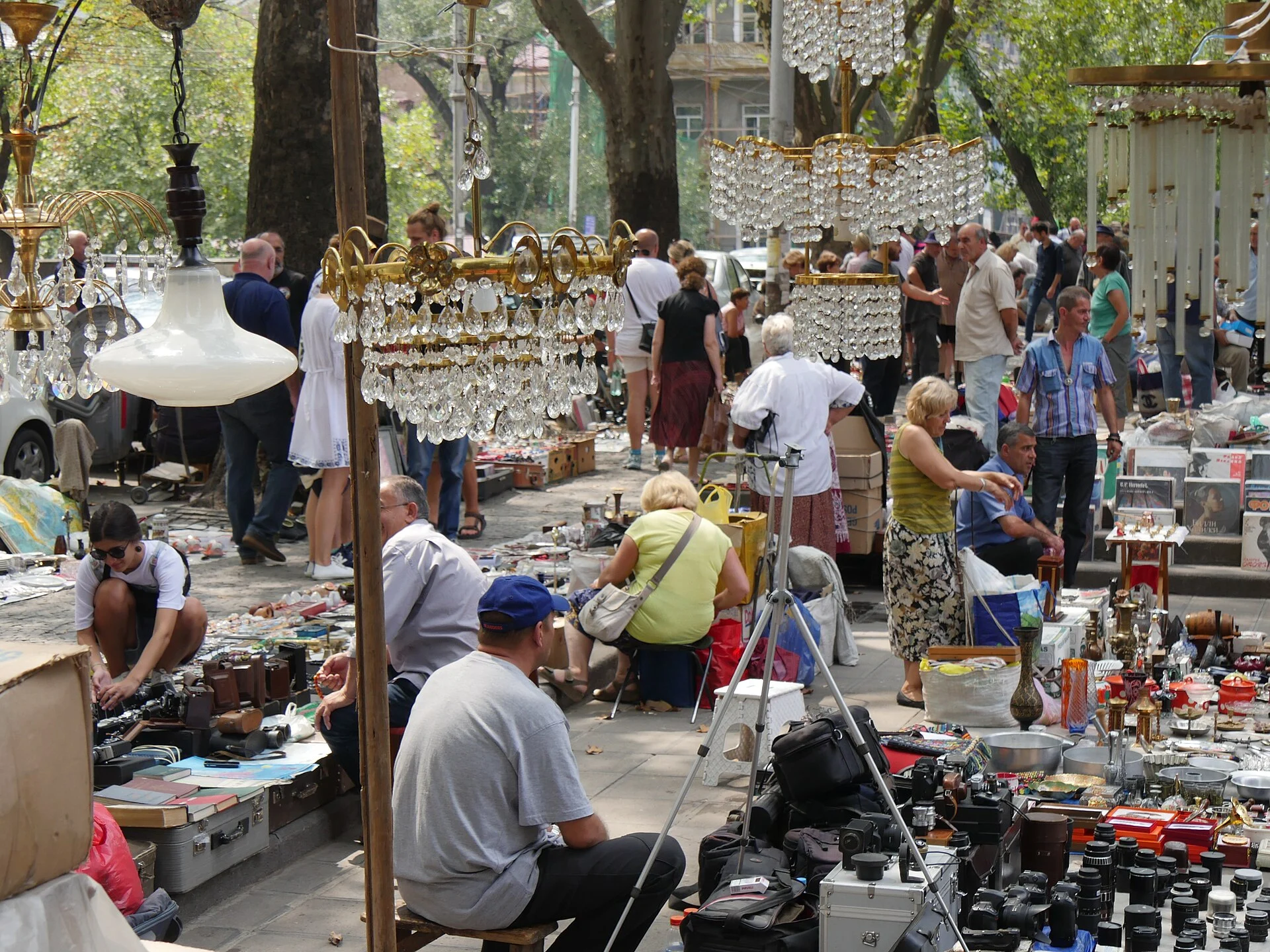
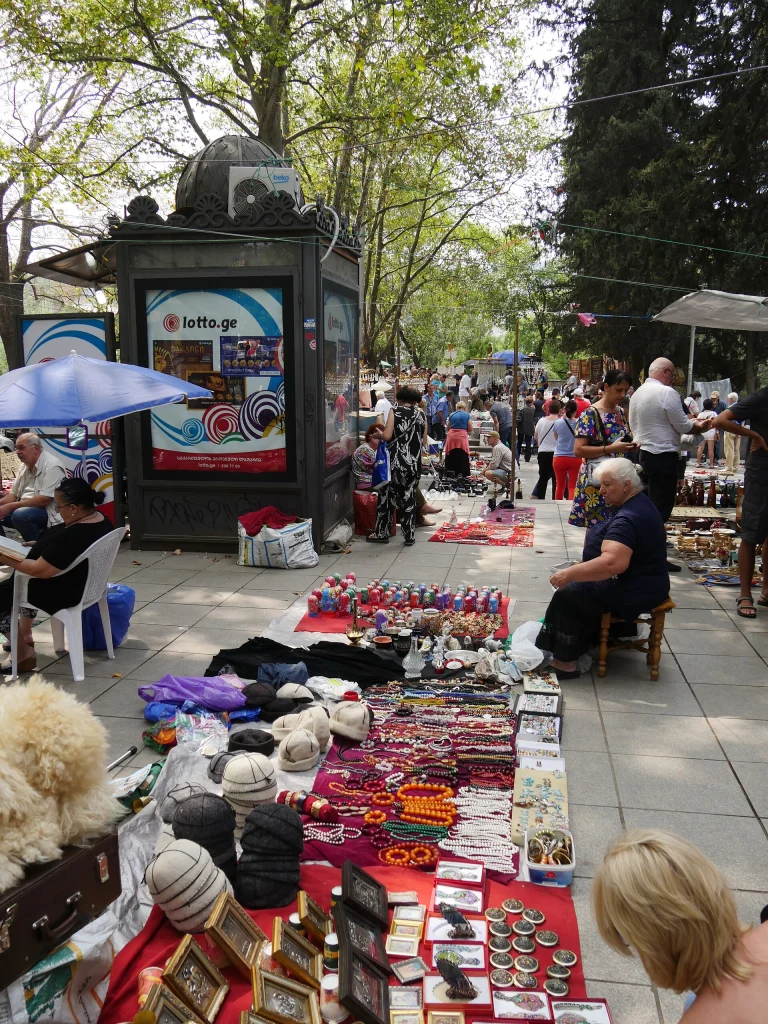
Visitors browse antiques and chandeliers at Tbilisi's famous Dry Bridge Market, a popular stop for travellers. · Photo: tjabeljan / Wikimedia Commons, CC BY 2.0
Been to Georgia? Tell us how it went — the best stories are published here.
Share your tripOne email a week: what changed for travellers in Georgia — rules, roads, flights, seasons — plus one place worth the trip. Written by the GTour desk, no advertising, unsubscribe in one click.
This story across our partner network — ქართულად: შენი დასვენება
