

Sighnaghi City Walls — opening hours, tickets, how to get there and what to see
The Sighnaghi city wall is an 18th-century defensive circuit that encloses the Kakheti hill town of Sighnaghi, built in 1762 on the order of King Erekle II to shelter the town and its farmland from Dagestani raids. At roughly 4.5 kilometres long, it is one of the few largely surviving town fortifications in Georgia and gives the walkable ramparts their wide views over the Alazani valley. Restoration work tied to Sighnaghi’s 2006–2007 townscape renewal left most of the wall path open and free to visit today.
What you see
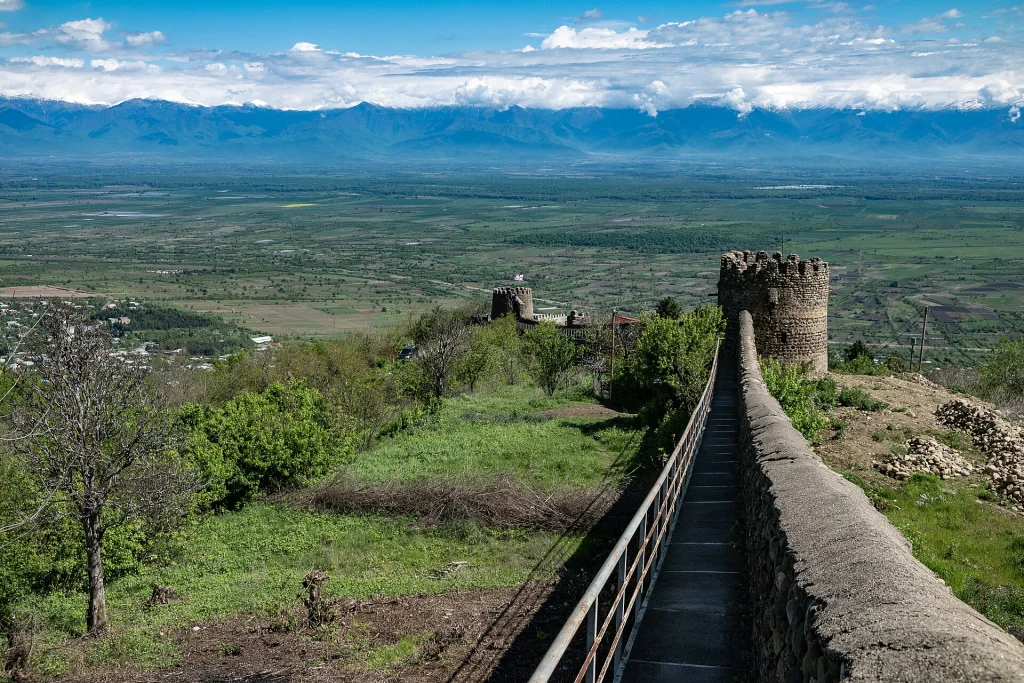
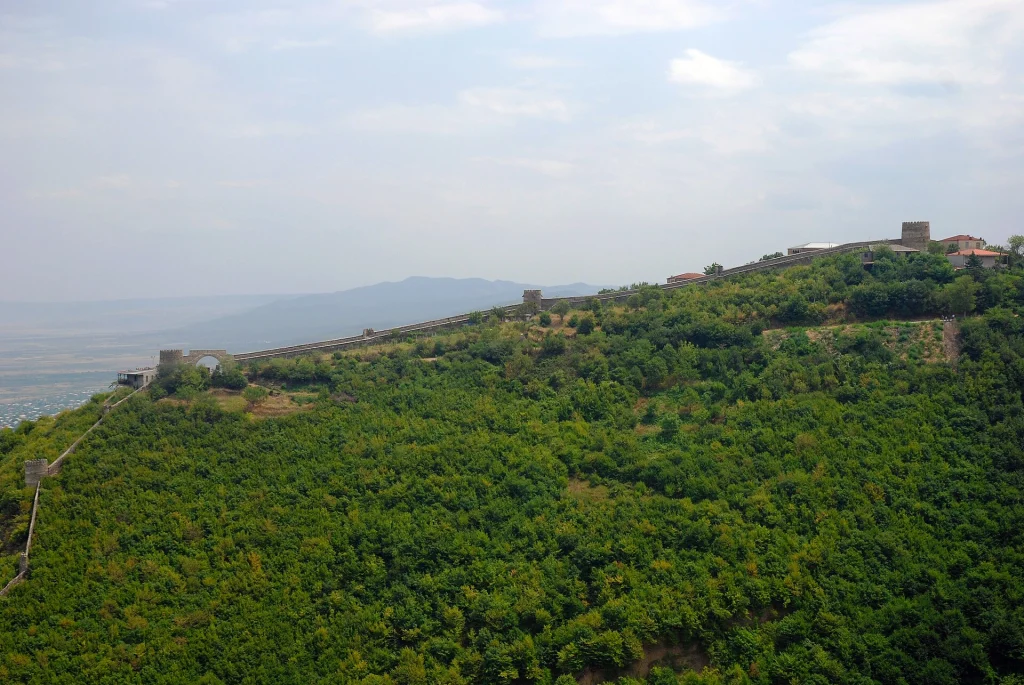
The wall runs along the ridge on which Sighnaghi sits, following the natural contours rather than a straight perimeter, which is why it is unusually long for a town of this size. Sections are walkable on foot, linking bastions, arched gateways and watch points that look down over vineyard terraces toward the Alazani river and, on clear days, the snow line of the main Caucasus range. Some stretches have been consolidated with new stonework and handrails, others remain rougher, overgrown with grass and scrub. A few short segments pass through the courtyards of hotels and restaurants built into or against the old fortification, so the wall is as much a working part of the townscape as a monument set apart from it.
History
King Erekle II of the united kingdom of Kartli-Kakheti ordered the wall built in 1762, after decades of raids by Dagestani (Lezgin) horsemen into the Alazani valley. The design let the town’s population and livestock take refuge inside the walls during an attack, which explains why the enclosed area is far larger than the historic town itself. Accounts of the fortification describe up to six gates and roughly two dozen towers along the circuit, though the exact original count is not settled in the surviving record. The wall lost its military purpose once Russian imperial control stabilised the region in the 19th century, and long stretches fell into disrepair over the Soviet period. A state-led restoration of Sighnaghi’s townscape in the mid-2000s, part of a wider push to develop Kakheti tourism, repaired gates and wall sections and is the version visitors walk today; the fortification is listed as an immovable cultural heritage monument, with upkeep now overseen by Georgia’s national heritage preservation body (National Agency for Cultural Heritage Preservation of Georgia).
Opening hours and tickets
| Item | Pattern |
|---|---|
| Access to the wall path and gates | Open at all times, no ticket, no barrier at most points |
| Staffed sections or viewpoints | None known; occasional seasonal closures for repair work, checked at booking |
| Best light for photographs | Early morning and roughly the hour before sunset |
There is no admission fee and no single ticket office, since the wall is a public monument rather than a managed museum site. Where the path crosses hotel or restaurant grounds, access is generally tolerated for guests walking through at a reasonable pace, though this is informal and can change.
How to get there
From Tbilisi, Sighnaghi is about 1 hour 40 minutes by car, roughly 100 kilometres via Sagarejo and Tsnori. Marshrutka minibuses run from Tbilisi’s Ortachala (Isani) station toward Sighnaghi, sometimes direct and sometimes with a change at Tsnori, with a total journey of around 2.5 to 3 hours. From Telavi, the regional centre, it is about 50 minutes by car. There is no rail link to Sighnaghi. With us, the day trip Sighnaghi & Bodbe — Wine Country Day Trip and the shorter Sighnaghi at Sunset — Afternoon Wine Trip from Tbilisi both include the wall and the town; a private transfer or a Car with Driver by the Day gives more flexibility to stop at wineries en route.
How long and the best time
Walking a representative stretch of the wall, including one or two gate towers and a viewpoint, takes about an hour to an hour and a half. Spring and autumn offer the clearest views of the Caucasus and cooler conditions for walking the open, largely unshaded ramparts; September and October coincide with the Kakheti grape harvest. Summer afternoons can be hot with little shade along the wall; winter mornings are often misty in the valley below, which can either obscure or dramatise the view depending on timing.
Tips
- Wear shoes with grip: cobbled lanes and uneven wall-top paths are involved, and some sections slope steeply.
- For photographs, the bastions on the valley-facing side give the widest views; backlighting is strong in the late afternoon facing west.
- The ramparts are exposed to wind; bring a layer even on a warm day.
- Tour buses from Tbilisi tend to arrive around midday; early morning or early evening is quieter.
- Combine the walk with the town’s main square and the Pirosmani-themed cafes nearby, both a short walk inside the walls.
Nearby
- Bodbe Monastery, burial place of St Nino, about 2 kilometres away
- Pirosmani House-Museum in Mirzaani village
- Alaverdi Monastery, northern Kakheti
- Tsinandali Estate and wine museum
- Family wine cellars (marani) in the villages around the Alazani valley
Sighnaghi City Walls is on these private tours: Georgia in 4 Days — Tbilisi, Kazbegi and Kakheti · Keda Wine Villages and the Dandalo Bridge · Sighnaghi at Sunset — Afternoon Wine Trip from Tbilisi. A travel expert adapts any of them to your dates.
Questions
Is there an entrance fee to walk the Sighnaghi city wall?
No, the wall path and gate towers are open to the public without charge; a few short stretches cross hotel or restaurant courtyards.
How long is the wall and how many towers does it have?
It runs roughly 4.5 kilometres with around six gates and about two dozen towers, though exact historical counts vary between sources.
When was the wall built and why?
In 1762, ordered by King Erekle II of Kartli-Kakheti, to give the town and its farmland shelter from Dagestani raids.
Can I drive close to the wall?
Yes, roads reach several of the main gates and there is parking near the town centre, though exact restrictions should be checked at booking.
Sources
The city walls of Sighnaghi stretch along the Gombori ridge above the Alazani valley. · Photo: Donovan Driver from Texarkana, Texas, USA / Wikimedia Commons, CC BY-SA 2.0