

Old and New Shuamta Monasteries — opening hours, tickets, how to get there and what to see
Old and New Shuamta are two monastery complexes set in oak forest about 8 km west of Telavi, in Kakheti. Old Shuamta preserves three churches built between roughly the 5th and 7th centuries, while New Shuamta, founded in the 1560s by Queen Tinatin of Kakheti, is a working convent and houses the icon long venerated as the Shuamta Mother of God. Together they form one of the clearest, least-crowded windows onto early and late-medieval Georgian church architecture in the region.
What you see
The two sites sit a short drive (or a steep 1.5 km forest path) apart, on a wooded hillside above the Alazani Valley. Old Shuamta is a cluster of three stone churches standing close together: a three-nave basilica, considered the oldest structure on the site; a smaller single-nave basilica; and a cross-domed church added later, when the complex functioned as a bishopric. The stonework is plain and heavily weathered, with little surviving decoration, which is part of what makes the group interesting to anyone comparing early Georgian basilica and cross-dome forms side by side.
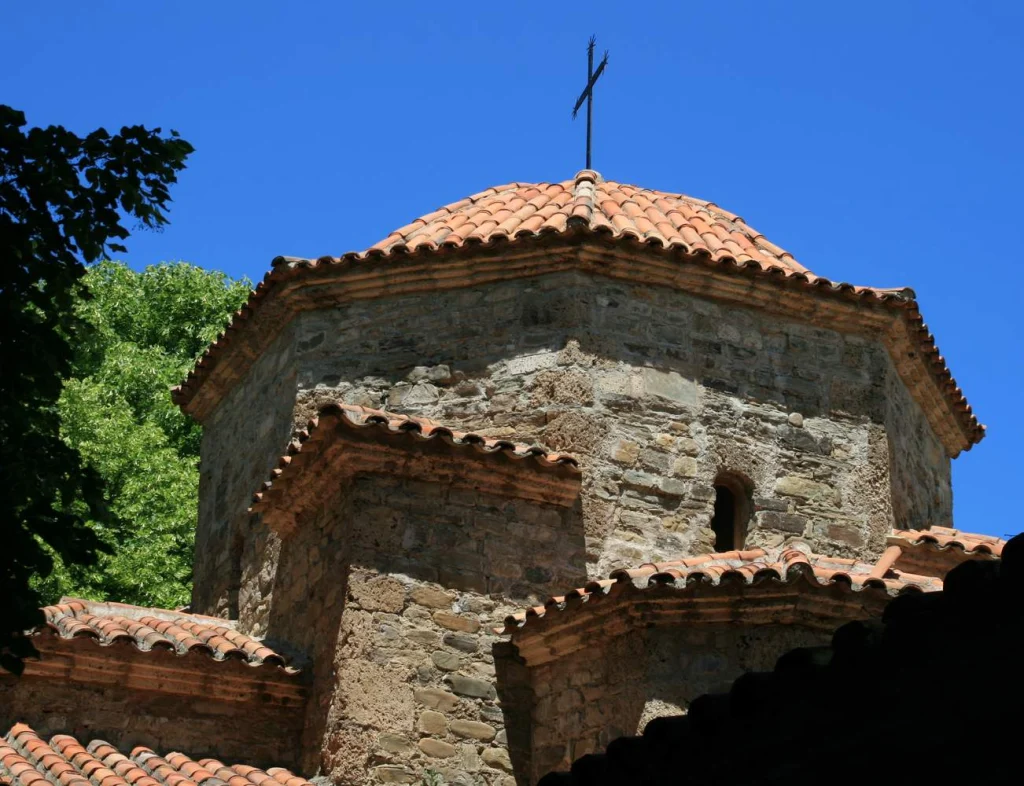
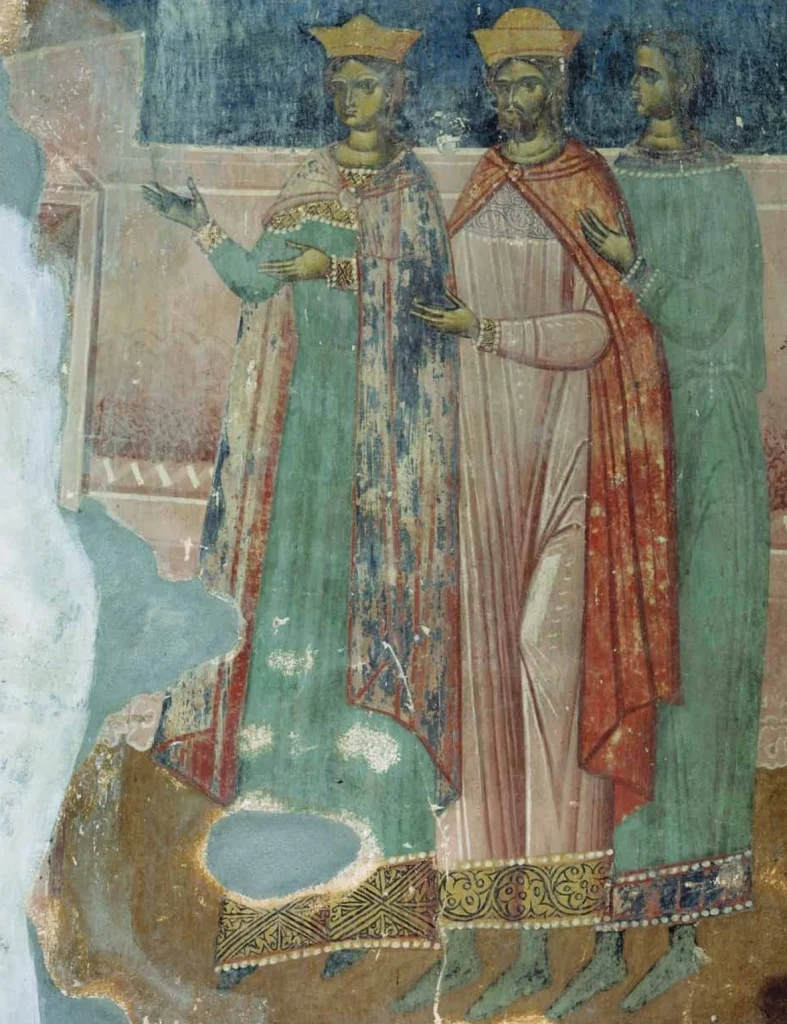
New Shuamta is a walled convent centred on a single cross-domed Church of the Dormition, built of neat ashlar and still in active use by a community of nuns. Inside are the tombs of members of the Kakhetian royal house, including Queen Tinatin herself, and the church holds the icon known as the Shuamta Mother of God, a focus of local pilgrimage. The convent grounds are kept, with gardens and a bell tower, in contrast to the bare, unrestored feel of Old Shuamta.
History
Old Shuamta’s three churches were built in stages from the early Christian period into the early medieval era, with the oldest basilica generally dated to the 5th century and the cross-domed church to the 6th or 7th century, when Shuamta briefly served as the seat of a bishopric for the Kakhetian kingdom. The complex later lost its administrative role as the centre of church life shifted to Alaverdi and other sites, and Old Shuamta was gradually abandoned as an active monastery, surviving mainly as a protected architectural monument.
New Shuamta was founded in the second half of the 16th century, traditionally dated to around 1565-1588, by Queen Tinatin, wife of King Levan of Kakheti, as a royal convent closer to Telavi. It became a burial place for Kakhetian royal women and remained an active religious community through the subsequent Ottoman and Persian incursions that affected much of Kakheti. The monastery has continued in use into the present day and is cared for jointly by the Georgian Orthodox Church and the state heritage authorities (National Agency for Cultural Heritage Preservation of Georgia).
Opening hours and tickets
| Site | Typical hours | Entry |
|---|---|---|
| Old Shuamta | Daylight hours, roughly 9:00-18:00 | Free, donations welcome |
| New Shuamta (convent) | Daylight hours, church may close for services | Free, donations welcome |
Neither site sells tickets or has a visitor centre. Both are open-air monuments with no fixed closing day, but New Shuamta is a functioning convent, so the church itself may be closed to visitors during services; pattern checked at booking.
How to get there
From Telavi it is about 8 km to New Shuamta on a paved then gravel road through forest, roughly 15-20 minutes by car; Old Shuamta is a further short drive or a signed forest walk of about 1.5 km from New Shuamta. There is no direct marshrutka to either site; a taxi from Telavi’s centre, arranged one way or as a return with waiting time, is the usual independent option. From Tbilisi, the drive to Telavi takes about 1.5-2 hours via the Gombori or Sagarejo road, making Shuamta a feasible add-on to a Telavi day. We run this as part of our Telavi & Kakheti Wine Region — Monasteries and Cellars day trip (10 hours, from €128 per person for four to six travellers, https://gtour.ge/tour/telavi-kakheti-wine/), and it also features on the longer Kakheti Grand Wine & Heritage — 3 Days tour (https://gtour.ge/tour/kakheti-grand-wine/) and the Monasteries of Georgia — 3 Days itinerary (https://gtour.ge/tour/monasteries-of-georgia-3-days/). A private car with driver for the day from Tbilisi, including Telavi and Shuamta, costs €150 for a sedan (https://gtour.ge/services/).
How long and the best time
Allow 45-60 minutes for New Shuamta and a similar time for Old Shuamta, plus travel; a combined visit with the forest walk between them takes about two to three hours. Spring and autumn give the clearest light and cool walking conditions under the oak canopy; summer is warm but shaded, and the unpaved stretch of road can turn muddy after heavy rain in winter, so a car with reasonable clearance is useful then.
Tips
- Dress modestly for New Shuamta, since it is an active convent: covered shoulders and knees, and a headscarf for women, usually available at the gate.
- Photography is generally fine outdoors at both sites; ask before photographing inside the church at New Shuamta, as services or the nuns’ routine may be in progress.
- The forest path and the road to Old Shuamta have little shade in places and no facilities, so carry water, particularly in summer.
- Queues are not an issue at either site; visitor numbers are low compared with Alaverdi or Nekresi.
- Combine the visit with Telavi’s old town and the Batonistsikhe royal castle, and with the wine villages of the Alazani Valley below.
Nearby
- Telavi old town and Batonistsikhe fortress
- Alaverdi Cathedral
- Ikalto Monastery and former academy
- Tsinandali estate and wine museum
- Nekresi Monastery
Old and New Shuamta Monasteries is on these private tours: Sighnaghi at Sunset — Afternoon Wine Trip from Tbilisi · Telavi, Alaverdi and Tsinandali — Northern Kakheti in a Day · Tbilisi City Break — 4 Days with Mtskheta and a Kakheti Cellar. A travel expert adapts any of them to your dates.
Questions
Are Old and New Shuamta the same place
No, they are two separate complexes about 1.5 km apart in the same forest, one abandoned and one an active convent.
Is there an entrance fee
No, both sites are free to enter, with donations accepted at New Shuamta.
Can I visit without a car
It is difficult without one, since there is no direct public transport; a taxi from Telavi or a guided tour is the practical option.
Is New Shuamta still a working monastery
Yes, it is an active convent with resident nuns, so modest dress and quiet behaviour near the church are expected.
Sources
Akhali Shuamta (New Shuamta) Monastery near Telavi, built in the 16th century. · Photo: Roberto Strauss from Frankfurt am Main, Deutschland / Wikimedia Commons, CC BY 2.0