

Ikalto Monastery and Academy — opening hours, tickets, how to get there and what to see
Ikalto is a working monastery and the ruined site of a 12th-century academy set among vineyards about 8 km northwest of Telavi in Kakheti. Founded in the sixth century by one of the Thirteen Syrian Fathers and expanded into a centre of theology, science and winemaking under Arsen Ikaltoeli, the academy was destroyed in 1616 during Shah Abbas I’s invasion of Kakheti and never rebuilt. The grounds still hold one of the country’s oldest large-scale qvevri wine cellars, a practical link to the clay-vessel winemaking method that UNESCO listed as intangible cultural heritage in 2013.
What you see
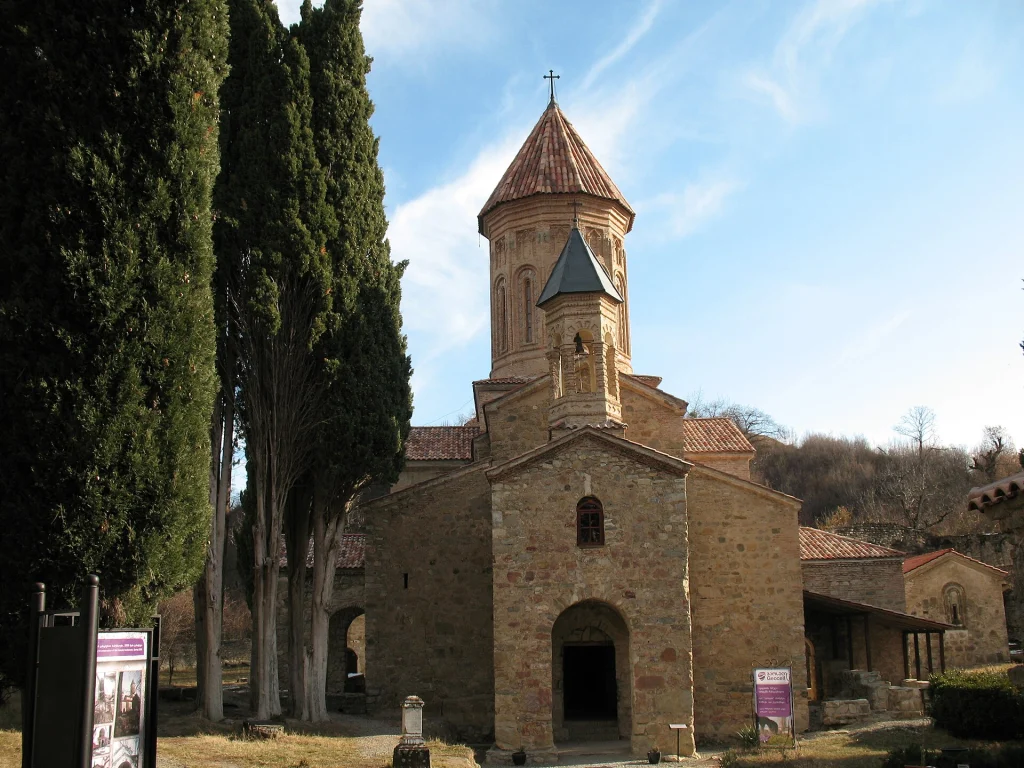
The complex sits on a wooded slope with three churches of different periods grouped inside a low stone wall. The oldest and largest, Khvtaeba (the Church of the Divinity), dates to the sixth century and carries traces of later rebuilding after earthquake and war damage. Next to it stand the smaller Sameba (Trinity) church and the Elia (St Elijah) chapel, both added in subsequent centuries. A bell tower and sections of the monastic wall survive from the medieval period.
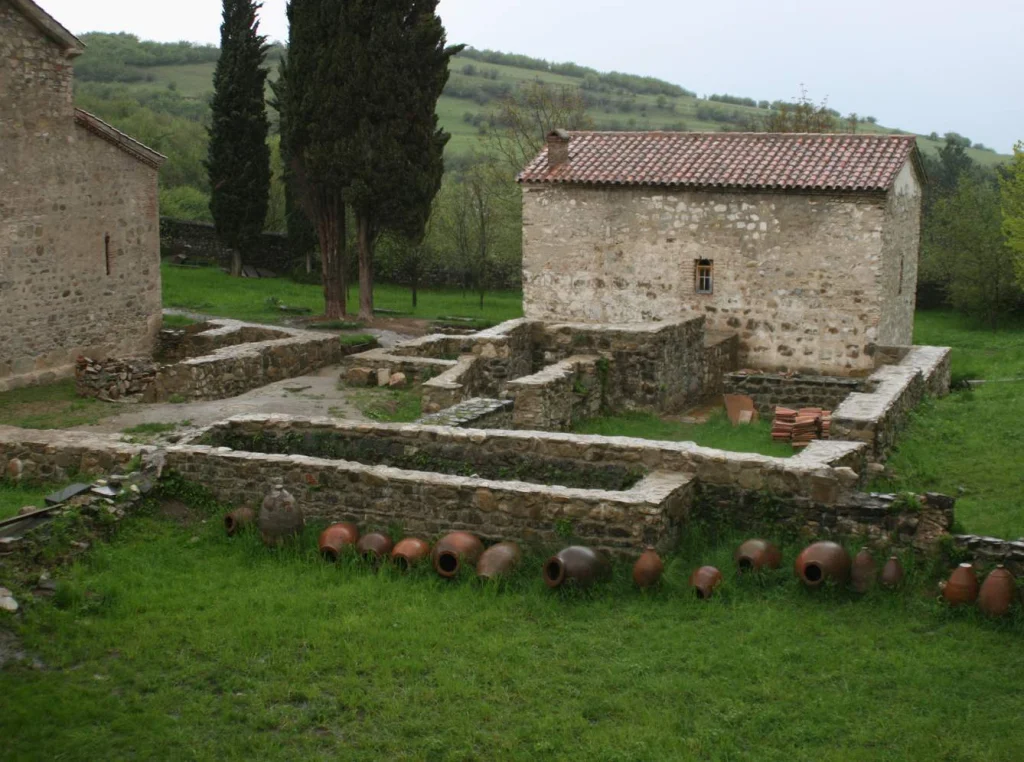
Below the churches, on a terrace, lie the roofless stone foundations of the academy: lecture rooms, a refectory and, most striking for visitors, a large wine cellar with rows of qvevri sunk into the floor and a stone wine press. This was a working school of theology, rhetoric, music, astronomy and philosophy, and tradition links it to the young Shota Rustaveli, Georgia’s national poet, though no contemporary document confirms his attendance. The site has no reconstruction or roofing over the academy ruins, so the ground plan is read directly from the stone.
History
Ikalto monastery was established in the sixth century by Zenon Ikaltoeli, one of the Thirteen Syrian (Assyrian) Fathers credited with spreading organised monastic Christianity in eastern Georgia. The academy was founded in the late 11th or early 12th century by Arsen Ikaltoeli, a theologian and translator associated with the court of King David IV, and it operated as one of Georgia’s two major medieval academies alongside Gelati near Kutaisi. The school combined religious study with natural science and practical skills, including the viticulture and winemaking for which Kakheti was already known.
In 1616, during Shah Abbas I’s punitive campaign against Kakheti, Ikalto was burned along with Alaverdi and Gremi nearby, and the academy was never restored to its earlier function. The monastery churches were repaired piecemeal over later centuries and remain in use for worship. The site is listed as an immovable cultural heritage monument of national significance (heritagesites.ge), and the surrounding qvevri winemaking tradition is recognised separately by UNESCO (ich.unesco.org).
Opening hours and tickets
| Item | Usual pattern |
|---|---|
| Grounds and churches | Open daily, roughly sunrise to sunset; no fixed closing hour posted |
| Entrance fee | None for the monastery grounds; small donation box inside the churches |
| Academy ruins | Freely accessible on foot from the monastery courtyard, no separate ticket |
| Dress code | Headscarf for women, no shorts above the knee, enforced loosely but scarves are available at the gate |
Hours are not published in a formal schedule and can shift with the resident clergy’s routine; checked at booking is the safest approach if you plan to arrive very early or at dusk.
How to get there
From Telavi, Ikalto is about 8 km and a 15-minute drive on a signposted local road, often combined with Alaverdi Cathedral which lies a further 10–15 minutes away. From Tbilisi it is roughly 95–100 km, about 1 hour 45 minutes to 2 hours by car via the Gombori or Napareuli road, depending on route and traffic. There is no train service to Ikalto; the nearest rail link is Telavi’s bus and marshrutka station, from which a taxi covers the remaining distance, since no public marshrutka runs directly to the monastery gate. With us, the site is included on the Telavi & Kakheti Wine Region day tour and on the three-day Kakheti Grand Wine & Heritage and Monasteries of Georgia itineraries; a private car with driver from Tbilisi for a Kakheti day, sedan class, runs €150 for the day (see gtour.ge/data).
How long and the best time
Thirty to forty-five minutes is enough to see the churches and walk the academy ruins; an hour allows time to sit in the shade and take in the setting. Morning visits avoid tour-bus clusters and give softer light for photographs of the stone facades. Spring and autumn are the most comfortable seasons, with September and October adding the backdrop of the grape harvest in the surrounding vineyards; midsummer afternoons can be hot with little shade on the open terrace.
Tips
- Bring a headscarf or light shawl for women entering the churches; men should avoid shorts.
- Wear shoes with grip, the path down to the academy ruins is uneven stone and can be slippery after rain.
- Photography is generally allowed outdoors and in the churches, but ask before photographing clergy or services in progress.
- There are no ticket queues, but parking is limited to a small gravel area near the gate during peak harvest weekends.
- Combine the visit with Alaverdi Cathedral and a wine cellar stop in Kvareli or Telavi to fill a half day.
Nearby
- Alaverdi Cathedral
- Telavi old town and the Batonistsikhe fortress
- Nekresi Monastery
- Tsinandali estate and wine museum
- Shuamta monasteries (Old and New)
Ikalto Monastery and Academy is on these private tours: Sighnaghi at Sunset — Afternoon Wine Trip from Tbilisi · Telavi, Alaverdi and Tsinandali — Northern Kakheti in a Day · Tbilisi City Break — 4 Days with Mtskheta and a Kakheti Cellar. A travel expert adapts any of them to your dates.
Questions
Is there an entrance fee for Ikalto Monastery?
No standard ticket; the grounds are free to enter, with a donation box inside the churches.
Can I see the academy ruins without a guide?
Yes, the ruins are open and unfenced within the monastery grounds, though a guide adds historical context the site itself does not provide.
How far is Ikalto from Alaverdi Cathedral?
About 10–15 minutes by car, making the two a natural pairing on a Kakheti day trip.
Does Ikalto have its own train or marshrutka stop?
No, visitors reach it by car or taxi from Telavi, as no direct public transport serves the monastery gate.
Sources
Ruins of the Academy of Ikalto, the medieval seat of learning within the monastery complex. · Photo: Bernard Gagnon / Wikimedia Commons, CC BY 4.0