

Anatori Crypts — opening hours, tickets, how to get there and what to see
Anatori is a small cluster of stone burial crypts on the Arghuni gorge road between Shatili and Mutso, in the highland region of Khevsureti, Mtskheta-Mtianeti. Local tradition holds that during a plague epidemic, remembered as striking the area in the 17th–18th centuries, the sick walked here to die apart from their families rather than risk spreading infection to the village. The crypts remain open and unguarded, their small stone openings showing human bones still inside, a detail confirmed by visitors and regional heritage surveys as recently as 2025.
What you see
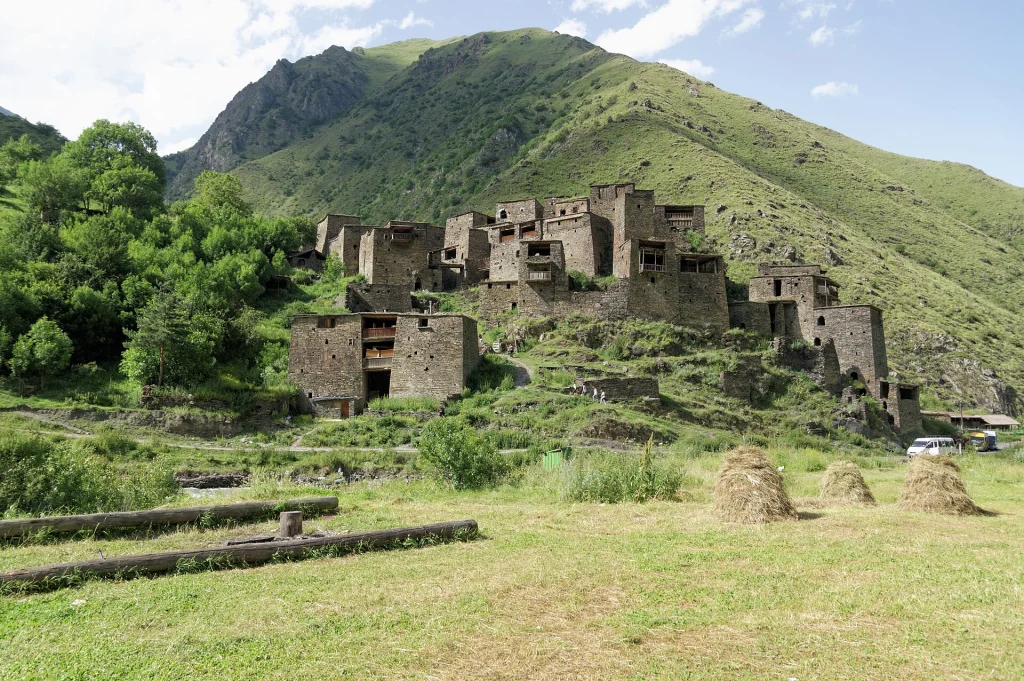
Anatori consists of a row of low, drystone vaults built into the hillside above the Arghuni River, roughly two kilometres from Shatili on the track toward Mutso. Each crypt is a small chamber, chest-high at most, with a narrow opening at the front. Looking through the opening, visitors can see human skeletal remains, in some cases arranged in rows, in others heaped together. There is no fence, signage in several languages, or ticket booth; the site is a cluster of structures set directly against the rock and grass, with the river and the Khevsureti peaks as backdrop.
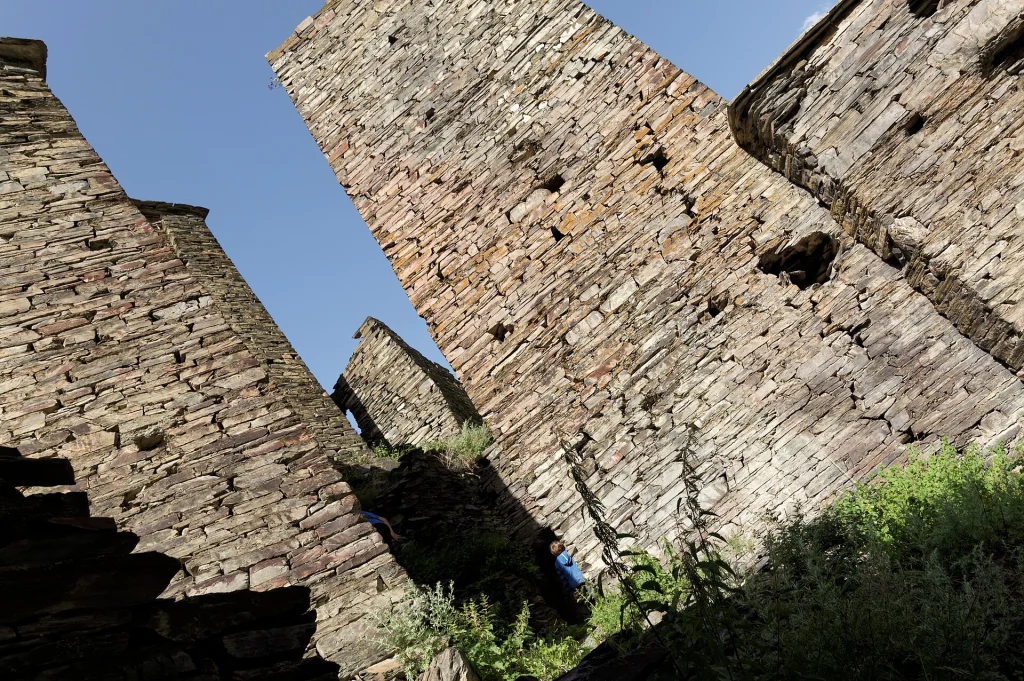
The crypts are built in the same dry-stone technique used throughout Khevsureti for tower-houses and field walls, with flat stone slabs laid without mortar. Their small scale and simplicity contrast with the defensive tower complexes of Shatili and Mutso nearby, and this contrast is part of what makes the site notable: it is a record of how the community dealt with disease rather than with war.
History
Khevsureti’s highland communities developed strict customs around illness and isolation, and Anatori is usually explained locally as a quarantine site from a plague outbreak dated by oral tradition to the 17th or 18th century. People showing symptoms are said to have left their households and walked to Anatori to wait out their illness alone, to avoid infecting relatives, and to have been buried where they died rather than carried back to the village. Georgian ethnographers and heritage researchers have documented similar isolation practices across Khevsureti and neighbouring Pshavi, though exact dating of the Anatori crypts has not been fixed by archaeological excavation. The structures, along with the fortress complexes of Shatili and Mutso, fall within the area’s protected cultural heritage, administered under Georgia’s national monument legislation (matsne.gov.ge) and overseen by the national heritage preservation authority (heritagesites.ge).
Opening hours and tickets
| Item | Detail |
|---|---|
| Access | Open site, no gate, no fixed hours |
| Entrance fee | None |
| Staff on site | None; no ticket office or guard |
| Seasonal access | The gorge road can be closed by snow or landslide in winter and early spring; checked at booking |
Because there is no management office at Anatori itself, condition and accessibility depend on the state of the Shatili–Mutso road. Local guesthouses in Shatili and the regional administration in Mtskheta-Mtianeti are the best sources for current road status.
How to get there
From Tbilisi, the drive to Shatili takes about 3 hours 25 minutes, crossing the Datvisjvari Pass; Anatori is a further 20–30 minutes along the unpaved road toward Mutso, and a high-clearance or 4×4 vehicle is recommended for this final stretch, especially after rain. From Kutaisi or Batumi, the practical route is via Tbilisi, adding most of a day to the journey. Seasonal marshrutka services run from Tbilisi to Shatili, usually a few times a week in summer, but they do not continue to Anatori, so the last stretch is on foot or by arranged local transport. With us, this leg is best covered with a multi-day 4×4 car-with-driver booking rather than a single long day, given the remoteness of Khevsureti and the condition of the mountain roads; a licensed guide familiar with the region can also arrange the Mutso extension.
How long and the best time
Allow 20 to 30 minutes at the crypts themselves; most visitors see them on the way to or from Mutso, which adds another one to two hours round trip on foot from Shatili. The road is realistically open from late May to early October; July and August give the most reliable conditions and daylight for the long drive from Tbilisi. Outside this window, snow and landslip risk on the Datvisjvari Pass make the trip unpredictable, and local advice should always be checked before setting out.
Tips
- Wear sturdy shoes; the ground around the crypts is uneven stone and grass, often wet near the river.
- Photograph respectfully: these are human remains in an open site, not a museum display, and some visitors prefer not to photograph the bones directly.
- Weather changes quickly in the gorge; bring a layer even in summer, and check the pass status before the drive from Tbilisi.
- There are no facilities, signage or staff at the site itself, so bring water and plan timing around daylight for the return drive.
- Combine the stop with Mutso fortress ruin, a short further drive or hike along the same road.
Nearby
- Shatili fortress village
- Mutso fortress ruin
- Arghuni River gorge
- Datvisjvari Pass
- Khevsureti highland trail network toward Roshka and Juta
Anatori Crypts is on these private tours: Georgia Classic in 7 Days — Tbilisi, Kazbegi, Kakheti and Mtskheta · Tbilisi or Kutaisi to Mestia — Private 4×4 Transfer · Tbilisi to Batumi — Private Transfer, 6 Hours with Stops. A travel expert adapts any of them to your dates.
Questions
Is there an entrance fee for Anatori Crypts?
No, the site is open and unmanaged, with no ticket office, checked at booking.
Can the crypts be visited year-round?
Only when the Shatili–Mutso gravel road is passable, usually late May to early October; winter and early spring access is unreliable.
What were the crypts used for?
Local tradition says they were used during a plague epidemic, remembered as occurring in the 17th–18th century, by people who isolated themselves there to die apart from their families.
Can Anatori be combined with a visit to Mutso?
Yes, Mutso fortress ruin lies further along the same gorge road and is commonly visited on the same trip.
Sources
Stone crypt tombs of the Anatori necropolis stand near Shatili in Khevsureti. · Photo: Jelger Groeneveld / Wikimedia Commons, CC BY 2.0