

Mutso Fortress Village — opening hours, tickets, how to get there and what to see
Mutso is a ruined fortress village of stacked stone tower-houses on a rock spur above the Andaki gorge, in Khevsureti, Mtskheta-Mtianeti region, about 5 km from Shatili near Georgia’s border with Chechnya (Russia). Most of its towers date from the 9th–13th centuries, though the site was finally emptied in 1951, when Soviet authorities resettled Khevsureti’s highland villages to the lowlands. Left to collapse for decades, it has been part-restored since 2010 and is now visited as an extension of a trip to Shatili rather than as a stand-alone destination.
What you see
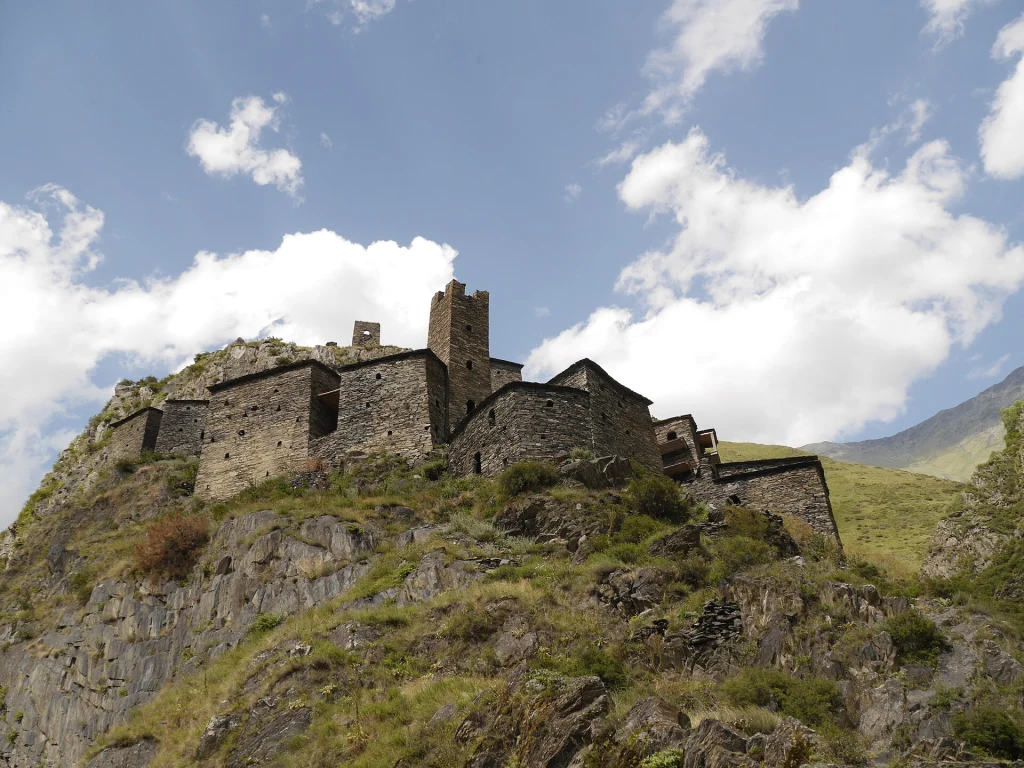
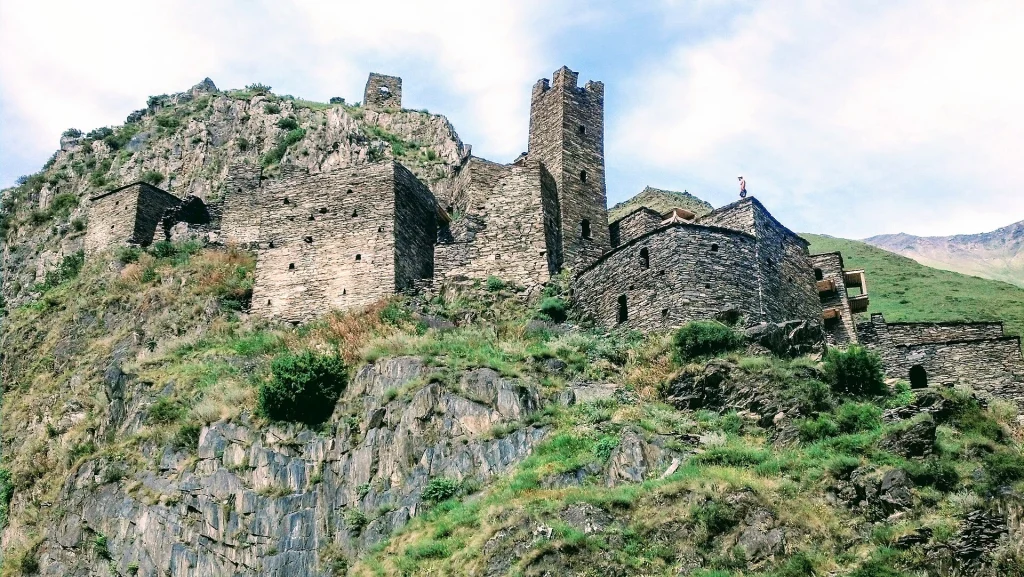
Mutso is built on a narrow rocky ridge that drops steeply to the Andaki River on both sides, a defensive position typical of Khevsureti rather than a single castle. Around sixty stone tower-houses (koshkebi) are packed against each other up the slope, linked by low passages and defensive walls, with a watchtower at the summit. Unlike Shatili, which is still partly inhabited, Mutso has been empty since the mid-20th century and is a ruin, with roofs missing on many towers and only the restored sections safe to approach closely. A short, steep path climbs from the parking area to the lower towers; the upper fortress requires scrambling over loose stone and is not fenced or lit. Below the village, several free-standing crypt-like structures are associated with local plague traditions, where the sick are said to have gone to isolate themselves rather than infect their families.
History
Khevsureti’s tower villages developed from the early medieval period as a defensive response to raids from the northern side of the Caucasus; most of the standing towers at Mutso are attributed to the 9th–13th centuries, with later repairs and additions into the 18th century. The region kept a distinct dialect, dress and customary law into the 20th century, remaining largely cut off from lowland Georgia for much of the year by snow on the Datvisjvari Pass. In 1951, Soviet authorities carried out a forced resettlement of highland communities in Khevsureti and neighbouring Tusheti to lowland state farms, and Mutso was abandoned along with other villages in the gorge. Decades of frost and neglect brought down roofs and upper walls; a restoration programme began in 2010 under Georgia’s cultural heritage authorities, rebuilding several towers and stabilising the approach path, a project that also drew criticism at the time for the amount of new concrete used alongside old stonework. Mutso is listed as a monument of cultural heritage and is often discussed together with Shatili as the clearest surviving example of Khevsureti’s defensive architecture.
Opening hours and tickets
| Item | Usual pattern |
|---|---|
| Access | Open site, no gate, no fixed hours — visited in daylight only |
| Entrance fee | None recorded; no ticket booth or staff on site (checked at booking) |
| Season | Road to Shatili and the final track to Mutso are usually passable June–September; closed or difficult in snow the rest of the year |
| Border zone | Khevsureti lies in Georgia’s border security zone; foreign visitors may be asked for passports at checkpoints near Shatili (checked at booking) |
How to get there
From Tbilisi, Mutso is reached by driving to Shatili first (about 5–6 hours, roughly 150 km, mostly on a narrow mountain road over the Datvisjvari Pass, partly unpaved), then continuing a further 5 km on a rough track along the Andaki gorge, finishing with a short walk up to the towers. There is no scheduled marshrutka to Mutso itself; occasional marshrutka services reach Shatili in summer, but most visitors use a private 4×4 or join an organised trip, since the final stretch is unsuitable for standard cars. GTour does not run a fixed-itinerary tour to Khevsureti; for Mutso and Shatili we arrange a custom trip with a car with driver (4×4 required) or a specialist guide, priced from our standard day and multi-day rates on gtour.ge/services. Combining Mutso with an overnight in Shatili avoids an exhausting same-day return from Tbilisi.
How long and the best time
Allow half a day for Mutso itself: 30–45 minutes to drive from Shatili, 1–2 hours to walk through the lower towers and back, more if you want to climb to the upper fortress. Because the round trip from Tbilisi is long, most itineraries pair Mutso with one or two nights in Shatili rather than a single long day. July and August give the most reliable road conditions and daylight; June and September are quieter but the pass can still close after early snow or heavy rain.
Tips
- Wear sturdy, ankle-supporting boots; the path and the ruins themselves are loose stone with no handrails.
- Bring layers even in summer: the gorge is shaded and windy, and weather changes quickly at this altitude.
- Carry cash; there are no card payments, shops or fuel beyond Shatili.
- Expect no mobile signal for long stretches of the drive and at the site itself.
- Avoid flying drones without checking locally first, given the proximity to the international border.
- Keep children close inside the ruins; sections have unguarded drops and missing floors.
Nearby
- Shatili fortress village
- Anatori plague crypts
- Ardoti village
- Datvisjvari Pass viewpoint
- Khevsureti highland pastures and trekking routes
Mutso Fortress Village is on these private tours: Georgia Classic in 7 Days — Tbilisi, Kazbegi, Kakheti and Mtskheta · Tbilisi to Batumi — Private Transfer, 6 Hours with Stops · Kutaisi Airport to Tbilisi — Private Transfer, 3.5 Hours. A travel expert adapts any of them to your dates.
Questions
Is Mutso an active village or a ruin?
It is a ruin, abandoned since the 1951 Soviet resettlement of highland Khevsureti; only restored sections are structurally sound.
Do I need a permit to visit Mutso?
Khevsureti is within Georgia's border zone and checkpoints near Shatili may ask for passports; confirm current rules when booking.
Can I drive my own rental car to Mutso?
The final approach track needs a 4×4 and local knowledge of the Andaki gorge; a standard sedan is not suitable.
Is there an entrance fee?
No fee or staffed entrance is recorded at the site, but this should be checked at booking since arrangements can change.
Sources
The fortified village of Mutso perches dramatically atop its rocky ridge in Khevsureti, Georgia. · Photo: Mutichou / Wikimedia Commons, CC BY-SA 4.0