

Timotesubani Monastery — opening hours, tickets, how to get there and what to see
Timotesubani Monastery is a working convent in a quiet side valley about 12 kilometres from Borjomi, in Samtskhe-Javakheti, built around a large brick church whose interior holds one of the most complete fresco cycles to survive from the reign of Queen Tamar. An inscription in the sanctuary dates the main painting campaign to the opening years of the thirteenth century, making the church a reference point for Georgian medieval art historians. It remains a functioning nunnery, visited mainly as a half-day add-on to a Borjomi or Borjomi–Bakuriani itinerary.
What you see
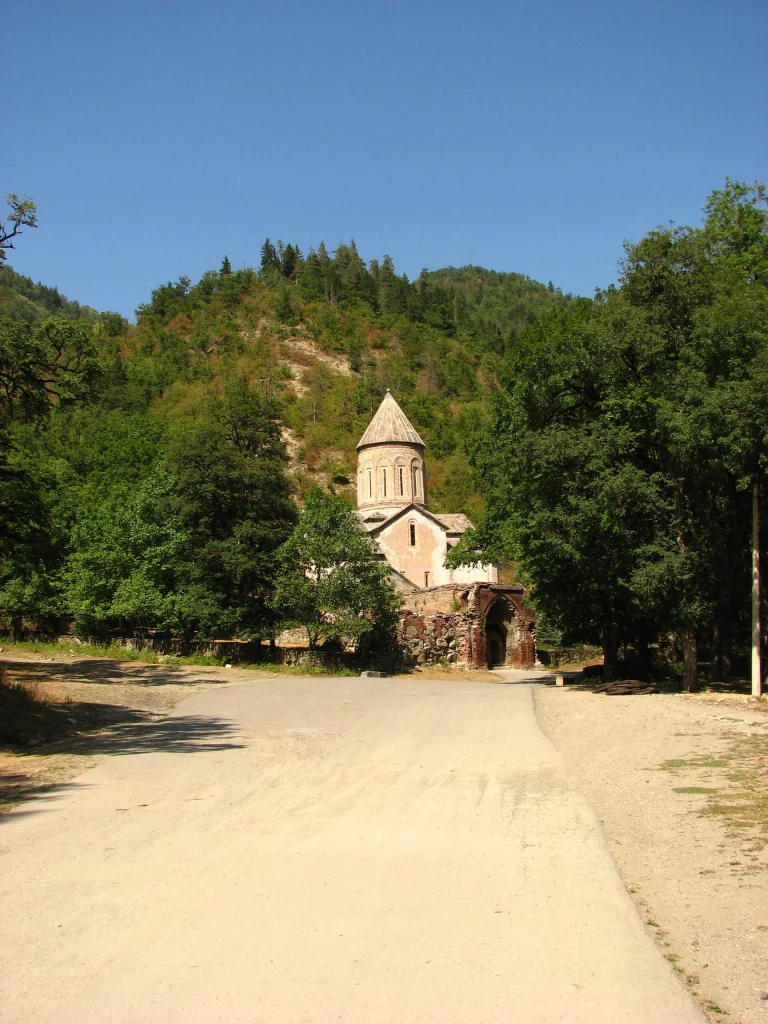
The monastery sits in the small village of Timotesubani, in a wooded side valley off the Borjomi–Bakuriani road, well away from the spa town’s crowds. The core of the complex is a large cross-in-square church, built of brick with a tall drum and dome, dedicated to the Dormition of the Mother of God. Unusually for Georgia, where most medieval churches are built of dressed stone, the brick construction and the proportions of the drum point to links with Byzantine building practice of the period.
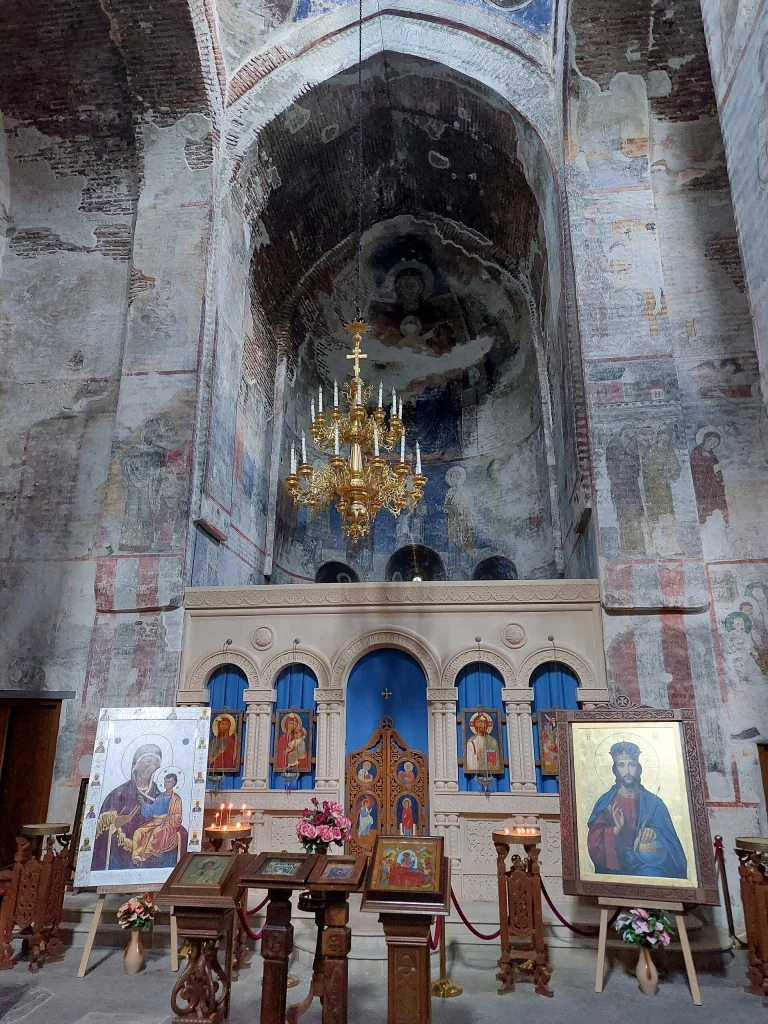
The reason art historians make the detour is inside. The walls carry two layers of fresco painting: an earlier, partly damaged cycle, and, over it, a second and far more sophisticated campaign covering the apse, the dome and the nave. The later paintings include a Communion of the Apostles, scenes from the life of the Virgin, a Last Judgement on the west wall, and donor portraits believed to show members of the royal court. The colour palette, the modelling of faces and the handling of drapery are usually cited as among the high points of Georgian wall painting before the Mongol invasions interrupted large-scale church building across the region.
Outside, a small cemetery, a bell tower and modest convent buildings surround the church. Nuns live and work on site, and the grounds are kept simple rather than manicured, with vegetable plots and beehives visible from the path.
History
The church is generally dated to the end of the twelfth or the first years of the thirteenth century, the peak of Georgia’s medieval political and cultural expansion under Queen Tamar (reigned 1184–1213). A donor inscription associated with the second fresco layer is read by specialists as placing that painting campaign within her reign, which is why Timotesubani is routinely grouped with other royal-period monuments such as Vardzia and Betania as evidence of the artistic ambition of the period. Later centuries were harder on the site: like much of Samtskhe-Javakheti, the area came under Ottoman control from the sixteenth century, and monastic life at Timotesubani lapsed for a long period before being revived in the modern era. The church and its frescoes have undergone conservation work in recent decades, part of a broader programme of fresco protection across Georgia’s medieval churches supported by the state heritage authorities (heritagesites.ge). Today the site is an active convent under the Georgian Orthodox Church, and the frescoes are referenced in national cultural heritage listings (culture.gov.ge).
Opening hours and tickets
Timotesubani is a working convent, not a museum, so there is no ticket office and no fixed admission charge. Visiting hours follow the rhythm of monastic life rather than a published schedule; the honest summary is below, and it is worth checking at booking if your visit is time-sensitive, for example around major feast days.
| Item | Usual pattern |
|---|---|
| Access to the grounds and church | Daylight hours, roughly 09:00–18:00, closed to visitors during services — checked at booking |
| Entrance fee | None; a small donation box is usually present |
| Photography inside the church | Often restricted or asked to be discreet — checked at booking |
| Dress code | Modest dress required; skirts and headscarves for women are usually available at the gate |
How to get there
From Borjomi, Timotesubani is about 12 kilometres, roughly 20–25 minutes by car along the road toward Bakuriani, with a short turn-off into the village. From Tbilisi, allow around 2.5 hours of driving to Borjomi and then the short detour, so the monastery works well as a stop on a longer Borjomi–Bakuriani day. From Kutaisi, the drive to Borjomi is also around 2 hours, making Timotesubani a feasible add-on from either direction. There is no direct marshrutka to the village; public transport means a marshrutka or taxi to Borjomi or Bakuriani and a taxi for the last stretch, since there is no scheduled service into Timotesubani itself. With us, a car with English-speaking driver for a half day in and around Borjomi runs from €150 for a sedan, or the monastery can be built into our two-day Borjomi, Bakuriani & Rabati tour from €420 per person for two travellers (see https://gtour.ge/tour/borjomi-bakuriani-rabati-2-days/).
How long and the best time
A visit takes 30–45 minutes, enough time to look at the exterior, step inside the church and take in the frescoes without rushing. It pairs naturally with a morning or afternoon in Borjomi Park or a run up to Bakuriani. Spring and early autumn give the best light for the interior and avoid the peak summer heat of the gorge; winter visits are possible but the church can be very cold and services may limit access.
Tips
- Dress modestly: covered shoulders and knees for everyone, and a headscarf for women, since this is an active convent rather than a monument site.
- Photography inside the church is sensitive; ask before taking pictures of the frescoes and never use flash.
- The interior can be dim, so a short wait for your eyes to adjust is more useful than a torch, which can be seen as intrusive.
- There are no facilities at the monastery itself; use services in Borjomi or Bakuriani before setting out.
- The site is quiet and rarely crowded, so there is no queue to plan around, but services on Sundays and feast days may restrict visiting to the grounds only.
- Combine the stop with Borjomi Park, the Rabati fortress in Akhaltsikhe, or a day in Bakuriani to make the detour worthwhile.
Nearby
- Borjomi Central Park and mineral water source
- Bakuriani ski resort
- Rabati Castle, Akhaltsikhe
- Borjomi-Kharagauli National Park
- Vardzia cave monastery
Timotesubani Monastery is on these private tours: The South in 3 Days — Borjomi, Vardzia, Rabati and Abastumani · Vardzia and Rabati — the Long Day South · Borjomi and Bakuriani — Spa Town and Mountain Air in a Day. A travel expert adapts any of them to your dates.
Questions
Is Timotesubani Monastery open to independent visitors?
Yes, the grounds and church are generally accessible during daylight hours, though it is an active convent, so access can be limited during services, checked at booking.
Is there an entrance fee?
No fixed ticket price; a donation box is usually present, and there is no museum-style admission.
How far is it from Borjomi?
About 12 kilometres, roughly 20–25 minutes by car along the road toward Bakuriani.
What is the monastery known for?
A thirteenth-century fresco cycle in the main church, dated by inscription to the reign of Queen Tamar, considered one of the finest surviving examples of Georgian medieval wall painting.
Sources
The medieval Timotesubani Monastery church stands amid greenery near Borjomi, Georgia. · Photo: BRUTE / Wikimedia Commons, CC BY 2.0