

Borjomi Central Park and Mineral Spring — opening hours, tickets, how to get there and what to see
Borjomi Central Park is the nineteenth-century spa park in Borjomi, Samtskhe-Javakheti, built around the naturally carbonated spring that gives Georgia’s best-known mineral water its name. Laid out from 1850 under Russian imperial patronage, it remains the town’s main public space, with a free-to-taste drinking gallery, a cable car to a hilltop viewpoint, and the Firuza bathhouse nearby. The water is still bottled commercially today, a trade that dates to industrial-scale export beginning in the 1890s.
What you see
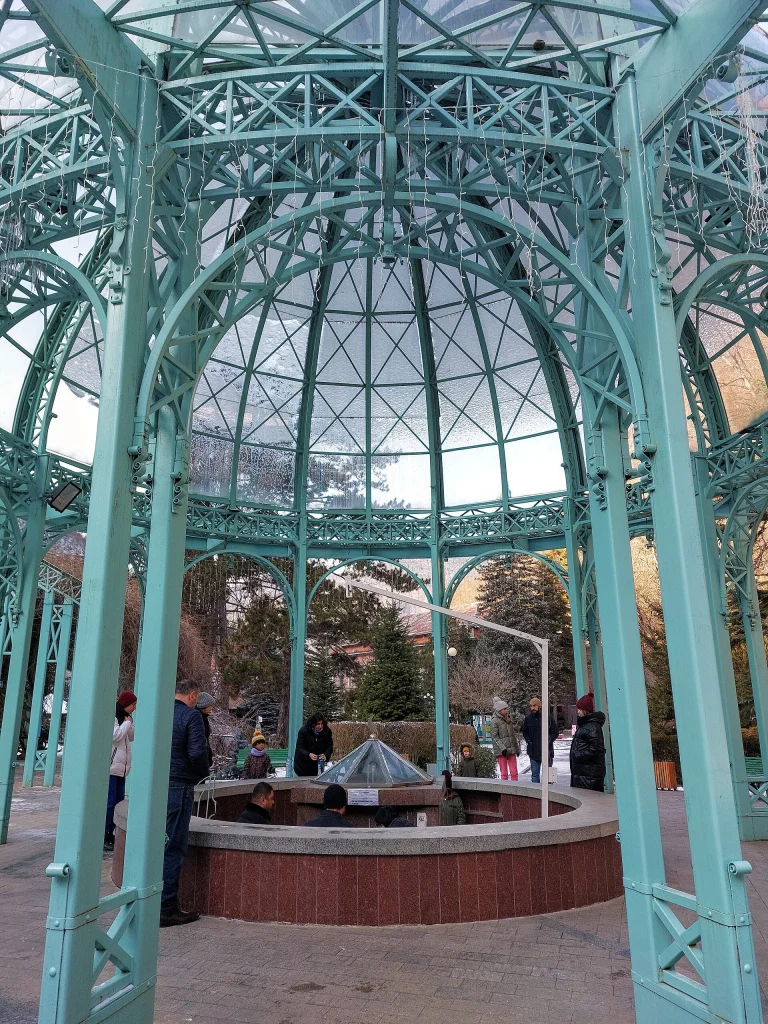
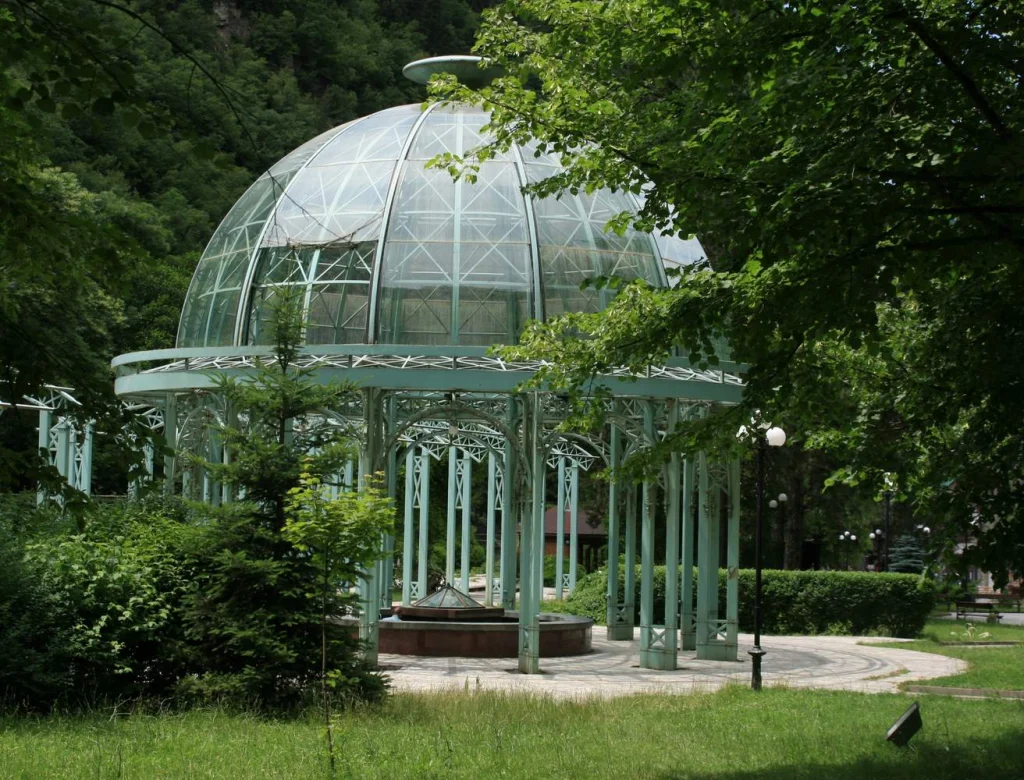
The park follows the narrow Borjomula gorge for about a kilometre, shaded by plane trees and conifers, with the stream running down its centre and footbridges crossing it at intervals. At the entrance stands the drinking gallery over Spring No. 1, where the warm, salty mineral water flows from taps into the air and visitors fill cups or bottles for free. Benches, an open-air concert shell, a small funfair and paddle boats on an artificial pond fill the lower park, while a cable car (built in 1966 and rebuilt in 2011) climbs the hillside to a viewing platform and a second, quieter park above the gorge. Just outside the gates, the Firuza sulphur bathhouse, built in Persian revival style in the 1890s, is one of the more photographed buildings in town, though it is not always open to casual visitors.
History
The spring was known locally for centuries, but its development began after Russian garrison troops stationed in the gorge in the 1810s noticed the water’s effects. Mikhail Vorontsov, viceroy of the Caucasus, and his wife Elizaveta promoted the site from the 1840s, and the park itself was laid out from 1850, giving the resort its planned, European spa-town character. Commercial bottling and export of Borjomi water expanded through the late nineteenth century, turning the town into a recognised brand across the Russian Empire; this history of bottling and branding is summarised in regional reporting on the company’s modern operations (agenda.ge). The park and the wider resort sit at the edge of Borjomi-Kharagauli National Park, one of Georgia’s largest protected areas, gazetted in 1995 and managed today by the national Agency of Protected Areas (apa.gov.ge). The park has been renovated more than once in the post-Soviet period, most visibly after severe flood damage in 2015, which also affected the gorge and the cable car line.
Opening hours and tickets
| Item | Usual pattern |
|---|---|
| Park access | Open daily, roughly 08:00–22:00 in summer, shorter in winter; ticket booths at the main gate, small entrance fee (a few GEL), checked at booking |
| Drinking gallery (mineral water) | Same hours as the park, free to drink or fill a bottle |
| Cable car | Runs through the day in season, closes earlier in low season and in bad weather, separate small fee, checked at booking |
| Firuza bathhouse | Exterior viewable anytime; interior access varies, checked at booking |
How to get there
From Tbilisi, Borjomi is about 155 km and roughly 2 hours by car via Gori and Khashuri. Marshrutka minibuses run from Tbilisi’s Didube station several times a day, taking around 2.5–3 hours; a seasonal direct train also links Tbilisi and Borjomi in summer, with a change at Khashuri at other times. From Kutaisi the drive is also about 2 hours via Khashuri. With us, a private car with driver for the day from Tbilisi costs €150 for a sedan or €220 for a 4×4 (up to 10 hours, 250 km included, see gtour.ge/data/), or you can take our packaged Borjomi, Bakuriani & Rabati — 2 Days tour (from €357 per person in a group of four to six) or the Vardzia, Rabati & Borjomi — 2 Days tour, which both build Borjomi into a wider Samtskhe-Javakheti loop.
How long and the best time
Allow 1 to 2 hours to walk the lower park, drink the water and ride the cable car; add 30 to 60 minutes if you also walk the upper park or visit the bathhouse exterior. Spring and autumn bring mild weather and fewer crowds than the July–August peak, when Georgian families fill the park on weekends. Winter is quiet and cold but the gallery and lower park stay open, and Borjomi works well as a stop on the way to or from the Bakuriani ski slopes.
Tips
- Bring a reusable bottle; the mineral water is free at the gallery taps and widely sold bottled if you prefer it chilled.
- The water is an acquired taste, strongly mineral and slightly salty; try a small cup before filling a bottle.
- Comfortable shoes help, since the gorge path has gentle slopes and some stairs near the cable car station.
- Weekends in high season bring queues for the cable car; early morning or late afternoon is calmer.
- Photography is unrestricted in the park; the Firuza bathhouse facade is a popular shot from the footbridge opposite.
- Check road and weather status before a winter visit if combining with Bakuriani, see gtour.ge/road-status/.
Nearby
- Likani Palace, the former Romanov summer residence on the edge of town
- Borjomi-Kharagauli National Park visitor centre and trailheads
- Green Monastery at Timotesubani, a short drive away
- Rabati Castle in Akhaltsikhe
- Bakuriani ski resort, about 30 minutes up the mountain road
Borjomi Central Park and Mineral Spring is on these private tours: The South in 3 Days — Borjomi, Vardzia, Rabati and Abastumani · Vardzia and Rabati — the Long Day South · Borjomi and Bakuriani — Spa Town and Mountain Air in a Day. A travel expert adapts any of them to your dates.
Questions
Is Borjomi Central Park free to enter?
There is usually a small entrance fee at the main gate; the mineral water itself is free to drink at the gallery taps, checked at booking.
Can I drink the water straight from the spring?
Yes, the gallery over Spring No. 1 dispenses it continuously for visitors to taste or bottle.
Is the cable car worth the extra fee?
It saves a steep climb and gives a view over the gorge and upper park, useful if you want a short walk above the valley.
Is Borjomi a good base for Bakuriani or Vardzia?
Yes, both are reachable as day trips by road, and several multi-day tours combine Borjomi with Bakuriani, Rabati and Vardzia.
Sources
Visitors stroll past the iconic glass-domed mineral spring pavilion in Borjomi Central Park. · Photo: Karelj / Wikimedia Commons, CC BY-SA 3.0