

Samtavro Monastery — opening hours, tickets, how to get there and what to see
Samtavro Monastery is a working convent in the centre of Mtskheta, about 400 metres from Svetitskhoveli Cathedral, built around the grave of King Mirian III, who made Christianity the state religion of Iberia in the early fourth century. The site is part of the UNESCO World Heritage property “Historical Monuments of Mtskheta,” inscribed in 1994. It is also one of Georgia’s most visited pilgrimage spots because of the nearby grave of the monk Gabriel (Gabriel Urgebadze), who was glorified as a saint by the Georgian Orthodox Church in 2012.
What you see
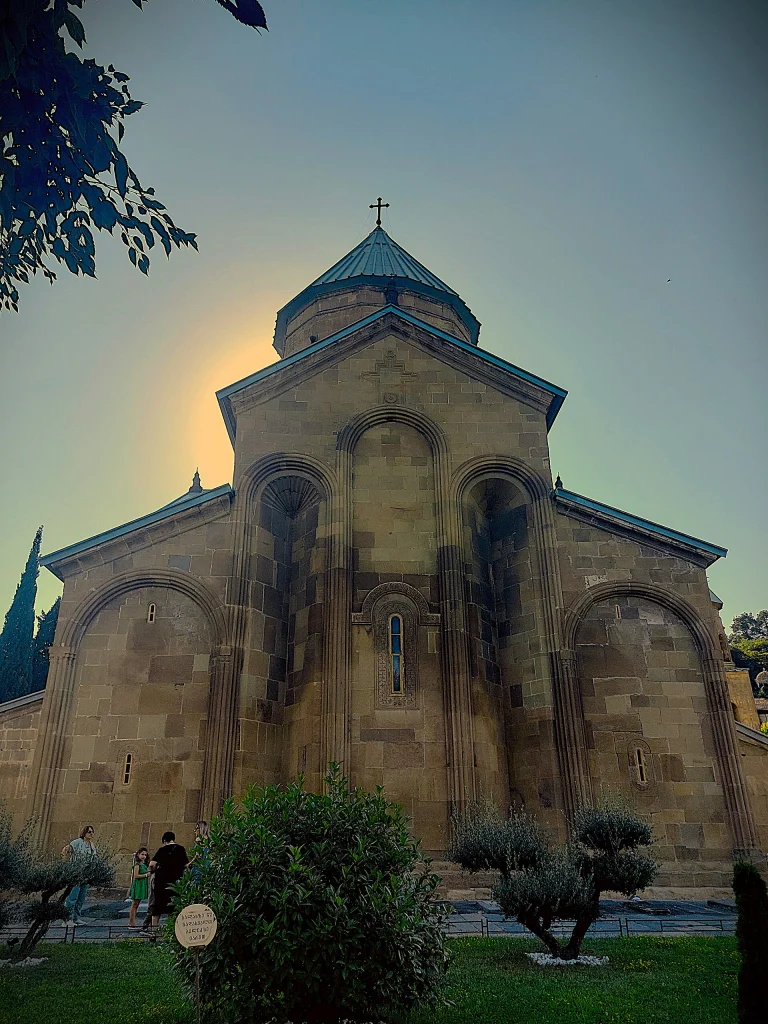
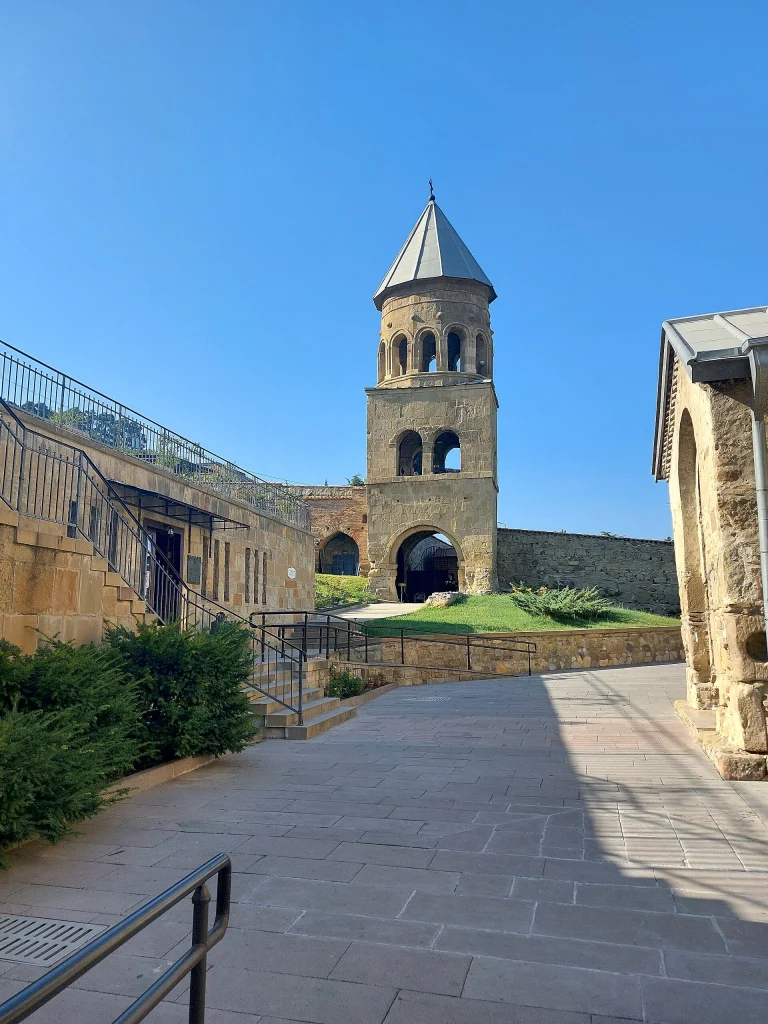
Samtavro is a walled convent complex rather than a single building. The main church, dedicated to the Transfiguration, is a cross-domed structure of pink and ochre stone, smaller and plainer than Svetitskhoveli Cathedral down the road, but built on the same ground where the first Christian ruler of Kartli is said to have erected a wooden church in the fourth century. Inside, to the left of the entrance, is the stone tomb of King Mirian III and Queen Nana, marked with a simple inscription. A separate, free-standing bell tower from the medieval period stands in the courtyard, and the convent grounds include a small 11th-century chapel and later monastic buildings where nuns still live and work.
Most visitors today come specifically for the grave of Father Gabriel (Gabriel Urgebadze, 1929–1995), set against the outer wall of the main church under a metal canopy. It draws a steady line of pilgrims most days and a much longer queue on Thursdays and feast days, with people touching the tomb, leaving notes, and queuing sometimes for over an hour.
History
Tradition holds that a wooden church stood on this spot soon after Mirian III adopted Christianity around 326 AD, making Samtavro one of the earliest Christian foundations in the Caucasus. The present stone church was largely rebuilt in the 11th century, in the same wave of construction that produced the nearby Svetitskhoveli Cathedral, and it was restored again after earthquake damage in later centuries. In 1994 UNESCO inscribed Samtavro together with Svetitskhoveli Cathedral, Jvari Monastery and the surrounding archaeological remains as “Historical Monuments of Mtskheta,” citing the exceptional testimony of medieval Georgian architecture and religious life these sites preserve (UNESCO World Heritage Centre). In the 20th century Samtavro became the home convent of Father Gabriel Urgebadze, a monk known locally for his austere life and acts of charity under Soviet rule; the Georgian Orthodox Church canonized him in 2012, and his grave has since become the single busiest pilgrimage point in Mtskheta.
Opening hours and tickets
| Item | Usual pattern |
|---|---|
| Opening hours | Daily, roughly 09:00–19:00 (shorter in winter) |
| Entrance fee | Free, donations welcomed |
| Dress code | Covered shoulders and knees for all visitors; headscarves for women, usually available to borrow at the entrance |
| Photography | Permitted in the courtyard; restricted or discouraged inside the church and near the grave of Father Gabriel |
Hours are set by the convent rather than a ticketing system and can shift around major feast days (Easter, St Nino’s Day on 1 June, Mtskhetoba in October); checked at booking.
How to get there
From central Tbilisi, Mtskheta is about 20–25 minutes by car (roughly 20 km), and Samtavro sits inside the old town, an easy walk from the main parking area near Svetitskhoveli Cathedral. Marshrutka minibuses to Mtskheta leave frequently from Tbilisi’s Didube station, take around 30–40 minutes depending on traffic, and cost only a few lari; from the Mtskheta bus stop it is a 10-minute walk to the monastery. There is no direct train service to Mtskheta.
With us, Mtskheta is covered on several set routes: the half-day Tbilisi & Mtskheta — The Essential First Day, the full-day St Nino’s Way — Mtskheta, Sioni and Bodbe, and the three-day Monasteries of Georgia — Mtskheta, the Thirteen Fathers and Kakheti, as well as the eight-day Christian Georgia pilgrimage itinerary. A private sedan with driver for a day trip from Tbilisi to Mtskheta, Kazbegi, Kakheti or Gori-style routes starts at €150 for the car (see Services on our price table).
How long and the best time
Allow 30–45 minutes for Samtavro itself, and half a day if combining it with Svetitskhoveli Cathedral and Jvari Monastery on the hill above town, which is the usual pattern for a Mtskheta visit. Early morning on a weekday, before coach groups arrive from Tbilisi, is the quietest time; Thursdays bring the largest crowds because of devotions at Father Gabriel’s grave.
Tips
- Bring a scarf or shawl; borrowed headscarves and wraps are usually available at the gate but can run out when groups are large.
- Expect a queue at the grave of Father Gabriel, especially on Thursdays, feast days and in summer; mornings are calmer.
- Photography inside the church and directly at the grave is generally discouraged out of respect; ask before using a camera.
- The site has no shade and little seating; midsummer midday heat can make the courtyard uncomfortable.
- Combine the visit with Svetitskhoveli Cathedral, a five-minute walk away, to understand the full UNESCO ensemble.
Nearby
- Svetitskhoveli Cathedral
- Jvari Monastery
- Mtskheta old town and river confluence viewpoint
- Armaztsikhe-Bagineti archaeological site
- Zedazeni Monastery
Samtavro Monastery is on these private tours: Georgia in 10 Days — Tbilisi to Svaneti to the Sea · Tbilisi in a Day — Old Town, Sulphur Baths, Mtatsminda and the Markets · Mtskheta, Gori and Uplistsikhe — Kartli in a Day. A travel expert adapts any of them to your dates.
Questions
Is Samtavro Monastery the same as Svetitskhoveli Cathedral?
No, they are separate buildings about 400 metres apart in Mtskheta, both part of the same UNESCO-listed group of monuments.
Why do so many people queue at Samtavro?
Most queue at the grave of Father Gabriel Urgebadze, a monk canonized by the Georgian Orthodox Church in 2012, rather than for the monastery itself.
Is there an entrance fee?
No, entry is free, though donations are welcomed; dress should cover shoulders and knees.
Can Samtavro be visited on a day trip from Tbilisi?
Yes, it is usually combined with Svetitskhoveli Cathedral and Jvari Monastery on a half-day or full-day trip from Tbilisi.
Sources
Visitors gather at Samtavro Monastery's church and bell tower in Mtskheta. · Photo: Arian Zwegers from Brussels, Belgium / Wikimedia Commons, CC BY 2.0