

By Nino Gelashvili, Travel News Editor · 27/10/2026
Georgia is reachable from Venezuela, but only with at least one, usually two, connecting flights, and the entry rules that apply to a Venezuelan passport are the single detail you must confirm before buying a ticket, because Georgia’s visa list is reviewed periodically and Venezuela’s own passport and travel situation has changed repeatedly in recent years. As of this writing, the safest approach is to treat Georgia as a country that may require either a standard e-visa or allow visa-free entry depending on your exact passport and travel history, and to verify your status on the official e-visa portal and the Ministry of Foreign Affairs site before booking anything non-refundable.
Beyond the paperwork, Georgia for a Venezuelan traveller means a country with its own currency (the lari), its own alphabet, a cuisine with a few comforting echoes of home (cheese bread, grilled meats, bean stews) but mostly new flavours, and almost no Spanish spoken outside a handful of hotels. Direct cultural and trade ties between the two countries are thin, and this guide says so plainly rather than inventing connections, while focusing on what actually helps you plan: visas, flights, money, language, food, health cover and safety.
Visa and entry: what to check before you book
Georgia’s entry policy is set out on two official sites, and both say the same thing in different words: rules change, and the only current answer is the one you get from the system itself, not from a blog or a forum post. The e-visa portal has a built-in eligibility checker where you enter your nationality and travel purpose and it tells you immediately whether you need to apply for an e-visa, whether you qualify for visa-free entry, or whether you need to apply in person at a Georgian diplomatic mission. Venezuelan citizens should run this check themselves rather than rely on general guides, because passport issuance irregularities in recent years have at times affected how some countries treat Venezuelan documents, and Georgia’s policy can be adjusted without much public notice.
If the checker shows you need an e-visa, the process is usually straightforward: an online form, a scanned passport photo page, proof of accommodation and return travel, and in many cases proof of travel medical insurance (see the health section below). Processing is typically quoted at a few business days, but apply at least two to three weeks ahead to allow for any request for extra documents. The Ministry of Foreign Affairs website lists which Georgian consulates or honorary consuls, where they exist, can also issue visas in person, which matters because Venezuela does not host a Georgian embassy, so applications from Venezuela are usually routed either online or through a Georgian mission in a neighbouring country.
Venezuela does not maintain an embassy in Tbilisi, and Georgia does not maintain one in Caracas. Consular protection for Venezuelan citizens travelling in Georgia is, in most cases, handled by a Venezuelan diplomatic mission in a nearby country with jurisdiction over the Caucasus; which mission currently holds that responsibility can change, so confirm with Venezuela’s own foreign ministry before you travel and keep its contact details with you, alongside the nearest honorary consul or embassy of a friendly state as a fallback in an emergency.
Flights from Venezuela: hubs and connections
There are no direct flights between Venezuela and Georgia, and none are likely to appear soon given the size of the market. Realistic itineraries from Caracas or Maiquetía route through a major hub and then on to Tbilisi, Batumi or Kutaisi. The two connections that most consistently apply are:
- Istanbul: Turkish Airlines’ hub has historically served Latin America and has strong onward frequency to all three Georgian airports; this is usually the shortest total routing when it is operating.
- Doha: Qatar Airways connects through its hub with a onward link to Tbilisi, typically reached from Venezuela via a European or North/Central American gateway first, since Doha is not served directly from Caracas.
Warsaw, Munich and Dubai routings are less commonly the natural choice from Venezuela and only make sense if your first long-haul leg already takes you to Europe or the Gulf for other reasons. Airline schedules on the Venezuela side change often, partly for commercial and partly for regulatory reasons, so check your carrier’s current network and build in a generous connection time, especially in Istanbul. On arrival, confirm your flight status against the live boards at Tbilisi International Airport, Kutaisi International Airport or Batumi International Airport. For the onward leg into the city, a pre-booked private transfer removes one uncertainty from a long journey; G Tour’s airport transfers are fixed in writing in advance, from a sedan at €25 Tbilisi airport to the city, up to a minivan at €35, with 60 minutes of free waiting built in for delayed flights.
Driving licence, money, cards and connectivity
A Venezuelan driving licence, printed in the Latin alphabet, is generally usable in Georgia for a limited period as a visitor, but Georgian traffic law on foreign licences is set in national legislation, and recognised validity periods and International Driving Permit requirements are revised from time to time, so confirm the current rule on the Legislative Herald of Georgia before renting a car, and consider carrying an International Driving Permit alongside your Venezuelan licence as a precaution. For longer or mountain routes, hiring a car with an English-speaking driver removes the question entirely; G Tour prices a sedan for a day around Tbilisi at €90, a 4×4 at €150, rising for multi-day touring.
Georgia’s currency is the lari (GEL). Cards are accepted in most Tbilisi, Batumi and Kutaisi hotels, restaurants and supermarkets, but cash is still useful in villages, markets and for taxis outside the capital. One point specific to Venezuelan travellers: international sanctions and currency controls have at times made Venezuelan-issued Visa and Mastercard cards unreliable for payments or withdrawals abroad, so do not plan a trip around a Venezuelan bank card alone. Carry some cash in US dollars or euros to exchange locally, and if you hold a card issued by a bank outside Venezuela, test it with a small transaction on arrival before relying on it. Mobile connectivity is easy: Magti, Geocell and Beeline sell prepaid tourist SIMs at the airports and in city stores, and eSIM options are increasingly available for travellers who prefer not to swap a physical SIM.
Language and food: what’s familiar, what’s not
Georgian is the national language and uses its own script, unrelated to Latin letters. Russian is still widely understood by an older generation and in the tourism and hospitality sector, and English is common among guides, hotel staff and younger people in Tbilisi, Batumi and Kutaisi, though less so in villages. Spanish is rare; a handful of larger hotels and some tour operators serving the recent growth in Latin American visitors may have Spanish-speaking staff, but do not expect it as a default. A translation app and a few basic Georgian or Russian phrases go a long way, and a private guide who speaks Spanish removes the problem entirely for anyone who prefers it.
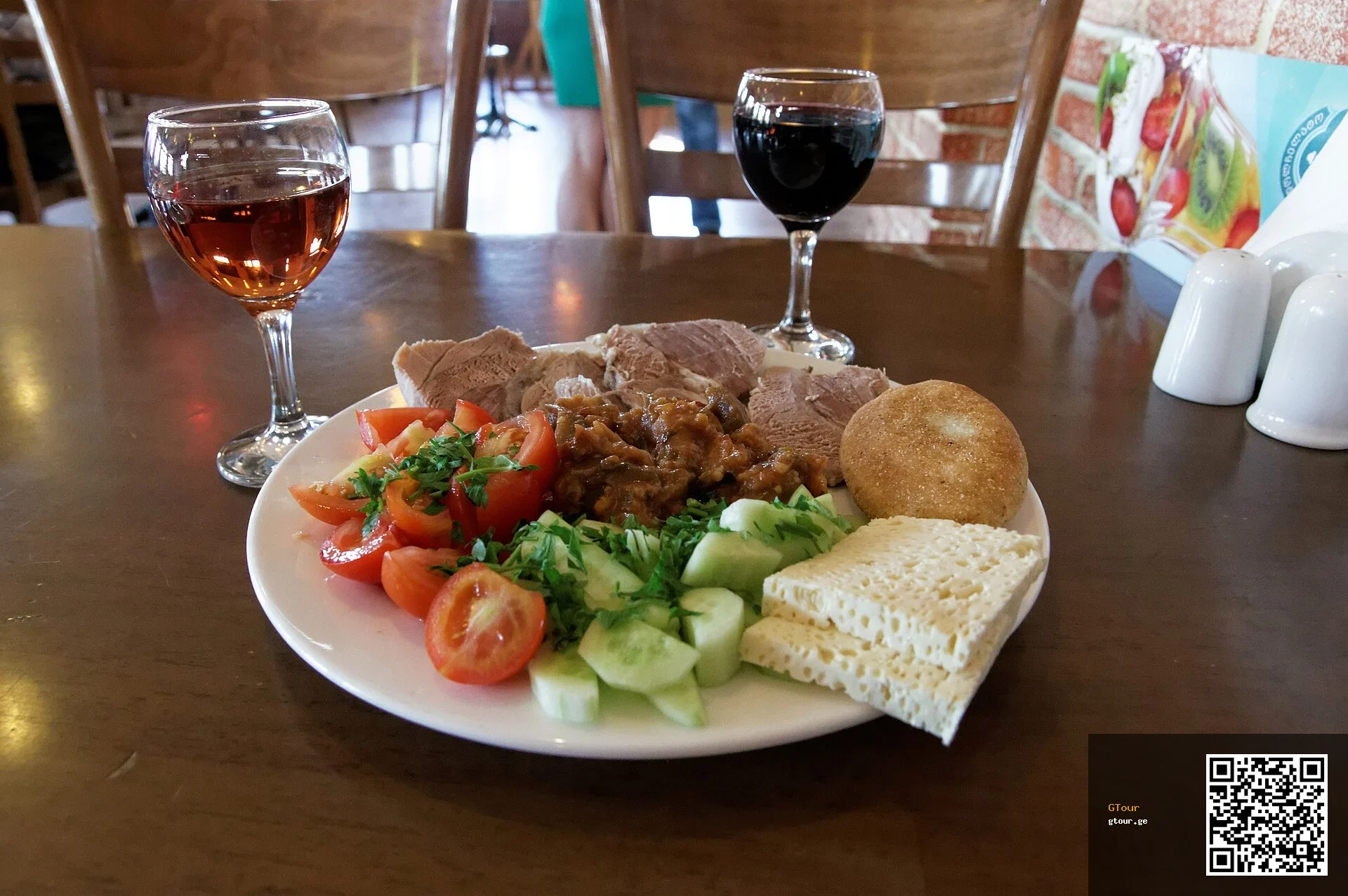
Georgian food is distinct from Venezuelan cuisine but not entirely foreign in texture or idea. Khachapuri, the cheese-filled bread baked in several regional styles, has an obvious kinship with an arepa con queso. Mtsvadi, skewered grilled pork or beef cooked over charcoal, sits close to a Venezuelan parrilla in spirit. Lobio, a slow-cooked bean stew, will feel familiar to anyone used to caraotas. Vegetarians are well served thanks to Georgia’s long Orthodox fasting tradition, which produced an entire category of meat-free dishes such as pkhali (vegetable and walnut pastes) and ajapsandali (eggplant and pepper stew); ask for “mxolod bostneuli” (vegetables only) or simply “vegetarian” in English, which is usually understood. Halal food is limited outside Adjara, where Georgia’s Muslim minority and Batumi’s international visitor base support halal-friendly kitchens and mosques; in Tbilisi, ask in advance and expect fewer certified options.

Health insurance, safety and etiquette
Georgia’s e-visa and entry requirements for many nationalities include proof of valid travel medical insurance covering the stay, and this is checked both at the application stage for an e-visa and sometimes on arrival. Confirm the current requirement and minimum coverage amount on the e-visa portal at the time you apply, since the exact figure has been adjusted before. Buy a policy before you fly, covering at minimum emergency treatment and repatriation, and for anyone with an existing health condition, speak to a doctor at home about fitness to travel at altitude if your itinerary includes the Caucasus mountains, Kazbegi or Svaneti. General public health information for travellers is published by Georgia’s national health authorities and is worth a quick check through the national health platform before departure.
Georgia is, in day-to-day terms, a safe country for visitors, with low rates of violent crime against tourists; ordinary precautions around valuables and late-night streets apply as anywhere. Etiquette worth knowing: a supra, or traditional feast, involves lengthy toasts led by a toastmaster (tamada), and it is polite to drink at least a token amount when toasted, though no one should feel pressured to drink alcohol if they prefer not to. Dress modestly when visiting working churches and monasteries, covering shoulders and, for women, often the head with a scarf provided at the door. Traffic drives on the right, and pedestrian crossings are not always respected by drivers, so cross with caution even where a signal says you may.
Cultural, trade and diaspora ties: where they are thin
It is honest to say that direct historical, cultural or trade links between Georgia and Venezuela are limited. There is no significant Venezuelan diaspora community in Georgia, no direct trade agreements of note, and no shared historical narrative comparable to Georgia’s ties with its immediate neighbours or with larger diplomatic partners. What has brought a small, recent flow of Venezuelan and other Latin American visitors and residents to Georgia is mostly practical: Georgia’s relatively open company registration rules and, for some nationalities, straightforward residency pathways have attracted a modest number of entrepreneurs and remote workers in recent years, a trend documented in Georgia’s own economic reporting rather than in any formal bilateral programme. Travellers should not expect embassies, cultural institutes or a built-in support network; they should expect a country that is welcoming to visitors generally, with infrastructure built for international tourism rather than for any single nationality.
What a G Tour private guide adds
Given the language gap and the thin institutional ties described above, a private, English or Spanish-speaking guide removes most of the friction a Venezuelan traveller would otherwise face alone: reading menus and museum labels, negotiating taxi fares, navigating church etiquette, and handling the inevitable moment when a card does not work and cash is needed quickly. G Tour’s licensed guides are priced per group rather than per person, from €70 for a half-day city walk in Old Tbilisi and Mtskheta to €120 per day on a multi-day route, with Spanish available for a surcharge of €25 per day on top of the standard rate. For a first visit, the Georgia in 7 Days itinerary combines Tbilisi, Kazbegi and Kakheti wine country with a guide who can translate both the language and the customs, which matters more on a short trip than on a long one.
If this guide is part of a trip you are planning, our Georgia in 10 Days — Tbilisi to Svaneti to the Sea and Monasteries of Georgia — Mtskheta, the Thirteen Fathers and Kakheti in 3 Days cover the places it describes with a private guide and driver; a GTour travel expert adapts the route to your dates.
Practical summary
- Check visa status on evisa.gov.ge and current advice on mfa.gov.ge well before booking flights; rules for Venezuelan passports can change.
- No direct flights exist; plan via Istanbul or Doha, confirm schedules with the airline and check arrivals on tbilisiairport.com, kutaisiairport.com or batumiairport.com.
- Carry an International Driving Permit alongside your Venezuelan licence and confirm current validity rules on matsne.gov.ge.
- Do not rely solely on a Venezuelan bank card abroad; carry cash in USD or EUR and test any card before depending on it.
- Buy travel medical insurance before departure; it may be required for your e-visa and is sensible regardless.
- Expect Georgian and Russian more often than Spanish; English is common in tourist-facing roles in Tbilisi, Batumi and Kutaisi.
- Vegetarian Georgian food is easy to find; halal options are concentrated in Adjara.
- Book a private guide or driver through G Tour’s services page to bridge the language gap on arrival.
Sources
- Georgia e-visa portal and eligibility checker
- Ministry of Foreign Affairs of Georgia
- Legislative Herald of Georgia, driving and traffic law
- Georgian National Tourism Administration
- Georgia Travel official tourism site
Questions this guide does not answer? Write to info@castle.ge or WhatsApp +995 577 41 63 14 — a person in Tbilisi replies. See also our travel services and all guides.
A typical restaurant meal with wine served in Tbilisi, Georgia. · Photo: Vyacheslav Argenberg / Wikimedia Commons, CC BY 4.0
Been to Georgia? Tell us how it went — the best stories are published here.
Share your tripOne email a week: what changed for travellers in Georgia — rules, roads, flights, seasons — plus one place worth the trip. Written by the GTour desk, no advertising, unsubscribe in one click.
This story across our partner network — ქართულად: შენი დასვენება