

By Mariam Lomidze, Culture & Events Reporter · 27/10/2026
Argentine citizens travelling to Georgia in 2026 do not need a visa for short tourist stays: Georgia has for several years granted visa-free entry to Argentine passport holders for stays that have typically run up to 360 days. That said, visa and stay rules are set by decree and can be adjusted without much notice, so the only responsible answer is “check before you book flights.” The authoritative source is the Ministry of Foreign Affairs’ consular pages and, if a visa or e-Visa is ever required for your specific case (diplomatic passport, longer stay, change of purpose), the official portal is evisa.gov.ge, where applications are usually processed within a few working days.
There is no direct flight between Argentina and Georgia, so every itinerary involves at least one stop, usually in Istanbul, Doha, Dubai or Munich. Expect a journey of roughly 20 to 28 hours door to door depending on connection times. Once on the ground, Georgia is straightforward for Argentine travellers: the lari is the only currency that matters for cash, cards are widely accepted in cities, Georgian and Russian are the working languages outside the capital, and food built around grilled meat, bread and wine will feel familiar to anyone used to an asado. This guide sets out the practical detail, nationality by nationality, the way our founder — a public-health professor — insists we do: plainly, with sources, and without glossing over what is genuinely uncertain.
Visa and entry rules for Argentine passport holders
As of October 2026, Argentine citizens travelling as tourists can enter Georgia without a visa and stay for an extended period under the country’s standard visa-free regime for a long list of nationalities, Argentina among them. Georgia’s rules are governed by government decree rather than a fixed treaty, and the Ministry of Foreign Affairs can and does revise entry conditions, permitted stay lengths and document requirements. Do not rely on a blog post, a forum thread or last year’s rule: before you buy tickets, check the current position directly on the Ministry’s site, mfa.gov.ge, and keep a screenshot or printout of what you read on the day you checked.
If your situation falls outside the standard tourist case — a different passport type, a planned stay longer than the visa-free allowance, or travel for work rather than tourism — Georgia’s e-Visa system handles applications online through evisa.gov.ge. The portal asks for a scanned passport, a passport photo and a return ticket or itinerary, and published processing times are generally a few business days, though the portal itself states the current figure and should be treated as the final word. There is no visa-on-arrival fallback to assume; if the e-Visa is required for your case, it must be approved before departure.
Flights from Argentina: hubs and connections
No airline flies nonstop between Buenos Aires and Tbilisi, and this is unlikely to change in the near term given the distance and the thin direct traffic between the two countries. Nearly every reasonable routing uses one of four hub airports, matching the connections that already serve South America well:
| Hub | Typical connecting airline(s) | Notes |
|---|---|---|
| Istanbul | Turkish Airlines | Usually the shortest overall routing and the most frequent onward service to Tbilisi, Kutaisi or Batumi |
| Doha | Qatar Airways | Strong onward frequency to Tbilisi |
| Dubai | Emirates, flydubai | Good option if your outbound leg from Argentina already routes through the Gulf |
| Munich | Lufthansa + partner onward | Useful if your transatlantic leg lands in Germany |
Georgia has three international airports: Tbilisi, Batumi and Kutaisi. Kutaisi in particular has grown as a budget-carrier gateway from Europe, so travellers connecting via a European hub should compare fares into all three before settling on Tbilisi by default. Check live schedules directly with the airports at tbilisiairport.com, kutaisiairport.com and batumiairport.com, since routes and frequencies change seasonally. If you land in Kutaisi and plan to spend most of your trip around Tbilisi or Kakheti, a private transfer is usually simpler than chasing a connecting domestic flight; our fixed-price Kutaisi airport to Tbilisi transfer runs €120 by sedan or €150 by minivan, booked in writing before you fly.
Driving licence, money and cards
Argentina is a party to the 1968 Vienna Convention on Road Traffic, and Georgian traffic law generally recognises foreign driving licences from convention countries for a limited period, alongside an International Driving Permit where the licence itself is not in Latin script or lacks a photograph. Because enforcement and documentation requirements can vary by road police discretion, carry both your Argentine licence and an International Driving Permit if you intend to rent a car, and confirm current requirements through Georgia’s road authority at georoad.gov.ge or the relevant legislation on matsne.gov.ge before you drive. Many visitors, especially on mountain routes to Svaneti, Tusheti or Kazbegi, choose a car with an English-speaking driver instead of self-driving; see our car-with-driver rates on gtour.ge/services.
The currency is the Georgian lari (GEL). On 27 October 2026 the National Bank of Georgia’s reference rate was approximately 2.60 lari to the US dollar and 2.91 lari to the euro — rates move daily, so check the current figure before converting a budget. Visa and Mastercard are accepted at hotels, most restaurants and supermarkets in Tbilisi, Batumi and Kutaisi; carry cash for rural guesthouses, village markets, minibuses (marshrutka) and small wine-country cellars, where card machines are inconsistent. ATMs are common in cities and towns but sparse in high mountain areas such as Tusheti, so withdraw what you need before heading into the regions.
SIM cards, eSIM and staying connected
Georgia has three main mobile operators — Magticom, Geocell and Beeline — all offering prepaid tourist SIM packages with data at airports and city kiosks, usually requiring only a passport to register. eSIM options from international providers are increasingly straightforward if your phone supports them and you prefer to activate data before landing. Coverage is reliable in cities, towns and along the main highways; expect it to thin out in high Svaneti and Tusheti, where some valleys have no signal at all.
Language: Georgian, Russian, English and Spanish
Georgian is the state language and uses its own script, which Argentine travellers will not be able to sound out by guesswork. Russian remains widely understood among older Georgians and in many tourism and hospitality settings, a legacy of the Soviet period. English has expanded fast in Tbilisi, Batumi and among younger guides, hotel staff and restaurant servers in tourist areas, but it is noticeably thinner in villages, at bus stations and with older taxi drivers. Spanish is rarely spoken; do not expect to get by on it outside a handful of international hotels. A translation app, a phrasebook with the Georgian alphabet, or — more practically — a private guide who bridges Georgian, Russian and English solves most situations an independent Argentine traveller will meet.
Food: common ground with an asado culture, plus vegetarian and halal options
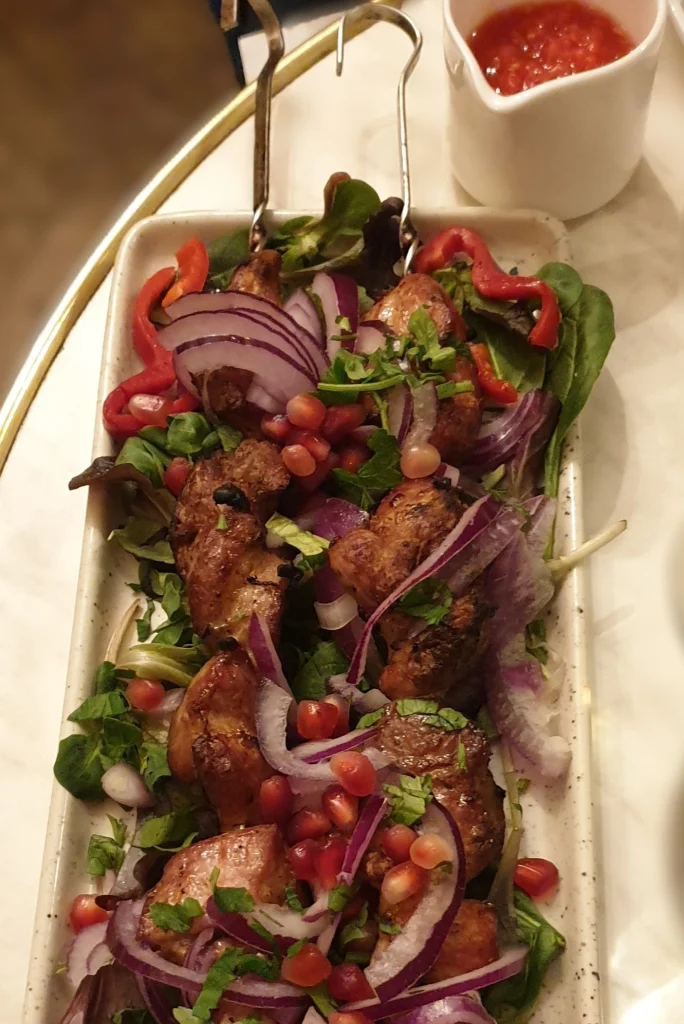
Argentine visitors tend to find Georgian food more familiar than they expect. Mtsvadi, chunks of pork or beef grilled over vine-wood embers and served with raw onion and tkemali sauce, sits close to the spirit of an asado, and Georgia’s wine culture — built around qvevri clay-vessel fermentation — gives the meal a natural partner. Khachapuri (cheese-filled bread) and khinkali (dumplings, eaten by hand) are the dishes every visitor should try at least once. Vegetarians are well served: lobio (bean stew), pkhali (walnut-and-vegetable pastes), ajapsandali and a long tradition of Orthodox fasting dishes mean plant-based eating is a normal part of Georgian cuisine, not an afterthought. Halal food is less consistently available outside Adjara and Tbilisi’s larger hotels and a handful of dedicated restaurants; travellers with halal requirements should ask in advance rather than assume, and our guides can identify suitable restaurants on request.
Ties between Georgia and Argentina, best season, and embassy coverage
It would be dishonest to overstate the relationship: trade and diplomatic ties between Georgia and Argentina are thin, with no resident embassies in either capital as a routine matter and modest bilateral trade volumes, which can be checked through Georgia’s national statistics office at geostat.ge. There is no significant historical Georgian diaspora in Argentina comparable to those in Russia or parts of Europe, and no major shared historical episode that shapes how the two countries see each other. What does connect Argentine and Georgian travel culture is incidental but real: a shared pride in grilled meat and red wine, and a similar instinct for long, toast-heavy table hospitality, which Georgians formalise in the supra feast with a tamada (toastmaster).
Because Argentina does not maintain an embassy in Tbilisi and Georgia does not maintain one in Buenos Aires, consular matters for Argentine citizens are typically handled through the nearest accredited mission or an honorary consul, and the arrangement can change. Before you travel, confirm current consular coverage through Argentina’s own foreign ministry channels and cross-check entry questions on Georgia’s side via mfa.gov.ge. Most Argentine visitors come during the Georgian high summer (June to September), partly because it falls in the Argentine winter and offers an easy escape, and a smaller number come in December and January for Gudauri‘s ski season, when value for snow sports compares well with resorts in the southern hemisphere.
Health, insurance, safety and etiquette for Argentine travellers
Georgia has, at various points, required visitors to hold travel medical insurance covering their stay; this rule has been applied and relaxed depending on the period, so confirm the current requirement directly through official channels before departure rather than assuming last year’s policy still applies. Regardless of the legal requirement, travel insurance with medical evacuation cover is strongly advisable for mountain regions such as Svaneti, Tusheti and Kazbegi, where emergency transport is slow and costly. For any personal medical question, including vaccination advice before a high-altitude trip, see a doctor rather than relying on a travel guide.
Georgia is generally a safe destination for independent travellers, including solo women, with violent crime against tourists rare. Standard precautions apply: agree taxi fares or use a metered app before the ride, watch belongings in crowded markets, and take mountain road warnings seriously, particularly the Georgian Military Highway in winter. Etiquette notes specific to Argentine visitors are few, since the two cultures share an easy warmth around food and hospitality; the one habit worth adjusting is pace at the table — a Georgian supra is a long, structured evening of toasts led by the tamada, and leaving early or refusing a toast outright can read as rude, so pace your wine rather than skip the ritual.
What a G Tour private guide adds
For Argentine travellers managing an unfamiliar alphabet, a Russian-leaning linguistic landscape outside the capital, and the logistics of mountain roads, a private guide removes the guesswork rather than adding luxury for its own sake. A licensed English-speaking guide runs €70 for a half-day city walk in Old Tbilisi, Mtskheta, Kutaisi or Batumi, or €110 for a full day using your own transport; a specialist guide for wine, architecture or hiking is €140 a day, and multi-day touring is €120 a day with the guide’s meals and accommodation included. Paired with a car and driver — from €90 a day around Tbilisi, or €165 a day for the 4×4 needed in Tusheti or Ushguli — the two together give an Argentine traveller a trip where the language barrier, the driving conditions and the pace of each day are someone else’s problem to solve. Fixed airport transfers start at €25 for Tbilisi airport to the city by sedan. Popular ready-made options for a first visit include the Tbilisi & Mtskheta — The Essential First Day day trip and the Georgia in 7 Days — The Classic Grand Tour itinerary, both bookable with full pricing on gtour.ge.
If this guide is part of a trip you are planning, our Georgia in 10 Days — Tbilisi to Svaneti to the Sea and Monasteries of Georgia — Mtskheta, the Thirteen Fathers and Kakheti in 3 Days cover the places it describes with a private guide and driver; a GTour travel expert adapts the route to your dates.
Practical summary
- Visa: Argentine citizens currently enjoy visa-free entry to Georgia for tourism; confirm the exact permitted stay on mfa.gov.ge before booking, since rules can change by decree.
- e-Visa: only needed outside the standard tourist case; apply at evisa.gov.ge, allow a few business days, and do not assume visa-on-arrival.
- Flights: no direct route exists; connect via Istanbul, Doha, Dubai or Munich, and compare fares into Tbilisi, Kutaisi and Batumi airports.
- Driving: carry your Argentine licence plus an International Driving Permit; verify current recognition rules via georoad.gov.ge.
- Money: the lari is the only currency for cash; cards work in cities, carry cash for villages, markets and minibuses.
- Connectivity: buy a local SIM or activate an eSIM; expect gaps in Tusheti and high Svaneti.
- Language: Georgian and Russian are the practical languages outside tourist Tbilisi and Batumi; Spanish is rarely spoken.
- Insurance: confirm the current mandatory insurance rule before departure, and carry evacuation cover for mountain travel regardless.
- Guides: a licensed private guide and driver solve most language, road and pacing issues for Argentine visitors; see gtour.ge/services for current rates.
Sources
- Georgia e-Visa portal
- Ministry of Foreign Affairs of Georgia
- Georgian National Tourism Administration
- Georgia road authority
- Georgian legislation database
- National statistics office of Georgia
Questions this guide does not answer? Write to info@castle.ge or WhatsApp +995 577 41 63 14 — a person in Tbilisi replies. See also our travel services and all guides.
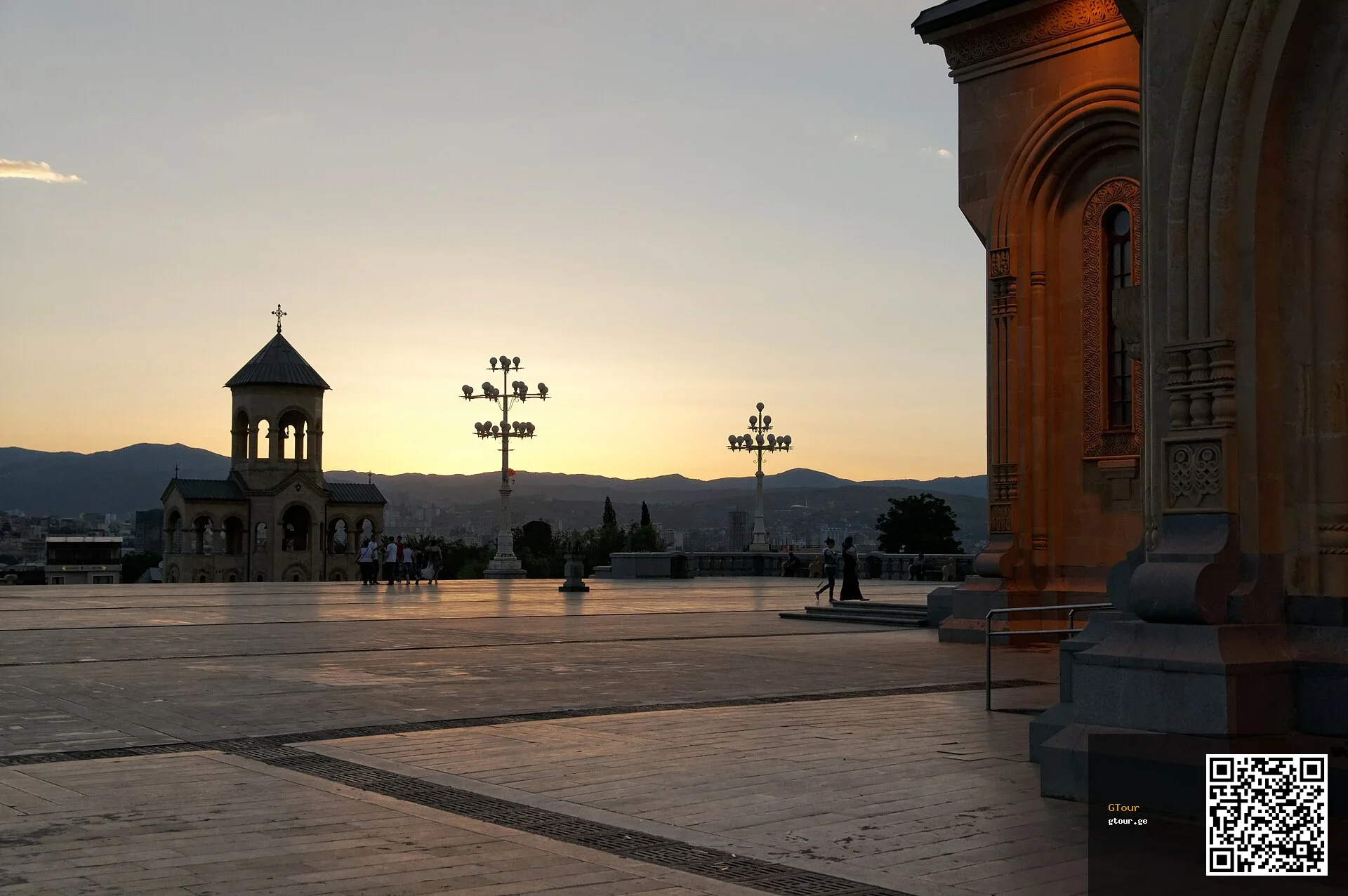
Sunset view of Tbilisi's Holy Trinity Cathedral, the city's iconic landmark for visitors. · Photo: Vyacheslav Argenberg / Wikimedia Commons, CC BY 4.0
Been to Georgia? Tell us how it went — the best stories are published here.
Share your tripOne email a week: what changed for travellers in Georgia — rules, roads, flights, seasons — plus one place worth the trip. Written by the GTour desk, no advertising, unsubscribe in one click.
This story across our partner network — ქართულად: შენი დასვენება