

By David Kiknadze, Transport & Openings Reporter · 27/10/2026
Yes, getting to Georgia from Costa Rica is straightforward on paper but long in practice. Most Costa Rican passport holders can currently enter Georgia visa-free for short tourist stays, there are no direct flights so plan on one or two connections (realistically through Istanbul or Doha), the currency is the lari rather than dollars or colones, and Spanish is rarely spoken outside a handful of tourism staff, so English becomes your working language. Formal ties between the two countries are thin, and this guide says so plainly rather than inventing a history that does not exist, focusing instead on what actually matters before you fly: entry rules, money, phones, food and the honest logistics of a 24-plus-hour journey.
Georgia’s appeal to Costa Rican travellers is practical rather than sentimental: a compact, mountainous country with a very old wine culture, Orthodox monasteries, and trekking that rewards the same love of volcanoes and cloud forest that shapes travel at home, without the direct flight connections or large diaspora that would make it an obvious choice. Treat this as a first-timer’s checklist, verify every rule close to your travel date on the official pages linked below, and build in extra connection time given how few routings exist from San José.
Visa and entry rules for Costa Rican citizens
Georgia runs one of the more liberal unilateral visa regimes in the region, and Costa Rican citizens are generally among the nationalities able to enter visa-free for short tourist stays. Entitlement periods and conditions are set by government decree and do change, so confirm your exact allowance, the maximum stay within a rolling period, and any new document requirements on the Ministry of Foreign Affairs’ consular portal, geoconsul.gov.ge, and on the Ministry of Foreign Affairs site itself before you book flights. If your trip falls outside the visa-free terms, for example a longer stay, a different travel purpose, or a rule change, Georgia’s e-visa portal handles applications online: you upload a passport scan and a photo, pay the fee by card, and processing is typically quoted at a few business days, though the portal states the current figure and you should not assume it matches what worked for a previous traveller.
Getting there: flights and the usual connections
There are no direct flights between Costa Rica and Georgia, and none are likely soon given the distance and thin demand. From San José, the two connecting hubs that realistically apply are Istanbul and Doha. Turkish Airlines’ network reaches Panama City, Bogotá and other Latin American gateways and connects onward to Tbilisi, while Qatar Airways links Doha with Panama City and onward to Tbilisi as well. Dubai, Munich and Warsaw routings exist for other origin countries but rarely make sense from San José, so do not expect a one-stop itinerary; most bookings involve two stops and 24 to 34 hours of total travel time depending on layovers.
Tbilisi International Airport is the country’s main long-haul gateway; check arrivals and terminal information on tbilisiairport.com. Kutaisi and Batumi handle mostly regional and low-cost European traffic rather than intercontinental connections, but are worth checking if your routing happens to pass through Istanbul with a budget carrier onward leg; see kutaisiairport.com and batumiairport.com for current schedules.
Money, cards and cash
Georgia’s currency is the lari (GEL). As of 27 October 2026, the National Bank of Georgia’s reference rate puts 1 US dollar at roughly 2.60 GEL and 1 euro at roughly 2.91 GEL; there is no direct market quote against the Costa Rican colón, so most travellers convert dollars or euros on arrival or withdraw lari directly from ATMs, which are plentiful in Tbilisi, Batumi and Kutaisi. Cards are widely accepted in cities, hotels and most restaurants, but carry some cash lari for rural guesthouses, mountain villages, market stalls and marshrutka minibuses, where card machines are unreliable or absent.
Driving licence, SIM, eSIM and the language gap
- Driving licence: foreign licences are generally recognised for the length of a visa-free stay, but Costa Rican licences are issued in Spanish, so carrying an International Driving Permit alongside your national licence avoids disputes at rental counters and checkpoints. Confirm the current rule through Georgia’s legislative database at matsne.gov.ge, and check seasonal mountain pass closures before any self-drive trip on georoad.gov.ge.
- SIM and eSIM: Magti, Geocell and Beeline sell prepaid tourist SIM cards at airport kiosks with generous data bundles; eSIMs from global providers also work well if your phone supports them, and are worth activating before you land given the long journey.
- Language: Georgian is the official language, written in its own script, and Russian is widely understood by older generations. English is spoken in tourism, hospitality and most guided settings in Tbilisi, Batumi, Kazbegi and Mestia. Spanish is rarely spoken outside a small number of tourism staff, so expect to rely on English, translation apps, and a guide for anything beyond basic transactions.
Embassy and consulate coverage for Costa Rica
Georgia does not host a resident Costa Rican embassy or honorary consulate, and Costa Rica’s own network in the region is small. Coverage for Georgia is most likely assigned to a Costa Rican mission elsewhere in Europe or the Middle East, but we cannot confirm which one with certainty, and this can change. Before travelling, confirm the current responsible embassy directly with Costa Rica’s foreign ministry, and separately check Georgia’s list of accredited diplomatic missions on mfa.gov.ge. Register your trip with whichever embassy is confirmed, and carry its contact details rather than assuming local help will be easy to find.
Food and dietary notes for Costa Rican visitors
Georgian food has a few accidental bridges to Costa Rican staples: mchadi, a grilled cornbread, sits close enough to a tortilla that corn-culture travellers often find it familiar, and lobio, a slow-cooked bean stew, echoes the bean base of gallo pinto even though the spicing is entirely different. Khachapuri, the cheese-filled bread found in regional variants across the country, is the dish most visitors remember. Vegetarian travellers eat well without much planning, since Georgian Orthodox fasting traditions produced a large repertoire of meat-free dishes such as pkhali (walnut and vegetable pastes); strict vegan eating takes more advance notice. Halal options are limited outside Adjara, the Muslim-majority region around Batumi, and a small number of halal-certified restaurants in Tbilisi; ask your guide or hotel in advance rather than assuming availability. Georgia’s wine culture, built around qvevri clay-vessel fermentation, is a genuinely distinct experience worth building time for, documented by UNESCO’s intangible heritage listing of the tradition.
Historical and trade ties, and when Costa Ricans tend to travel
It is worth being honest here: direct ties between Georgia and Costa Rica are thin. Both countries are UN member states with formal diplomatic relations on paper, but trade flows are negligible and there is no established Georgian-Costa Rican diaspora in either direction; official trade statistics on geostat.ge confirm that bilateral commerce does not register as a meaningful category. This guide does not pretend otherwise.
On timing, Costa Rican travellers who take their main holidays during the region’s dry season, December to April, or around Easter, often find this overlaps usefully with Georgia’s ski season in Gudauri and Bakuriani and with quieter sightseeing in Tbilisi and Kakheti. One calendar quirk worth noting: Georgian Orthodox Easter frequently falls on a different date than the Catholic Easter observed in Costa Rica, so if you are timing a visit around the holiday, check both calendars rather than assuming they align. Late summer and early autumn, when the Kakheti wine harvest (rtveli) is underway, is the other strong window for travellers coming from a coffee-growing country who appreciate agrarian festivals.
Health, insurance, safety and etiquette
Georgia requires visitors applying through the e-visa system, and those seeking residence permits, to show valid travel medical insurance covering their stay; confirm the exact current wording on evisa.gov.ge before you apply. Even travellers entering visa-free, who may not face a border check for insurance, should carry it regardless, given the cost of private care and the logistics of medical evacuation from mountain regions like Svaneti or Tusheti. Official Georgian public health advisories are published by the National Center for Disease Control and Public Health; check this before departure and speak to your own doctor about any personal health considerations, altitude concerns, or vaccination needs for your specific itinerary.
Georgia is generally safe for travellers who take ordinary precautions. Two etiquette points matter in practice: dress modestly when visiting working churches and monasteries, a norm that will feel familiar to Costa Rican Catholic visitors used to similar expectations; and treat the supra toasting tradition with respect but moderation, since Georgia enforces strict drink-driving laws and mountain roads demand full attention regardless of who is behind the wheel.
What a G Tour private guide adds
A private guide removes most of the friction described above in one step. Our licensed guides work in English and Russian as standard, with Spanish available for an additional €25 per day, which matters given how rarely Spanish is spoken outside tourism settings. A guide also handles the practical gaps a first-time visitor from Costa Rica is likely to hit: reading Georgian script on menus and road signs, explaining church etiquette on the spot, and managing cash versus card decisions in rural areas. Airport transfers are fixed in writing before you fly, from €25 for a sedan between Tbilisi airport and the city. For a full itinerary, Georgia in 7 Days — The Classic Grand Tour or the shorter Tbilisi & Mtskheta — The Essential First Day both suit travellers arriving after a long multi-stop flight who want the logistics handled from the first morning, and Kakheti Wine Country — Day Trip pairs naturally with the agrarian, harvest-focused travel style many Costa Rican visitors already enjoy at home.
If this guide is part of a trip you are planning, our Georgia in 10 Days — Tbilisi to Svaneti to the Sea and Monasteries of Georgia — Mtskheta, the Thirteen Fathers and Kakheti in 3 Days cover the places it describes with a private guide and driver; a GTour travel expert adapts the route to your dates.
Practical summary
- Confirm your exact visa-free entitlement on geoconsul.gov.ge and mfa.gov.ge before booking; apply through evisa.gov.ge if a visa is required.
- Expect two flight stops via Istanbul or Doha; no direct or one-stop Costa Rica–Georgia routing exists.
- Carry some cash lari; cards work in cities but not reliably in mountain villages.
- Bring an International Driving Permit alongside your Costa Rican licence if self-driving.
- Buy a local SIM or activate an eSIM on arrival; rely on English and translation apps, not Spanish.
- Confirm which embassy currently covers Costa Rica in Georgia before you travel.
- Carry travel medical insurance regardless of whether it is checked at entry.
- Book a Spanish-speaking private guide in advance if English alone feels insufficient for your trip.
Sources
- E-visa portal
- Ministry of Foreign Affairs of Georgia
- Georgian legislative database
- Georgian Road Department
- Georgia trade statistics
- Qvevri winemaking heritage listing
Questions this guide does not answer? Write to info@castle.ge or WhatsApp +995 577 41 63 14 — a person in Tbilisi replies. See also our travel services and all guides.
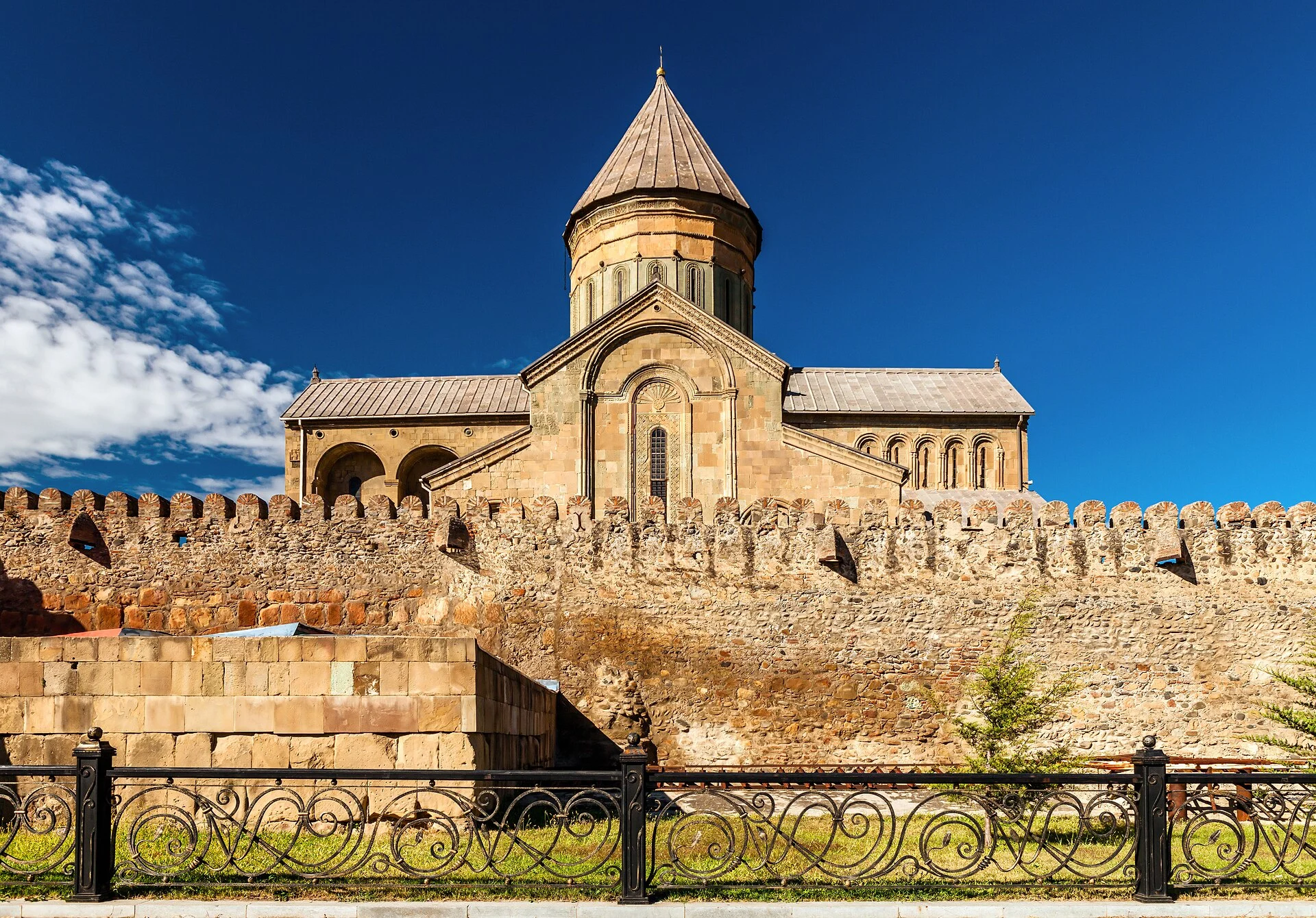
Svetitskhoveli Cathedral in Mtskheta, one of Georgia's most visited historic sites. · Photo: Moahim / Wikimedia Commons, CC BY-SA 4.0
Been to Georgia? Tell us how it went — the best stories are published here.
Share your tripOne email a week: what changed for travellers in Georgia — rules, roads, flights, seasons — plus one place worth the trip. Written by the GTour desk, no advertising, unsubscribe in one click.
This story across our partner network — ქართულად: შენი დასვენება