

By Nino Gelashvili, Travel News Editor · 27/10/2026
Georgia is reachable for travellers from Palestine, but it is not a visa-free destination: unless Georgia’s policy changes, Palestinian passport holders should expect to apply for a visa or e-visa before flying, since Palestine does not currently appear on Georgia’s short visa-free list. There are no direct flights from Ramallah, Gaza or any Palestinian airport (none operate international service), so the realistic route is a connection through a Gulf or Istanbul hub after crossing into Jordan or Israel, a journey that commonly takes a full day door to door.
Once you land, Georgia is straightforward: the lari (GEL) is the only currency that matters day to day, cards work in most of Tbilisi and Batumi, eSIMs and local SIMs are cheap and easy, and English is the default tourism language, with Russian still widely understood by an older generation. Historical and diaspora ties between Georgia and Palestine are genuinely thin, so this guide focuses on what actually helps you plan: documents, routes, money, food and the few places where a private guide earns its keep.
Visa and entry rules for Palestinian citizens
Rules on who needs a Georgian visa change periodically, so treat anything written here, including by us, as a starting point rather than a final answer. As of October 2026, Palestine is not on Georgia’s published visa-free list, which means travellers on a Palestinian Authority passport should plan to apply for an electronic visa before departure through the official portal, evisa.gov.ge. The e-visa system lets you upload a passport scan, a photo and a confirmed return ticket or itinerary, and processing is usually quoted in a few business days, though the portal itself states the current fee, validity period and permitted length of stay, and these details are revised from time to time.
Always cross-check against Georgia’s Ministry of Foreign Affairs consular pages before booking flights, since country lists and categories are amended by government decree: see mfa.gov.ge for the current visa regime, and the consular department’s registration and application guidance at geoconsul.gov.ge. If you hold a second passport (for example from a country on Georgia’s visa-free list), travelling on that document, where legally permitted, can simplify matters considerably.
Getting to Georgia: flights and connections
There is no international airport serving Gaza, and travel from the West Bank normally starts with crossing to Amman via the Allenby/King Hussein Bridge, since East Jerusalem and West Bank airports do not run commercial international flights. From Amman, Istanbul, Dubai and Doha are the three hubs most likely to have workable connections onward to Tbilisi, Kutaisi or Batumi; Warsaw and Munich options exist on European carriers but usually mean a longer, pricier routing and are less commonly used from this origin.
| Likely routing | Typical hub | Notes |
|---|---|---|
| Amman (after Allenby Bridge crossing) → Tbilisi | Istanbul or Dubai | Usually one stop; check visa transit rules for the hub country separately |
| Amman → Kutaisi | Istanbul | Kutaisi serves mostly budget European carriers; routings from the Gulf are less common |
| Amman → Batumi | Istanbul or Doha | Seasonal; fewer weekly frequencies than Tbilisi |
Check live schedules close to your date, since frequencies shift by season: tbilisiairport.com, kutaisiairport.com and batumiairport.com publish current arrivals. Build in buffer time at each connection, since visa and transit requirements at Istanbul, Dubai or Doha are separate from Georgia’s own rules and depend on your passport and any other documents you carry.
Driving licence, money and cards
Georgia generally recognises foreign driving licences for a limited period after entry, with recommendations in practice to carry an International Driving Permit alongside your national licence, since rules on exactly how long a foreign licence remains valid, and which licences qualify without an IDP, are set in Georgian traffic legislation that is periodically updated and published through matsne.gov.ge. If you plan to self-drive, confirm the current position before your trip rather than relying on older advice, and consider that a car with an English-speaking driver removes this question entirely.
The lari (GEL) is Georgia’s only legal tender; neither US dollars nor Israeli shekels are used for everyday purchases, though both convert easily at exchange offices and banks in Tbilisi and Batumi. Cards are accepted at most hotels, restaurants and shops in cities, but carry some cash for markets, small guesthouses, mountain villages and taxis outside the capital. As a rough guide using the National Bank of Georgia’s rate of 26 October 2026, 1 EUR was about 2.908 GEL and 1 USD about 2.597 GEL; rates move daily, so check at the point of exchange.
SIM, eSIM and staying connected
Georgian mobile operators (Magti, Geocell and Beeline) sell tourist SIM cards at airport kiosks on arrival, typically with a passport check and a same-day activation; eSIM options from international providers also work well if your phone supports them and you want connectivity the moment you land, before you have found a local shop. Coverage is good in Tbilisi, Batumi and along the main highways, and patchier in high mountain areas such as Tusheti or upper Svaneti, which is worth knowing if you are booking a trip like Tusheti — Georgia’s Last Wild Frontier or Mestia & Ushguli.
Language, who speaks what, and the mosque in Tbilisi
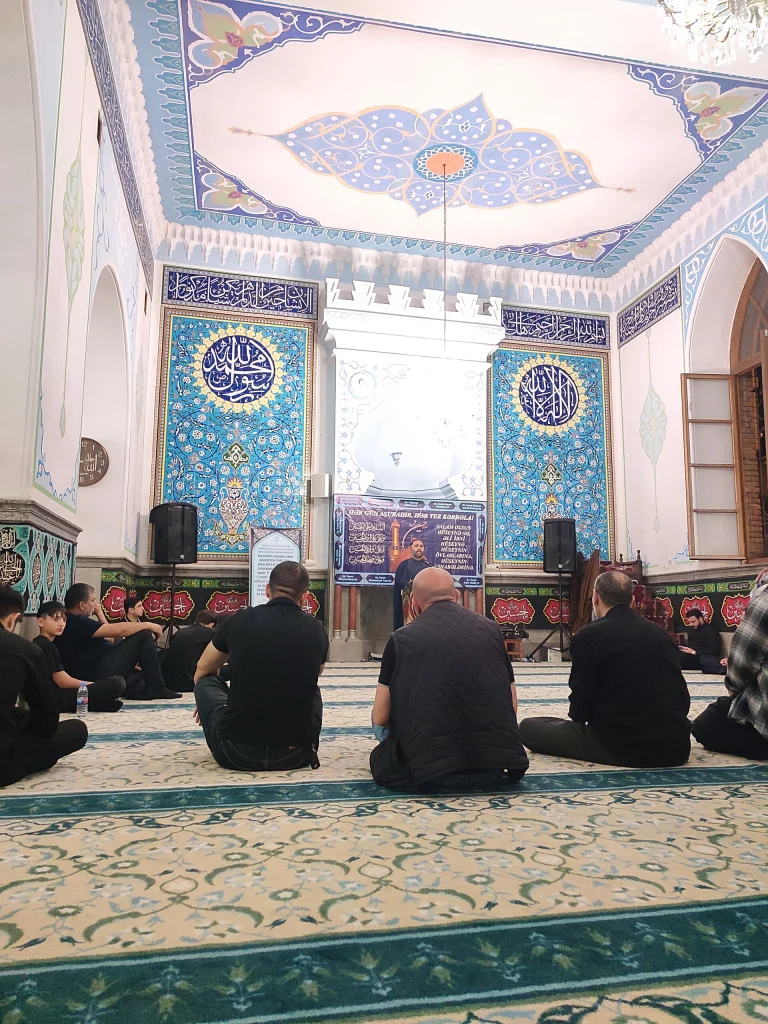
Georgian is the state language and the one you will see on street signs and menus, but English is widely used in tourism in Tbilisi, Batumi, Kazbegi and Kakheti, and Russian remains a practical second language for many older Georgians, hotel staff and drivers. Arabic is not commonly spoken outside a handful of hotels and restaurants that cater specifically to Gulf visitors, so do not expect Arabic signage or menus as a default; a translation app and a few Georgian or English phrases go a long way. Muslim travellers from Palestine will find a working historic mosque in Tbilisi’s Old Town, serving both Sunni and Shia communities, and a larger Muslim population in Adjara around Batumi, a detail worth knowing if Friday prayers matter to your itinerary.
Georgian mission for Palestine, and honest notes on the historical tie
Georgia does not maintain an embassy or consulate inside the Palestinian territories, and which Georgian mission is formally responsible for consular matters involving Palestinian applicants can change; the only reliable way to confirm the current arrangement, whether that is a mission in the region or handling via the e-visa portal and the Ministry in Tbilisi, is the Ministry of Foreign Affairs itself at mfa.gov.ge, rather than relying on older lists.
We will be direct about depth of connection: there is no significant Palestinian diaspora community in Georgia, and modern trade and political ties between the two are modest. The one genuine historical thread worth knowing runs through Jerusalem rather than Tbilisi: the Georgian Orthodox Church has maintained a presence in the Holy City for centuries, most visibly at the Monastery of the Cross, and Georgian pilgrims have travelled there since the medieval period, a connection documented by the Patriarchate of Georgia. It is a shared point of religious geography rather than a living people-to-people tie, and travellers should not expect Arabic-language infrastructure or a visible Palestinian community on the ground in Georgia.
Food: halal, vegetarian and what will feel familiar
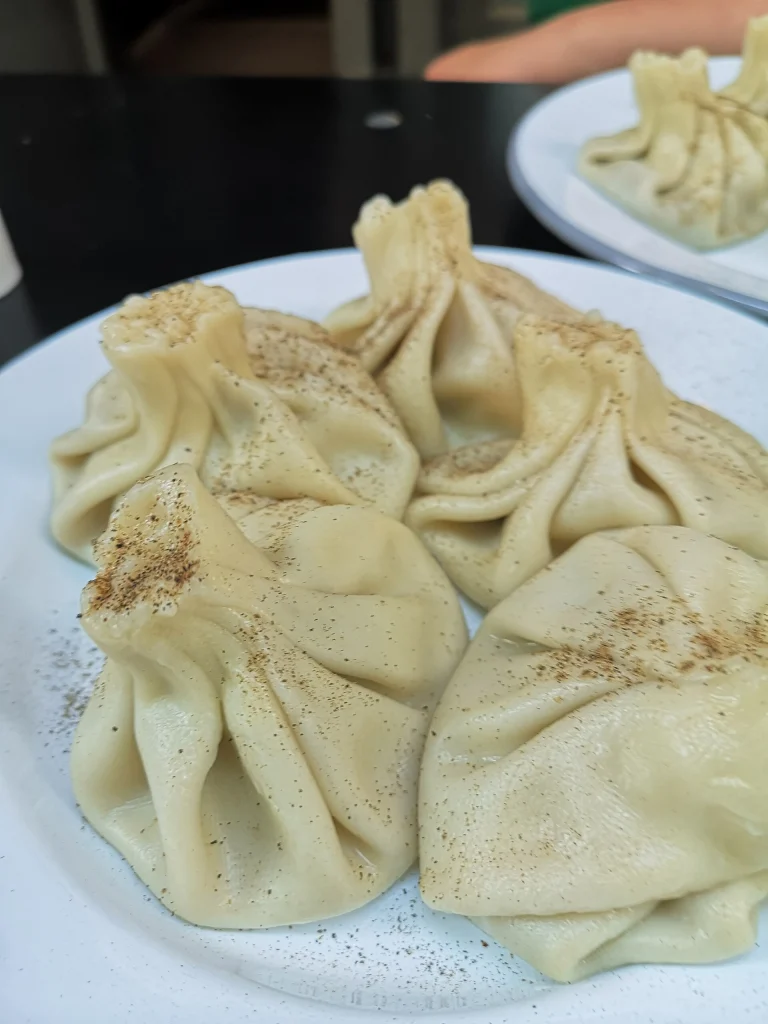
Georgian cuisine is built around bread, cheese, walnuts, beans, aubergine and grilled meat, which gives Palestinian visitors a reasonable number of naturally vegetarian dishes, including lobio (bean stew), badrijani (walnut-stuffed aubergine rolls), pkhali (vegetable and walnut pâtés) and most bread and cheese preparations. Pork appears often in traditional Georgian cooking, including in some sausages and stews, so do not assume a dish is pork-free without asking; halal-certified restaurants exist but are not the norm outside areas with more international tourism, so it is worth asking directly about ingredients and preparation at each restaurant, particularly for meat dishes and khinkali dumplings, whose filling varies by kitchen. Batumi and parts of Adjara, with a larger local Muslim population, tend to have more halal and pork-free options than smaller rural guesthouses.
Health, insurance, safety and etiquette
Georgia does not currently impose a blanket mandatory travel-insurance requirement tied to nationality, but this kind of rule has been introduced and lifted before during health emergencies, so confirm the current position before you fly rather than assuming, via official guidance from the National Center for Disease Control’s successor bodies and portals such as ncgh.ge, and the entry conditions listed on mfa.gov.ge. Regardless of any legal requirement, comprehensive travel insurance covering medical treatment, evacuation and trip interruption is strongly advised for any international trip, and a personal decision about coverage should involve your own doctor if you have ongoing health needs.
Georgia is generally a safe country for travellers, with low rates of violent crime against tourists; normal city precautions around bags and valuables apply in Tbilisi and Batumi. Georgians are, on the whole, a hospitable and curious people, and Palestinian visitors should not expect hostility or unusual scrutiny; questions about your home country tend to come from genuine curiosity rather than politics. Modest dress is appreciated at churches and mosques alike (shoulders and knees covered, headscarves available for women at most church entrances), and removing shoes before entering a mosque is expected, as it would be at home.
What a G Tour private guide adds
Given thin direct flight options, language gaps around Arabic, and a visa process that rewards careful preparation, a private guide and driver removes the guesswork. We can arrange a fixed-price airport transfer the moment you land (from €25 for a sedan at Tbilisi airport), a full day with a car and English-speaking driver (from €90 around Tbilisi, Mtskheta, Kakheti or Kazbegi), or a licensed guide who also speaks Arabic for an additional €25 per day on top of standard guiding rates, useful if English or Russian are not comfortable for everyone in your group. For a first orientation day we usually suggest Tbilisi & Mtskheta — The Essential First Day, and for travellers curious about Georgia’s Christian heritage and its own pilgrimage tradition, Christian Georgia — Pilgrimage and Sacred Heritage in 8 Days gives useful context on the same religious landscape that connects, loosely, back to Jerusalem.
If this guide is part of a trip you are planning, our Georgia in 10 Days — Tbilisi to Svaneti to the Sea and Monasteries of Georgia — Mtskheta, the Thirteen Fathers and Kakheti in 3 Days cover the places it describes with a private guide and driver; a GTour travel expert adapts the route to your dates.
Practical summary
- Check Georgia’s visa policy for Palestinian passport holders before booking flights, since it can change: see evisa.gov.ge and mfa.gov.ge.
- No direct flights exist; plan a routing via Amman and then Istanbul, Dubai or Doha to Tbilisi, Kutaisi or Batumi.
- Carry an International Driving Permit alongside your national licence if self-driving, and confirm current validity rules via matsne.gov.ge.
- Use lari (GEL) for cash purchases; cards work in cities but carry cash for rural areas and markets.
- Buy a local SIM or activate an eSIM at the airport; coverage is weaker in high mountain regions.
- Expect English and some Russian; Arabic is not widely spoken outside a few tourist-facing businesses.
- Ask specifically about halal and pork-free options; many traditional vegetable dishes are naturally vegetarian.
- Confirm any current insurance requirement before departure and carry comprehensive travel insurance regardless.
Sources
- Georgia e-visa portal
- Consular registration and services
- Legislative Herald of Georgia (traffic law)
- Patriarchate of Georgia – historical ties to Jerusalem
- National Statistics Office of Georgia — Tourism Statistics
- Agenda.ge — Tourism News
- Georgia Today — Travel Section
- Georgian Wine Agency — Official Portal
Questions this guide does not answer? Write to info@castle.ge or WhatsApp +995 577 41 63 14 — a person in Tbilisi replies. See also our travel services and all guides.
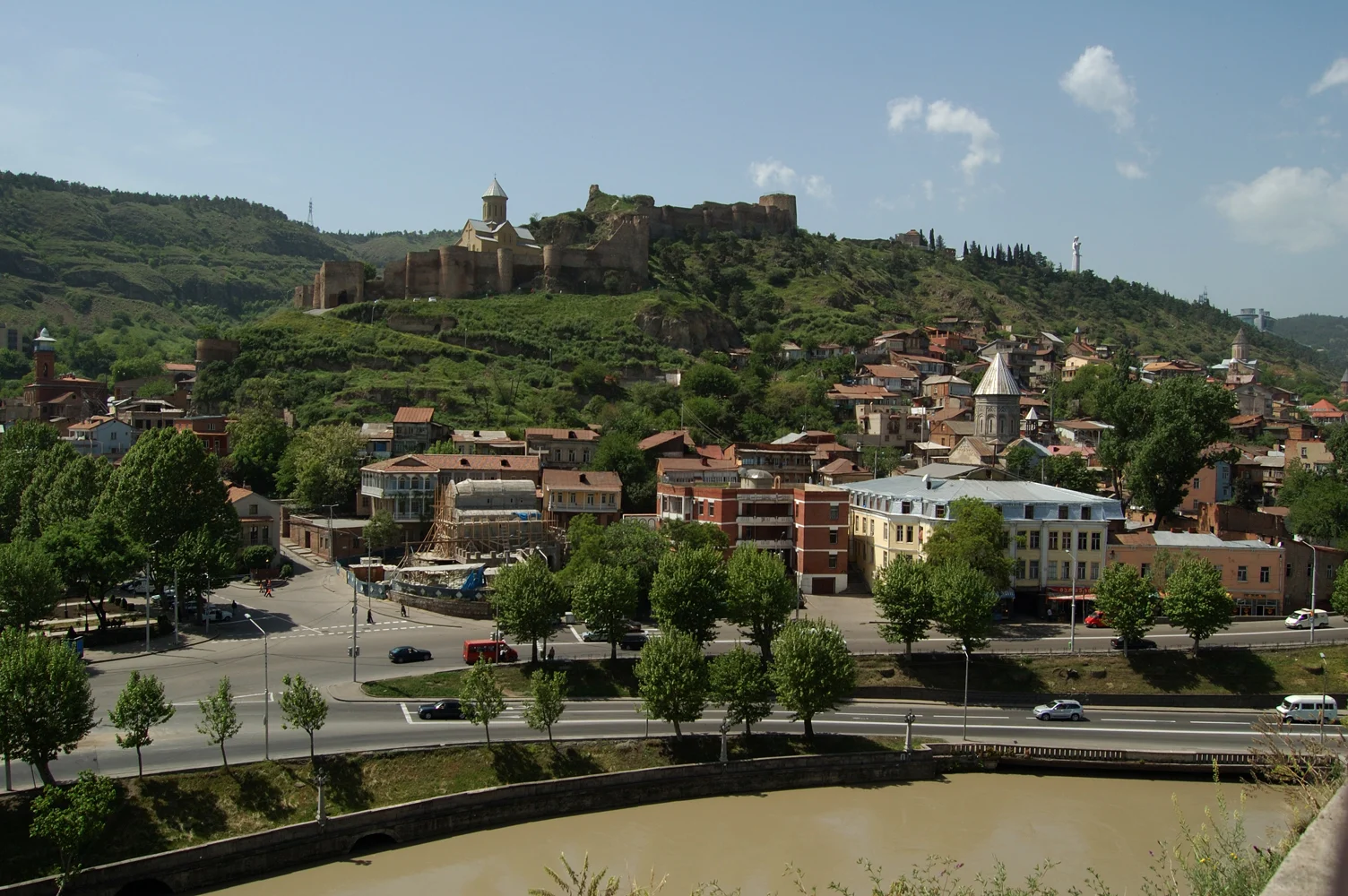
Old Tbilisi and Narikala fortress, the city most Palestinian visitors will see first. · Photo: tanyakuchma / Wikimedia Commons, CC BY 2.0
Been to Georgia? Tell us how it went — the best stories are published here.
Share your tripOne email a week: what changed for travellers in Georgia — rules, roads, flights, seasons — plus one place worth the trip. Written by the GTour desk, no advertising, unsubscribe in one click.
This story across our partner network — ქართულად: შენი დასვენება