Archives


Tianetoba in Georgia: dates, meaning and how to experience it
Next dates
14 August 2027 – 15 August 2027 (to be confirmed) · Tianeti, Mtskheta-Mtianeti. See the full events calendar and Georgia today for roads and weather.
What it is
Tianetoba is the annual town festival of Tianeti, the small highland center of Mtskheta-Mtianeti region, roughly two hours’ drive north of Tbilisi on the road toward Pshavi and Khevsureti. The name follows a common pattern in Georgian: the suffix “-oba” turns a place name, a saint’s name, or a concept into the name of a feast or occasion — the same ending appears in Tbilisoba (the feast of Tbilisi) and in church feasts such as Alaverdoba or Mtskhetoba. “Tianetoba” therefore means, literally, “the feast/day of Tianeti,” a civic and cultural celebration rather than a religious commemoration.
The festival belongs to local residents of Tianeti municipality and the surrounding Pshavi villages, many of whose families spend summers in the highlands and return to Tbilisi or abroad for the rest of the year. It is also an occasion for Georgians with roots in Pshavi — a historic mountain province celebrated in Georgian literature — to gather for a day of music, sport, trade and remembrance of local heritage, including the legacy of the poet Vazha-Pshavela, who was born nearby.
Historical background
- Medieval period — Pshavi, the highland province in which Tianeti lies, is named in Georgian historical sources as one of the mountain communities along the Aragvi and Iori river basins, bordering Khevsureti and Kakheti.
- 1801 — The eastern Georgian kingdom of Kartli-Kakheti is annexed by the Russian Empire; the Pshavi highlands, including Tianeti, are subsequently drawn into the administrative structure of the Tiflis Governorate.
- 1861 — Luka Razikashvili, who would become known under his pen name Vazha-Pshavela, one of Georgia’s most celebrated poets, is born in the village of Chargali near Tianeti.
- Early 20th century — Vazha-Pshavela’s poetry, drawing on Pshavian oral tradition, mountain custom and the landscape around Tianeti, becomes central to the modern Georgian literary canon; he dies in 1915.
- 1921 onward — Following the establishment of Soviet rule in Georgia, Tianeti is organized as a district (raioni) center, and highland communities are gradually brought into collective agriculture and forestry administration.
- Soviet period — Across Georgia, towns and districts develop annual “town day” celebrations combining harvest fairs, sport and folk performance; this civic festival culture, later renamed with the Georgian “-oba” suffix, underlies many present-day local festivals.
- 2006 — Georgia’s Law on Local Self-Government, administered under the Georgian legal code published by Matsne, reorganizes the country into self-governing municipalities; Tianeti becomes a self-governing municipality within Mtskheta-Mtianeti region.
- Present day — Tianetoba is held annually, organized by the municipal administration together with local cultural houses, typically in mid-August.
Tianeti’s history is inseparable from that of Pshavi, a province whose relative isolation in the mountains allowed distinctive dialect, dress, oral poetry and polyphonic song to survive into the modern era. The written record of the area grows substantially from the early nineteenth century, once Russian administrative surveys and, later, Georgian ethnographers and writers began documenting highland life in detail. Vazha-Pshavela’s work, composed in and around Tianeti district, did more than any single source to carry Pshavian idiom and worldview into the national literary tradition, and his house-museum near the town remains a point of reference for the region’s identity.
The festival itself belongs to a broader, twentieth-century Georgian tradition of civic “town days,” in which Soviet-era local culture festivals were, after independence, reframed in explicitly Georgian terms using the “-oba” suffix — the pattern visible in Tbilisoba, first held in its modern form in 1979, and in numerous district festivals established or revived since. Because municipal and cultural-house records for a small highland town such as Tianeti are not centrally published, the exact year Tianetoba was first organized under that name is not firmly documented; what is established is the modern municipal structure within which it is now organized.
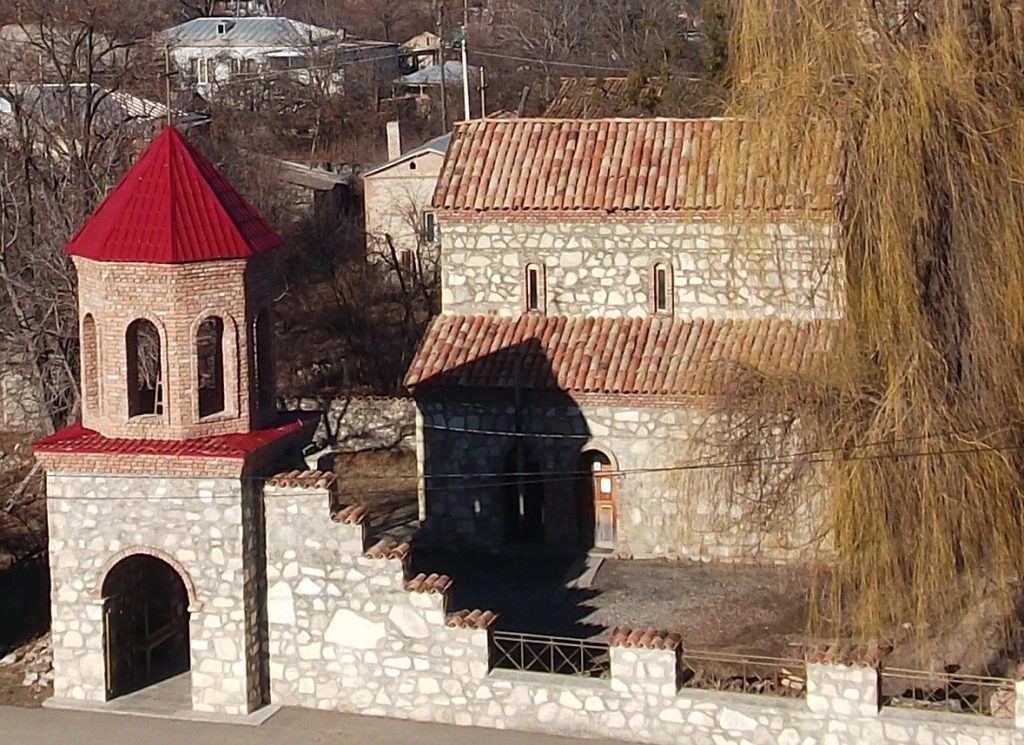
derivative work: geagea / Wikimedia Commons, CC BY-SA 3.0
Meaning and traditions
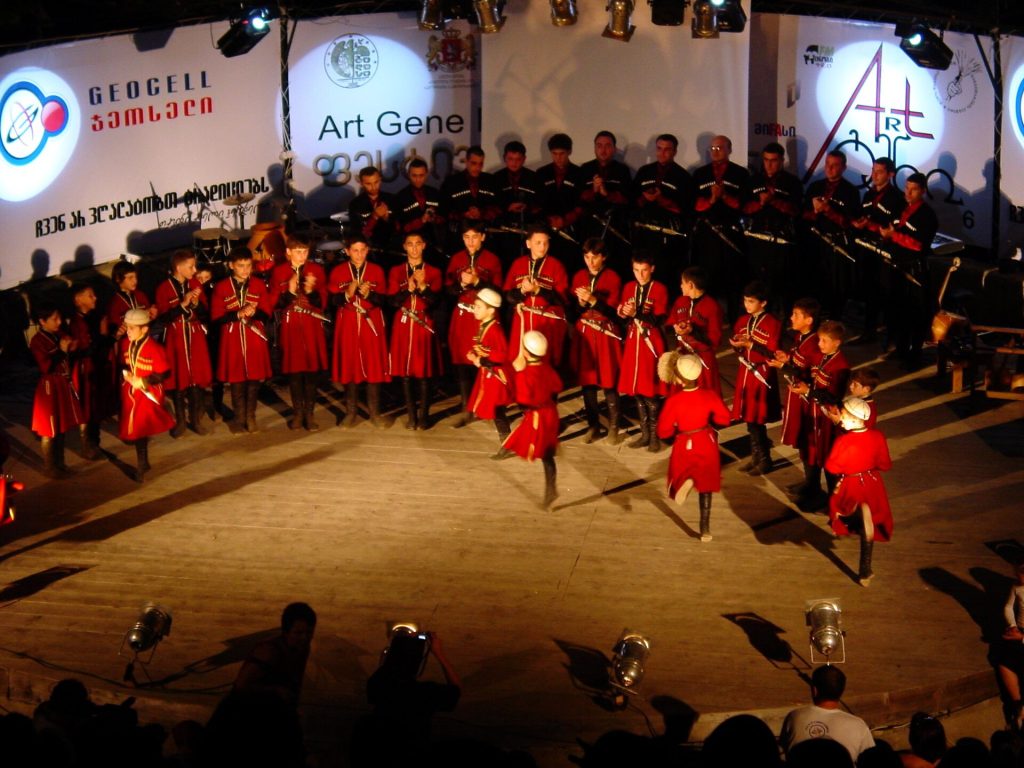
Tianetoba combines a harvest and craft fair (bazroba) with staged performances and informal feasting. Typical elements include exhibitions of local produce, honey, wool and woodcraft; displays of Pshavian weaving and carpet work; folk ensembles performing Georgian polyphonic song and perkhuli, the Georgian round dance performed in a line with linked hands; and readings or staged excerpts from the poetry of Vazha-Pshavela, whose verse is closely tied to the valleys around the town. Equestrian contests and other mountain sports are a common feature of highland town days generally, reflecting the historic importance of horsemanship in Pshavi and Khevsureti.
Food and hospitality follow the pattern of the Georgian supra, the long table feast presided over by a tamada (toastmaster), who leads a sequence of formal toasts to guests, ancestors, homeland and peace. Highland specialties typically on offer include khinkali, the boiled mountain dumpling whose origin is traditionally associated with Pshavi, Khevsureti and Mtiuleti; mountain cheeses; freshly baked bread; and, increasingly, wine and chacha brought up from the lowlands for the occasion. Dress for performers often includes the chokha, the traditional long coat once worn across the Georgian highlands and still used in folk ensembles nationwide.
Unlike church feast days that share the same “-oba” naming pattern — Alaverdoba in Kakheti or Mtskhetoba-Svetitskhovloba in Mtskheta, both tied to specific saints and cathedrals — Tianetoba is a civic rather than liturgical occasion. Its character is closer to Tbilisoba than to a religious pilgrimage day, though visitors who wish to see a church service while in the area can do so at local parish churches on an ordinary Sunday.
When it happens
Tianetoba does not fall on a fixed date. It is organized by Tianeti municipality in mid-August, a period chosen because it coincides with the height of summer, when highland families and diaspora visitors are most likely to be present in the area and when the harvest fair has produce to show. The exact two-day dates are set and announced by the municipal administration each year and can shift by a week or more. For 2027 the festival is provisionally scheduled for 14–15 August, pending confirmation closer to the date; travellers planning a visit specifically for the festival should check with the municipality or a local operator shortly beforehand.
Tianetoba is not a national public holiday under Georgian law; government offices, banks and most businesses nationwide operate normally. In Tianeti itself, the municipal building, schools and some local offices may adjust hours around the festival days, and the town center is closed to traffic for the duration of the main events.
Where to experience it
The festival is centered on Tianeti’s town square and the grounds around the municipal cultural house, where the stage program, fair stalls and sports contests take place, generally from late morning through evening on each festival day. Visitors with more time can combine the festival with a short trip to the Vazha-Pshavela house-museum in the nearby village of Chargali, and with a drive further along the mountain road toward Pshavi, which offers views over the Iori river valley and the forested hills that define the region. In any church along the route, visitors should dress modestly — covered shoulders and knees, and a headscarf for women — and ask before photographing services or icons. At private homes or supra tables, guests should wait to be formally invited to speak and should not refuse a toast outright; a small sip is an acceptable alternative to finishing a full glass.
Travel with GTour
The Georgia in 10 Days — Tbilisi to Svaneti to the Sea route passes through Mtskheta-Mtianeti on its way north, and its early days can be aligned with the 14–15 August dates of Tianetoba in Tianeti, while Tbilisi & Mtskheta — The Essential First Day can be extended toward Tianeti for travelers arriving just before the festival. A GTour travel expert designs the exact route and timing around the guest’s dates.
Did you know
- Tianeti district is the birthplace region of Vazha-Pshavela, whose house-museum stands in the nearby village of Chargali and is maintained as a literary heritage site.
- The Georgian suffix “-oba” that names Tianetoba is the same ending found in Tbilisoba and in church feasts such as Alaverdoba, turning a place or saint’s name into the name of a day.
- Georgian polyphonic singing, regularly performed at town festivals like Tianetoba, is recognized by UNESCO as part of the Representative List of the Intangible Cultural Heritage of Humanity, after being proclaimed a Masterpiece of Oral and Intangible Heritage in 2001 and formally inscribed in 2008, as listed by UNESCO’s Intangible Cultural Heritage programme.
- Khinkali, now served across Georgia, is traditionally traced to the mountain provinces of Pshavi, Khevsureti and Mtiuleti, the highland zone bordering Tianeti municipality.
- Mtskheta-Mtianeti, the region containing Tianeti, is one of Georgia’s smallest regions by population, a legacy of highland depopulation over the twentieth century that gives town festivals like Tianetoba particular importance as gathering points for dispersed families.
Practical tips for visitors
Tianeti lies about 70 kilometers from Tbilisi; the drive via Mtskheta and the Jinvali reservoir road takes roughly one and a half to two hours by car, with some mountainous sections. Public marshrutka minibuses run from Tbilisi’s Didube station, but schedules are limited, especially outside festival days, so a private vehicle or arranged transport is the more reliable option; GTour can arrange a private driver or guide for the day. Dress casually and in layers, since highland evenings can turn cool even in August; carry cash, as card acceptance is limited at fair stalls. Accommodation in Tianeti itself is modest, so many visitors treat the festival as a day trip from Tbilisi rather than an overnight stay. Confirm the exact festival dates with the municipality in the weeks beforehand, since they are set annually rather than fixed.
Combine it with
Tianetoba sits naturally within a wider visit to Mtskheta-Mtianeti, the region of ancient capitals and highland valleys. It pairs well with a trip further north toward Kazbegi along the Georgian Military Highway, and can be combined with a day in Tbilisi for travellers based in the capital.
Questions travellers ask
What does the word “Tianetoba” mean?
It combines the town name Tianeti with the Georgian suffix “-oba,” which turns a name into the name of a feast or occasion. It translates loosely as “the day/feast of Tianeti.”
Is Tianetoba a public holiday in Georgia?
No. It is a local municipal festival, not a national public holiday, so government offices and businesses elsewhere in the country operate as usual; only Tianeti’s own town center adjusts for the event.
How do I get to Tianeti from Tbilisi?
By car it takes about one and a half to two hours via Mtskheta, on a road that includes mountainous stretches. Limited marshrutka services run from Tbilisi’s Didube station, but a private driver is more practical for a festival day trip.
Can foreign visitors take part in the festival?
Yes, Tianetoba is open to everyone, and visitors are welcome to watch the performances, browse the fair stalls and sample food. Joining a supra table usually happens by invitation, which visitors can receive through local hosts or an arranged guide.
What food is typical at Tianetoba?
Expect khinkali, the mountain-style dumpling associated with Pshavi and neighboring highland provinces, along with local cheese, bread, honey, wine and chacha served around a traditional supra table.
Is Tianetoba the same kind of festival as Tbilisoba?
They follow the same naming pattern and civic spirit — both are town festivals rather than church feast days — but Tianetoba is a much smaller, local event centered on Pshavian highland culture rather than the capital’s multi-day city-wide program.
What else is there to see in Tianeti besides the festival?
The Vazha-Pshavela house-museum in nearby Chargali village is the main literary and historical attraction, along with the forested Iori river valley and the mountain road continuing toward Pshavi and Khevsureti.
When exactly will Tianetoba take place in 2027?
The provisional dates are 14–15 August 2027, but as with most town festivals the schedule is confirmed by the municipality closer to the date, so travellers should verify before planning a trip.
Sources
- Georgia National Tourism Administration
- Georgian National Tourism Administration (GNTA)
- Ministry of Culture, Sport and Youth of Georgia
- National Parliamentary Library of Georgia
- Georgian Legislative Herald (Matsne)
- UNESCO Intangible Cultural Heritage
- National Statistics Office of Georgia (Geostat)
- Kvira.ge, regional news report
- Kvira.ge, regional news report
- Radio Tavisupleba (RFE/RL Georgian Service)
Plan your Georgia
Want to be in Georgia for Tianetoba? A GTour travel expert designs the itinerary around it and calls you back.
Panoramic view of Tianeti town, the Mtskheta-Mtianeti setting for the Tianetoba festival. · Photo: G.N / Wikimedia Commons, CC BY-SA 3.0
This page in other languages: Русский
GTour conciergeAsk anything about Georgia · we reply within hours