Archives


Gudauri ski season in Georgia: dates, meaning and how to experience it
Next dates
15 December 2026 – 10 April 2027 (to be confirmed) · Gudauri, Mtskheta-Mtianeti. See the full events calendar and Georgia today for roads and weather.
What it is
Gudauri ski season refers to the period, roughly from mid-December to early April, when the village of Gudauri in the Mtskheta-Mtianeti region opens its lifts and becomes Georgia’s principal winter sports destination. The place name is traditionally linked to the Georgian root “guda,” meaning a leather sack or bellows once carried by shepherds and travellers who rested here on the high road through the Caucasus; some toponymists connect it instead to a broader Caucasian root describing a saddle-shaped mountain pass. Unlike religious feasts tied to the church calendar, the ski season is a modern, commercially organised event, but it sits inside a landscape and a road that have carried travellers, traders and armies for centuries.
The season is celebrated, in a loose sense, by several overlapping communities: Georgian and international skiers and snowboarders, the guesthouse and hospitality families of the Mtiuleti and Khevi highlands who depend on winter income, and a wider tourism sector centred on Tbilisi, ninety kilometres away. For many Georgians, a winter weekend at Gudauri has become as much a part of the national calendar as a summer trip to the Black Sea coast, even though it has no fixed date and no liturgical meaning.
Historical background
- Late 18th century — Following the 1783 Treaty of Georgievsk, the Russian Empire began improving the mountain route across the central Caucasus that would become the Georgian Military Road, passing near the future site of Gudauri.
- 1799–1863 — The Georgian Military Road was progressively engineered and widened, with Gudauri functioning as a waystation close to the Jvari (Cross) Pass, one of the highest points on the route.
- 1840 — Mikhail Lermontov’s novel “A Hero of Our Time” describes the Koishauri Valley below Gudauri, among the earliest literary records of the area’s dramatic winter terrain.
- 1980s — Soviet Georgia installed the first chairlifts and tows at Gudauri, establishing it as the republic’s main winter sports centre.
- 1990s — Economic collapse following the dissolution of the Soviet Union interrupted lift maintenance and investment, and the resort’s infrastructure deteriorated.
- Early 2000s — Modernisation began with new Austrian-built lift equipment, restarting commercial skiing and attracting the first wave of post-Soviet foreign visitors.
- Mid-2010s — A new gondola linking Gudauri to the neighbouring village of Kobi substantially expanded the skiable terrain and connected two valleys for the first time.
- 2020s — After a pandemic-era pause, Gudauri resumed and expanded operations, gaining international recognition as a freeride and heli-skiing destination alongside its traditional piste skiing.
Gudauri’s history is inseparable from the road it sits beside. For two centuries the Georgian Military Road was the principal route connecting Tbilisi to the North Caucasus and onward to Russia, and travellers, poets and administrators who crossed the Jvari Pass left written accounts of the harsh beauty and heavy winter snows around what is now the resort. Long before skis arrived, the high pastures above the village were used by Mtiuleti herders, whose seasonal movement with livestock shaped the local toponymy and the stone architecture still visible in surrounding villages.
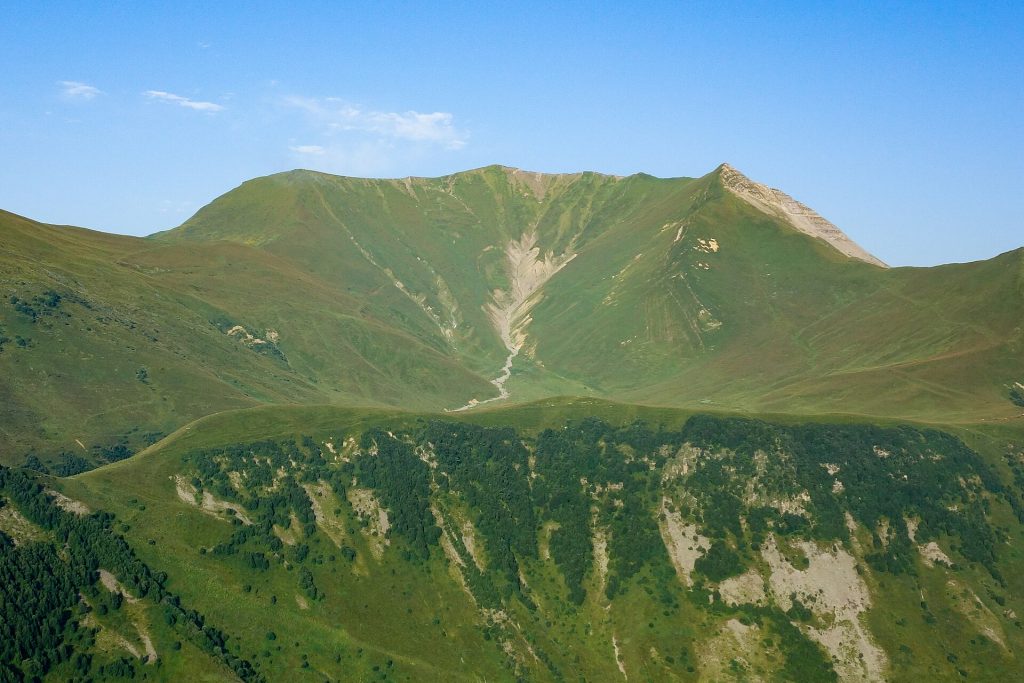
The transformation into a ski resort is a 20th-century development, accelerated twice: first under Soviet sports planning in the 1980s, and again after 2000 as Georgia rebuilt its tourism economy. Each phase has left physical traces — Soviet-era pistes cleared on the lower slopes, newer gondolas and chairlifts reaching higher terrain, and a growing cluster of hotels built along the single access road. The resort’s elevation, between roughly 2,200 and 3,300 metres, has made it increasingly attractive as lower-altitude European resorts face shorter, less reliable snow seasons.
Meaning and traditions
There is no single ritual attached to the Gudauri ski season, but a set of recognisable customs has grown around it. Visitors speak of going for “tovlze,” meaning “onto the snow,” and locals describe a good winter as one with plenty of “tovli” (snow) rather than rain on the pass. Evenings in Gudauri typically centre on Georgian hospitality customs transplanted to altitude: a shared table, or “supra,” with khinkali (dumplings), mtsvadi (grilled meat), khachapuri and bowls of lobio, accompanied by wine or chacha and often a toast offered by a designated toastmaster, the “tamada.”
Mtiuleti and Khevi families who run guesthouses sometimes mark the season’s opening informally, with a shared meal for staff and neighbours rather than a church service, since skiing itself has no place in the Orthodox liturgical calendar. Those who wish to combine the ski trip with religious observance usually do so nearby, visiting churches in Mtskheta or at Gergeti near Kazbegi rather than in Gudauri itself. Regional variation within Georgia is strong: Bakuriani, in Samtskhe-Javakheti, offers gentler, forested terrain suited to families, while the newer resorts of Hatsvali and Tetnuldi in Svaneti combine skiing with Svan tower-house villages and a distinct highland cuisine and song tradition recognised by UNESCO for its polyphonic singing.
When it happens
There is no fixed calendar date for the Gudauri ski season; it depends on snowfall and is confirmed each year by the resort operators and lift companies. In practice, opening has typically fallen in mid-December, with lower lifts closing by late March or early April and higher lifts, which hold snow longer, sometimes operating into April. For the 2026–2027 season, organisers are expected to target an opening around 15 December 2026 and a closing around 10 April 2027, though exact dates will be confirmed closer to the time and may vary by lift.
The ski season itself is not a public holiday, so Gudauri’s lifts generally operate on a commercial schedule unaffected by the national calendar. However, it overlaps with two public holidays that do affect the wider country: New Year (1–2 January) and Orthodox Christmas (7 January), when government offices, banks and many shops close nationwide. These are also the busiest and most expensive weeks at Gudauri, since Georgians travel in large numbers during the holiday break, so lifts, restaurants and accommodation should be booked well in advance for that period.
Where to experience it
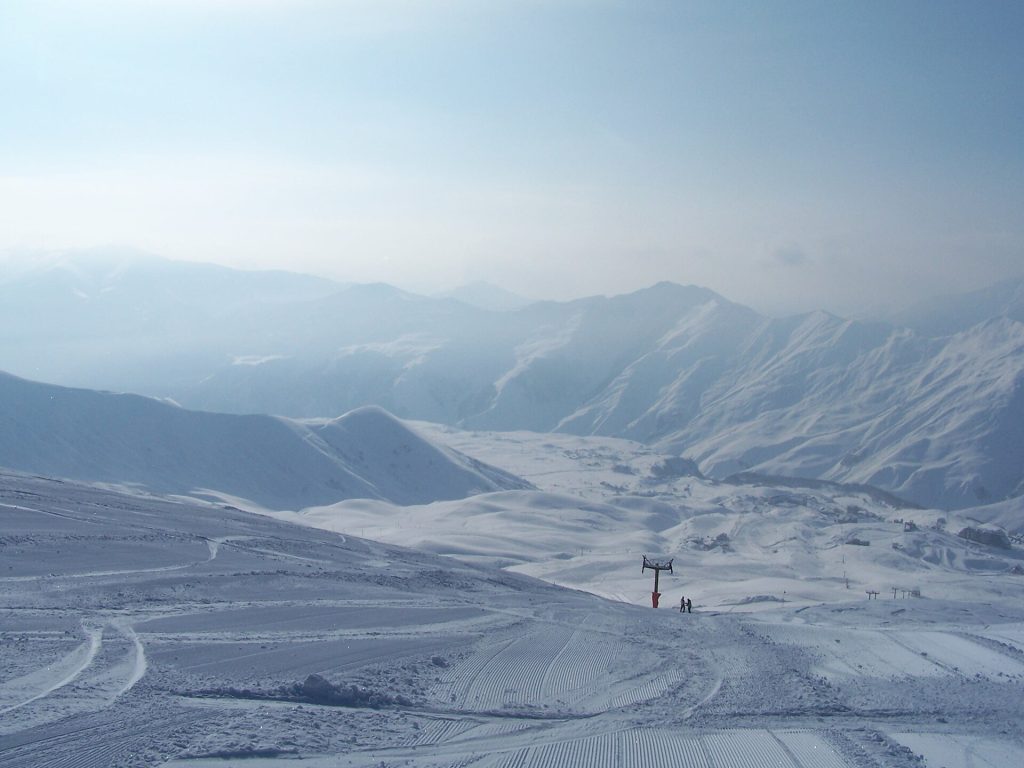
The resort is centred on the village of Gudauri itself, strung along the Georgian Military Road, with the main lift base at the lower end and the newer gondola connecting across the valley toward Kobi. The Kudebi ridge, reached by chairlift, is the area most associated with freeride and off-piste skiing, with views toward Mount Kazbegi on clear days. Morning is the best time to see fresh grooming and the clearest mountain light; by early afternoon, cloud often builds around the higher peaks.
Visitors wanting a cultural counterpoint to the slopes can continue along the Georgian Military Road to Ananuri fortress-church complex or further north to the town of Kazbegi (Stepantsminda), below the Gergeti Trinity Church. Church etiquette there follows standard Georgian Orthodox practice: modest dress, covered shoulders and legs, headscarves for women entering the church, and quiet behaviour during services. In private guesthouses, guests are generally expected to remove outdoor shoes, accept offered food and drink graciously, and respond to a toast rather than ignore it.
Did you know
- Gudauri sits close to the Jvari (Cross) Pass on the historic Georgian Military Road, one of the oldest engineered mountain crossings in the Caucasus.
- The novelist Mikhail Lermontov set a chapter of “A Hero of Our Time” in the valley just below present-day Gudauri.
- Mount Kazbegi, one of Georgia’s highest peaks and a site of Georgian Orthodox legend connected to the hermitage above Gergeti, is visible from several of the resort’s upper runs.
- Gudauri’s altitude range, extending above 3,000 metres on its highest lifts, allows it to hold snow later into spring than many lower European resorts.
- Georgian polyphonic singing, practised in highland regions including Mtiuleti near Gudauri, is recognised by UNESCO as part of the Representative List of the Intangible Cultural Heritage of Humanity.
Practical tips for visitors
Gudauri lies roughly ninety kilometres from Tbilisi along the Georgian Military Road, a drive of about two to two and a half hours in clear conditions, longer in snow. Marshrutka minibuses and shared taxis run from Tbilisi’s Didube station, and private transfers and organised day trips are widely available; a four-wheel-drive vehicle or winter tyres and chains are strongly advised for anyone self-driving in winter. Dress in warm, waterproof layers regardless of forecast, since weather at altitude changes quickly, and use sun protection even on overcast days, as UV exposure is intensified by altitude and snow glare.
Ski and snowboard equipment can be rented in the village, and lift passes are increasingly sold online in advance, which is recommended around New Year and Orthodox Christmas when the resort is busiest. The road itself can close temporarily above Gudauri due to avalanche risk or heavy snowfall, so travellers should build flexibility into transport plans and check conditions before departing Tbilisi.
Combine it with
Gudauri is most often paired with a trip toward Kazbegi to see Mount Kazbegi and the Gergeti Trinity Church, with the wider Mtskheta-Mtianeti region for its fortress churches and highland villages along the Georgian Military Road, and with a base in Tbilisi for evenings and onward travel.
Questions travellers ask
When does the Gudauri ski season start and end?
There is no fixed date; the season typically opens in mid-December and closes between late March and mid-April depending on snow conditions and which lift is in question. Dates are confirmed annually by resort operators rather than set by a calendar or calendar authority.
Is Gudauri suitable for beginners?
Gudauri has marked beginner and intermediate pistes near the base area, along with ski schools offering lessons, though it is best known internationally for its off-piste and freeride terrain on the upper slopes. Beginners are generally advised to stay on the lower, groomed runs and hire a local instructor for the first days.
How far is Gudauri from Tbilisi and how do I get there?
Gudauri is about ninety kilometres from Tbilisi, roughly two to two and a half hours by road along the Georgian Military Road. Options include marshrutka minibuses from Didube station, shared or private taxis, and organised transfers booked through tour operators.
Do I need to book lift passes in advance?
Advance booking is not strictly required outside peak weeks, but is strongly recommended around New Year and Orthodox Christmas, when the resort sees its highest domestic and international demand. Many passes can now be purchased online before arrival.
Is heli-skiing available at Gudauri?
Yes, Gudauri is one of the few places in the Caucasus where licensed operators offer heli-skiing and heli-boarding above the resort’s lift-served terrain, weather and avalanche conditions permitting. This typically requires advance booking and suitable off-piste experience.
How does Gudauri’s snow compare to major European resorts?
Gudauri’s altitude, generally between 2,200 and 3,300 metres, allows it to hold reliable snow into spring in years with normal precipitation, comparable to many mid-altitude Alpine resorts. Snow quality and quantity vary year to year, which is why the season’s exact dates are never fixed in advance.
Can I visit Gudauri without skiing?
Yes, the resort and surrounding Georgian Military Road offer mountain scenery, guesthouses and restaurants that can be enjoyed without taking to the slopes, and the gondola can sometimes be used for sightseeing. Many visitors also stop briefly in Gudauri while travelling onward toward Kazbegi.
Are there road closures or avalanche risks to plan around?
The Georgian Military Road above Gudauri can close temporarily during heavy snowfall or elevated avalanche risk, particularly near the Jvari Pass. Travellers should check road conditions before departing Tbilisi and allow flexibility in winter travel plans.
Sources
- Georgian National Tourism Administration
- Georgia National Tourism Administration (GNTA)
- Patriarchate of Georgia
- Legislative Herald of Georgia (Matsne)
- UNESCO Intangible Cultural Heritage
Plan your Georgia
Want to be in Georgia for Gudauri ski season? A GTour travel expert designs the itinerary around it and calls you back.
Snow-covered mountain slopes in Gudauri, the iconic winter sports landscape of the Caucasus. · Photo: Alexander Savonin lordpinguin / Wikimedia Commons, CC0
This page in other languages: Русский
GTour conciergeAsk anything about Georgia · we reply within hours