Archives


Bedoba in Georgia: dates, meaning and how to experience it
Next dates
2 January 2027 · Nationwide. See the full events calendar and Georgia today for roads and weather.
What it is
Bedoba (ბედობა) takes its name from the Georgian word bedi, meaning “fate,” “destiny” or “luck,” joined to the suffix -oba, which turns a noun into the name of a day or state of being — the same construction used for Christmas (shoba) or Easter-season feast days. Bedoba, then, is literally “the day of fate.” It falls on 2 January, the second day of the secular New Year holidays, and is observed by Georgians across the country regardless of religious practice, since it sits inside the civil calendar rather than the church calendar proper.
The holiday is a household observance rather than a public spectacle. There are no processions, no church services dedicated to it, and no special liturgical texts. Its meaning rests in a single shared belief: however a person spends 2 January — calm or quarrelsome, surrounded by loved ones or alone, well-fed or anxious — sets the emotional and material tone for the twelve months ahead. For visitors, Bedoba is less something to watch than something to be let into, usually as a guest at a family table.
Historical background
- Pre-Christian period (traditionally) — Agrarian communities across the South Caucasus marked the winter solstice period with rites intended to secure a fortunate year, a layer of belief that long predates the Christian calendar later placed over it.
- 4th century — Christianity becomes the state religion of the kingdom of Kartli under King Mirian III, according to the Georgian Orthodox Church’s own chronology; new Christian feasts are layered onto the existing seasonal calendar rather than replacing it outright, a pattern visible in how the December–January period came to hold both Christmas and older fate-related customs side by side, as described by the Georgian Orthodox and Apostolic Church.
- Medieval period — Georgian ecclesiastical practice follows the Julian calendar, the same reckoning still used today for fixed feasts such as Christmas and Epiphany.
- 1918 — Most civil administrations, including Georgia’s, adopt the Gregorian calendar for everyday use; the Georgian Orthodox Church retains the Julian calendar, producing the 13-day gap between the civil New Year (1 January) and Orthodox Christmas (7 January) that still frames the modern holiday season.
- 1921–1991 — Under Soviet rule, religious observance of Christmas is officially discouraged while secular New Year celebrations are promoted as the principal winter holiday; household customs tied to the days following 1 January, including Bedoba, persist informally within families.
- 1991 — Georgian independence is restored, and Orthodox Christmas returns as a recognised public holiday alongside the secular New Year.
- Present day — Bedoba remains a nationwide non-working day, the second date in a holiday sequence that runs from New Year’s Eve through Epiphany on 19 January.
Because Bedoba has never had its own church liturgy, it survives mainly as oral custom rather than documented ritual, which means its exact age is impossible to fix with certainty. What is clear is that it belongs to a broader Caucasian pattern of New Year divination — the idea that the opening days of a cycle forecast its course — attested among several peoples of the region and absorbed, rather than erased, by Georgia’s Christianisation.
The holiday’s modern shape owes a great deal to the twentieth century. Soviet policy suppressed religious Christmas celebration but left secular New Year festivities untouched, concentrating Georgian family ritual onto 31 December, 1 January and 2 January. This had the effect of consolidating Bedoba’s role as the quiet, domestic counterpart to the louder public New Year’s Eve, a division that has persisted since independence even as Orthodox Christmas has regained its place in the calendar.
Meaning and traditions
The central custom is restraint and selection. Households try to avoid conflict, debt collection, lending or borrowing money, and bad news on 2 January, on the belief that such events would recur throughout the year. Many families choose carefully who crosses their threshold first that day — echoing the older mekvle tradition, in which the identity and character of a household’s first visitor after New Year is thought to shape its fortune. A warm, generous, good-natured mekvle is considered to bring a correspondingly good year.
Food remains abundant from New Year’s Eve, and the table (supra) is kept full rather than cleared away, symbolising continued plenty. Dishes typically include satsivi (walnut sauce with poultry), gozinaki (honey-and-walnut brittle associated with the whole New Year period), churchkhela, dried fruit, and regional wines. A toastmaster, or tamada, may still lead toasts if guests are present, though Bedoba gatherings are usually smaller and calmer than New Year’s Eve itself. Singing, when it happens, draws on Georgia’s polyphonic tradition, recognised by UNESCO’s Intangible Cultural Heritage list.
Regional variation is modest but real. In parts of Kakheti and Kartli, elders place more weight on the mood of 1 January itself, treating 2 January as a quieter continuation; in some highland communities of Svaneti and Racha, older agrarian solstice beliefs about the “turning of the year” are still referenced alongside the Christian calendar, though practice today is largely harmonised nationwide around the fixed 2 January date.
When it happens
Bedoba falls on a fixed civil date, 2 January, every year. This year it falls on 2 January 2026, a Friday, and in 2027 it falls on 2 January 2027, a Saturday. It is a nationwide public holiday in Georgia, part of the official New Year non-working period. Government offices, banks, courts, schools and most state institutions are closed. Many private businesses also close or shorten hours; supermarkets and some restaurants in Tbilisi and Batumi stay open, but with reduced staff and hours, and smaller towns see most commercial activity pause until after the holiday block ends.
Where to experience it
Because Bedoba is a private, family-centred day, there is no single site where visitors gather to watch it unfold. The most authentic way to experience it is as a guest in a Georgian home, arranged through a host family, guesthouse or tour operator, particularly in wine-growing Kakheti or in rural Imereti and Racha, where family hospitality traditions remain strong. In Tbilisi, the holiday atmosphere is visible rather than ritual: quieter streets than New Year’s Eve, decorated avenues such as Rustaveli still lit, and churches such as Sioni Cathedral open for quiet visits, though without a service specific to Bedoba itself.
Visitors invited into a home should dress modestly and warmly, remove outdoor shoes if asked, bring a small gift such as sweets or wine rather than cash, and follow the host’s lead on toasts and conversation. Discussion of debts, illness or conflict is avoided by custom on this particular day; guests are expected to contribute a calm, pleasant presence, in keeping with the day’s purpose.
Did you know
- The Georgian word for “happy,” bednieri, shares its root with bedi (fate), linking the ideas of happiness and destiny directly in the language.
- Georgia is among a small number of Orthodox churches, alongside Russia, Serbia and Jerusalem, that still calculate fixed feasts by the Julian calendar, producing the 13-day gap between civil and church New Year observances.
- The “first-footer” belief behind Bedoba’s visitor customs is documented among several peoples of the wider Caucasus, not uniquely Georgian.
- Georgian polyphonic singing, often heard at winter family tables, is inscribed on UNESCO’s Representative List of the Intangible Cultural Heritage of Humanity.
- Because of the Julian–Gregorian gap, Georgians effectively mark three New Year-related dates within three weeks: 1 January, Orthodox Christmas on 7 January, and the “Old New Year” on 14 January.
Practical tips for visitors
Book accommodation in Tbilisi, Kakheti or mountain regions well in advance, since early January is a peak domestic travel period. Expect reduced public transport schedules on 1–2 January and plan museum or gallery visits for after the holiday block, as many state institutions close. Mountain roads toward Svaneti, Kazbegi or Racha can be affected by winter weather; check conditions before travelling and dress for cold, often below freezing, temperatures. If invited to a home celebration, confirm timing in advance, as meals can run long, and arrive with a small gift rather than expectations of a fixed schedule.
Combine it with
Pair a Bedoba visit with time in Kakheti, where family winter hospitality and wine culture are strongest; with Tbilisi for the capital’s quieter post-New Year streets and open churches; or with Svaneti for a highland setting where older winter customs linger alongside the modern calendar.
Questions travellers ask
Is Bedoba a public holiday?
Yes. It is a nationwide non-working day in Georgia, part of the official New Year holiday period that begins on 31 December.
Can visitors take part in Bedoba?
Only indirectly, as it is a private family day. Visitors usually experience it by staying with a host family, guesthouse or arranged homestay rather than attending any public event.
What should I bring if invited to a Georgian home on Bedoba?
A small gift such as sweets, pastries or a bottle of wine is customary. Cash gifts or discussion of money are generally avoided on this particular day.
Does Bedoba have religious significance?
No. It has no dedicated church service or liturgical text and sits within the secular civil New Year period rather than the Orthodox feast calendar.
What is the difference between Bedoba and Shoba (Christmas)?
Shoba is the Orthodox Christmas feast on 7 January, with church services and the Alilo procession. Bedoba, on 2 January, is a home-based day focused on setting a good tone for the year, with no formal religious observance.
Will shops and restaurants be open?
Some supermarkets and restaurants in Tbilisi and Batumi stay open with reduced hours; many smaller businesses, banks and state offices close. Expect limited options in smaller towns.
What food is served?
Dishes carried over from New Year’s Eve, including satsivi, gozinaki, churchkhela and dried fruit, along with regional wines, kept on the table to symbolise continued abundance.
How is Bedoba different from New Year’s Day itself?
New Year’s Eve and Day centre on larger gatherings, fireworks and toasting the year’s arrival. Bedoba, the following day, is quieter and more selective, focused on calm, controlled company believed to shape the year ahead.
Sources
- UNESCO Intangible Cultural Heritage — Georgian polyphonic singing
- Georgia National Tourism Administration
- Georgia.travel official tourism portal
- Legislative Herald of Georgia (Matsne)
Plan your Georgia
Want to be in Georgia for Bedoba? A GTour travel expert designs the itinerary around it and calls you back.
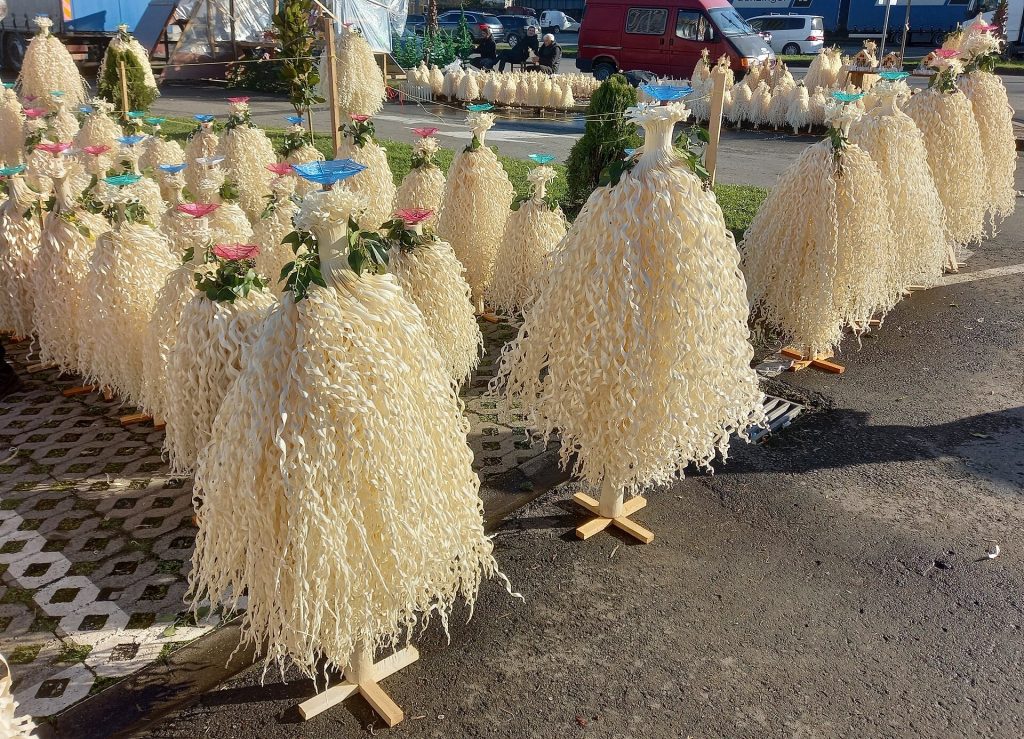
Chichilaki, the traditional Georgian New Year tree, symbolizes the holiday season around Bedoba. · Photo: Helen Owl / Wikimedia Commons, CC BY-SA 4.0
This page in other languages: Русский
GTour conciergeAsk anything about Georgia · we reply within hours