Archives


Gardabnoba in Georgia: dates, meaning and how to experience it
Next dates
2 October 2027 – 3 October 2027 (to be confirmed) · Gardabani, Kvemo Kartli. See the full events calendar and Georgia today for roads and weather.
What it is
Gardabnoba is the annual town-day festival of Gardabani, a municipal centre in the Kvemo Kartli region southeast of Tbilisi. The Georgian suffix -oba turns a place name into “the day of” or “the festival of” that place, so Gardabnoba means, literally, “the day of Gardabani.” It belongs to the same family of civic celebrations as Tbilisoba (Tbilisi’s city day) and similar “-oba” festivals held by towns across Georgia, rather than to the fixed cycle of Orthodox Christian feasts.
The festival is celebrated primarily by the residents of Gardabani Municipality itself: a working agricultural and industrial town on the Mtkvari (Kura) river plain, home to a mixed population of Georgians, Azerbaijanis and smaller Armenian and other communities, reflecting the broader ethnic composition of Kvemo Kartli. It also draws former residents who return for the day, neighbouring villages, and local officials who use the occasion for civic ceremony. It is not a nationally observed religious holiday, and its character is closer to a harvest-season community fair than to a church feast.
Historical background
- 6th–5th millennium BC — Early farming communities of the Shulaveri-Shomu culture settled the plains of Kvemo Kartli near present-day Gardabani, among the earliest known agricultural sites excavated in the Caucasus, a heritage documented by Georgia’s national museums.
- Antiquity — The lower Mtkvari valley around Gardabani formed part of the eastern borderlands of the ancient kingdom of Kartli (Iberia).
- 19th century — Under the Russian Empire the district belonged to Tiflis Governorate, and the adjoining Karayazi steppe was used chiefly as seasonal pasture.
- 1930s–1960s — Soviet-era irrigation schemes and the construction of a thermal power station converted the rural settlement of Gardabani into a growing industrial town.
- Mid-20th century — Gardabani was reclassified from a village into a town as its population and industrial base expanded.
- 1990s — After Georgian independence, Gardabani became the administrative seat of Gardabani Municipality within the newly defined Kvemo Kartli region.
- 2000s — Local authorities began holding a yearly early-autumn “Gardabnoba” town day, joining a nationwide pattern of municipal “-oba” festivals documented by Georgia’s tourism administration.
- 2023–2024 — Gardabnoba was held on 4 October in both years, with concerts, sports contests and agricultural and craft exhibitions in the town centre.
Unlike feasts tied to a saint’s day or a church council, Gardabnoba has no ancient liturgical pedigree. Its roots lie instead in the twentieth-century urbanisation of Kvemo Kartli, when irrigation and industry turned a cluster of villages on the Mtkvari floodplain into a functioning town. Yet the surrounding land carries a much older story: the Neolithic farmers of Shulaveri, who built some of the first permanent settlements in the Caucasus, worked soil only a short distance from where Gardabani’s central square now hosts a stage each autumn.
That layering — ancient farmland, imperial-era pastureland, Soviet industrial town, and post-independence municipal centre — is part of what Gardabnoba quietly celebrates. The festival gives a multi-ethnic, agriculturally productive district a single day to mark its own identity within Georgia, in the same way Batumi, Kutaisi, Telavi and dozens of smaller towns hold their own “-oba” each year, usually timed to the end of the farming season.
Meaning and traditions
A typical Gardabnoba follows the pattern common to Georgian town days. The mayor or municipal administration opens proceedings in the central square, often with a formal address and the raising of flags, followed by performances from local folk ensembles singing Kartli-region polyphony and dancing regional kartuli and khorumi-style numbers. Given the municipality’s mixed population, cultural programmes sometimes include Azerbaijani music and dance alongside Georgian acts, reflecting Kvemo Kartli’s demographic makeup.
Daytime events usually include sports competitions — wrestling (chidaoba), football tournaments, and sometimes equestrian games — alongside exhibitions of local produce: Gardabani’s farms are known for grain, vegetables and melons grown on the Mtkvari plain. Stalls sell shoti puri (boat-shaped bread baked in a clay tone oven), grilled mtsvadi skewers, lobio beans, and churchkhela. The day closes with an evening concert, often featuring well-known Georgian performers, and fireworks over the town centre. There is no single fixed liturgy attached to the day, though a local Orthodox church may hold a service or blessing as part of the programme.
When it happens
Gardabnoba has no fixed civil or religious date; it is set each year by the Gardabani municipal administration, typically in the first days of October. In 2023 and 2024 the festival fell on 4 October. For 2027, organisers have provisionally indicated 2–3 October, to be confirmed closer to the date; the exact 2026 date was not finalised at the time of writing. It is not a nationally recognised public holiday: government offices, banks and shops across Georgia operate normally, though some streets and municipal buildings in Gardabani itself may close to traffic or adjust hours on the day.
Where to experience it
The festival centres on Gardabani’s main square and central avenue, with additional activity at the town’s House of Culture and local stadium. Visitors coming from Tbilisi, roughly 30–40 minutes southeast by road, can expect the fullest programme in the late afternoon and evening, when stages, food stalls and the concert draw the largest crowds. If a church service forms part of the day, modest dress — covered shoulders and knees, a headscarf for women entering the sanctuary — is expected, as in any Georgian Orthodox church. Outside religious moments, the atmosphere is informal and family-oriented, similar to a county fair.
Travel with GTour
The Georgia in 10 Days — Tbilisi to Svaneti to the Sea route passes near Gardabani in Kvemo Kartli, and its early days can be arranged around the first days of October to coincide with Gardabnoba, while the Tbilisi & Mtskheta — The Essential First Day tour can be extended with a short detour to the town on the festival dates. A GTour travel expert designs the exact route and timing around the guest’s own dates.
Did you know
- Shulaveris Gora, a Neolithic mound near Gardabani, is one of the earliest known farming settlements identified in the Caucasus, dated to the sixth millennium BC.
- Kvemo Kartli is one of Georgia’s most ethnically mixed regions, with significant Azerbaijani and Armenian communities living alongside ethnic Georgians.
- Gardabani Municipality borders Azerbaijan and sits on the floodplain of the Mtkvari (Kura) river, one of the two major rivers that give the South Caucasus its geography.
- The town is home to one of Georgia’s major thermal power stations, which has supplied electricity to the national grid since the Soviet period and was later modernised.
- Most Georgian town-day festivals, including Tbilisoba, Batumoba and Gardabnoba, cluster in September and October, marking the traditional close of the agricultural harvest.
Practical tips for visitors
Gardabani is most easily reached by private car or marshrutka from Tbilisi; a day trip comfortably combines the festival with a morning in the capital. Early October weather on the Kvemo Kartli plain can be warm by day and cool after sunset, so layered clothing is practical. Because the exact date is confirmed only shortly before the event, travellers planning a visit around early October should check municipal announcements close to the time rather than relying on a fixed calendar entry. GTour can arrange a private driver or guide for the day, including transport and local orientation.
Combine it with
Gardabnoba pairs naturally with a short regional itinerary. Visitors often combine it with the churches, markets and nightlife of Tbilisi, a day among the vineyards and monasteries of Kakheti, or the fortresses and cathedrals of historic Kartli, all within a half-day’s drive of Gardabani.
Questions travellers ask
Is Gardabnoba a religious holiday?
No. It is a civic town-day festival organised by the local municipality, though a church service may be included in the programme. It is not part of the fixed Orthodox liturgical calendar.
Is Gardabnoba a public holiday in Georgia?
No. Government offices, banks and businesses across the country operate normally; only some local streets and municipal services in Gardabani may be affected on the day.
How do I get to Gardabani from Tbilisi?
Gardabani lies roughly 30–40 minutes southeast of central Tbilisi by road, reachable by private car, taxi or marshrutka minibus from Tbilisi’s Isani or Samgori bus stations.
What should I wear to the festival?
Casual, comfortable clothing suited to early-autumn weather is appropriate for the festival itself; modest dress is expected only if entering a church for an associated service.
Is Gardabnoba suitable for families and children?
Yes. The daytime programme typically includes sports, music, food stalls and craft displays aimed at a broad community audience, making it accessible for visitors of all ages.
Why does the date change every year?
Unlike church feasts fixed by the Orthodox calendar, Gardabnoba is a municipal event whose date is set administratively each year, usually in the first days of October, and confirmed shortly before the festival.
Are there other town-day festivals like this in Georgia?
Yes. Most Georgian cities and towns hold an annual “-oba” day; Tbilisoba in Tbilisi and similar celebrations in Batumi, Kutaisi and Telavi follow the same pattern of autumn civic festivity.
Can a private guide arrange a visit around Gardabnoba?
Yes. GTour arranges a private driver or guide for the day, which is useful given that the exact festival schedule is confirmed only close to the event.</
Sources
- Gardabnoba (Gardabani City Day)
- Gardabani Municipality City Day coverage
- Gardabani Municipality statistics
- Gardabani news archive
- Gardabani municipal cultural events
- Gardabani Municipality (2026)
- Gardabani Municipality (2024)
- Newpress.ge (Imereti) report
Plan your Georgia
Want to be in Georgia for Gardabnoba? A GTour travel expert designs the itinerary around it and calls you back.
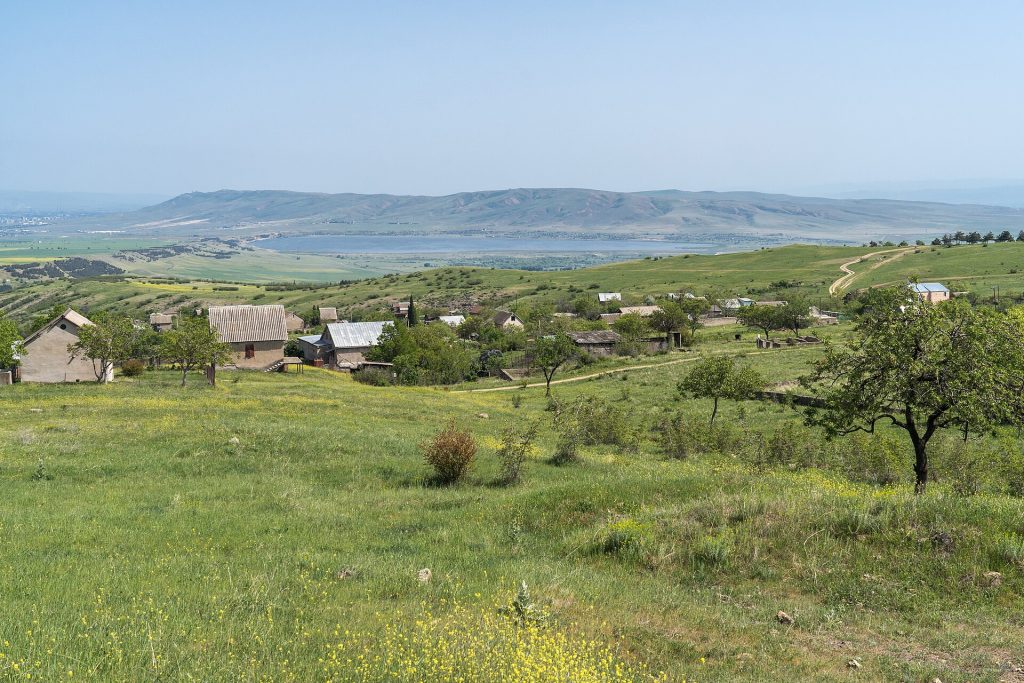
A hillside view over Gardabani town and the Kvemo Kartli plain, the festival's host municipality. · Photo: Alexkom000 / Wikimedia Commons, CC BY 4.0
This page in other languages: Русский
GTour conciergeAsk anything about Georgia · we reply within hours