Archives


Dushetoba in Georgia: dates, meaning and how to experience it
Next dates
26 September 2027 (to be confirmed) · Dusheti, Mtskheta-Mtianeti. See the full events calendar and Georgia today for roads and weather.
What it is
Dushetoba is the annual town festival of Dusheti, the small administrative centre of the Mtskheta-Mtianeti region that guards the southern approach to the Georgian Military Road. The name follows a common pattern in Georgian word-formation: the place name “Dusheti” takes the suffix -oba, the same ending used to form abstract nouns, saints’ feast days (giorgoba, the feast of St George) and other town celebrations (Tbilisoba, Batumoba). Literally, Dushetoba means something like “Dusheti-ness” or “the days of Dusheti” — in practice, “Dusheti’s town day.”
Unlike a church feast fixed by the liturgical calendar, Dushetoba is a secular, municipal celebration. It is organised by Dusheti’s local government for residents of the town and the surrounding Aragvi valley villages, for families from the mountain communities of Pshavi, Khevsureti and Mtiuleti who come down for the day, and for former residents who return from Tbilisi or abroad. Visitors are welcome and increasingly form part of the crowd, since the festival is listed among Georgia’s calendar of regional events promoted by the Georgian National Tourism Administration.
Historical background
- 13th–14th century — according to Georgian chronicles, the Aragvi valley around Dusheti was governed by a hereditary line of eristavis (dukes), the Eristavis of Aragvi, one of the ruling noble houses of feudal eastern Georgia.
- mid-18th century — after repeated conflict between the Aragvi eristavis and the Georgian crown, the eristavate was abolished and its lands brought under direct royal administration, a turning point remembered in local tradition.
- 1801 — the Kingdom of Kartli-Kakheti was absorbed into the Russian Empire; Dusheti subsequently became the seat of an uyezd (county) within Tiflis Governorate.
- 19th century — Dusheti grew as a market and garrison town on the route linking Tbilisi to the highland communities of Khevsureti, Pshavi, Mtiuleti and, further north, Khevi.
- 1921 — with the establishment of Soviet rule in Georgia, Dusheti became the administrative centre of a district (raion) within the Georgian SSR, a status it retains within independent Georgia.
- 1979 — Tbilisoba, the citywide autumn festival of the capital, was launched in Tbilisi, establishing the modern template of an “-oba” town day combining fair, concert and civic pride that smaller Georgian towns later adapted.
- 1990s–2000s — in the post-Soviet period, Dusheti’s municipality revived and formalised a local autumn town day along similar lines, giving rise to the event now known as Dushetoba.
- 2010s–2020s — Dushetoba appears in regional and national tourism listings, including those compiled by the Georgian National Tourism Administration, as one of the seasonal festivals of Mtskheta-Mtianeti.
Dusheti’s historical weight rests less on monuments than on its role as a threshold town. For centuries, anyone travelling from the Kartli lowlands into the high valleys of Pshavi, Khevsureti or Khevi passed through or near Dusheti, and the town’s fortunes rose and fell with the power of the Aragvi dukes and, later, with imperial and Soviet administrative reorganisation. The exact year the modern festival was first held is not well documented in published sources, and GTour treats the founding date of Dushetoba itself as uncertain rather than claim a precise origin.
What is clear is the pattern it follows: like many Georgian regional centres, Dusheti adopted the “oba” format — a day of concerts, crafts and shared food, named after the town — that Tbilisoba had popularised at national scale from 1979 onward. The result is a festival that is young as an institution but draws deliberately on the older identity of the Aragvi valley and its mountain neighbours.
Meaning and traditions
Dushetoba centres on a public fair and concert in the town itself. Stalls set up along the main street and central square sell local produce — apples, potatoes and honey from Mtianeti’s cooler farmland, cheese pressed in a goatskin sack known as guda, and preserves — alongside handicrafts such as felted wool items and Khevsur-style embroidery brought down from the mountain districts. Folk ensembles perform the three-voice polyphonic singing associated with the highland communities of Pshavi, Khevsureti and Mtiuleti, often alongside dance groups in mountain dress. Horse displays and Georgian wrestling, chidaoba, sometimes feature as competitive entertainment, echoing games historically held at mountain gatherings.
Food and drink follow the pattern of any Georgian public celebration: grilled meat (mtsvadi), dumplings (khinkali), bread and local wine or chacha (grape pomace spirit) are sold or shared at impromptu tables. Where a formal feast, or supra, is held among relatives or hosted by local institutions, a toastmaster (tamada) leads a sequence of toasts (sadღეgrdzelo, “for long life”) honouring family, guests, ancestors and the town itself. Visitors invited to such a table should expect to remain until the toasting concludes and to respond, however briefly, when toasted directly.
Because Dusheti sits at the edge of several distinct highland cultures, the festival’s character varies from year to year depending on which mountain communities send performers: a given Dushetoba may lean more toward Khevsur costume and song, another toward Mtiuletian or Pshavian groups. This variability is itself part of the town’s identity as a meeting point rather than a single cultural zone.
When it happens
Dushetoba does not fall on a fixed date. As a municipal rather than religious observance, its timing is set by Dusheti’s local authorities each year, typically in September, after the main summer harvest and before the onset of mountain winter. The Georgian National Tourism Administration’s listing for a recent year gave 28 September; the tentative date for 2027 circulating among organisers is 26 September, though this remains subject to confirmation closer to the time. As of late October 2026, no confirmed 2026 date had been widely published, underscoring the pattern: check with the municipality or the Georgian National Tourism Administration listings in the weeks beforehand rather than relying on a fixed calendar entry.
Dushetoba is not a national public holiday. Government offices, banks and shops across Georgia operate normally on the day; in Dusheti itself, some businesses along the festival route may adjust hours around the fair and concert, and parking in the centre is restricted while the event is set up.
Where to experience it
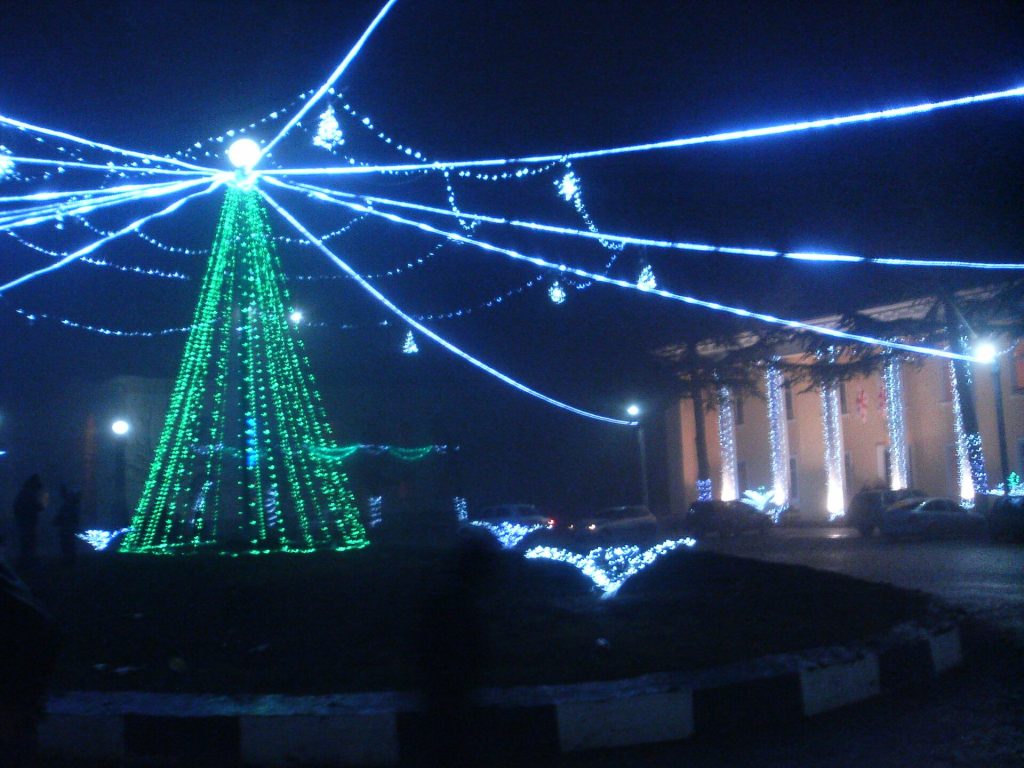
The festival is centred on Dusheti’s town square and main street, roughly 70 kilometres north of Tbilisi on the Georgian Military Road. Activity typically runs from late morning, when the craft and produce stalls open, through an afternoon of performances, into an evening concert on an open-air stage. Visitors can expect to see local families, schoolchildren’s groups and mountain-community ensembles rather than a large-scale tourist production — Dushetoba remains, first and foremost, a local event.
A short detour from the centre takes in Dusheti’s older quarters and, further along the highway, the well-known fortress complex of Ananuri on the Zhinvali reservoir, often visited on the same day by travellers heading toward Kazbegi. Anyone entering a church along the route — in Dusheti or at Ananuri — should dress modestly: covered shoulders and knees, a headscarf for women, and no photography during an active service. Shoes need not be removed, but hats should come off for men inside the church.
Travel with GTour
The Georgia in 10 Days — Tbilisi to Svaneti to the Sea route passes through Dusheti on its way into Mtskheta-Mtianeti, allowing a stop timed to late September when Dushetoba is held, while the Tbilisi & Mtskheta — The Essential First Day tour can be extended slightly to reach the town on the same day. A GTour travel expert designs the route around the guest’s dates, adjusting the itinerary once the festival date is confirmed.
Did you know
- Dusheti was historically the seat of the hereditary Eristavi, or duke, of Aragvi, one of the powerful noble houses of feudal eastern Georgia.
- The suffix “-oba” that gives Dushetoba its name is the same grammatical ending used for Georgian saints’ feast days, such as Giorgoba, the feast of St George.
- Georgian polyphonic singing, performed by ensembles from the mountain districts near Dusheti, was proclaimed a Masterpiece of Oral and Intangible Heritage by UNESCO in 2001 and later inscribed on its Representative List.
- Dusheti lies on the historic Georgian Military Road, the mountain route connecting Tbilisi with the North Caucasus that has carried travellers, traders and armies for centuries.
- Dushetoba follows a format pioneered by Tbilisoba, the Georgian capital’s citywide autumn festival first held in 1979, which inspired many smaller Georgian towns to establish their own “-oba” days.
Practical tips for visitors
Dusheti is roughly one and a half hours by road from Tbilisi along the Georgian Military Highway toward Kazbegi; marshrutka minibuses and taxis run from Tbilisi’s Didube station, and a private car is the most flexible option given the festival’s uncertain timing. There is no rail service to Dusheti. Late September weather in Mtskheta-Mtianeti is cool and can turn wet, with chilly evenings even when Tbilisi is warm, so a light jacket is worthwhile. Dress for the fair itself is casual; save modest clothing for church visits. Accommodation in Dusheti town is limited, so visitors combining the festival with a trip further into the mountains should book lodging in Kazbegi or return to Tbilisi the same evening. GTour arranges a private driver or guide for the day for visitors who prefer not to rely on public transport around an unconfirmed festival date.
Combine it with
Dushetoba sits naturally within a loop that includes a return base in Tbilisi, a continuation north to the high-mountain scenery of Kazbegi, or a separate day devoted to the vineyards and historic towns of Kakheti.
Questions travellers ask
What does “Dushetoba” literally mean?
It combines the town name Dusheti with the Georgian suffix “-oba,” which forms abstract nouns and feast-day names. The result translates loosely as “the day(s) of Dusheti,” comparable to how Tbilisoba means the festival day of Tbilisi.
Is Dushetoba a public holiday in Georgia?
No. It is a local municipal festival, not a state or religious public holiday, so government offices, banks and most businesses across the country operate normally on the day.
When exactly will Dushetoba take place in 2027?
Organisers have indicated 26 September 2027 as a tentative date, but it requires confirmation closer to the time, since the festival’s date is set annually by the municipality rather than fixed by calendar or church rule.
How do I get from Tbilisi to Dusheti?
Dusheti is about 70 kilometres north of Tbilisi on the Georgian Military Road, reachable in roughly 90 minutes by marshrutka from Didube station, by taxi, or with a private driver.
Is Dushetoba suitable for children and families?
Yes. The festival is a community-oriented fair with music, crafts, food stalls and open-air performances, drawing families from Dusheti and the surrounding mountain villages.
Can Dushetoba be combined with a trip to Kazbegi?
Yes, since Dusheti lies directly on the road north toward Kazbegi; many visitors treat the festival as a stop on the way to or from the high mountains.
What should visitors wear?
Casual clothing is appropriate for the fair and concert itself; modest dress — covered shoulders and knees, a headscarf for women — is expected when entering any church along the route, such as nearby Ananuri.
Is there an entrance fee for Dushetoba?
No. It is an open, public town festival held in Dusheti
Sources
- Dushetoba celebration coverage – Agenda.ge
- Dushetoba festival mention – Georgian National Museum heritage calendar
- Kvira.ge, regional news report
- Kvira.ge, regional news report
- Radio Tavisupleba (RFE/RL Georgian Service)
Plan your Georgia
Want to be in Georgia for Dushetoba? A GTour travel expert designs the itinerary around it and calls you back.
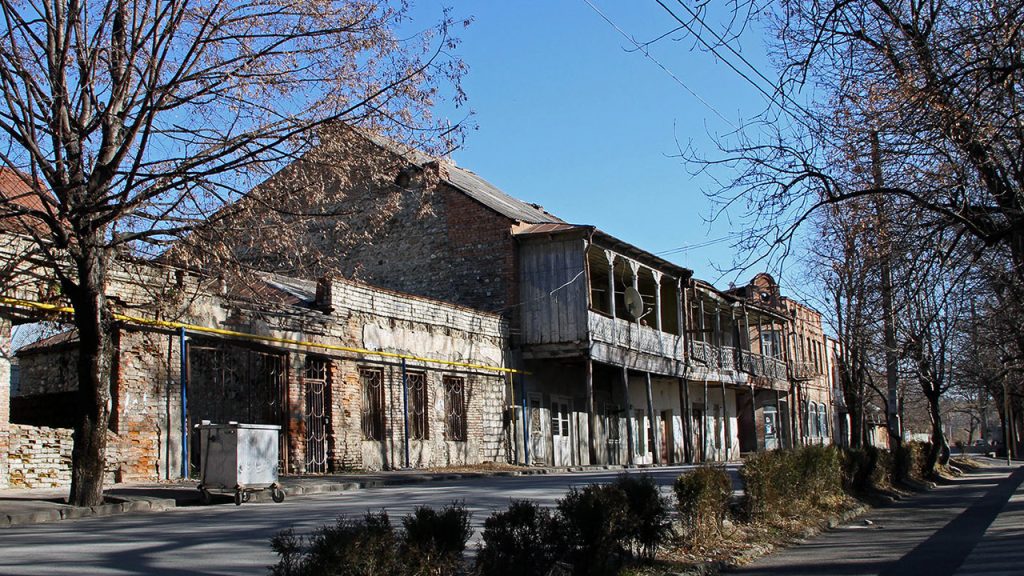
General view of Dusheti town, host of the annual Dushetoba autumn festival. · Photo: This work is created by George Melashvili. You can redistrib / Wikimedia Commons, CC BY-SA 3.0
This page in other languages: Русский
GTour conciergeAsk anything about Georgia · we reply within hours