Archives


Shatiloba in Georgia: dates, meaning and how to experience it
Next dates
4 September 2027 – 5 September 2027 (to be confirmed) · Shatili, Khevsureti. See the full events calendar and Georgia today for roads and weather.
What it is
Shatiloba is the annual cultural festival of Khevsureti, held among the fortified tower-houses of Shatili in Georgia’s northeastern highlands. The name follows a common Georgian pattern: the village name Shatili combined with the suffix -oba, which turns a place or saint’s name into the name of its feast day, as in Alaverdoba or Lomisoba. Shatiloba therefore means, literally, “the feast of Shatili” — a gathering built around the identity of the village itself rather than around a single saint’s commemoration.
The festival is celebrated by Khevsurs, the highland Georgian community native to the Arghuni and Andaki river gorges, along with descendants who were resettled to the lowlands in the twentieth century and now return each year, and increasingly by Georgian and foreign visitors drawn by the architecture and the mountains. It is as much a homecoming as a festival: families whose grandparents left Shatili for Kakheti decades ago travel back over the mountain road to reconnect with ancestral towers, shrines and burial grounds, making Shatiloba one of the clearest living expressions of how Georgia’s highland communities maintain ties to places many no longer inhabit year-round.
Historical background
- 9th–13th centuries — according to Georgian architectural historians, the core stone tower complex of Shatili was raised in this period, as Khevsureti’s communities fortified the Arghuni gorge, a historic route toward the North Caucasus.
- Medieval period — Georgian royal chronicles describe highland militias from Khevsureti, Pshavi and Tusheti serving as frontier defenders of the Kingdom of Georgia, a role that shaped the region’s distinct warrior culture and customary law.
- 1813 — Khevsur resistance to conscription and taxation under the newly established Russian imperial administration leads to armed confrontation in the gorge, part of the broader, gradual incorporation of the Caucasus highlands into the Russian Empire.
- 1861–1915 — the Georgian poet Vazha-Pshavela, active in this period, documents Khevsureti’s customs, shrine law and councils of elders in narrative poems that remain the principal literary record of the region’s traditional society.
- 1920s–1930s — Soviet authorities incorporate Khevsureti into collective farms; shrine-based customary justice is formally discouraged, though many practices continue informally in the villages.
- 1950s–1960s — Soviet resettlement programs move a substantial share of Khevsur families to lowland villages in Kakheti, sharply reducing Shatili’s year-round population.
- Late 20th century — Shatili’s tower complex is registered as a protected monument by Georgian heritage authorities.
- 1990s–2000s — after Georgian independence, seasonal return migration and growing interest in heritage tourism help re-establish Shatiloba as a recurring early-autumn gathering.
- 2020s — the festival continues, with dates confirmed each year by local organizers once the condition of the unpaved Datvisjvari pass road is known.
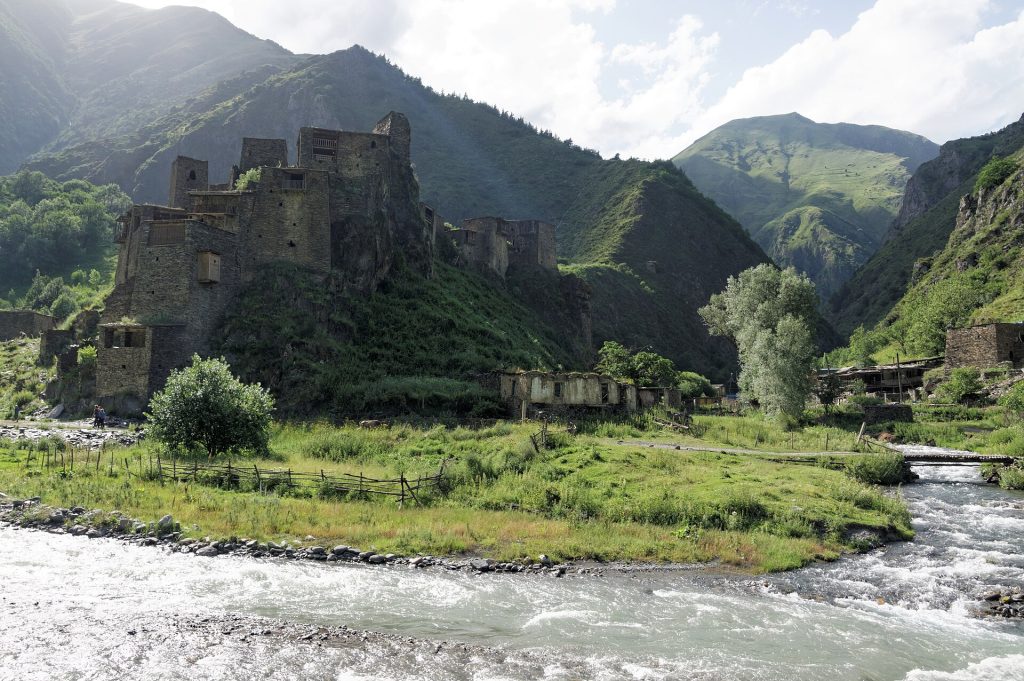
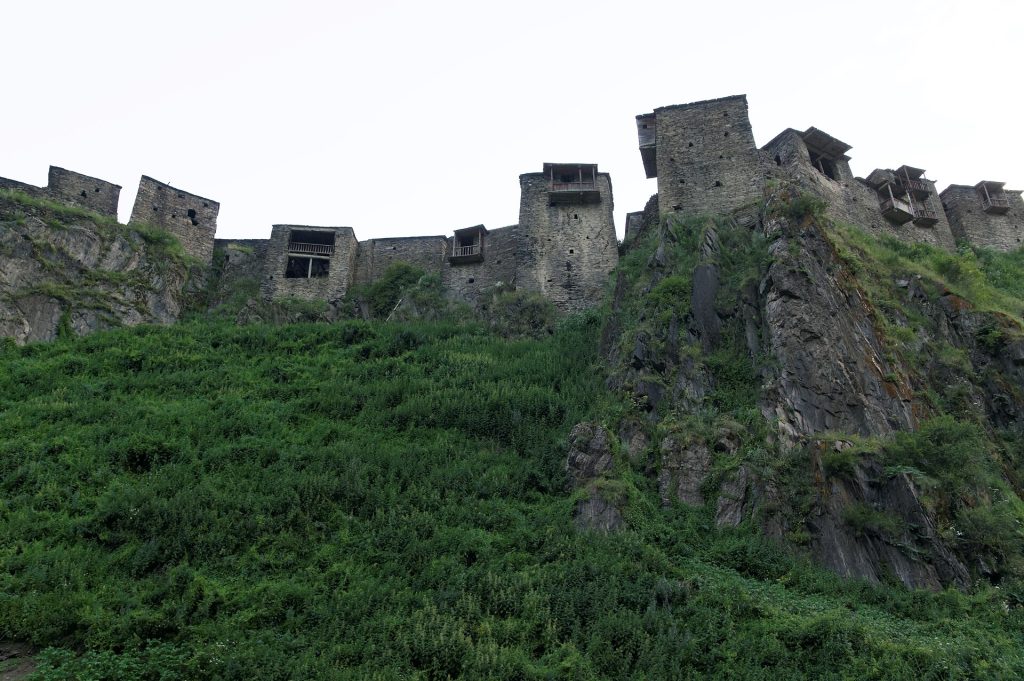
Shatili’s survival as a built environment is unusual even by the standards of Georgia’s mountain architecture. Rather than isolated towers, the village forms a single defensive mass of interlocked stone houses rising along the gorge wall, so that a family moving through its own home might pass through the fabric of several neighboring houses. This compact fortress-settlement pattern, shared with the nearby ruined village of Mutso, reflects centuries in which the gorge communities needed to defend themselves collectively against raids from across the mountains, a condition that shaped not only the architecture but also the strict customary law and shrine-based governance described by Vazha-Pshavela and later ethnographers, whose field notes and manuscripts are preserved in the collections of the National Parliamentary Library of Georgia.
The twentieth century brought the sharpest break in this continuity. Collectivization and, later, planned resettlement emptied much of Khevsureti of its permanent population, and Shatili itself was, for long stretches, close to abandoned outside summer. Shatiloba’s modern form dates to the post-Soviet decades, when heritage protection, improved though still seasonal road access, and a deliberate effort by descendants and cultural organizations to keep the connection to Shatili alive combined to revive an annual gathering. The festival today functions simultaneously as a reunion of dispersed families, a showcase of Khevsur dance, song and dress for outside visitors, and an informal check on the condition of the towers that the National Agency for Cultural Heritage Preservation of Georgia lists among the country’s protected architectural monuments.
Meaning and traditions
At Shatiloba, the open ground below and among the towers fills for a day or two with horsemen, dancers, singers and extended family groups who set up shared tables. The central performance is the Khevsuruli, a dance performed with wooden shields and blunted swords that stages a formal duel, accompanied by drum and the distinctive close-interval polyphonic singing of the Georgian mountains. Men and women traditionally dance separate but interlocking roles, and historic Khevsur dress — geometric cross-stitched wool garments, and on ceremonial occasions chainmail and helmets preserved as family heirlooms — is worn and displayed rather than treated purely as costume.
Food and hospitality follow the pattern of the Georgian supra, the long shared feast table led by a tamada (toastmaster) who directs a sequence of toasts to ancestors, guests, the mountains and peace. Regional dishes served include kotori, a flatbread filled with cheese characteristic of Pshavi and Khevsureti, and khinkali, the boiled dumpling that food historians commonly trace to the mountain regions of eastern Georgia before its spread to the cities. Recitation of Vazha-Pshavela’s poetry, much of it set in this exact landscape, is a recurring feature of the speeches and toasts. Similar -oba festivals exist elsewhere in highland Georgia — Lomisoba in Mtiuleti and Atengenoba in Svaneti among them — but Shatiloba is distinguished by its direct link to a single named fortress-village rather than to a shrine or saint.
When it happens
Shatiloba has no fixed date on the civil or church calendar. It is scheduled by local organizers for a weekend in early September, chosen each year according to the condition of the Datvisjvari pass road, weather forecasts, and the harvest and herding calendar that still governs much of highland life. The 2026 edition took place in early September; the 2027 edition is provisionally set for 4–5 September 2027, subject to confirmation closer to the date. It is not a Georgian national public holiday, so businesses, schools and government offices nationwide operate normally; the practical constraint for visitors is not an official closure but the road itself, which can become impassable with early snow or heavy rain well before or after the festival weekend.
Where to experience it
Shatili itself, built into the gorge wall, is the only place to experience Shatiloba directly: the festival ground sits at the foot of the towers, with the dancing, singing and feasting visible to anyone present rather than staged for a separate audience. Visitors with time can combine the trip with Mutso, a ruined sister fortress-village roughly twelve kilometers further up the valley, and with Barisakho, the lowland gateway town where the paved road ends. Information on access to Khevsureti and its monuments is maintained by the Georgian National Tourism Administration. Etiquette matters here: many towers remain private family property used seasonally, so visitors should ask before entering or photographing interiors, and should follow local guidance regarding the shrines (khati) scattered through the gorge, some of which traditionally restrict entry to their inner precincts for women. Modest, practical mountain dress is appropriate throughout.
Travel with GTour
Georgia in 10 Days — Tbilisi to Svaneti to the Sea can be extended with a detour to Shatili, letting travelers reach the tower houses in early September when Shatiloba fills the village and the road to Khevsureti is open. A GTour travel expert designs the route around the guest’s dates, adjusting the itinerary so Tbilisi & Mtskheta — The Essential First Day fits naturally before the journey north begins.
Did you know
- Shatili’s towers are not freestanding but interlocked into a single continuous fortress-village, so that movement through the settlement once passed through the fabric of several households at once.
- Khevsur ceremonial dress historically included chainmail and cross motifs that struck some nineteenth- and twentieth-century travelers as strikingly similar to medieval European armor, a comparison still repeated in Georgian regional histories.
- The Datvisjvari pass road connecting Khevsureti to the rest of Georgia remains unpaved for its final stretch and closes seasonally, making Shatili one of the few Georgian villages still cut off from road access for part of the year.
- Vazha-Pshavela’s narrative poems, set in Khevsureti and Pshavi, documented a customary legal system of elder councils and shrine-based arbitration that operated alongside, and sometimes instead of, state law into the early twentieth century.
- Soviet-era resettlement moved a large number of Khevsur families to lowland villages in Kakheti’s Kvareli district in the mid-twentieth century, which is why many Shatiloba participants today travel in specifically to attend, rather than living in the gorge year-round.
Practical tips for visitors
Shatili lies roughly 150 kilometers from Tbilisi, but the journey typically takes seven to nine hours because the final section beyond Barisakho is unpaved mountain track requiring a high-clearance 4×4 vehicle; there is no fuel available beyond Barisakho, and mobile signal is unreliable in the gorge. Guesthouse accommodation in Shatili is limited and should be booked well ahead of the festival weekend. September weather at this elevation can turn cold and wet without warning, so warm layers and waterproof footwear are recommended even if Tbilisi is still warm. GTour arranges a private driver or guide for visitors wishing to attend Shatiloba, which is advisable given the road conditions and limited public transport to the gorge.
Combine it with
Shatiloba sits within the broader highlands administered as part of Mtskheta-Mtianeti, and pairs naturally with a trip toward Kazbegi along the Georgian Military Highway. Travelers interested in comparing fortress architecture across Georgia’s mountain regions often extend the trip to Svaneti, home to the country’s other major tradition of defensive tower-houses.
Questions travellers ask
Is Shatiloba a public holiday in Georgia?
No. It is a local cultural festival specific to Khevsureti, not a nationwide public holiday, so offices, shops and schools elsewhere in Georgia operate as usual on its dates.
How do I get to Shatili?
From Tbilis
Plan your Georgia
Want to be in Georgia for Shatiloba? A GTour travel expert designs the itinerary around it and calls you back.
Shatili's fortified tower houses rise above the Argun River in Khevsureti. · Photo: Vyacheslav Argenberg / Wikimedia Commons, CC BY 4.0
This page in other languages: Русский
GTour conciergeAsk anything about Georgia · we reply within hours