Archives


Kazbegi Mountain Marathon in Georgia: dates, meaning and how to experience it
Next dates
29 August 2027 (to be confirmed) · Gergeti, Stepantsminda. See the full events calendar and Georgia today for roads and weather.
What it is
The Kazbegi Mountain Marathon is a trail-running event held in the shadow of Mount Kazbek, Georgia’s most recognisable peak, in the Mtskheta-Mtianeti highlands of the northern Caucasus. The event’s English name is descriptive rather than a translation of an old Georgian word: “marathoni” (მარათონი) is itself a borrowed term in Georgian, used for any long-distance running race, while “Kazbegi” refers to the historic district and the former name of the town now called Stepantsminda. The mountain itself carries an older Georgian name, Mkinvartsveri (მყინვარწვერი), meaning roughly “ice-topped peak” or “glacier peak”, a description still used by Georgians alongside the Russian-derived “Kazbek.”
The race is celebrated less by a single ethnic or religious community than by Georgia’s growing community of trail runners, mountain guides, and adventure travellers, together with residents of Stepantsminda and the village of Gergeti who host it. It sits within a wider calendar of Georgian mountain sport that has expanded over the past decade, drawing domestic athletes from Tbilisi and international competitors who come specifically for the chance to run beneath a 5,047-metre dormant volcano and finish at one of the country’s most photographed churches.
Historical background
- 14th century — Gergeti Trinity Church (Tsminda Sameba) is built on a ridge above the village of Gergeti, beneath Kazbek, giving the area its enduring religious landmark.
- 1868 — British mountaineer Douglas Freshfield leads the first recorded ascent of Kazbek, opening the peak to international alpinism and documenting the surrounding terrain in Western climbing literature.
- 1976 — a nature reserve is established around Kazbek to protect its glaciers, forests and alpine meadows, later reorganised into what is managed today as Kazbegi National Park under Georgia’s environmental authorities.
- 2006 — the town below the mountain officially reverts to its historic name, Stepantsminda, after decades as the Soviet-era “Kazbegi.”
- 2010s — Georgia’s trail-running and sky-running scene expands rapidly, with organised mountain races introduced in Svaneti, Racha and the Kazbegi area as part of a broader push toward adventure and sports tourism promoted by Georgia’s national tourism administration.
- today — organisers stage the Kazbegi Mountain Marathon annually on the last Sunday of August, starting in or near Stepantsminda and finishing beneath Gergeti Trinity Church, with the exact date and course confirmed each year ahead of registration.
The landscape the race crosses has been a crossing point and a place of refuge for far longer than any running event has existed. The Georgian Military Road, which threads the Darial Gorge past Kazbek, has carried travellers, traders and armies between the South Caucasus and the North Caucasus for centuries, and Gergeti Trinity Church has stood as a pilgrimage site and, according to local tradition, a wartime hiding place for religious relics. Mount Kazbek also holds a central place in Georgian mythology: it is traditionally identified as the mountain where Amirani, a Promethean hero punished for defying the gods, was chained — a parallel to the Greek Prometheus myth that ancient writers also located somewhere in the Caucasus.
Against this backdrop, the marathon is a recent layer rather than an ancient one. It belongs to the same wave of development that has brought cable transport, boutique guesthouses and international hiking routes to Stepantsminda over the past fifteen years, turning a historically remote highland parish into one of Georgia’s most visited mountain destinations. Locals describe the race less as a revival of custom and more as a new occasion for old highland hospitality — guesthouses fill, supras are laid, and the church that has watched over Gergeti for six centuries now also watches over a finish line.
Meaning and traditions
Runners typically choose among several distances on race day, from a full mountain marathon to shorter family-friendly routes, climbing from the valley floor near Stepantsminda toward Gergeti and Kazbek’s lower slopes before returning or finishing at the church grounds. Georgian terms a visitor may hear include “mtis marat’oni” (მთის მარათონი), “mountain marathon,” and “sirbili” (სირბილი), simply “running.” Course markings, aid stations and start formalities follow international trail-running conventions, but the surrounding culture is distinctly local.
After the race, hospitality customs familiar from any Georgian gathering tend to take over: a supra (feast table) with khinkali (dumplings associated especially with mountain regions), khachapuri, and a tamada (toastmaster) offering toasts, sometimes with chacha, a pomace brandy. Traditional Mokheve and Khevsur highland dress occasionally appears at opening ceremonies or award presentations, reflecting the historic ethnographic identity of this part of Mtskheta-Mtianeti, distinct from the Kartli or Kakheti lowlands. Regional variation is modest since this is a single-location modern event, but its character — mountain hospitality layered onto a sporting format — mirrors other Georgian trail races in Svaneti and Racha.
When it happens
The Kazbegi Mountain Marathon is held on the last Sunday of August each year. In 2026 that date fell on 30 August; the next edition is expected on 29 August 2027, though organisers confirm the exact date, course and registration details closer to the event each year, as weather and logistics in high mountain terrain can require adjustment. It is not a public holiday in Georgia: government offices, schools and most businesses operate normally on race day. The principal visible effect for visitors is temporary road and parking restrictions in Stepantsminda and along the approach to Gergeti during race hours.
Where to experience it
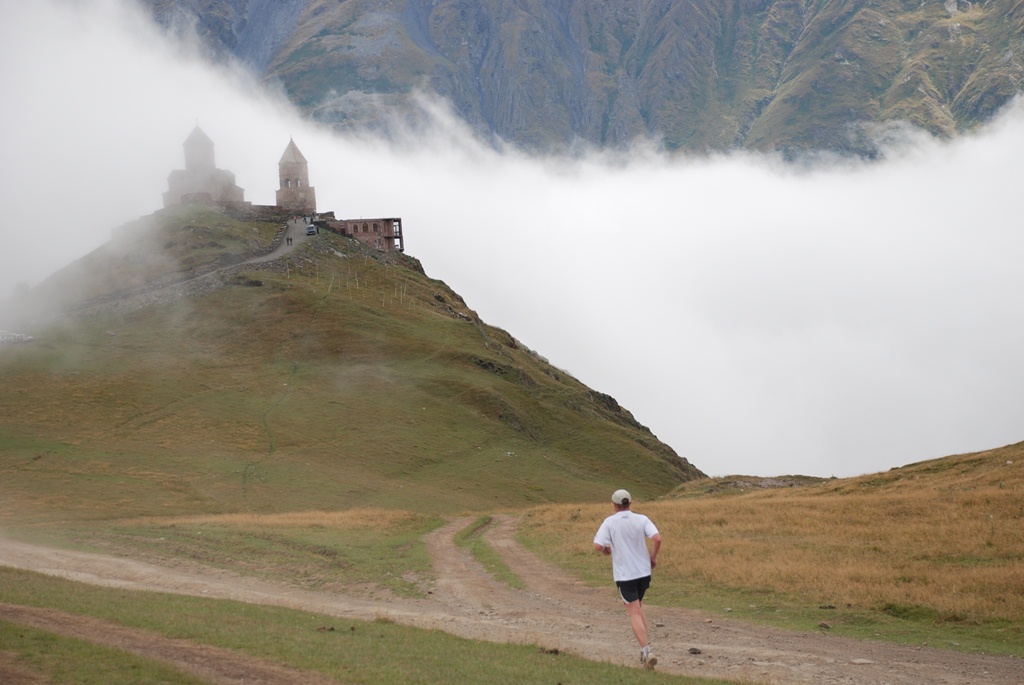
Stepantsminda, the administrative centre of the Kazbegi municipality, is the usual hub for registration, start logistics and accommodation. The route typically climbs toward Gergeti village and finishes near Gergeti Trinity Church, perched at roughly 2,170 metres with Kazbek rising behind it — widely considered one of the most photographed views in Georgia. Spectators gather along the church approach road and on the terrace near the church itself, where Kazbek’s summit is visible on a clear day.
Visitors entering Gergeti Trinity Church, whether on race day or any other, should dress modestly: knee-length skirts or trousers, covered shoulders, and head coverings for women are expected, and shorts are discouraged for men. Photography inside the church is usually restricted, especially during services, and visitors should move quietly and avoid turning their back to the altar. Outside race weekends, the Tergi riverside in Stepantsminda and the Gveleti waterfalls nearby offer additional, quieter ways to experience the same landscape.
Travel with GTour
The Kazbegi — Gergeti Trinity Church in a Day tour passes directly through Gergeti, so a visit can be set around the last Sunday of August when runners gather beneath Mount Kazbek, while the Kazbegi — 2-Day Mountain Journey allows an overnight stay in Stepantsminda to watch the race unhurried. A GTour travel expert designs the route around the guest’s dates.
Did you know
- Mount Kazbek stands 5,047 metres high and is classified as a dormant stratovolcano, one of the highest peaks in the Caucasus.
- The older Georgian name for Kazbek, Mkinvartsveri, means “ice-topped” or “glacier peak,” predating the Russian-derived name now used internationally.
- Georgian mythology places the punishment of Amirani, a Promethean hero, on Kazbek’s slopes, echoing the ancient Greek Prometheus legend also tied to the Caucasus.
- The first recorded ascent of Kazbek was made in 1868 by British mountaineer Douglas Freshfield and his climbing party.
- The town beneath the mountain reverted to its historic name, Stepantsminda, in 2006 after decades of Soviet-era use of the name Kazbegi.
Practical tips for visitors
Stepantsminda lies roughly three hours by road from Tbilisi along the Georgian Military Highway, reachable by marshrutka (shared minibus), private transfer or self-drive; Tbilisi International Airport is the nearest major gateway. Mountain weather is unpredictable even in late August, so layered clothing, a waterproof shell and sturdy footwear are advisable for spectators as well as runners. Accommodation in Stepantsminda is limited relative to demand on race weekend, so booking well in advance is recommended. Expect short road closures near Gergeti during the event and plan church visits either early morning or outside race hours for a quieter experience.
Combine it with
The marathon pairs naturally with wider exploration of Kazbegi itself, the broader Mtskheta-Mtianeti highlands along the Georgian Military Highway, and, for travellers comparing Georgia’s mountain cultures, the glacier villages and towers of Svaneti.
Questions travellers ask
Is the Kazbegi Mountain Marathon a public holiday?
No. It is a sporting event, not a public or religious holiday, and does not affect national working hours, though local roads near Stepantsminda and Gergeti may see short closures.
Do I need to be an experienced runner to attend?
Only entrants in the race need running experience. Most visitors come as spectators to watch the finish near Gergeti Trinity Church and enjoy the mountain scenery and local hospitality around race weekend.
How do I get from Tbilisi to Stepantsminda?
Marshrutka minibuses run regularly from Tbilisi’s Didube station, taking around three hours; private transfers and self-drive via the Georgian Military Highway are also common.
Can I visit Gergeti Trinity Church on race day?
Yes, but expect crowds near the finish line during race hours. Dress modestly, remain quiet near the church, and avoid photography during services.
What is the weather like in late August?
Valley temperatures are generally mild, but conditions change quickly at altitude; rain, wind and sudden cold are all possible, so layered clothing is recommended.
Is the exact 2027 date confirmed yet?
Not officially. The event follows the last Sun
Sources
Plan your Georgia
Want to be in Georgia for Kazbegi Mountain Marathon? A GTour travel expert designs the itinerary around it and calls you back.
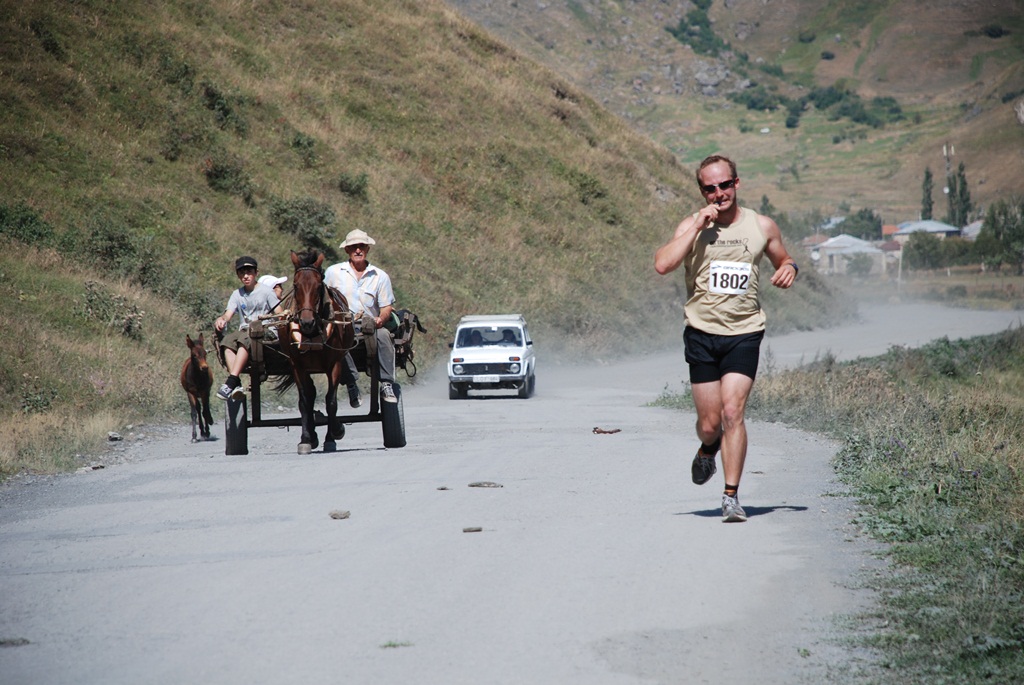
A runner races along a mountain road during the Kazbegi Marathon near Stepantsminda. · Photo: Yftaheco / Wikimedia Commons, CC BY-SA 3.0
This page in other languages: Русский
GTour conciergeAsk anything about Georgia · we reply within hours