Archives


Gandagana in Georgia: dates, meaning and how to experience it
Next dates
21 November 2026 – 22 November 2026 (to be confirmed) · Europe Square, Batumi. See the full events calendar and Georgia today for roads and weather.
What it is
Gandagana takes its name from one of the fastest and most demanding dances in the Georgian repertoire, a whirling solo or paired dance historically performed in the highland valleys of Adjara and neighboring Guria to the accompaniment of the panduri (a three-stringed lute) and doli (a hand drum). Organisers of the modern festival borrowed the word precisely because it evokes energy, speed and celebration — qualities meant to carry over into a two-day fair that has nothing to do with the religious calendar and everything to do with showcasing what Adjara’s villages produce after the harvest is in.
Gandagana the festival is a rural and agricultural tourism event, not a feast day. It is organised by the government of the Autonomous Republic of Adjara in cooperation with municipal administrations — chiefly the highland districts of Khulo, Shuakhevi and Keda and the lowland districts of Kobuleti and Khelvachauri — and is aimed equally at visitors, at Batumi residents who rarely travel into the mountains, and at small producers who otherwise sell only at local markets. It sits within a wider push by Georgia’s tourism authorities to extend the Black Sea coast’s summer-dominated visitor season into the quieter, cooler months.
Historical background
- pre-20th century — Georgian ethnographers record Gandagana and the related Acharuli dance as part of the living folk-dance repertoire of Adjara’s mountain communities, performed at weddings, harvest gatherings and village festivities.
- 1878–1921 — Adjara is administered as part of the Ottoman-held Batumi Oblast before passing to Soviet Georgia; mountain villages such as Khulo and Shuakhevi retain a distinct highland economy based on livestock, dairy and apiculture throughout this period.
- 1921 — the Treaty of Kars and subsequent Soviet decree establish the Adjarian Autonomous Soviet Socialist Republic, the political basis for the region’s distinct administration, which today runs its own tourism and cultural promotion programs.
- 1930s — Soviet agricultural policy develops subtropical farming on the Adjarian coast, introducing large-scale citrus, tea and hazelnut cultivation that still defines the lowland produce seen at Gandagana today.
- 2001 and 2008 — Georgian polyphonic singing, the choral tradition performed at village gatherings across the country including Adjara, is proclaimed a UNESCO Masterpiece of the Oral and Intangible Heritage of Humanity and later inscribed on the Representative List.
- 2000s–2010s — depopulation of Adjara’s highland villages prompts the autonomous government to develop agrotourism and rural-guesthouse programs as a way of keeping mountain communities economically viable.
- early 2020s — Gandagana is launched as a dedicated village produce and folk-culture fair on Batumi’s Europe Square, bringing highland and coastal municipalities together under one roof for the first time in this format.
- 22–23 November 2024 — the festival is held on its usual late-autumn weekend, with dairy, honey, wine, citrus and sweets stalls organised by municipality.
- 2026 — organisers schedule the festival for 21–22 November, subject to confirmation closer to the date.
Gandagana belongs to a recognisable pattern in Adjaran cultural policy: the pairing of a folk-dance name with a practical economic purpose. Adjara’s identity has long been built on contrast — a subtropical coastline of citrus and tea groves facing a steep, pastoral highland of honey, cheese and transhumant livestock — and the festival is structured explicitly to put both halves of that geography on the same square at the same time. It is a comparatively young event by Georgian standards, but it draws on genuinely old material: the dance itself, the cheese-making and apiculture techniques of the highland villages, and the polyphonic singing tradition that provides much of its soundtrack are all attested well before the festival existed.
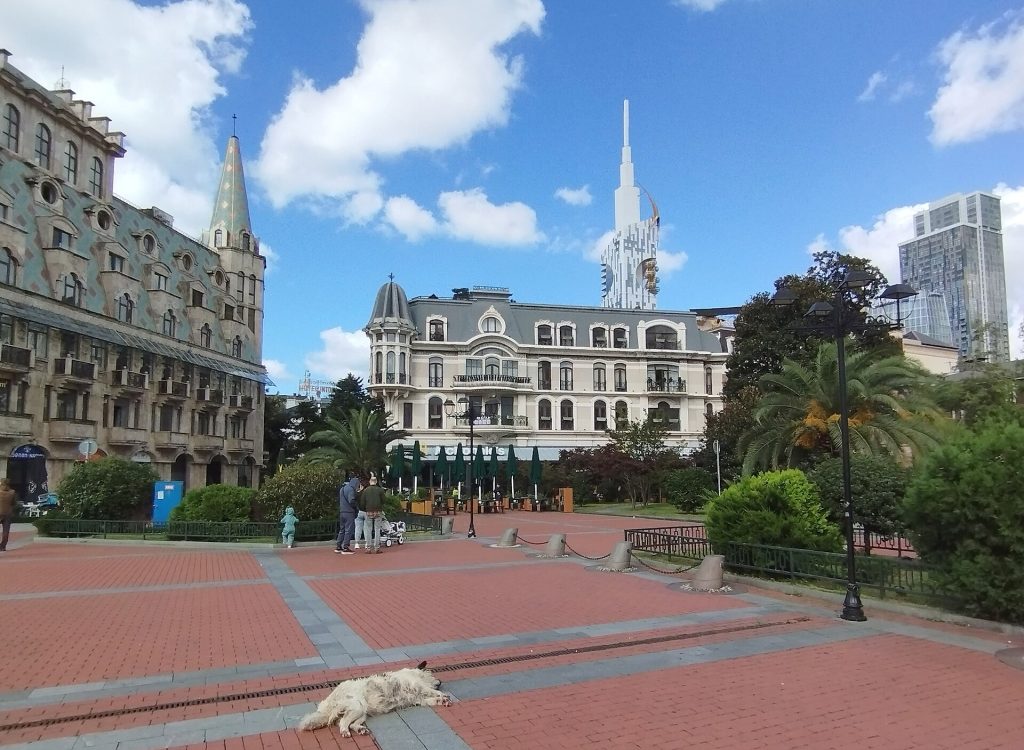
The choice of Europe Square as the venue is also deliberate. Built in the late 2000s as part of Batumi’s post-Soviet redevelopment as a Black Sea resort city, the square is the most recognisable civic space in Adjara’s capital, and placing a rural fair there each autumn is a statement that the region’s mountain economy is as central to Adjaran identity as its beach tourism.

Meaning and traditions
Each municipality typically sets up its own row of wooden stalls, so a visitor can walk from Khulo’s honey and tenili (a hand-stretched, skin-aged highland cheese) to Kobuleti’s mandarins and feijoa, then on to Keda’s Chkhaveri wine, a rare pink grape variety native to Adjara’s coastal hills traditionally made into a naturally semi-sweet wine without added sugar. Sweets tables usually feature churchkhela (a string of nuts dipped repeatedly in grape-juice paste) and pelamushi, a soft grape-must pudding eaten at the same season. Adjarian khachapuri acharuli — the boat-shaped cheese bread with a raw egg and butter stirred into the centre — is often cooked to order.
Music and dance run throughout both days: folk ensembles in highland Adjaran costume perform Gandagana and Acharuli to panduri, chonguri (a four-stringed lute) and doli, and groups often sing in the three-voice polyphonic style characteristic of Georgian village tradition. Regional variation is part of the point of the festival: highland stalls emphasise pastoral products — wool, honey, dairy, preserved meats — while lowland stalls emphasise subtropical agriculture — citrus, tea, hazelnuts, herbs. Visitors should expect tastings to be offered freely by producers, with small purchases in cash welcomed rather than expected.
When it happens
Gandagana has no fixed date. It is scheduled by the Adjaran government’s tourism and agriculture administration for a weekend in late October or November, after the regional citrus and grape harvests are in, and the exact dates are confirmed publicly only a few weeks beforehand. In 2024 it was held on 22–23 November. For 2026, organisers have indicated 21–22 November, though this should be treated as provisional until confirmed through official regional tourism channels closer to the date. It is not a public holiday: government offices, shops and transport in Batumi operate normally, and only Europe Square itself is closed to traffic and given over to the fair.
Where to experience it
The festival takes place on Europe Square in central Batumi, in front of the Statue of Europe and within walking distance of Batumi’s Old Town, the Boulevard and the city’s main hotels. Stalls are usually open from late morning into the evening on both days, with folk performances concentrated around midday and again in the early evening. No special etiquette applies to the fair itself, which is entirely secular; visitors combining the trip with a stop at one of Batumi’s working churches, such as the Cathedral of the Nativity of the Virgin, should dress modestly and remove hats as usual.
Travel with GTour
The Georgia in Winter — Gudauri Skiing, Tbilisi & Kakheti (6 Days) tour can be arranged to begin or end in Batumi, allowing guests to pass through Europe Square while the Gandagana fair’s dairy, honey and wine stalls from Adjarian villages are set up. For travelers already in the region for the Rtveli — Wine Harvest in Kakheti (3 Days, September–October) tour, a GTour travel expert will design the wider route and timing around the guest’s own dates to see whether a stop in Batumi fits the trip.
Did you know
- Georgian polyphonic singing, often heard at Gandagana, was proclaimed a UNESCO Masterpiece of the Oral and Intangible Heritage of Humanity in 2001 and later placed on the Representative List.
- Tenili, one of the signature cheeses at the fair, is hand-pulled into fine threads and traditionally matured in a sheep’s-skin bag, a highland technique found almost nowhere else in Georgia.
- Chkhaveri, the pink grape variety grown in Adjara’s coastal hills, is one of relatively few Georgian varieties historically vinified as a naturally semi-sweet wine rather than a dry one.
- Adjara’s highland municipalities of Khulo and Shuakhevi sit among the highest permanently inhabited villages in western Georgia, with some settlements above 1,500 metres.
- The Autonomous Republic of Adjara’s distinct administrative status dates to the Treaty of Kars of 1921, the same political settlement that underpins the region’s separate tourism and cultural programming today.
Practical tips for visitors
Batumi is reached directly by Batumi International Airport, by overnight or day train from Tbilisi via Georgian Railway, or by road along the coastal highway. Late October and November on the Adjaran coast are rainy and mild rather than cold, so waterproof layers are more useful than heavy winter clothing. Entry to the fair is free and no booking is required, but accommodation in Batumi should be booked ahead if the festival coincides with a weekend, since the city’s hotel stock is geared toward the summer season. Carry cash in small denominations, as village producers rarely accept cards. Confirm the exact dates close to the time through the regional tourism portals GoBatumi and the Adjara government site, or the national Georgian National Tourism Administration.
Combine it with
A Gandagana visit pairs naturally with a drive into the Adjaran highlands around Khulo and Shuakhevi to see the villages whose produce fills the stalls — part of the wider Adjara region. Visitors extending the trip inland often continue to Imereti, reachable by the same rail line, or to Kakheti for a direct comparison between Adjara’s Chkhaveri and Georgia’s larger eastern wine region.
Questions travellers ask
Is Gandagana a public holiday?
No. It is a tourism and agricultural fair, not a state or church holiday, so businesses, offices and transport in Batumi continue as normal; only Europe Square is closed to traffic for the event.
Do I need a ticket?
Entry is free. Visitors pay only for food, drink or craft items purchased from individual stalls.
Is the exact date fixed every year?
No. The festival moves within a late October to November window depending on when the citrus and grape harvests finish, and the precise weekend is confirmed by Adjaran authorities only a few weeks in advance.
Is it suitable for children?
Yes. It is an open-air food and music fair with folk dance performances, similar in atmosphere to a harvest market, and poses no particular hazards for families.
How do I get from Tbilisi to Batumi?
The most comfortable option is the train operated by Georgian Railway, which takes roughly five to six hours; flights and shared minivans are also available, with the drive by road taking about six hours depending on route and weather.
What is the weather like at that time of year?
Batumi in late October and November is mild but notably rainy, as it sits in Georgia’s wettest climatic zone; waterproof clothing is more useful than heavy insulation.
Can I buy wine and honey to take home?
Yes. Producers sell bottled wine, jarred honey, dried fruit and churchkhela directly from their stalls, though quantities for air travel should respect standard liquid and customs allowances.
What other Adjaran festivals pair well with a visit?
Travellers often combine Gandagana with a separate trip to the highland districts themselves, visiting village guesthouses and apiaries directly, or extend the journey toward Imereti or Kakheti to compare regional wine and food traditions within the same visit to Georgia.
Sources
- Georgian National Tourism Administration
- GoBatumi tourism portal
- Visit Batumi
- UNESCO Intangible Cultural Heritage
- Georgian Railway
- Batumi City Hall
Plan your Georgia
Want to be in Georgia for Gandagana? A GTour travel expert designs the itinerary around it and calls you back.
Europe Square in Batumi, the venue hosting the Gandagana rural tourism fair. · Photo: Andrew Milligan sumo / Wikimedia Commons, CC BY 2.0
This page in other languages: Русский
GTour conciergeAsk anything about Georgia · we reply within hours