Archives


Lomisoba in Georgia: dates, meaning and how to experience it
Next dates
23 June 2027 · Lomisa church above the Ksani/Aragvi valleys, Mtskheta-Mtianeti. See the full events calendar and Georgia today for roads and weather.
What it is
Lomisoba is the feast day of Lomisa, the mountain shrine of St George that stands above the headwaters of the Ksani and Aragvi rivers in Mtskheta-Mtianeti. The name follows a common Georgian pattern in which the suffix -oba turns a place or a saint’s name into the name of its feast day, as in Giorgoba (the feast of St George) or Mariamoba (the feast of the Virgin). Lomisoba therefore means, literally, “the day of Lomisi” — the day belonging to the mountain and its church.
The feast is kept above all by the highland communities of former Mtiuleti, Gudamakari, the Ksani and Aragvi gorges, and neighbouring Pshavi, for whom Lomisa has long served as the chief communal shrine, or khati. Families from dozens of villages traditionally send a representative and a votive banner up the mountain on this day. In recent decades the pilgrimage has also drawn Orthodox believers from Tbilisi and other regions, together with travellers curious to see one of the most physically demanding and visually striking religious gatherings in the Georgian calendar.
Historical background
- pre-Christian era — Mount Lomisi and similar peaks in the central Caucasus were already venerated as sacred sites by highland communities, whose religious life centred on hereditary lay custodians (khevisberi) long before the arrival of Christianity, a pattern documented by Georgian ethnographers of the highland cults.
- 4th–6th century — Christianity becomes the state religion of Kartli under King Mirian III, and the cult of St George, already venerated across the Eastern Christian world, spreads through Georgia and is gradually layered onto existing mountain shrines, a process attested across the Georgian highlands.
- medieval centuries — a church dedicated to St George is built on the summit of Lomisi; the exact founding date is not recorded, but the shrine is established as the principal communal khati for communities of the Ksani and Aragvi valleys.
- 19th century — Russian and Georgian travellers and clergy record the Lomisoba pilgrimage and its blend of church liturgy with older communal customs, including animal offerings and banner processions.
- early–mid 20th century — Georgian ethnographers studying Pshav-Khevsur and Mtiuletian religion, notably Vera Bardavelidze, document Lomisoba as a living example of the layering of pre-Christian highland cult practice onto Orthodox veneration of saints.
- Soviet period — organised religious gatherings, including mountain pilgrimages, are discouraged and in places suppressed, though the custom survives informally in highland villages.
- after 1991 — with Georgian independence and the revival of church life, the Lomisoba pilgrimage resumes openly, with clergy of the Georgian Orthodox Church again conducting the Divine Liturgy at the summit church.
- today — Lomisoba continues each year on the Wednesday after Pentecost, combining an overnight or early-morning climb, a liturgy, communal feasting, and customs such as horse racing and wrestling on the lower slopes.
What makes Lomisoba historically significant is less a single founding date than the continuity it represents. The mountain shrine predates the church built upon it, and the church in turn absorbed rather than replaced the office of the khevisberi, the lay elder who traditionally organised the sacrifice, the feast, and the order of ascent. This layering — pre-Christian mountain cult, early Georgian Christianity, and later Orthodox liturgical practice — is one of the clearest surviving examples in the Caucasus of how a national church accommodated older communal religion rather than erasing it outright.
St George himself occupies an unusually large place in Georgian religious imagination, venerated across the country under many local titles, of which the highland “White George” tradition linked to Lomisa is among the oldest. The persistence of the pilgrimage through Soviet-era restriction and its rapid revival after 1991 reflect the depth of attachment highland families retain to their ancestral shrine, an attachment that today sits alongside, rather than against, the authority of the Georgian Orthodox Church, which sends priests to serve the liturgy at the summit each year.
Meaning and traditions
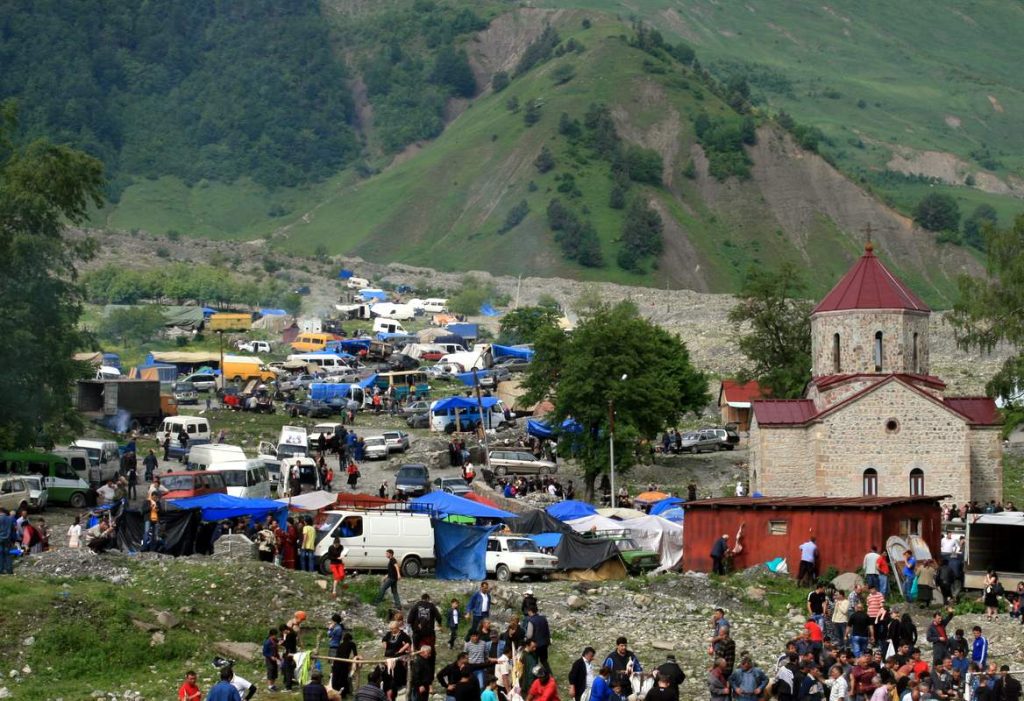
The core of Lomisoba is the climb itself: pilgrims ascend the steep path to the Lomisa church, a walk of roughly two hours from the nearest trailhead, often beginning before dawn so as to reach the summit for the morning liturgy. Many carry a drosha (banner) representing their village or family, continuing the custom by which each community historically sent its own standard up the mountain to be blessed at the shrine.
At the church, pilgrims light candles, venerate the icon of St George, and make vows or give thanks for vows fulfilled. A traditional element of the day, still practised by some communities, is qurbani — the sacrificial offering of a sheep or other animal, its meat later shared as a communal meal on the mountainside. This custom, rooted in the pre-Christian layer of the shrine’s history, exists alongside the Christian liturgy rather than as part of it, and the Georgian Orthodox Church does not treat it as a sacrament. Lower on the slopes, the day traditionally includes horse racing, wrestling (chidaoba), and extended toasting led by a tamada (toastmaster) over Georgian wine, bread, and roasted meat. Songs and polyphonic chants specific to Mtiuleti and the Pshav-Khevsur highlands are sung during the feast. Regional variants of Lomisoba, and of related xatoba (icon-feast) days, are kept with local differences in Khevsureti and Pshavi, where other mountain shrines hold their own feast days on different dates through the summer.
When it happens
Lomisoba is a moveable feast, fixed to the Georgian Orthodox liturgical calendar rather than to a set civil date. It falls on the Wednesday after Pentecost, which is itself the seventh Sunday after Orthodox Easter (Pascha), so the date shifts each year with the date of Easter. Converted to the Gregorian calendar used for civil life in Georgia, Lomisoba fell on Wednesday 3 June 2026, and will next fall on Wednesday 23 June 2027.
Lomisoba is not a state public holiday in Georgia; government offices, banks, and city businesses operate normally on the day. It is, however, a significant local and religious observance in Mtskheta-Mtianeti, where some village life, transport, and the church itself are organised around the pilgrimage, and where accommodation near the trailhead can fill well in advance.
Where to experience it
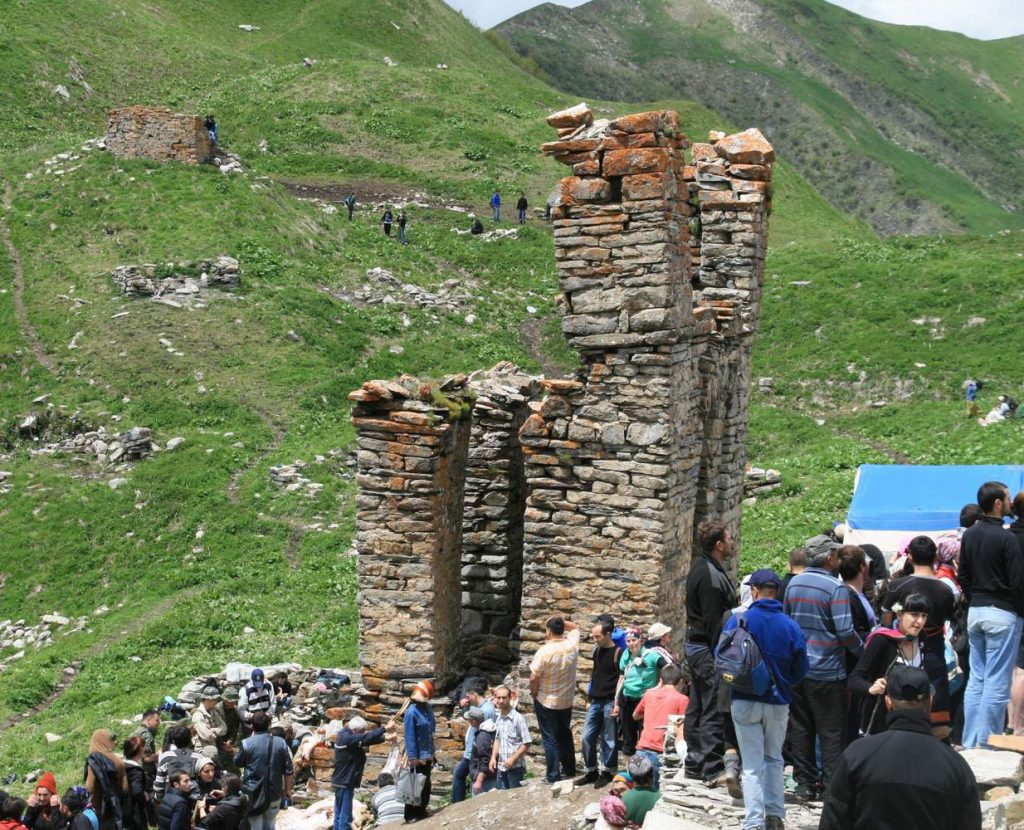
The Lomisa church stands on Mount Lomisi above the Ksani and Aragvi valleys, in Dusheti municipality, Mtskheta-Mtianeti, within reach of the Jvari Pass road that connects Tbilisi to Gudauri and the Georgian Military Highway. Visitors typically park near a trailhead village and climb for about two hours on a clear but steep path; sturdy footwear, water, and an early start are essential, since the main liturgy and the busiest hours at the summit are in the morning. At the church, visitors should dress modestly — long trousers or skirts, covered shoulders, and a headscarf for women — remain quiet during the liturgy, and ask before photographing the clergy, the icon, or any sacrificial rite in progress. Lower slopes around the feast ground are more informal, with families picnicking, racing horses, and sharing food; guests are often invited to join a toast, which it is polite to accept with a small sip rather than a refusal.
Travel with GTour
The Kazbegi & Gergeti Trinity Church — Day Trip from Tbilisi and the Kazbegi — 2-Day Mountain Journey both pass through the Ksani and Aragvi valleys on the route toward Kazbegi, within reach of the Lomisa church climb held on 23 June 2027. A GTour travel expert can design the itinerary and timing around your dates if you wish to combine the journey with the pilgrimage.
Did you know
- St George is venerated in Georgia under many local titles and at hundreds of shrines, a reflection of how deeply the saint’s cult was absorbed into pre-existing highland religion.
- The khevisberi, the hereditary lay custodian of a mountain shrine, is a pre-Christian religious office that survived into the Christian era and still has a ceremonial role at some highland feasts.
- Lomisoba is one of many xatoba, or icon-feast days, observed across the Georgian highlands, each tied to a specific communal shrine and its own date in the church calendar.
- Because it is calculated from the date of Orthodox Easter, Lomisoba falls on a different Gregorian calendar date almost every year.
- Villages from both the Ksani and Aragvi valleys historically sent separate banners up the mountain, reflecting Lomisa’s role as a shared shrine for communities on either side of the ridge.
Practical tips for visitors
The nearest base is along the Tbilisi–Gudauri road through the Jvari Pass; a private car or organised tour is the most practical way to reach the trailhead, since public transport does not run directly to it. The climb is steep and unshaded in places, so visitors should carry water, wear hiking shoes, and check the weather, since mountain conditions can change quickly even in June. Accommodation in nearby villages is limited and should be booked well ahead of the feast date; many visitors instead stay in Tbilisi or Gudauri and travel up for the day. Modest dress is expected at the church, and patience is useful, since the path and the summit grounds are crowded during the morning liturgy.
Combine it with
Lomisoba pairs naturally with a wider visit to the mountains north of Tbilisi: Mtskheta-Mtianeti, where the shrine itself stands; Kazbegi, further along the Georgian Military Highway; and Kartli, the historic region bordering the Ksani valley below.
Questions travellers ask
What does “Lomisoba” mean?
It means “the day of Lomisi,” combining the mountain’s name with the Georgian suffix -oba, which marks a feast day. It refers to the summit church of St George and the communities’ annual pilgrimage to it.
When is Lomisoba in 2027?
It falls on Wednesday 23 June 2027, the Wednesday after Orthodox Pentecost. The date moves each year with the date of Orthodox Easter.
Is Lomisoba a public holiday in Georgia?
No. Government offices, banks, and most businesses operate as usual nationwide, though in the immediate area of the shrine local life is organised around the pilgrimage.
Can visitors join the climb to Lomisa church?
Yes, the pilgrimage is open to visitors, and the path, while steep, requires no technical skill. Visitors should dress modestly, carry water, and be respectful during the liturgy and any sacrificial rites they encounter.
What happens at the shrine?
Pilgrims climb to the church for a morning Divine Liturgy, light candles, and venerate the icon of St George. On the slopes below, families share a communal feast, often including a sacrificed sheep, alongside horse racing, wrestling, and toasting.
Why is animal sacrifice part of the tradition?
The offering, known as qurbani, predates the Christian layer of the shrine’s history and survives as a community custom rather than a church sacrament. It reflects Lomisa’s origin as a pre-Christian mountain shrine later dedicated to St George.
Are women allowed to climb to Lomisa?
Women take part in the pilgrimage and the feast, though at some highland shrines older customary restrictions traditionally limited who could approach the innermost part of a sanctuary. Visitors should follow any guidance given on site rather than assume uniform rules.
How difficult is the hike?
The ascent takes roughly two hours on a steep but well-used path, suitable for a reasonably fit walker with proper footwear. Starting early avoids both the midday heat and the largest crowds around the liturgy.
Sources
- Georgian Orthodox Patriarchate
- Georgian National Tourism Administration
- Ministry of Culture, Sport and Youth of Georgia
- National Parliamentary Library of Georgia
- Georgian National Museum
- Lomisoba
- Lomisoba intangible heritage
- Lomisoba tradition
Plan your Georgia
Want to be in Georgia for Lomisoba? A GTour travel expert designs the itinerary around it and calls you back.
Pilgrims gather at Lomisa church on the mountaintop above the Aragvi valley during Lomisoba. · Photo: Aleksey Muhranoff / Wikimedia Commons, CC BY-SA 3.0
This page in other languages: Русский
GTour conciergeAsk anything about Georgia · we reply within hours