Archives


Orthodox Easter (Aghdgoma) in Georgia: dates, meaning and how to experience it
Next dates
30 April 2027 – 3 May 2027 · Nationwide (public holidays). See the full events calendar and Georgia today for roads and weather.
What it is
Aghdgoma (აღდგომა) is the Georgian word for Easter, and it translates literally as “the rising up” or “resurrection.” It is built from the verb root dgoma, “to stand,” with the prefix agh- indicating upward motion — the same construction used for Christ’s Resurrection in Georgian liturgical texts since the earliest translations of the Gospels into Old Georgian. The feast closes the forty days of Great Lent (Didi Marxva) and the final, most intense week of fasting and services known as Holy Week, or Didi Shabati tsin, “before Holy Saturday.”
Aghdgoma is celebrated by the roughly 80 percent of Georgia’s population who identify as Orthodox Christian, under the Patriarchate of Georgia, but in practice the holiday is observed nationwide, including by Armenian Apostolic, Catholic and secular Georgians, because the civil calendar closes the country for four consecutive days. It is, by universal agreement among Georgian clergy and historians, the principal feast of the liturgical year — ranked above Christmas — since it commemorates the event on which the Georgian Church’s own foundation narrative, the mission of St. Nino in the fourth century, ultimately rests.
Historical background
- c. 326 AD — According to the Georgian Chronicles, King Mirian III of Kartli accepts Christianity at the preaching of St. Nino, and Christianity becomes the state religion of eastern Georgia, among the earliest such conversions anywhere.
- 5th century — Under King Vakhtang I Gorgasali, a Catholicos is seated at Mtskheta, and the Georgian Church begins to function as an autocephalous (self-governing) church with its own Paschal calculation.
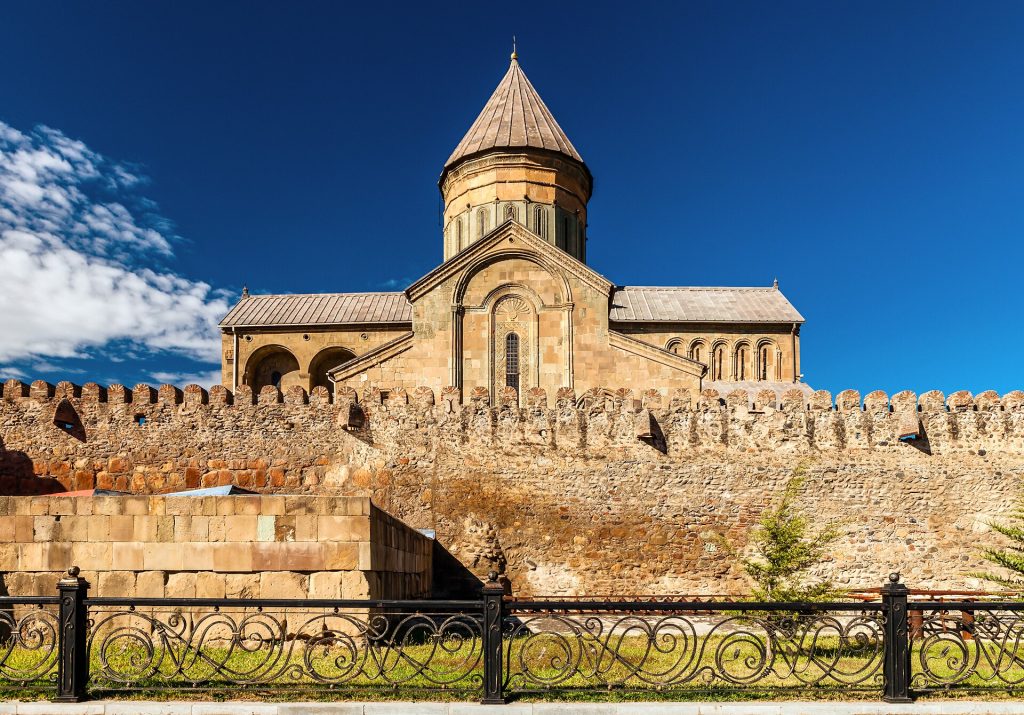
- 1010–1029 — Svetitskhoveli Cathedral, the mother church of Georgian Orthodoxy, is built at Mtskheta by the architect Arsukisdze for Catholicos Melkisedek I; it remains a site of major Easter liturgies and is inscribed, with other Mtskheta monuments, as a UNESCO World Heritage Site.
- 1811 — The Russian Empire, having annexed the Georgian kingdoms, abolishes the autocephaly of the Georgian Church and subordinates it as an Exarchate of the Russian Orthodox Church.
- 1917 — Following the collapse of the Russian Empire, Georgian bishops meeting at Mtskheta restore the autocephaly of the Georgian Orthodox Church.
- 1921–1980s — Under Soviet rule, churches are closed and public religious observance is suppressed; Easter is kept largely as a private, domestic feast of dyed eggs and family gatherings.
- 1990 — The Ecumenical Patriarchate of Constantinople formally recognizes the autocephaly and the Patriarchal dignity of the Georgian Orthodox Church.
- 2004 — The Holy Trinity Cathedral (Sameba) is consecrated in Tbilisi and becomes, alongside the historic Sioni Cathedral, the principal venue of the nationally broadcast Easter midnight service.
- Today — Good Friday, Holy Saturday, Easter Sunday and Easter Monday are public holidays across Georgia, and Patriarch-led services are followed on national television.
The continuity claimed for Georgian Easter observance is unusual in the Orthodox world: a church established in the fourth century, formally self-governing by the fifth, survived Persian, Arab, Mongol, Ottoman and Russian periods of rule, and emerged from seventy years of Soviet anti-religious policy with its Paschal cycle and its cathedral at Mtskheta intact. Clergy and historians alike treat this survival, rather than any single miracle, as the quiet argument at the heart of the feast.
What has changed is scale and visibility. For most of the twentieth century, Easter in Georgia was observed indoors — a boiled egg dyed with onion skins, a loaf of sweet bread, a quiet toast — because open churchgoing carried professional risk. Since 1991, the midnight liturgy at Sameba Cathedral, attended by the Patriarch, senior clergy and often the President and Prime Minister, has become a televised national event, restoring Aghdgoma to the public, civic prominence it is understood to have held before the Soviet period.
Meaning and traditions
Holy Week begins with Lazaroba (Lazarus Saturday) and Bzoba, Palm Sunday — so called because Georgians carry branches of box tree (bza) rather than palm, the plant available locally. Good Friday (Didi Paraskevi) is kept with strict fasting and the reading of the twelve Gospel passages of the Passion; many churches hold a symbolic burial service for the Epitaphios (Georgian: Tsminda Sabanisa) in the evening. Holy Saturday is traditionally a day for visiting family graves, tidying them and leaving dyed eggs and bread, a custom that predates and runs alongside the church calendar.
The midnight liturgy that opens Easter Sunday is the emotional center of the feast. Congregations gather in darkness; at midnight the priest announces “Kriste Aghsdga!” (“Christ is risen!”) and the congregation answers “Cheshmaritad Aghsdga!” (“Truly he is risen!”), an exchange repeated throughout the following forty days in place of ordinary greetings. Candles are lit from a single flame and passed hand to hand, and the service ends with a procession around the church exterior before dawn.
At home, the table centers on krashanebi — eggs dyed a deep red, traditionally with onion skins, symbolizing the blood of Christ and the renewal of life — and on paska, a sweet, slightly spiced Easter bread similar in spirit to Russian kulich but lighter and less sweet. Families break the fast with these, with cheese, and often with the first spring greens and a glass of Georgian wine blessed at the Saturday service. A well-known domestic game involves tapping dyed eggs end to end; the person whose egg survives unbroken is said to have good luck for the year. Regional variation is modest but real: in Kakheti, wine blessed in church is central to the table; in mountain regions such as Svaneti and Khevsureti, older pre-Christian spring customs of fire and bread sometimes overlap with the church calendar.
When it happens
The Georgian Orthodox Church calculates Easter by the Orthodox Paschalion, based on the Julian calendar, which generally places Orthodox Easter later than Western Easter and on a different date each civil year; the method and its background are summarized by Britannica’s entry on Easter. In 2026, Easter Sunday falls on 12 April, with Good Friday on 10 April and Easter Monday on 13 April. In 2027, Easter Sunday falls on 2 May, with Good Friday on 30 April and Easter Monday on 3 May.
Good Friday, Holy Saturday, Easter Sunday and Easter Monday are all public holidays in Georgia. Government offices, banks, schools and most private businesses close for the full stretch; larger supermarkets and tourist-facing restaurants in Tbilisi and Batumi typically stay open with reduced hours, but village shops and many museums close, particularly on Easter Sunday itself.
Feel free to / Wikimedia Commons, CC BY 4.0
Where to experience it
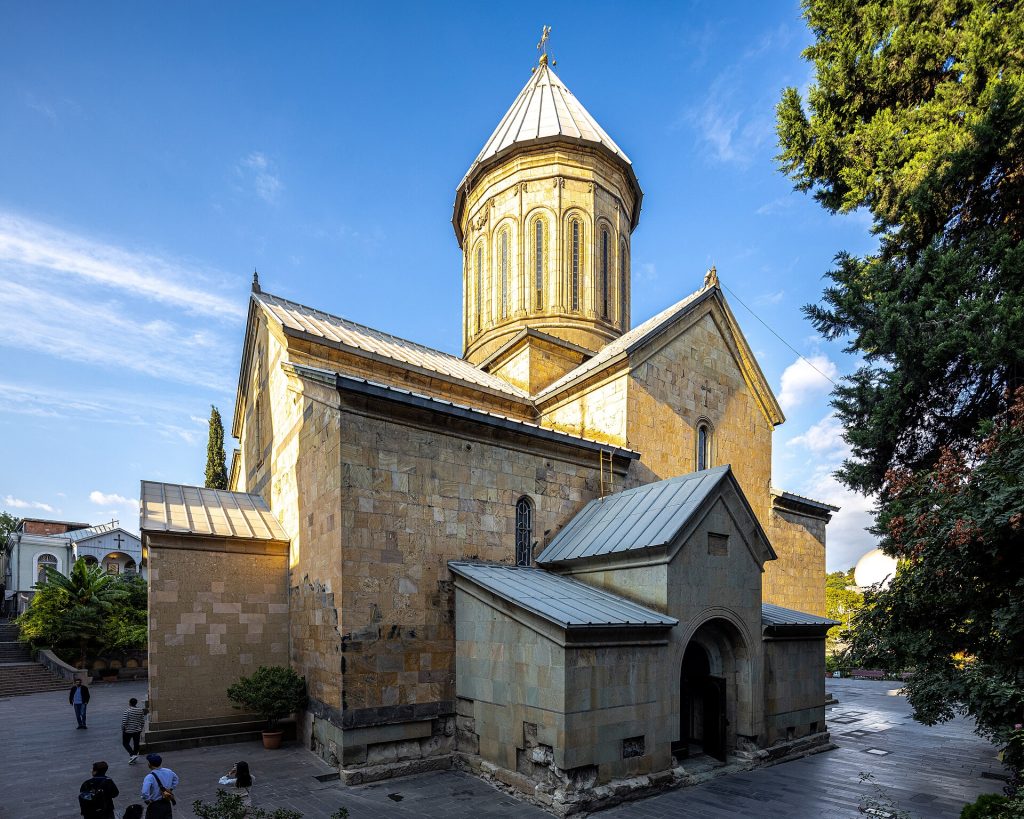
The Holy Trinity Cathedral (Sameba) in Tbilisi holds the main nationally attended midnight liturgy, beginning around 23:00 on Holy Saturday and running past midnight; it draws large crowds and is the most accessible place for a visitor to witness the full service with its candlelit procession. Sioni Cathedral, the historic seat of the Patriarchate in Tbilisi’s Old Town, offers a smaller, more intimate version of the same liturgy. Svetitskhoveli Cathedral in Mtskheta, the mother church of Georgian Christianity and a UNESCO-listed monument, holds its own midnight service and is a natural pairing with a visit to Tbilisi. In Kakheti, Bodbe Monastery, the burial place of St. Nino, and Alaverdi Monastery hold services notable for their rural, less crowded atmosphere.
Visitors are welcome at these services but should dress modestly — covered shoulders and, for women, a headscarf, which is usually available at the church entrance — and should remain near the back or sides rather than moving through the congregation. Candles are sold at a small table inside the door; lighting one and standing quietly is the expected participation for a non-Orthodox guest. Photography is generally tolerated at a respectful distance but flash and video during the consecration should be avoided.
Did you know
- Georgia’s conversion to Christianity in the early fourth century makes it one of the oldest Christian states in the world, alongside Armenia.
- The Georgian Orthodox Church lost its self-governing status for over a century, from 1811 to 1917, under Russian imperial rule.
- Svetitskhoveli Cathedral in Mtskheta, the setting for major Easter services, is traditionally said to stand over the burial place of Christ’s robe, according to Georgian church tradition.
- The Easter greeting exchange, “Kriste Aghsdga” and “Cheshmaritad Aghsdga,” replaces the everyday Georgian greeting for the full forty days following Easter.
- During the Soviet period, onion-skin-dyed eggs and home baking kept the feast alive as a domestic, rather than public, observance for nearly seven decades.
Practical tips for visitors
Expect variable spring weather across the country in late April and early May — mild in Tbilisi and Kakheti, cooler and possibly wet in mountain regions such as Svaneti or Kazbegi. Book intercity transport and accommodation in Tbilisi and Mtskheta well in advance, since the four-day holiday is also a popular domestic travel period for Georgians visiting family graves and relatives outside the capital. Car rental agencies, major hotels and tourist restaurants generally remain open, but assume that banks, state museums, pharmacies outside city centers and most small shops will be closed on Easter Sunday itself. If attending a midnight service, plan for a late night with limited public transport afterward and consider arranging a taxi in advance.
Combine it with
Easter pairs naturally with a visit to Mtskheta-Mtianeti, home to Svetitskhoveli Cathedral and the seat of the Georgian Church, and with Kakheti, where Bodbe and Alaverdi monasteries hold rural Easter services alongside the region’s vineyards. Travelers extending their stay in the capital should also explore Tbilisi, where Sioni and Sameba cathedrals anchor the city’s Holy Week calendar.
Questions travellers ask
Is Orthodox Easter the same date as Western Easter?
Rarely. The Georgian Orthodox Church follows the Julian-based Paschalion, which usually places Easter one to five weeks after the Western, Gregorian-calendar Easter, though the two occasionally coincide.
Can tourists attend the midnight service?
Yes. Services at Sameba, Sioni and Svetitskhoveli are open to the public, including non-Orthodox visitors, provided dress is modest and behavior respectful of the liturgy in progress.
Will restaurants be open during the holiday?
Most tourist-facing restaurants and hotel kitchens in Tbilisi and Batumi stay open, often with special Easter menus, but expect reduced hours and closures among smaller, family-run establishments, especially on Easter Sunday.
What should I bring if invited to a Georgian home for Easter?
A bottle of good Georgian wine or a box of pastries is appropriate; hosts will usually offer dyed eggs for the tapping game as a greeting at the door, which guests are expected to join.
Is public transport running on Easter Sunday?
Intercity and urban transport generally runs on a reduced holiday schedule; it is advisable to confirm specific routes in advance and to book private transfers for travel to Mtskheta or Kakheti for sunrise or midnight services.
Do museums and historic sites close for Easter?
Many state museums close on Easter Sunday and sometimes Easter Monday; major open-air and church sites usually remain accessible but with altered visiting hours around the services themselves.
What is the significance of the red eggs?
The red dye, traditionally made from onion skins, symbolizes the blood of Christ and the renewal of life associated with the Resurrection; the eggs are blessed, eaten, and used in the tapping game at the family table.
Is Easter celebrated differently in rural Georgia?
The church rites are the same nationwide, but rural regions, particularly in the mountains, sometimes layer older spring customs involving fire, bread and communal gatherings onto the church calendar, giving the holiday a more agrarian character than in Tbilisi.
Sources
- Patriarchate of Georgia
- Historical Monuments of Mtskheta, UNESCO World Heritage List
- Georgian National Tourism Administration
- Georgia Travel, official tourism portal
- Government of Georgia
- Law of Georgia on Public Holidays (Easter listed as non-working day)
- Georgian Polyphonic Singing (used in Easter liturgies)
Plan your Georgia
Want to be in Georgia for Orthodox Easter (Aghdgoma)? A GTour travel expert designs the itinerary around it and calls you back.
Sioni Cathedral in Tbilisi hosts a midnight Easter service during Orthodox Easter celebrations. · Photo: Kober / Wikimedia Commons, CC BY-SA 4.0
This page in other languages: Русский
GTour conciergeAsk anything about Georgia · we reply within hours