Archives


National Khachapuri Day in Georgia: dates, meaning and how to experience it
Next dates
27 February 2027 · Nationwide. See the full events calendar and Georgia today for roads and weather.
What it is
National Khachapuri Day is a modern culinary observance dedicated to khachapuri, the cheese-filled bread that stands at the center of Georgian daily eating and festive hospitality alike. The Georgian word combines khacha, meaning curds or soft fresh cheese, with puri, meaning bread, so the compound reads literally as “cheese bread” or “curd bread.” The day is not a religious feast and carries no ancient liturgical calendar behind it; it is a contemporary cultural initiative that gives a single, fixed date to something Georgians already eat, discuss, and argue about year-round — which regional version is the true khachapuri.
The occasion is marked across the country by bakeries, restaurants, hotels, and home cooks, and it draws attention from Georgian media, tourism promoters, and the diaspora alike. It is celebrated by anyone with an interest in Georgian food culture rather than by a specific religious or ethnic community, which is part of why it has traveled easily into restaurant menus and food-tourism itineraries abroad as well as at home.
Historical background
- Medieval period — wheat and corn breads filled or topped with fresh cheese were already a staple of peasant and noble tables across the historic Georgian principalities, according to Georgian ethnographic record, with styles diverging regionally in Imereti, Guria, Samegrelo, Adjara, and Svaneti.
- 19th century — Georgian folklorists and travelers recorded distinct provincial bread-and-cheese customs, laying the groundwork for the named regional varieties still used today.
- Soviet period (20th century) — khachapuri, especially the flaky Imeretian-style version baked in bakeries and canteens, became a standardized everyday food across Georgia and spread with Georgian communities into other Soviet cities.
- 1991 — following Georgian independence, khachapuri remained a constant marker of national identity on the family table and the restaurant menu, outlasting the political changes around it.
- 2013 — Georgia’s ancient qvevri wine-making method, closely bound to the same feast culture that produced khachapuri, was inscribed on UNESCO’s Representative List of the Intangible Cultural Heritage of Humanity, reinforcing international interest in Georgian table traditions generally.
- 2014 — the International School of Economics at Tbilisi State University began publishing the “Khachapuri Index,” tracking the retail cost of ingredients for a standard Imeretian khachapuri as an informal, widely cited measure of food-price inflation.
- Mid-2010s — the Gastronomic Association of Georgia established National Khachapuri Day on 27 February to promote Georgian cuisine domestically and internationally, inviting bakeries and restaurants to hold tastings, competitions, and discounted offerings.
- Today — the day is observed annually with events in Tbilisi, Batumi, Kutaisi, and other cities, and is increasingly referenced by travel and food media covering Georgian cuisine.
Khachapuri’s deeper history is one of regional adaptation rather than a single invention. Each Georgian province shaped the dish to its own cheese, dough, and cooking method: Imereti’s round, fully enclosed loaf; Adjara’s open, boat-shaped version finished with raw egg and butter at the table; Samegrelo’s variant topped with an extra layer of cheese; and Guria’s closed, half-moon loaf enclosing a boiled egg. These forms predate any calendar holiday by centuries and were shaped by local dairy practices, wheat varieties, and household baking traditions rather than by a single historical decree.
The decision to formalize a national day belongs to recent cultural diplomacy rather than to ancient custom. The Gastronomic Association of Georgia created the date as a tool of culinary promotion, aligning with a broader push — including UNESCO recognition of related food and wine traditions — to present Georgian cuisine as a distinct, documented heritage rather than a generic regional cuisine. The result is a holiday that is thoroughly modern in origin but draws its meaning entirely from food practices with a long, well-attested regional pedigree.
Meaning and traditions
On and around 27 February, bakeries and restaurants across Georgia run khachapuri-themed menus, tastings, and sometimes baking demonstrations. Families may simply bake extra at home, and social media fills with photographs comparing regional styles. The central act, whatever the format, is the same: sharing freshly baked bread and cheese, ideally still warm from a clay tone oven or a wood-fired hearth.
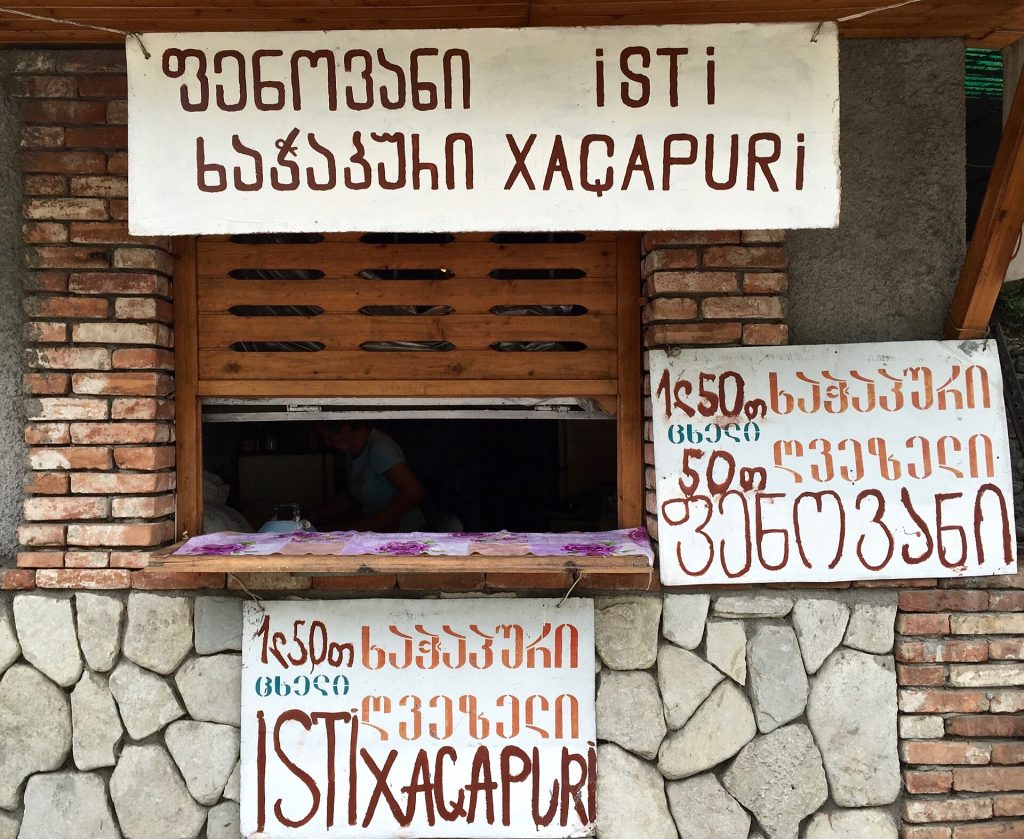
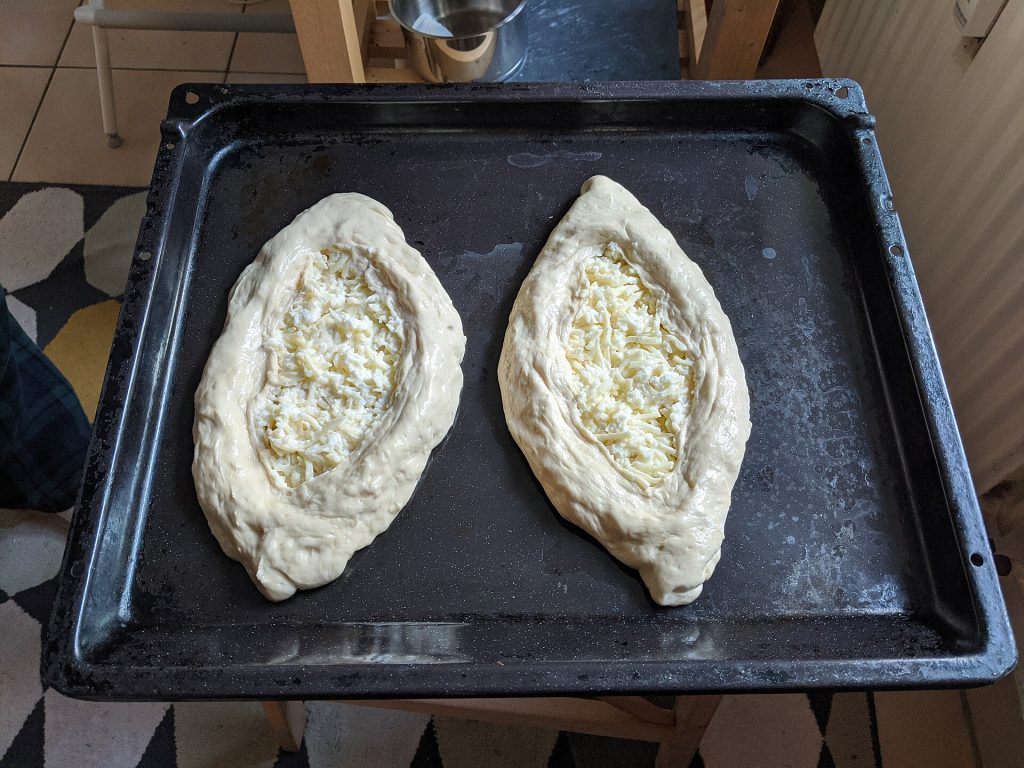
Key regional terms worth knowing: imeruli khachapuri (Imeretian, round and fully closed, the everyday bakery standard); acharuli khachapuri (Adjarian, open canoe-shaped dough filled with cheese, topped with a raw egg and a pat of butter that diners stir in themselves before tearing off the crust edges to dip); megruli khachapuri (Megrelian, cheese both inside and baked on top); guruli khachapuri (Gurian, closed and crescent-shaped, often with boiled egg inside); and penovani khachapuri, a puff-pastry version associated with Tbilisi bakeries. A related but distinct bread, lobiani, replaces cheese with spiced bean filling and is common during Orthodox fasting periods when dairy is avoided.
At a shared table, khachapuri is torn by hand rather than cut formally with cutlery, and pieces are passed rather than individually plated. It is common at a Georgian feast, or supra, alongside toasts led by a tamada (toastmaster), though khachapuri itself carries no ritual toast of its own — it is treated as a staple rather than a ceremonial dish, present at everyday meals as readily as at celebrations.
When it happens
National Khachapuri Day falls on a fixed calendar date, 27 February, each year, following the civil Gregorian calendar rather than the Orthodox liturgical one. In 2026 it fell on Friday, 27 February; the next observance is Saturday, 27 February 2027. It is not a public holiday under Georgian law, so government offices, banks, schools, and transport operate on their normal schedule. What changes is commercial: participating bakeries and restaurants run special tastings, limited-time offers, or competitions, and some host public demonstrations in central squares.
Where to experience it
Tbilisi is the most reliable place to find organized events, with bakeries in the old town and along Rustaveli Avenue offering tastings and, in some years, pop-up stalls. Batumi and the wider Adjara coast are the natural place to try acharuli khachapuri made by cooks who grew up with the regional style, often served for breakfast in small family-run bakeries near the Batumi boulevard. Kutaisi and smaller towns across Imereti are a good base for comparing the classic round loaf against urban bakery versions, and Zugdidi in Samegrelo is worth seeking out for the double-cheese megruli style. Visitors attending a khachapuri event in a restaurant should expect informal dress and communal ordering; no particular etiquette applies beyond the general Georgian custom of not refusing offered food outright and waiting for the host or eldest at the table to begin eating first at a hosted meal. Churches are not part of this observance, so no specific church etiquette applies to the day itself.
Travel with GTour
The Tbilisi & Mtskheta — The Essential First Day tour can be arranged around 27 February so guests spend National Khachapuri Day in Tbilisi’s bakeries and restaurants, while the Georgia in 10 Days — Tbilisi to Svaneti to the Sea route passes through the capital early on and can open with the same date. A GTour travel expert designs the route around the guest’s dates, adjusting the schedule so this stop coincides with the holiday.
Did you know
- The International School of Economics at Tbilisi State University has tracked the retail cost of ingredients for a standard Imeretian khachapuri since 2014 as an informal inflation indicator known as the Khachapuri Index.
- Georgia’s traditional qvevri wine-making method, part of the same feast culture that produced khachapuri, was inscribed on UNESCO’s Representative List of the Intangible Cultural Heritage of Humanity in 2013.
- At least five distinct regional khachapuri styles are commonly recognized, each tied to a historic Georgian province rather than to a single national recipe.
- Acharuli khachapuri’s open, boat-like shape is designed specifically so a raw egg and butter can be stirred into the hot cheese at the table just before eating.
- Khachapuri typically uses fresh Georgian cheeses such as sulguni and imeruli cheese, sometimes blended together within a single loaf.
Practical tips for visitors
Because the day is not a public holiday, public transport, banks, and government services run normally, and flights through Tbilisi International Airport, Batumi International Airport, and Kutaisi International Airport are unaffected. Late February weather in Tbilisi and the eastern lowlands is cool and sometimes rainy, while Adjara’s coast can be mild but damp; indoor dining is the norm, so no special clothing is required beyond ordinary winter layers. Popular bakeries and restaurants can get busy around the date, so booking a table in advance for an organized tasting is sensible in Tbilisi and Batumi. No religious dress code applies, since this is a secular, food-focused observance rather than a church feast.
Combine it with
A khachapuri-focused visit pairs naturally with wine tasting in Kakheti, the bakery and restaurant scene of Tbilisi, and the coastal acharuli tradition of Adjara.
Questions travellers ask
Is National Khachapuri Day a public holiday in Georgia?
No. It is a cultural and commercial observance organized by the Gastronomic Association of Georgia, so offices, schools, and transport continue on their regular schedule.
What is the difference between imeruli and acharuli khachapuri?
Imeruli is round and fully closed, with cheese baked inside the dough, while acharuli is open and boat-shaped, topped with a raw egg and butter that diners mix in at the table before eating.
Can I find khachapuri events outside Tbilisi?
Yes, bakeries and restaurants in Batumi, Kutaisi, and other cities often run their own tastings or offers around 27 February, though the largest concentration of organized events tends to be in Tbilisi.
Is khachapuri eaten with cutlery or by hand?
It is traditionally torn and eaten by hand, especially the closed varieties; acharuli khachapuri is typically eaten by tearing off the crust and dipping it into the egg-and-cheese center.
Is khachapuri suitable for vegetarians?
Yes, standard khachapuri contains only dough, cheese, butter, and sometimes egg, with no meat, making it suitable for vegetarians though not for vegans or those avoiding dairy.
What should I drink with khachapuri?
Georgian white or amber qvevri wine is a common pairing, and many restaurants serve it alongside khachapuri as part of a wider supra spread rather than as an isolated dish.
Are there khachapuri varieties without cheese?
Lobiani, a bean-filled bread baked in the same style, is a close relative eaten especially during Orthodox fasting periods when cheese and other dairy are avoided.
Do restaurants need to be booked in advance on the day?
For popular bakeries and restaurants holding organized tastings in Tbilisi or Batumi, advance booking is advisable, though casual bakery visits for a quick khachapuri generally need no reservation.
Sources
- Georgian National Tourism Administration
- Georgian National Tourism Administration (GNTA)
- Ministry of Culture and Sports of Georgia
- UNESCO Intangible Cultural Heritage – Qvevri wine-making
- National Wine Agency of Georgia
- Tbilisi City Hall
- Batumi Municipality
Plan your Georgia
Want to be in Georgia for National Khachapuri Day? A GTour travel expert designs the itinerary around it and calls you back.
A classic boat-shaped Adjarian khachapuri with egg and butter, the dish celebrated on National Khachapuri Day. · Photo: Bestalex / Wikimedia Commons, CC0
This page in other languages: Русский
GTour conciergeAsk anything about Georgia · we reply within hours