Archives


Victory Day in Georgia: dates, meaning and how to experience it
Next dates
9 May 2027 · Nationwide (public holiday). See the full events calendar and Georgia today for roads and weather.
What it is
Victory Day — in Georgian, Gamarjvebis dghe (გამარჯვების დღე), literally “Day of Victory,” from gamarjveba (“victory”) and dghe (“day”) — is a fixed, nationwide public holiday observed on 9 May. It commemorates the unconditional surrender of Nazi Germany and the end of the Second World War in Europe, a conflict Georgians experienced as citizens of the Soviet Union, which lost more people than any other country in that war. The day is civic rather than religious: it belongs to the state calendar, not the Georgian Orthodox liturgical year.
Today the holiday is observed by the whole population in the sense that it is a non-working day for public institutions, but in practice it is marked most visibly by veterans’ families, schoolchildren taking part in local ceremonies, and municipal authorities who lay wreaths at Soviet-era war memorials. For most residents it passes quietly, without parades, fireworks, or festive food — a day of remembrance rather than celebration in the usual sense.
Historical background
- 1941 — Nazi Germany invades the Soviet Union; the Georgian Soviet Socialist Republic, then part of the USSR, begins mass conscription into the Red Army.
- 1942–1943 — Georgian units fight in the Battle of the Caucasus, including engagements in the high passes near Georgia’s own mountains; General Konstantine Leselidze, a Georgian-born commander, leads Soviet forces in the region.
- 8–9 May 1945 — Germany signs its final instrument of unconditional surrender near Berlin shortly before midnight Central European Time, which is already past midnight in Moscow; the Soviet Union therefore marks victory on 9 May, one day after Western Europe’s 8 May commemoration.
- 1945 — Historians estimate that several hundred thousand people from Soviet Georgia, out of a wartime population of roughly 3.5 million, served in the Red Army, with large losses among them.
- 1965 — The Soviet government, under Leonid Brezhnev, formally designates 9 May a non-working public holiday for the war’s twentieth anniversary, reviving large-scale commemorations after two decades of more subdued observance.
- 1991 — Georgia regains independence; 9 May remains on the state calendar, now observed alongside, rather than instead of, Georgia’s own national day on 26 May.
- 2010s–present — Georgia separately commemorates 25 February as a day connected to the 1921 Soviet invasion of the Democratic Republic of Georgia, a reminder that the country’s relationship to its Soviet-era history, including Victory Day, remains layered and debated.
Georgia’s experience of the Second World War cannot be separated from its status, at the time, as a constituent republic of the USSR. Hundreds of thousands of Georgian men were conscripted far from home, serving on fronts from the Caucasus to Berlin, and the republic’s war memorials — typically Soviet in design, with eternal flames and lists of the fallen — were built to honour that sacrifice within a Soviet framework. For families across Georgia, the war remains a matter of direct, often painful memory: most households can still point to a grandfather or great-uncle who did not return.
Since independence, the day has taken on a more ambivalent character than in Russia, where 9 May has become a large state spectacle with military parades. Georgia holds no such parade. Relations with Moscow, shaped by the 2008 war and the continuing status of Abkhazia and South Ossetia, have made overt Soviet symbolism politically sensitive, and public commemoration in Tbilisi today tends toward modest, municipal wreath-laying rather than displays of state power.
Meaning and traditions
There is no festive meal, song cycle, or household ritual attached to Victory Day comparable to Georgia’s religious feasts. The core practice is the ghvtismshoblis gvirgvinis dadeba-style wreath-laying (literally “placing of a wreath”), carried out by officials, veterans’ associations, and schoolchildren at war memorials across the country. Elderly veterans, where still living, wear their Soviet-era medals; younger relatives often accompany them with flowers, usually carnations, a flower long associated in the region with war commemoration.
Several towns have a memorial known colloquially as Didebis gora (“Hill of Glory”), a Soviet-era monument type repeated across many former Soviet cities, consisting of an elevated site with an eternal flame and inscribed walls listing local war dead. Unlike in Russia, the orange-and-black St George’s ribbon widely worn on 9 May is rarely seen in Georgia today, a quiet marker of the two countries’ divergent politics of memory. Georgian Orthodox parishes have no fixed liturgical observance tied to the date, though prayers for the departed, a standing part of Orthodox practice, are sometimes offered informally for the war dead.
When it happens
Victory Day falls every year on the fixed civil date of 9 May, with no movement for weekday. In 2026 it falls on a Saturday; in 2027 it falls on a Tuesday. It is a designated public holiday, meaning government offices, banks, and schools close, but — unlike Christmas or Easter — it is a low-key day on which shops, restaurants, markets, and most tourist sites continue to operate normally.
Where to experience it
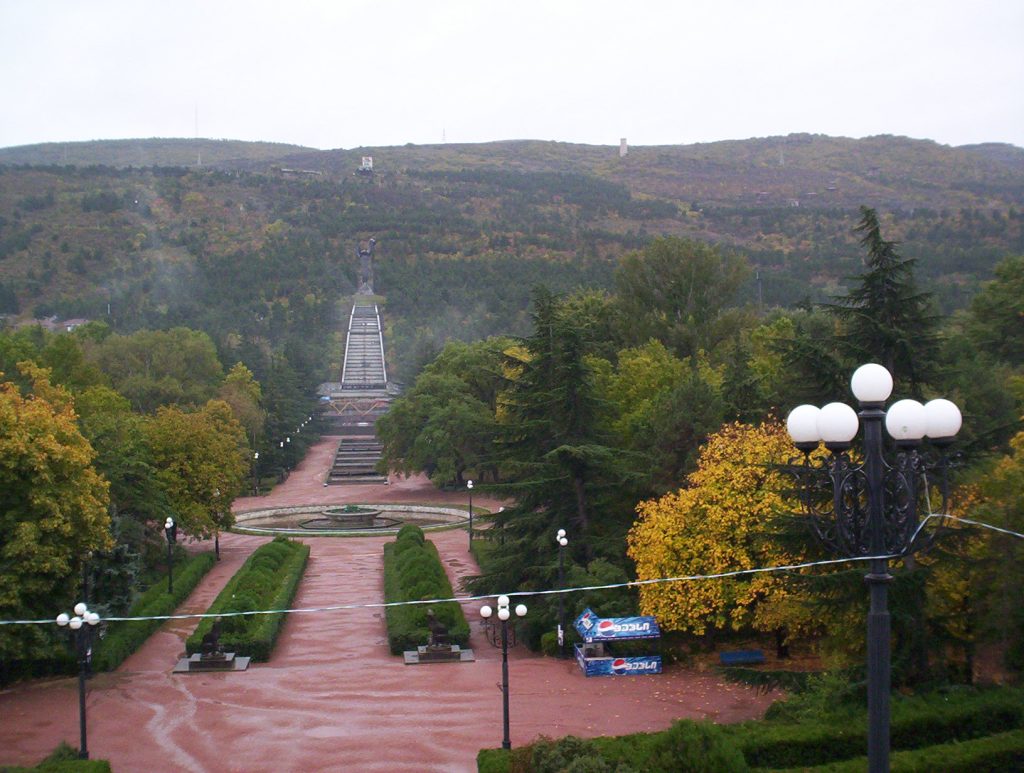
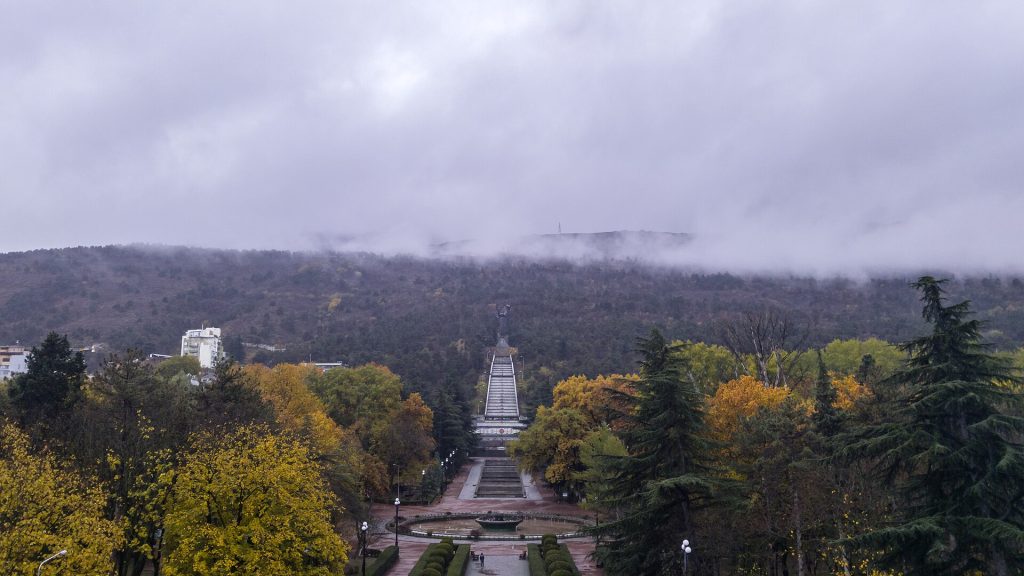
The principal public event is the morning wreath-laying ceremony at the Second World War memorial in Vake Park, Tbilisi, where city officials, diplomats, veterans, and schoolchildren gather around the eternal flame; the atmosphere is formal and subdued rather than festive. Visitors are welcome to observe from a respectful distance, dress modestly, and avoid photographing elderly veterans without asking first. Similar, smaller ceremonies take place at municipal war memorials in Kutaisi, Batumi, Gori, and Rustavi. Because the day carries no church service, there is no particular church etiquette beyond the usual rules for visiting any Georgian Orthodox church — covered shoulders, and for women, a headscarf is appreciated though not always enforced.
Travel with GTour
Tbilisi & Mtskheta — The Essential First Day can open in central Tbilisi on the morning of 9 May, allowing time to pass Vake Park and observe the wreath-laying before continuing to Mtskheta, while Georgia in 10 Days — Tbilisi to Svaneti to the Sea can be arranged to begin or pass through the capital on that date. A GTour travel expert designs the route around the guest’s dates.
Did you know
- Gamarjveba, the Georgian word for “victory,” is also the everyday Georgian word for “hello,” literally wishing the person addressed success or triumph.
- Georgia’s wartime losses, proportional to its small population of roughly 3.5 million in 1941, were among the heaviest of any Soviet republic.
- Because Germany’s surrender document was ratified after midnight Moscow time, the Soviet Union, and later its successor states including Georgia, mark Victory Day one day later than Western Europe’s 8 May commemoration.
- Joseph Stalin, the Soviet wartime leader, was born Ioseb Jughashvili in the Georgian town of Gori, a fact that complicates how the country publicly remembers the Soviet victory.
- Georgia also observes 26 May, Independence Day, marking the 1918 founding of the short-lived Democratic Republic of Georgia — a separate and, for most Georgians, more significant national holiday than 9 May.
Practical tips for visitors
No special transport disruption should be expected beyond brief, localised road closures near Vake Park during the morning ceremony. Museums, restaurants, and shops generally remain open, though banks and government offices are closed, so visitors needing official services should plan around the date. Early May weather in Tbilisi and the lowlands is mild and suitable for sightseeing, though higher regions such as Svaneti or Kazbegi can still have residual snow at altitude. As 9 May 2026 falls on a Saturday, hotel booking in Tbilisi is advisable given ordinary weekend demand rather than holiday-specific crowding.
Combine it with
A spring visit around Victory Day pairs well with Kartli, where Gori’s museums address twentieth-century history in more depth, with Imereti, home to Kutaisi’s own war memorial and a convenient base for exploring western Georgia, and with Adjara, where Batumi’s seaside promenade offers an easy, low-key day alongside its own municipal commemoration.
Questions travellers ask
Is Victory Day a public holiday in Georgia?
Yes. It is a fixed, nationwide public holiday on 9 May, meaning government offices, banks, and schools close for the day, though most shops, restaurants, and tourist sites remain open as usual.
Why does Georgia mark Victory Day on 9 May rather than 8 May, as in Western Europe?
Germany’s surrender was signed late on 8 May 1945 Central European Time, which fell after midnight in Moscow. The Soviet Union therefore dated its victory to 9 May, a convention Georgia inherited and has kept since independence.
Will museums and restaurants be closed on 9 May?
Generally no. Unlike major religious holidays, Victory Day is a quiet civic observance; most cultural sites, shops, and dining establishments operate on their normal schedule.
Is Georgia’s Victory Day similar to Russia’s large military parade?
No. Georgia holds no military parade on 9 May. Observance is limited to modest wreath-laying ceremonies at municipal war memorials, reflecting Georgia’s more cautious relationship with Soviet-era symbolism, particularly since 2008.
What will a visitor actually see in Tbilisi on the day?
A morning ceremony at the war memorial in Vake Park, attended by city officials, veterans, and schoolchildren, with wreaths and carnations laid at an eternal flame. The rest of the city continues its normal daily rhythm.
Does the Georgian Orthodox
Plan your Georgia
Want to be in Georgia for Victory Day? A GTour travel expert designs the itinerary around it and calls you back.
Want to be in Georgia for Victory Day? A GTour travel expert designs the itinerary around it and calls you back.
The Vake Park memorial and fountain in Tbilisi, site of Georgia's Victory Day wreath-laying. · Photo: Manfred Rackelhuhn / Wikimedia Commons, CC BY-SA 3.0
This page in other languages: Русский
GTour conciergeAsk anything about Georgia · we reply within hours