Archives


St Andrew’s Day in Georgia: dates, meaning and how to experience it
Next dates
12 May 2027 · Nationwide (public holiday). See the full events calendar and Georgia today for roads and weather.
What it is
St Andrew’s Day in Georgia — in Georgian, წმინდა ანდრია პირველწოდებულის დღე (Ts’minda Andria Pirvelts’odebulis Dghe) — literally “the Day of Holy Andrew the First-Called.” Pirveltsodebuli translates as “first-called,” a title drawn from the Gospel account in which Andrew, a fisherman of Galilee, was the first disciple summoned by Jesus, before his brother Simon Peter. The feast is kept by the Georgian Orthodox Church and observed nationally as a public holiday, distinct in date and emphasis from the 30 November St Andrew’s Day familiar in Scotland and parts of Western Europe.
In Georgia the day is tied not to Andrew’s martyrdom but to a native tradition that he personally evangelised the ancient kingdoms of Iberia and Colchis — the territories that became eastern and western Georgia — in the first century, generations before the kingdom’s official conversion under King Mirian III in the fourth century. For the Georgian Church this apostolic visit matters theologically: it allows Georgian Christianity to claim roots reaching back to the age of the apostles themselves, not only to the fourth-century mission of St Nino. The holiday is therefore both a liturgical commemoration and a quiet statement about the antiquity of the Georgian church.
Historical background
- 1st century AD (traditional) — According to Georgian church tradition, the Apostle Andrew travels through Iberia and Colchis, preaching the Gospel along the Black Sea littoral and into the southern Georgian highlands, long before the kingdom’s formal conversion.
- Medieval period — The tradition of Andrew’s mission is recorded within the corpus of Georgian ecclesiastical and chronicle writing, including material incorporated into the medieval compilation known as the Georgian Chronicles, preserved today in manuscript collections such as those of the National Parliamentary Library of Georgia.
- 327 (traditional) — King Mirian III of Kartli adopts Christianity as the religion of the royal court following the preaching of St Nino, an event the Georgian Church presents as fulfilment, not origin, of the seed Andrew is said to have planted earlier.
- 5th–10th centuries — A church community develops at Atskuri, in historic Samtskhe, around a site traditionally linked to Andrew’s preaching and to an icon he is said to have left there.
- 1801–1917 — Under the Russian Empire, the Georgian church’s autonomy is curtailed within the Georgian Exarchate, though its feast days, including Andrew’s, continue to be marked liturgically.
- 1921–1990 — Under Soviet rule, public religious observance is suppressed; feast days are kept within church walls rather than as public holidays.
- 1991 — Following the restoration of Georgian independence, the Georgian Orthodox Church and the state re-establish public observance of major religious feasts.
- Present day — 12 May is maintained as an official non-working public holiday, marked by liturgy at Sioni Cathedral in Tbilisi and at parish churches nationwide, and noted in national holiday listings published by Georgia’s tourism administration.
The claim of an apostolic founder is not unique to Georgia — many ancient churches around the Mediterranean and Black Sea trace a visit by one apostle or another — but it carries particular institutional weight here because Georgian autocephaly, the independence of the national church from external patriarchates, has historically been argued partly on grounds of antiquity. A church founded by an apostle in the first century stands on firmer ground, in ecclesiastical terms, than one converted by a missionary three centuries later, however revered that missionary (Nino) became. The two traditions are not presented as rivals: Georgian hagiography treats Andrew as the sower and Nino as the one who brought the harvest to the throne itself, baptising the king and queen and making Christianity the religion of the state rather than of scattered communities.
The feast’s survival through the Russian imperial period and the long Soviet interruption, when open religious practice was dangerous, says as much about Georgian identity as about theology. That 12 May re-emerged after 1991 as a full public holiday — alongside Christmas, Epiphany and St George’s Day — reflects how closely the restoration of Georgian statehood was bound up with the restoration of the Orthodox calendar as a marker of national continuity.
Meaning and traditions
The day centres on the Divine Liturgy (Liturgia), celebrated in parish churches across the country, with larger gatherings at cathedrals such as Sioni in Tbilisi. Worshippers light candles (sanatsme), venerate icons, and many attend confession and communion that morning. Because Andrew (Andria) and its diminutives (Andro, Andukap) remain common Georgian given names, families with a member bearing the name often mark it as a personal sakhelis dghe, or name day, with a small gathering and a festive table (supra) in the evening.
At a supra held on or near the feast, a toast (sadghegrdzelo) to the saint, to ancestors and to the endurance of Georgian Christianity is customary before the meal moves to lighter subjects; this follows the broader Georgian toasting order, which typically opens with peace, homeland and faith before turning to family and friendship. There is no gift-giving tradition comparable to Christmas, and no distinctive dish is reserved exclusively for the day — tables carry the standard range of Georgian feast foods, from khachapuri and mtsvadi to regional wines, rather than a special “Andrew’s Day” menu.
Regional emphasis varies. In Samtskhe-Javakheti, where Atskuri’s association with Andrew is strongest, older residents and clergy speak of the apostle’s passage through the region with particular pride, tying local geography directly to the gospel narrative. Along the Black Sea coast in Adjara, local tradition recalls Andrew preaching among ancient Colchian and Laz communities, reinforcing the idea of the coast as an early gateway for Christianity into the Caucasus. In Tbilisi and the eastern lowlands, observance is quieter and more purely liturgical, centred on the cathedral service rather than on pilgrimage to a specific site.
When it happens
St Andrew’s Day in Georgia falls on a fixed civil date, 12 May, unconnected to the movable Easter cycle. In 2026 it fell on Tuesday 12 May; in 2027 it falls on Wednesday 12 May. It is a national public holiday and non-working day: government offices, banks, schools and courts close. Most shops, markets, restaurants and transport services continue to operate normally, as is typical for Georgia’s religious public holidays, though staffing may be lighter in smaller towns.
Where to experience it
Sioni Cathedral in Tbilisi’s Old Town holds a morning liturgy that is open to the public; visitors may attend quietly from the rear of the nave, arriving before the service begins to avoid disrupting worship. Dress modestly — long sleeves and covered shoulders for all, a headscarf for women, and trousers rather than shorts for men — and refrain from photographing the congregation or clergy during the service itself; photographing the building’s architecture and icons is generally tolerated outside active worship. In Samtskhe-Javakheti, the village and church at Atskuri, set in the upper Mtkvari valley near Borjomi, carry the strongest living association with Andrew’s traditional route and reward a quieter, more reflective visit than the cathedral crowds of the capital. Village churches throughout Kakheti, Imereti and Racha hold their own smaller liturgies, offering a more intimate view of how the feast is kept outside the capital.
Travel with GTour
Since St Andrew’s Day is observed nationwide on 12 May 2027, travelers following Tbilisi & Mtskheta — The Essential First Day or setting out on Georgia in 10 Days — Tbilisi to Svaneti to the Sea may find churches and city squares quietly marking the holiday along their route. A GTour travel expert designs the itinerary around the guest’s own dates, adjusting stops as needed.
Did you know
- Andrew is known in Greek tradition as Protokletos, “the first-called,” the source of the Georgian title Pirveltsodebuli used for the feast.
- Georgia and Scotland both venerate Andrew as a patron saint, but on entirely different calendar dates and for different reasons — Scotland on 30 November for his martyrdom, Georgia on 12 May for his traditional mission to the Caucasus.
- Georgian church tradition holds that Andrew carried with him an icon of the Mother of God, later associated with the church at Atskuri, making it one of the country’s oldest venerated images.
- The apostolic tradition underpins Georgian claims to autocephaly, the church’s historic argument for independence from other patriarchates on the grounds of its ancient, apostolic foundation.
- Despite seven decades of Soviet restriction on public worship, the feast’s liturgical observance continued inside churches throughout the twentieth century before its public status was restored after 1991.
Practical tips for visitors
Mid-May brings mild, often warm weather to Tbilisi, Kakheti and the lowlands, while higher regions such as Svaneti and Kazbegi can still see cool mornings and occasional late snow at altitude, so pack layers if travelling onward to the mountains. As a public holiday, expect government offices, banks and some museums to close for the day, though private tour operators, restaurants and intercity transport generally run as usual. If visiting Sioni Cathedral or a village church, arrive early, dress modestly, and keep mobile phones silent. Those combining the day with a trip to Atskuri should book accommodation in the Borjomi area in advance, as the holiday weekend can coincide with wider spring travel demand.
Combine it with
Visitors marking the feast in the capital can pair a morning at Sioni Cathedral with the wider historic churches and museums of Tbilisi. Those tracing the Andrew tradition itself can continue to Samtskhe-Javakheti and the church at Atskuri, set among the valleys near Borjomi. Travellers interested in the coastal strand of the tradition, where Andrew is said to have preached among ancient Colchian communities, can extend a visit to Adjara and the Black Sea coast around Batumi.
Questions travellers ask
Is Georgia’s St Andrew’s Day the same holiday as Scotland’s?
No. Both honour the same apostle, but Scotland’s 30 November feast marks his martyrdom, while Georgia’s 12 May feast commemorates his traditional missionary journey through the Caucasus. The dates, emphasis and local customs are entirely separate.
Why does Georgia celebrate Andrew if St Nino brought Christianity?
Georgian tradition treats the two as complementary rather than competing. Andrew is remembered as an early first-century preacher who sowed the first seeds of the faith, while Nino, three centuries later, converted the royal court and made Christianity the state religion.
Can tourists attend the church services on this day?
Yes. Liturgies at cathedrals such as Sioni are open to the public. Visitors should dress modestly, remain near the back, keep quiet, and avoid photographing the congregation during worship.
Does the holiday close shops and transport?
Banks, state offices and schools close, but most restaurants, shops and intercity transport continue operating normally, making the day workable for sightseeing even though it is a public holiday.
What is Atskuri and why is it linked to this feast?
Atskuri is a village in Samtskhe-Javakheti, near Borjomi, traditionally associated with Andrew’s preaching route and with an icon he is said to have left in the region, making its church a focal point for the apostolic tradition.
Is the date fixed or does it move with Easter?
It is fixed. Unlike Easter-linked feasts, St Andrew’s Day falls on 12 May every year according to the civil Gregorian calendar used for Georgia’s public holidays.
Do Georgians exchange gifts on this day?
No. There is no gift-giving custom attached to the feast. Observance centres on church attendance, and for those named Andria or Andro, a family gathering may mark it as a personal name day.
Is mid-May a good time to visit Georgia generally?
Yes. Mid-May offers mild weather across most of the country, blossoming countryside in Kakheti and Imereti, and fewer crowds than the peak summer months, making it a favourable season to combine the feast with wider travel.
Sources
- Georgian Orthodox Church (Patriarchate of Georgia)
- Georgian National Tourism Administration
- National Parliamentary Library of Georgia
- Georgian National Museum
- Ministry of Culture, Sport and Youth of Georgia
- Civil.ge
Plan your Georgia
Want to be in Georgia for St Andrew's Day? A GTour travel expert designs the itinerary around it and calls you back.
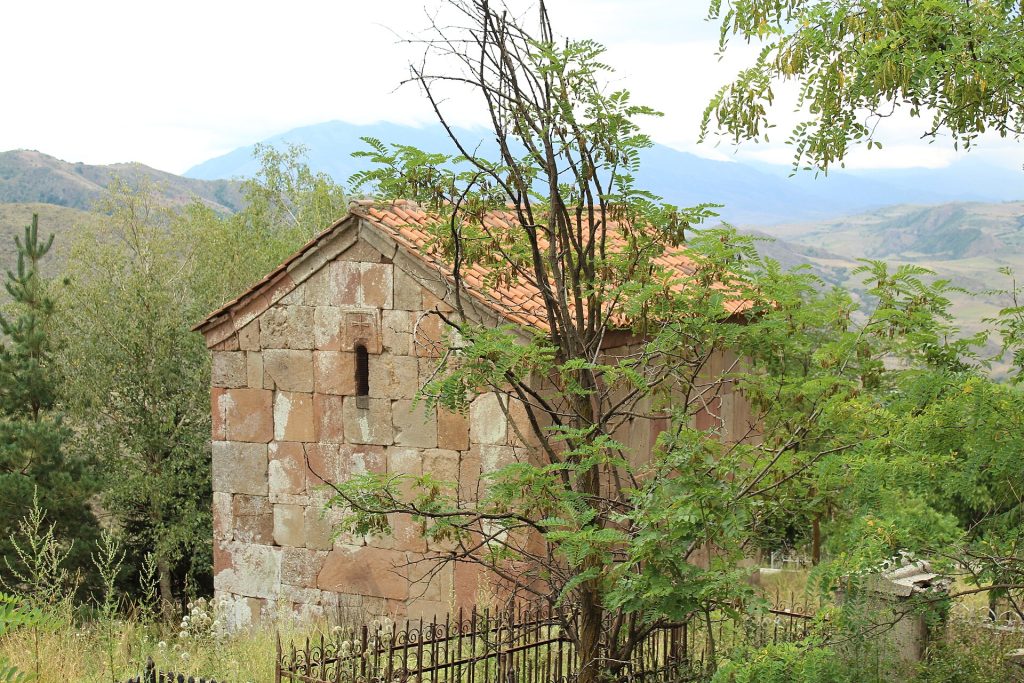
The Blue Monastery in Tbilisi, a historic church tied to the legacy of St Andrew the First-Called. · Photo: Santel01 / Wikimedia Commons, CC BY-SA 4.0
This page in other languages: Русский
GTour conciergeAsk anything about Georgia · we reply within hours