Archives


Atengenoba in Georgia: dates, meaning and how to experience it
Next dates
8 August 2027 · Shatili and the shrines of Khevsureti; Tusheti. See the full events calendar and Georgia today for roads and weather.
What it is
Atengenoba is a summer shrine festival (in Georgian, a khatoba, “feast of the shrine”) celebrated by the mountain communities of Khevsureti and, in a related form, Tusheti — two of the most isolated highland districts of the Greater Caucasus, reached only by seasonal mountain roads. It is not a church holiday in the parish sense but a communal gathering at a specific sanctuary, or xati, where families who have scattered to the lowlands for work return each year to honor the shrine that protects their clan or village.
The name follows a pattern found throughout the Georgian festive calendar: the suffix -oba turns a name into the title of an annual feast day, exactly as it does in Giorgoba (St George’s Day) or Mariamoba (the Dormition). Here it is attached to “Atengena,” a name whose pre-Christian origin is not fully settled among ethnographers; what is clear is that Atengenoba belongs to a layer of highland religion older than, and later interwoven with, Georgian Orthodoxy — a pattern typical of Khevsureti and Tusheti, where sanctuaries dedicated to local protector-spirits carry Christian names and are tended according to a calendar fixed to Easter rather than to the saints’ calendar used in lowland parishes.
Historical background
- 18th century — the Georgian royal geographer Vakhushti Bagrationi describes the distinct customs, dress and shrine-based religious life of Pshav-Khevsureti in his geographic survey of the kingdom.
- 1801 — the eastern Georgian kingdoms are absorbed into the Russian Empire, beginning a slow and incomplete administrative integration of Khevsureti and Tusheti, which retain local customary law and shrine governance well into the 19th century.
- mid-19th century — Russian imperial officers and early ethnographers travelling through the highlands record periodic shrine feasts following Easter, among the first outside descriptions of the khatoba cycle.
- 1920s–1930s — Georgian ethnographer Vera Bardavelidze undertakes systematic field research on the shrine cult (xati) system of Khevsureti and Pshavi, documenting its calendar of feast days.
- 1921–1991 — during the Soviet period, collectivization and anti-religious policy discourage public shrine worship; remote villages continue observances discreetly, and depopulation reduces the number of households able to maintain them.
- 1990s — after Georgian independence, families return to Khevsureti and Tusheti each summer and shrine feasts, including Atengenoba, are again observed openly.
- 21st century — Georgian cultural and tourism bodies document the living heritage of the highland regions, and the historic fortified village of Shatili is maintained as a protected architectural ensemble.
What survives today is best understood not as a fixed ritual text but as a living local tradition, transmitted orally through generations of shrine elders rather than through written liturgy. Georgian scholarship — most thoroughly Bardavelidze’s mid-20th-century fieldwork — treats the Khevsureti shrine system as a genuinely syncretic order: a substratum of pre-Christian mountain belief, concerned with fertility, weather and clan protection, overlaid with Christian saints’ names and occasional church rites, administered by lay officiants rather than ordained clergy.
The Georgian National Museum and National Parliamentary Library hold the principal ethnographic and photographic archives documenting this material, and UNESCO’s framework for intangible cultural heritage provides the international vocabulary — oral tradition, social practice, ritual — under which such festivals are now commonly described. The remoteness that once endangered these customs, by emptying villages of permanent residents, has also preserved them largely free of standardization, so that each shrine community keeps its own variant of the feast.
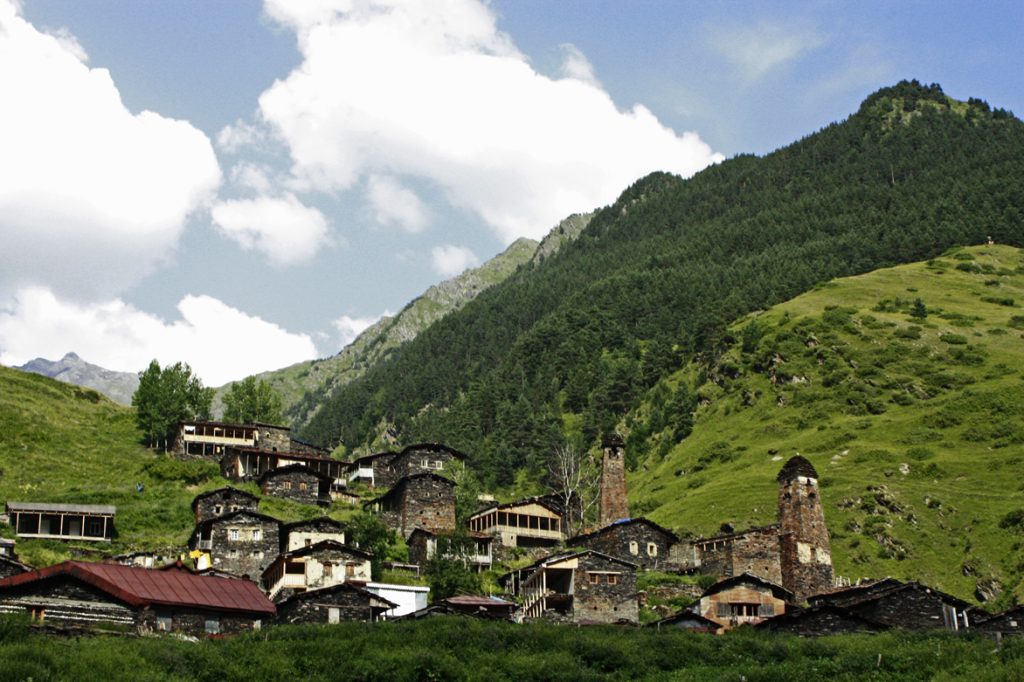
Meaning and traditions
At the center of Atengenoba is the xati (shrine), a stone enclosure or tower sanctuary that ordinary people, and especially women, may not enter or closely approach. The feast is directed by a xevisberi (shrine elder, literally “elder of the ravine”), assisted by a dasturi (steward or cupbearer), who oversee the ritual slaughter of a ram or bull donated by a family in fulfillment of a vow. The meat is boiled and shared communally outside the shrine fence, together with round ceremonial bread.
Beer — ludi — brewed from barley in the villages in the days before the feast, is the customary ritual drink of Khevsureti and Tusheti, distinct from the wine culture of lowland Georgia and tied instead to the mountain grain economy. Toasts are offered with a drinking horn, songs and the circling dance known across the highlands as khevsuruli accompany the gathering, and horse racing on open ground near the village is a central public spectacle, with young riders competing for prizes donated by local families. Men gather closest to the shrine; women traditionally remain at a respectful distance from the sanctuary itself, a restriction still generally observed by visitors as well as locals.
When it happens
Atengenoba is fixed not to a date on the civil calendar but to Orthodox Easter: it falls on the 98th day after Easter in the Georgian Orthodox (Julian-based) calendar, converted here to Gregorian civil dates. In 2026, with Orthodox Easter on 12 April, Atengenoba fell on 19 July — a date already past at the time of writing. In 2027, with Orthodox Easter on 2 May, the feast falls on 8 August 2027.
It is not a national public holiday; government offices, banks and city businesses in Tbilisi and other lowland centers operate normally. In the villages of Khevsureti and Tusheti themselves, however, the feast day effectively halts ordinary activity, with households devoted to the shrine gathering, the shared meal and the races.
Where to experience it
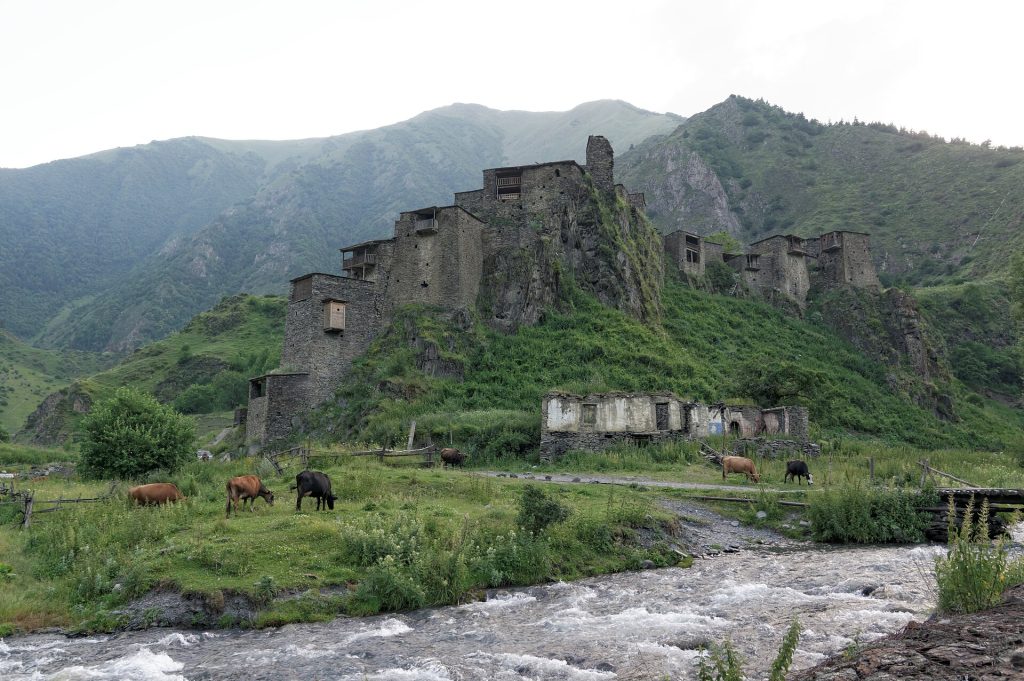
Khevsureti’s principal setting is Shatili, a cluster of stone defensive towers on the Argun river reached by road from Dusheti via Barisakho and the Datvisjvari Pass, a route generally passable only from late spring to early autumn. Nearby Mutso and Arkhoti hold related shrine feasts on their own local calendars. In Tusheti, villages such as Omalo, Dartlo and Shenako observe the summer shrine cycle; access is via the unpaved Abano Pass road from Kakheti, open only through the warmer months and requiring a four-wheel-drive vehicle and a local driver.
A visitor present on the day can expect to see the communal meal and toasting outside the shrine enclosure, horse races on open ground at the edge of the village, and music played on the panduri (a three-stringed lute) and drum. Visitors should ask a local host or shrine elder before approaching the sanctuary, should not touch shrine stones or offerings, and should dress modestly; photography of the ritual core of the ceremony should only be attempted with permission.
Travel with GTour
Tusheti — Georgia's Last Wild Frontier (4 Days) can be timed around 8 August 2027 to coincide with Atengenoba, allowing time near the shrines of Tusheti for the sacrificial meals, village beer, and horse races, while Georgia in 10 Days — Tbilisi to Svaneti to the Sea passes through the wider region during the same summer weeks. A GTour travel expert designs the exact route and schedule around the guest’s dates, so the festival can be included without disrupting the rest of the itinerary.
Did you know
- Khevsureti’s shrine religion, studied in depth by Georgian ethnographer Vera Bardavelidze in the twentieth century, layers Christian saints’ names over an older system of clan-protecting shrines.
- Shatili’s cluster of stone towers, inhabited into the twentieth century, is among the best-preserved fortified village complexes in the Caucasus.
- Tusheti’s Abano Pass, the only road link to the lowlands, lies above roughly 2,800 meters and is closed by snow for more than half of the year.
- Khevsureti once preserved distinctive chainmail and sword dances performed on feast days, a martial element unusual elsewhere in Georgian folk custom.
- The naming suffix “-oba” se
Plan your Georgia
Want to be in Georgia for Atengenoba? A GTour travel expert designs the itinerary around it and calls you back.
The medieval fortress-village of Shatili, heart of Khevsureti where Atengenoba shrines stand. · Photo: dare from Tbilisi, Georgia / Wikimedia Commons, CC BY-SA 2.0
This page in other languages: Русский
GTour conciergeAsk anything about Georgia · we reply within hours