Archives


Gemo Fest Samtskhe-Javakheti in Georgia: dates, meaning and how to experience it
Next dates
5 June 2027 – 6 June 2027 (to be confirmed) · Rabati Fortress, Akhaltsikhe. See the full events calendar and Georgia today for roads and weather.
What it is
Gemo Fest Samtskhe-Javakheti is a regional gastronomic festival held inside and around Rabati Fortress in Akhaltsikhe. The Georgian word gemo (გემო) means “taste” or “flavor,” and the festival is built entirely around that idea: tasting tables, cooking demonstrations and produce stalls set up along the fortress ramparts and courtyards for a weekend in late spring or early summer. It is organized by the Georgian National Tourism Administration together with the Akhaltsikhe municipal authorities, as one of several regional “taste” events the administration runs around the country to support local food producers and extend visitor stays beyond Tbilisi and Batumi.
Unlike the church feasts and saints’ days that fill the Georgian calendar, Gemo Fest is a modern civic event rather than a religious observance, so it carries no fasting rules, liturgical texts or fixed date on the Julian calendar. It draws local families, small farmers and cheese-makers, chefs from Akhaltsikhe and Borjomi, Georgian day-trippers and foreign travelers already touring the Borjomi–Akhaltsikhe road. It functions as an introduction to a borderland region where Georgian Orthodox Meskhetian villages and Armenian Apostolic Javakheti villages sit close together, each with a distinct table.
Historical background
- 9th–13th century — A stronghold on the site of present-day Rabati is traditionally linked to an early medieval fortress later rebuilt as a seat of the Jakeli family, hereditary princes (atabegs) of the Samtskhe (Meskheti) principality.
- 13th–16th century — The Jakeli atabegs rule Samtskhe from Akhaltsikhe, developing it as a crossroads market town linking Georgia, Armenia and Anatolia.
- 1579 — Ottoman forces take Akhaltsikhe; the town becomes the center of an Ottoman pashalik, and a mosque is added inside the fortress alongside the existing Georgian church.
- 1828 — Russian troops capture Akhaltsikhe during the Russo-Turkish War; the region is soon absorbed into the Russian Empire’s administration of the South Caucasus.
- 1944 — Soviet authorities deport the region’s Meskhetian Turk population, permanently reshaping the demographic and culinary map of southern Samtskhe.
- 2011–2012 — The Georgian government carries out a large-scale reconstruction of the citadel, rebuilding its walls, mosque minaret, Orthodox church and a synagogue within the same enclosure, reopening it as the Rabati Castle cultural and tourism complex.
- 2010s — The Georgian National Tourism Administration (georgia.travel) begins staging regional “Gemo” taste festivals to promote local producers; Samtskhe-Javakheti’s edition is set at Rabati.
- present — Gemo Fest Samtskhe-Javakheti is held annually at Rabati over a weekend in late spring or early summer, with exact dates confirmed by organizers each year.
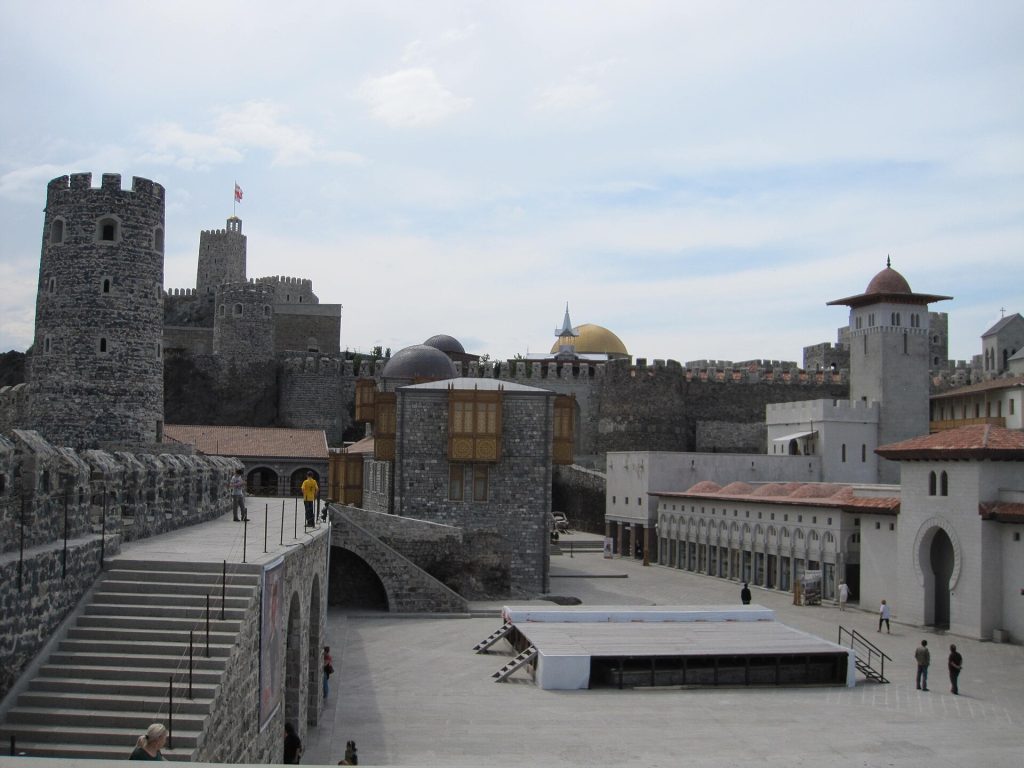
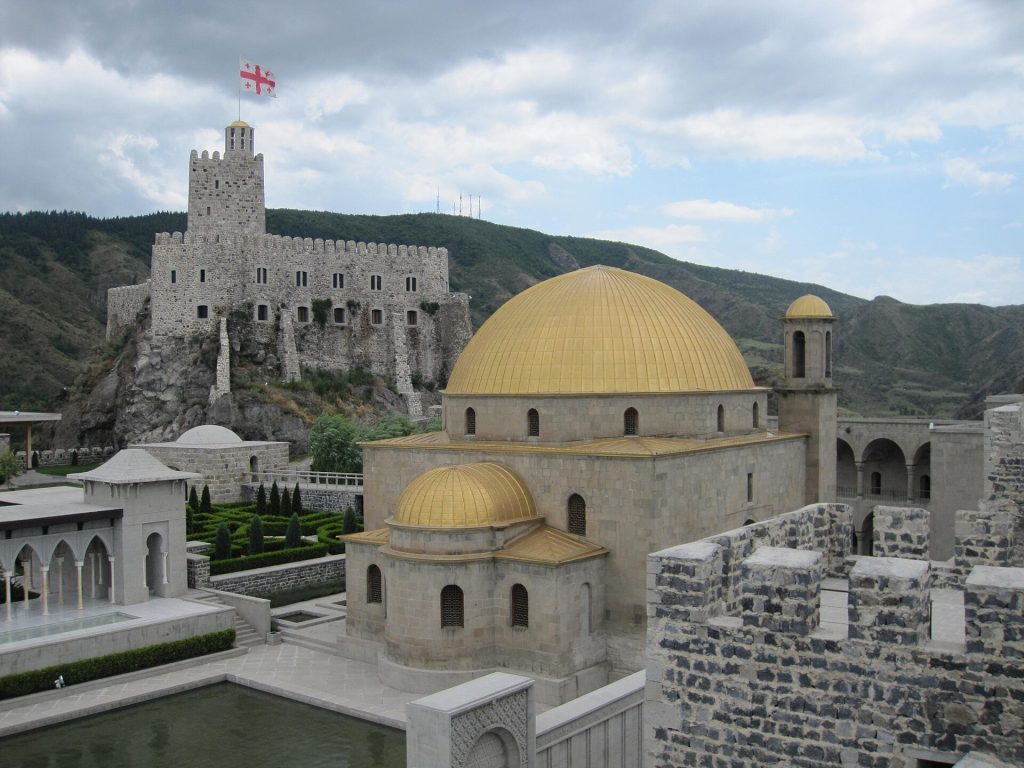
Rabati’s layered history explains why the fortress makes an apt stage for a food festival about a borderland region. Within the same enclosure stand an Orthodox church, a minaret-topped mosque and a synagogue, physical evidence of the successive Georgian, Ottoman and Russian periods that shaped Akhaltsikhe, and of the Jewish, Muslim and Christian communities that once shared the town. That same plurality survives today in the surrounding region: Georgian Orthodox villages in the lower Meskheti valleys, and largely Armenian Apostolic communities on the cold Javakheti plateau around Akhalkalaki and Ninotsminda, each contributing dishes that rarely appear together on the same table outside an event like this.
Gemo Fest is part of a broader post-2012 strategy, following Rabati’s reconstruction, to turn the fortress from a passive monument into a working venue, pairing a heritage site with living gastronomy so that visitors arriving to see the castle walls stay to sample what the surrounding valleys actually grow and cook.
Meaning and traditions
The festival centers on a long line of tasting tables where family farms, bakers and dairy producers from across Samtskhe-Javakheti offer small plates alongside cooking demonstrations and informal competitions. A supra (feast table) atmosphere prevails, usually without a formal tamada (toastmaster), since the event is organized around grazing and sampling rather than a seated banquet. Expect tenili, a stretched, fibrous cheese traditionally matured in clay vessels and particular to Meskheti; kada, a round sweet pastry given as a gift across the Borjomi–Akhaltsikhe area; khachapuri meskhuri, the region’s layered variant of the national cheese bread; bean dishes (lobio); mountain honey and fruit preserves; and churchkhela, the candle-shaped string of nuts coated in thickened grape must found throughout Georgia.
Because Javakheti’s cold plateau is one of Georgia’s main potato-growing areas, dishes built around potatoes and dairy feature strongly in stalls run by the region’s Armenian communities, sometimes alongside lavash bread and dishes showing Armenian influence. Music accompanies the tasting: Georgian panduri players and vocal groups perform alongside, in some years, Armenian duduk players, reflecting the two linguistic and liturgical traditions that meet in Samtskhe-Javakheti.
When it happens
Gemo Fest Samtskhe-Javakheti has no fixed date tied to a religious or civil calendar. Organizers typically schedule it for a weekend in late spring or early summer, most often around the first week of June, and confirm the exact dates only a few weeks in advance through the Georgian National Tourism Administration and the Akhaltsikhe municipal authorities. The most recently announced edition is set for 5–6 June 2027, subject to final confirmation closer to the date; travelers should verify before booking. It is not a public holiday: shops, offices, schools and transport in Akhaltsikhe and across Georgia operate normally, and the only noticeable local effect is adjusted pedestrian access around the fortress courtyard during the event hours.
Where to experience it
The festival takes place inside and around Rabati Fortress in the center of Akhaltsikhe, roughly 200 kilometers southwest of Tbilisi. Tasting stalls typically line the main courtyard between the Church of the Dormition and the fortress mosque, with craft stands near the synagogue building and views over the Potskhovi gorge from the ramparts. Activity usually runs from late morning into the evening on both days, with demonstrations and performances scheduled at intervals. As Rabati is a working religious and historic site as well as a festival venue, visitors should dress modestly to enter the church, mosque or synagogue within the walls — shoulders and knees covered, hats removed inside the church — and ask before photographing inside the synagogue or during active worship.
Travel with GTour
The Borjomi, Bakuriani & Rabati — 2 Days tour already stops at Rabati Fortress in Akhaltsikhe, so its second day can be aligned with the early-June tasting event, while the Vardzia Cave City — Day Trip passes through the same region and can be scheduled a day before or after. A GTour travel expert will design the exact route around the guest’s dates once the festival is confirmed.
Did you know
- Rabati Fortress encloses a Georgian Orthodox church, an Ottoman-era mosque and a synagogue within a single set of walls, a rare physical record of Akhaltsikhe’s layered religious history.
- The town’s name, Akhaltsikhe, literally means “new fortress” in Georgian.
- Samtskhe-Javakheti borders both Turkey and Armenia, making its cuisine one of the most visibly cross-border in Georgia.
- The Javakheti plateau, with its cold climate, is one of Georgia’s principal potato-growing areas, feeding into the region’s distinctive dishes.
- Georgia’s traditional qvevri clay-vessel winemaking method, part of the wider food culture celebrated at regional tasting festivals, is inscribed on UNESCO’s Representative List of the Intangible Cultural Heritage of Humanity.
Practical tips for visitors
Akhaltsikhe lies about four hours from Tbilisi by road via Khashuri and Borjomi; Kutaisi International Airport, roughly two and a half hours away, is often a shorter approach than Tbilisi. Marshrutka minibuses run from Tbilisi’s Didube station to Akhaltsikhe, but a rental car gives more flexibility for combining the festival with a Borjomi stop. Because the event falls in early summer, mountain mornings and evenings can still be cool even when midday is warm, so layered clothing is advisable. Accommodation in Akhaltsikhe and nearby Borjomi is limited and can fill quickly on the festival weekend, so booking ahead is recommended. Carry cash for small producer stalls, and confirm the exact program and dates on the Georgian National Tourism Administration’s site before traveling, since the schedule is set only shortly in advance.
Combine it with
Akhaltsikhe sits on the natural route between central Georgia and the Black Sea coast, making it easy to pair with a wider itinerary. Travelers often combine Gemo Fest with the Borjomi–Khashuri corridor and sites in Kartli, with a mountain crossing toward Adjara and Batumi, or with a stop in Imereti via Kutaisi on the way back to the capital.
Questions travellers ask
Is Gemo Fest free to attend?
Entry to the festival grounds and tasting areas is typically free, though individual producers charge small amounts for larger portions or bottled products. Entry to Rabati Fortress’s museum sections may carry a separate admission fee outside festival hours.
Do I need to book a ticket in advance?
No ticket is normally required for the open-air festival itself, but accommodation in Akhaltsikhe and Borjomi should be booked ahead, since rooms are limited and demand rises around the event weekend.
Is the festival only about food, or are there other activities?
Food and drink tastings are the core of the event, but most editions also include live folk music, dance performances and craft stalls selling textiles, ceramics and preserves from the region.
How do I get to Rabati Fortress from Tbilisi?
By car, the drive takes roughly four hours via Khashuri and Borjomi. Marshrutka minibuses run from Tbilisi’s Didube station to Akhaltsikhe, and the fortress is within easy walking distance of the town center.
What should I wear when visiting the mosque, church and synagogue inside Rabati?
Modest dress is expected: shoulders and knees covered for all three buildings, with hats removed inside the Orthodox church. Ask staff before photographing inside the synagogue, which functions as a heritage exhibit rather than an active congregation.
Is the festival suitable for children?
Yes. It is an open-air, family-oriented event with music and craft stalls alongside the food tastings, and the fortress courtyards are easy to walk with children, though some ramparts and towers involve stairs without full barriers.
Why do the dates change every year?
Gemo Fest is not tied to a religious calendar or fixed public holiday; organizers set the weekend according to logistics, weather and the agricultural calendar of participating producers, confirming it only a few weeks ahead.
Are there vegetarian options at the festival?
Yes. Bean dishes, cheeses such as tenili, breads, honey, fruit preserves and vegetable-based pastries are widely available alongside the meat dishes typical of a Georgian supra.
Sources
- Georgian National Tourism Administration
- Gemo Fest coverage
- Samtskhe-Javakheti regional administration
- Akhaltsikhe Municipality events
Plan your Georgia
Want to be in Georgia for Gemo Fest Samtskhe-Javakheti? A GTour travel expert designs the itinerary around it and calls you back.
Rabati Fortress in Akhaltsikhe, the historic setting for the Gemo Fest food festival. · Photo: John Wagner / Wikimedia Commons, CC BY-SA 2.0
This page in other languages: Русский
GTour conciergeAsk anything about Georgia · we reply within hours