Archives


Tea and Honey Festival in Georgia: dates, meaning and how to experience it
Next dates
24 April 2027 – 25 April 2027 (to be confirmed) · Mtatsminda Park, Tbilisi. See the full events calendar and Georgia today for roads and weather.
What it is
The Tea and Honey Festival — in Georgian, chais da tapalis pestivali (ჩაისა და თაფლის ფესტივალი), a straightforward compound meaning exactly “tea and honey festival” — is a modern, secular celebration of two of Georgia’s oldest agricultural products. It is not a church feast or a date fixed by the ecclesiastical calendar, but an organised public event that brings small tea growers, apiarists and food producers together in one place, open to residents and visitors alike.
The festival is hosted at Mtatsminda Park, the hilltop park above central Tbilisi, usually over a spring weekend. It is celebrated above all by the producers themselves — families who have replanted tea gardens in Guria, Adjara and Samegrelo, and beekeepers who bring varietal honeys down from Kakheti‘s lowlands, Racha‘s chestnut forests and the high pastures of Svaneti and Borjomi — together with the Tbilisi public and tourists who come to taste, buy and talk directly with the people who grow and harvest the goods.
Historical background
- c. 3000 BCE — Archaeologists working in eastern Georgia have recovered fossilised honeycomb from Bronze Age burial contexts, evidence that beekeeping in the South Caucasus is several thousand years old.
- 4th century BCE — The Greek soldier-historian Xenophon, marching through the Black Sea hinterland with the “Ten Thousand,” recorded in the Anabasis that his troops fell ill after eating local wild honey — an early literary reference to the intoxicating rhododendron honey still gathered in parts of the Caucasus.
- 1840s — Botanists working under the Russian Empire planted the first experimental tea bushes in gardens on Georgia’s Black Sea coast, part of a wider effort to acclimatise tea cultivation outside China.
- 1893 — The Chinese tea specialist Lau Jin Ho was invited to Chakvi, in Adjara, to lay out plantations that became the foundation of Georgia’s commercial tea industry.
- 1920s–1980s — Under Soviet administration, Guria, Adjara and Samegrelo were developed into the main tea-growing districts supplying the USSR, while household and cooperative-farm beekeeping continued across the mountains and in Kakheti.
- 1990s — The collapse of state and collective farming after independence left most tea plantations untended; many were abandoned or converted to other crops, a decline later documented by Georgia’s agriculture authorities.
- 2000s–2010s — Small producers and development projects began replanting and certifying organic tea gardens, while traditional beekeeping families started marketing varietal honeys — acacia, chestnut, wildflower, high-mountain — directly to visitors.
- 2010s–present — Mtatsminda Park began hosting an open-air spring festival bringing tea growers and beekeepers together with the public; it is now an annual fixture on Tbilisi’s cultural calendar, with exact dates confirmed by organisers each year.
Georgia’s relationship with honey is older than its relationship with tea by millennia. Wax and honey were part of the ancient economy of Colchis, the western Georgian kingdom associated with the Golden Fleece legend, and Georgian Orthodox monasteries — Davit Gareja and Alaverdi among them — have long kept bees for candle wax and for honey used in Lenten cooking, a practice that continues in rural parishes today. Tea, by contrast, is a comparatively recent arrival: it was introduced as an experimental crop in the mid-nineteenth century and only became a commercial industry at the end of that century, when Chinese specialists were brought to the humid Black Sea coast of Adjara to establish the first serious plantations.
The twentieth century turned Georgian tea into an industrial product, grown at scale across Guria, Adjara and Samegrelo to supply the Soviet Union, before the collapse of collective farming after 1991 left plantations abandoned for a generation. The festival at Mtatsminda Park grew directly out of the slow revival that followed: small family producers reclaiming hillside gardens, artisanal roasters experimenting with green and black teas, and beekeepers formalising honey production for a market that increasingly values origin and variety over volume. The event gives these producers — who rarely have the budget for their own storefronts — a single weekend each spring to meet buyers face to face.
Meaning and traditions
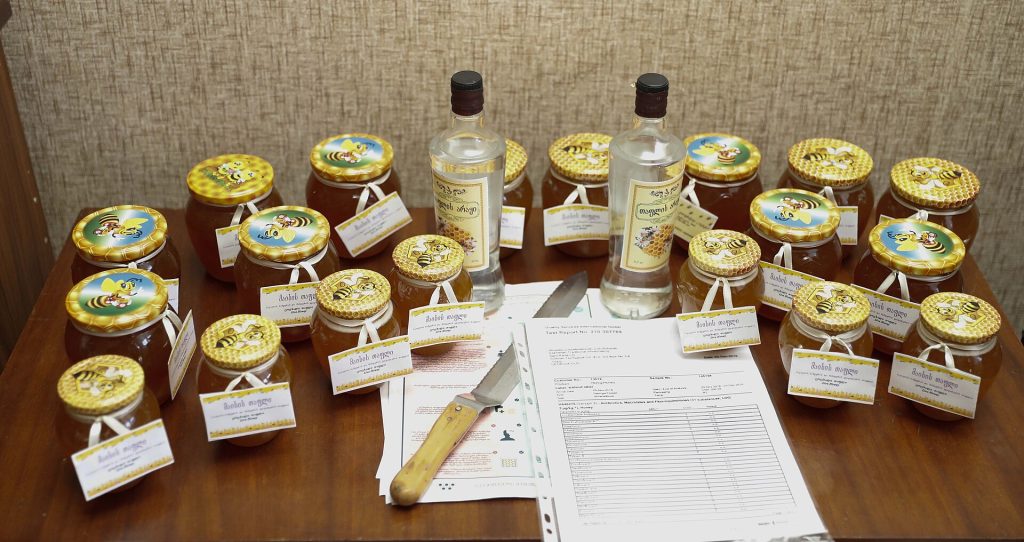
At its core the festival is about tasting and direct conversation rather than ritual. Visitors move between stalls sampling black, green and herbal chai (ჩაი, “tea”) brewed on the spot, and spooning comb or jarred tapli (თაფლი, “honey”) from different regions — chestnut honey from Racha, acacia honey from Kakheti, high-mountain wildflower honey from Svaneti and the Borjomi gorge. Producers typically explain harvest methods, altitude and flowering season, since Georgian honey is marketed by floral source much as wine is marketed by grape variety and region.
Food stalls usually offer honey-based sweets such as gozinaki (გოზინაყი), walnuts caramelised in heated honey, normally associated with the New Year table but popular as a festival snack, alongside honeyed fruit preserves and herbal infusions using mountain thyme, linden flower and rosehip. There is folk and acoustic live music, demonstrations of pruning and leaf-picking technique by tea growers, and sometimes a glass hive for observing bees safely. There is no liturgical dimension and no fixed script of toasts or songs comparable to a wine or church feast; the atmosphere is closer to a producers’ market with tastings than a ceremonial festival, and regional variation shows up mainly in which producers attend — Adjaran and Gurian tea growers one year, a stronger showing of Kakhetian or Rachan beekeepers another, depending on the harvest and who the organisers invite.
When it happens
The festival does not follow a fixed calendar date. It is held once a year in spring, typically in the second half of April, with the exact weekend set and announced by the organisers a few weeks ahead, depending on the tea-picking season, honey supply and park scheduling. It is not a public holiday: government offices, shops, banks and transport in Tbilisi operate normally on festival days, and the closure, where it exists, is limited to the festival grounds within Mtatsminda Park rather than the city at large.
This year’s edition fell earlier in 2026, before this page was last reviewed. The next edition is tentatively planned for 24–25 April 2027, subject to confirmation by the organisers closer to the date. Travellers planning a trip specifically around the festival should check for the confirmed dates in the weeks beforehand rather than booking around the tentative weekend alone.
Where to experience it
Mtatsminda Park sits on the summit of Mtatsminda (“Holy Mountain”), reached by the historic funicular from Chonkadze Street or by road. The festival normally runs through a single day or weekend, late morning into early evening, with stalls arranged along the park’s open terraces overlooking the Mtkvari valley and the city below. Visitors can expect to taste freely at most stalls, buy tea and honey directly from producers in bulk or packaged form, and talk with growers about where and how a particular jar or leaf was harvested.
There is no religious etiquette to observe, since the event is entirely secular, though visitors who continue on to the nearby Mtatsminda Pantheon, where writers and public figures are buried, should keep a quiet, respectful tone as at any cemetery. Cash in Georgian lari is useful for small producer stalls that may not take cards; arriving earlier in the day generally means a wider selection before popular honey varieties sell out.
Travel with GTour
The opening days of Georgia in 10 Days — Tbilisi to Svaneti to the Sea and the single-day route of Tbilisi & Mtskheta — The Essential First Day both pass through central Tbilisi, close enough to Mtatsminda Park to allow a stop at the Tea and Honey Festival on 24–25 April 2027. A GTour travel expert designs the route around the guest’s dates, adjusting the Tbilisi portion so the festival fits naturally into the schedule.
Did you know
- Fossilised honeycomb recovered from ancient burial sites in Georgia is among the oldest physical evidence of beekeeping found anywhere, according to Georgian archaeological research.
- Georgia’s commercial tea industry traces to a single invitation in 1893, when the Chinese agronomist Lau Jin Ho was brought to Chakvi, Adjara, to establish the country’s first serious plantations.
- During the Soviet period, Guria, Adjara and Samegrelo were developed as the principal tea-growing districts supplying the USSR, before plantations were largely abandoned after 1991.
- Wild honey gathered from rhododendron blossom in parts of the Caucasus can still cause mild, temporary intoxication if eaten in quantity — the same effect the Greek writer Xenophon described among his soldiers in the fourth century BCE.
- Mtatsminda Park, the festival’s home, is reached by a funicular railway that first opened in 1905, itself an early piece of Tbilisi’s modern transport infrastructure.
Practical tips for visitors
Reach Mtatsminda Park by the funicular, by taxi, or on foot via the upper park roads; traffic and parking near the base station can be congested on festival weekends. April weather in Tbilisi is changeable, with mild days and cool evenings, so light layers and a jacket are advisable, along with comfortable shoes for the park’s slopes. Entry to the festival grounds is normally free, tastings are informal and do not require booking, but confirm the current year’s dates and hours through the organisers or Tbilisi’s municipal event listings close to travel, since the weekend is set annually rather than fixed. Bring cash for small purchases, and allow time to linger, since the appeal of the event is unhurried conversation with producers rather than a fixed programme of performances.
Combine it with
Pair a spring visit to the festival with a trip to the tea and honey producing regions themselves: the plantations and botanical gardens of Adjara, where Georgian tea growing began; the vineyards and orchards of Kakheti, a major honey and agricultural region; and the chestnut forests and mountain apiaries of Racha, known for some of Georgia’s most distinctive honey varieties.
Questions travellers ask
Is the Tea and Honey Festival a public holiday?
No. It is a cultural and agricultural event, not a state or religious holiday, so offices, banks and transport across Georgia continue to operate normally.
Do I need to book tickets in advance?
Entry has typically been free and open, without advance ticketing, though it is worth checking the organisers’ current-year announcement in case arrangements change.
Can I buy tea and honey to take home?
Yes, most stalls sell packaged tea and jarred or comb honey for visitors to take away, and some producers can advise on customs allowances for food products if you are flying onward.
Is the festival suitable for children?
It is family-friendly, with tastings, music and sometimes an observation hive, though parents should supervise children around hot water urns used for tea brewing.
What happens if it rains?
Mtatsminda Park
Plan your Georgia
Want to be in Georgia for Tea and Honey Festival? A GTour travel expert designs the itinerary around it and calls you back.
Mtatsminda Park in Tbilisi, the venue hosting the spring Tea and Honey Festival. · Photo: Andrew Milligan sumo / Wikimedia Commons, CC BY 2.0
This page in other languages: Русский
GTour conciergeAsk anything about Georgia · we reply within hours