Archives


Kazbegoba in Georgia: dates, meaning and how to experience it
Next dates
28 August 2027 – 29 August 2027 (to be confirmed) · Stepantsminda (Kazbegi). See the full events calendar and Georgia today for roads and weather.
What it is
Kazbegoba is the town festival of Stepantsminda, the alpine district centre of Kazbegi Municipality in the Khevi gorge, held in honour of the community rather than of a particular saint or church feast. The Georgian word follows a familiar pattern: the place-name Kazbegi takes the suffix -oba, which turns a name into the title of a day of celebration — the same construction seen in Tbilisoba (“the day of Tbilisi”), Alaverdoba and Mtskhetoba. Kazbegoba therefore means, roughly, “the Kazbegi day” or “the festival of Kazbegi,” and it belongs to a wider family of Georgian village and town days that mark the end of the mountain summer.
The festival is celebrated primarily by the Mokheve community — the highlanders of the Khevi gorge around Mount Kazbek — together with municipal officials, returning families, shepherds coming down from summer pastures, and increasingly by domestic and foreign visitors drawn by the setting below Mount Kazbek and Gergeti Trinity Church. Unlike church feast days such as Alaverdoba or Lomisoba, Kazbegoba is organised as a civic and cultural occasion by the local municipality, which is why its date is announced anew each year rather than fixed by the liturgical calendar.
Historical background
- Medieval period — The village below Mount Kazbek became known as Stepantsminda, “Holy Stephen,” after a hermit monk traditionally said to have settled there; Gergeti Trinity Church, perched above the village, is traditionally dated to the 14th century.
- 1783 — The Treaty of Georgievsk brought the kingdom of Kartli-Kakheti under Russian protection, and the route through the Daryal Gorge past Stepantsminda was subsequently developed into the Georgian Military Highway, turning the village into a staging post between the South Caucasus and the North Caucasus.
- 1829 — The Russian poet Alexander Pushkin travelled the Military Highway past Mount Kazbek on his journey described in A Journey to Arzrum, one of several 19th-century literary accounts that fixed the mountain and the Daryal Gorge in the European imagination.
- 1848 — The writer Alexander Kazbegi, later famous for his fiction on highland Georgian life, was born into the Chopikashvili family, hereditary lords of Khevi who had long been known by the title Kazbegi, a name also attached to the mountain itself.
- 20th century — In the early Soviet period the village of Stepantsminda was renamed Kazbegi in honour of the writer, and the name was used for the town and district for several decades.
- 2006 — The Georgian authorities restored the historic name Stepantsminda to the town, while Kazbegi was retained as the name of the surrounding municipality, as it still is today.
- 2000s–2010s — Kazbegi Municipality began holding Kazbegoba as an annual late-summer or autumn community day, part of a broader revival across Georgia’s highland provinces of older village “-oba” gatherings centred on horse racing, wrestling and shared feasting.
- 2020s — Recent editions, reported in the national press, have been held on varying dates — 9 October 2022 and 31 August–1 September 2023 among them — confirming that the festival has no single fixed day and is set anew by the municipality each year.
Stepantsminda’s position at the foot of Mount Kazbek, on the single mountain road linking Georgia with the North Caucasus, has shaped its history as a crossing point long before it became a festival town. The Daryal Gorge route, improved under the Russian Empire after 1783, brought travellers, soldiers and writers through the village for two centuries, and the renaming of the settlement after Alexander Kazbegi reflects how closely the mountain, the gorge and the local noble family were bound together in both Georgian and Russian memory of the Caucasus.
Kazbegoba itself is a more recent layer on this long history. It does not derive from a medieval saint’s day or a documented ancient ritual; rather it continues, in municipal form, the older highland custom of marking the turn of the agricultural year with horse races, wrestling and a shared table — the same impulse behind Mtiuloba in neighbouring Mtiuleti and Lomisoba in the Aragvi valley. Because it is organised locally rather than prescribed by the church calendar, its date, programme and scale have varied considerably from year to year, which is part of what makes it worth checking carefully before planning a visit.
Meaning and traditions
The centrepiece of Kazbegoba is a supra, the long festive table, at which a tamada (toastmaster) leads rounds of toasts to the mountains, to guests, to ancestors and to Georgia, accompanied by highland polyphonic song and dance such as the Khevsuruli and Mtiuluri. Horse racing on the open ground outside Stepantsminda is traditionally the sporting highlight, drawing riders from across Khevi and sometimes from neighbouring Mtiuleti and Pshavi, alongside displays of Georgian wrestling, chidaoba</em, and foot races for children and adults.
Food is inseparable from the day. Khinkali, the twisted dumpling filled with spiced meat or, in mountain versions, with potato or cheese, is widely considered to have originated in Georgia’s highland provinces — Khevsureti, Pshavi and Mtiuleti — as hearty, portable food for herders before it became a national dish; Kazbegoba often features communal khinkali-making and eating contests. Visitors will also find khachapuri, mountain cheeses, and chacha, the grape pomace spirit used in toasting. Market stalls sell wool products, felt hats and carved wood characteristic of Khevi handicraft.
Regional variations are worth noting for context: Mtiuloba, held in Mtiuleti and Gudauri in midsummer, similarly combines horse racing and wrestling but has an older, more continuous pedigree; Lomisoba, a movable feast tied to Easter in the Aragvi valley, is explicitly religious in origin, centred on the shrine of St George at Lomisi; Alaverdoba in Kakheti combines a church feast with an autumn harvest fair. Kazbegoba sits closer to the civic end of this spectrum, though it borrows the vocabulary and sporting forms of its older neighbours.
When it happens
Kazbegoba has no fixed date in either the civil or the church calendar. It is set each year by Kazbegi Municipality, typically on a weekend falling between late August and early October, after the summer livestock have come down from high pasture but before the first heavy mountain snow. Recent editions have fallen on 9 October 2022 and 31 August–1 September 2023; the notice for 2026 had not been confirmed at the time of writing, and the 2027 edition is provisionally indicated for 28–29 August 2027, subject to confirmation by the municipality closer to the date.
The festival is not a national public holiday. Government offices, banks and schools across Georgia operate normally on Kazbegoba, and the day carries no special status under national holiday regulations. In Stepantsminda itself, some shops, the local administration and a few guesthouses may adjust hours around the event, and the main street or racing field may be closed to vehicle traffic for the duration of the races and procession, but the town otherwise functions as usual before and after.
Where to experience it
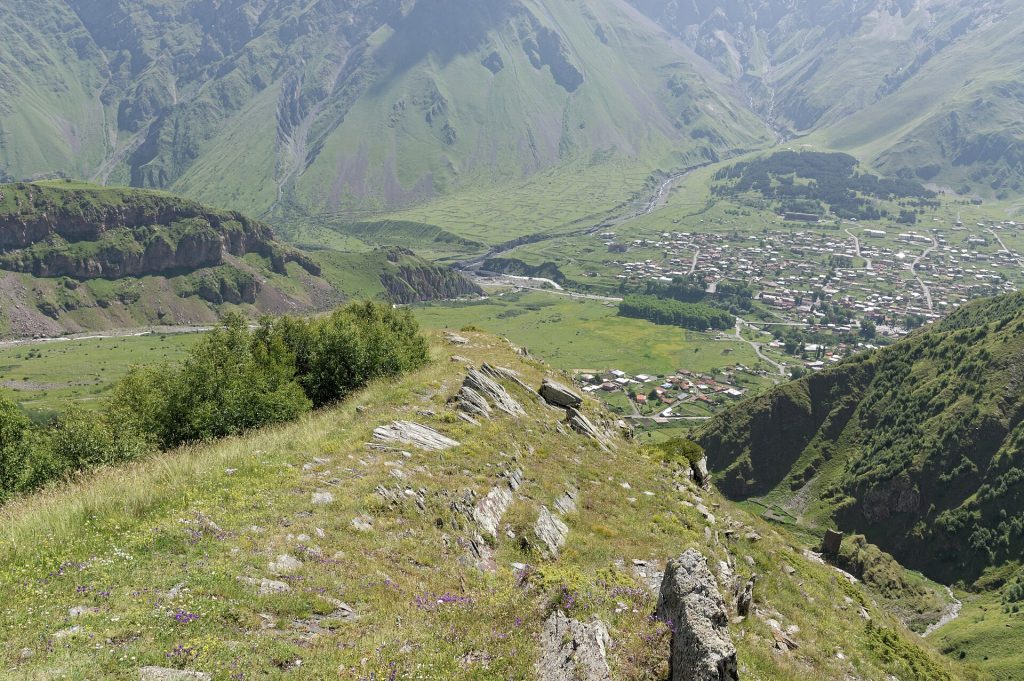
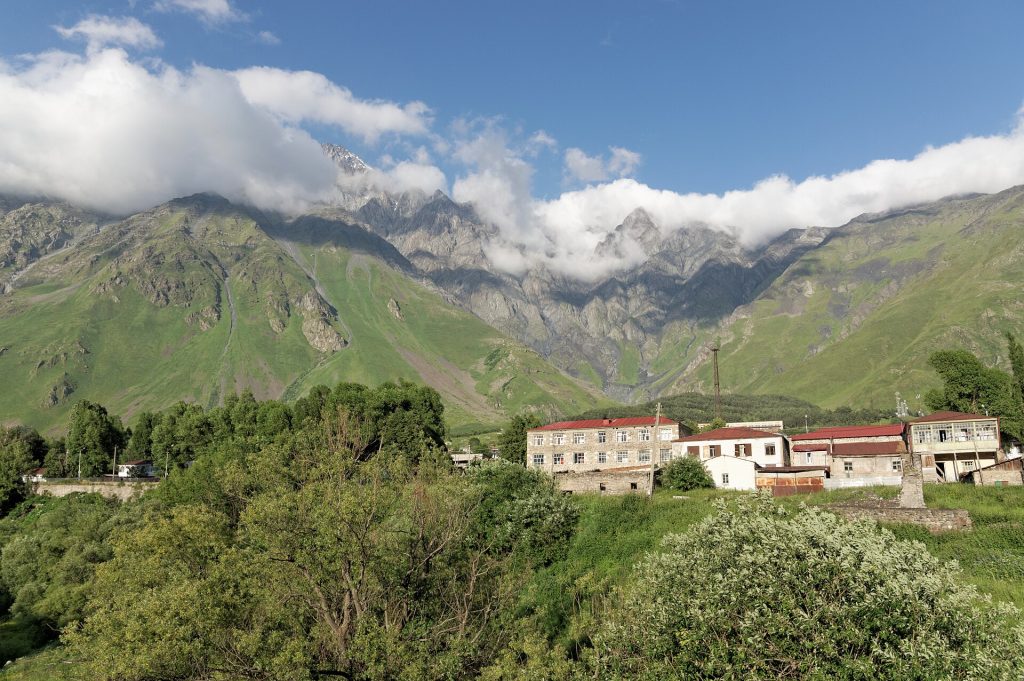
The centre of Stepantsminda — its main square and the road leading toward Gergeti village — is the natural focus of the day, with stalls, music and the opening ceremony usually concentrated there from late morning. Horse races and highland games are generally held on open ground at the edge of town, with Mount Kazbek and the Gergeti Trinity Church visible above the valley, making the setting as much a part of the event as the programme itself. Many visitors combine the festival with the short hike or 4×4 trip up to Gergeti Trinity Church, which remains an active monastery; modest dress is expected there — covered shoulders and knees, headscarves for women, no shorts — and photography inside the church should be avoided, particularly during services.
Evening feasting tends to move into guesthouses and private homes, where visitors invited to a supra should expect to follow the lead of the tamada, accept toasts with at least a token sip, and avoid refusing hospitality outright, which is considered impolite in highland custom.
Did you know
- Stepantsminda lies at roughly 1,740 metres above sea level at the foot of Mount Kazbek, one of the highest permanently inhabited towns in Georgia.
- The town’s Soviet-era name, Kazbegi, came from the 19th-century writer Alexander Kazbegi, whose family title was also attached to the mountain, which Georgians themselves more often call Mqinvartsveri, “the glacier peak.”
- Kh
Sources
- Kazbegoba festival news coverage
- Kazbegoba horse races and khinkali festival
- Visit Kazbegi region festivals
- Kazbegi mountain festival coverage
Plan your GeorgiaWant to be in Georgia for Kazbegoba? A GTour travel expert designs the itinerary around it and calls you back.
The center of Stepantsminda village, host town of the Kazbegoba mountain festival. · Photo: Alexander Roumega / Wikimedia Commons, CC0
This page in other languages: Русский
GTour conciergeAsk anything about Georgia · we reply within hours